
Renovations
Renovating your home in marble and stone, between Rome and Latina
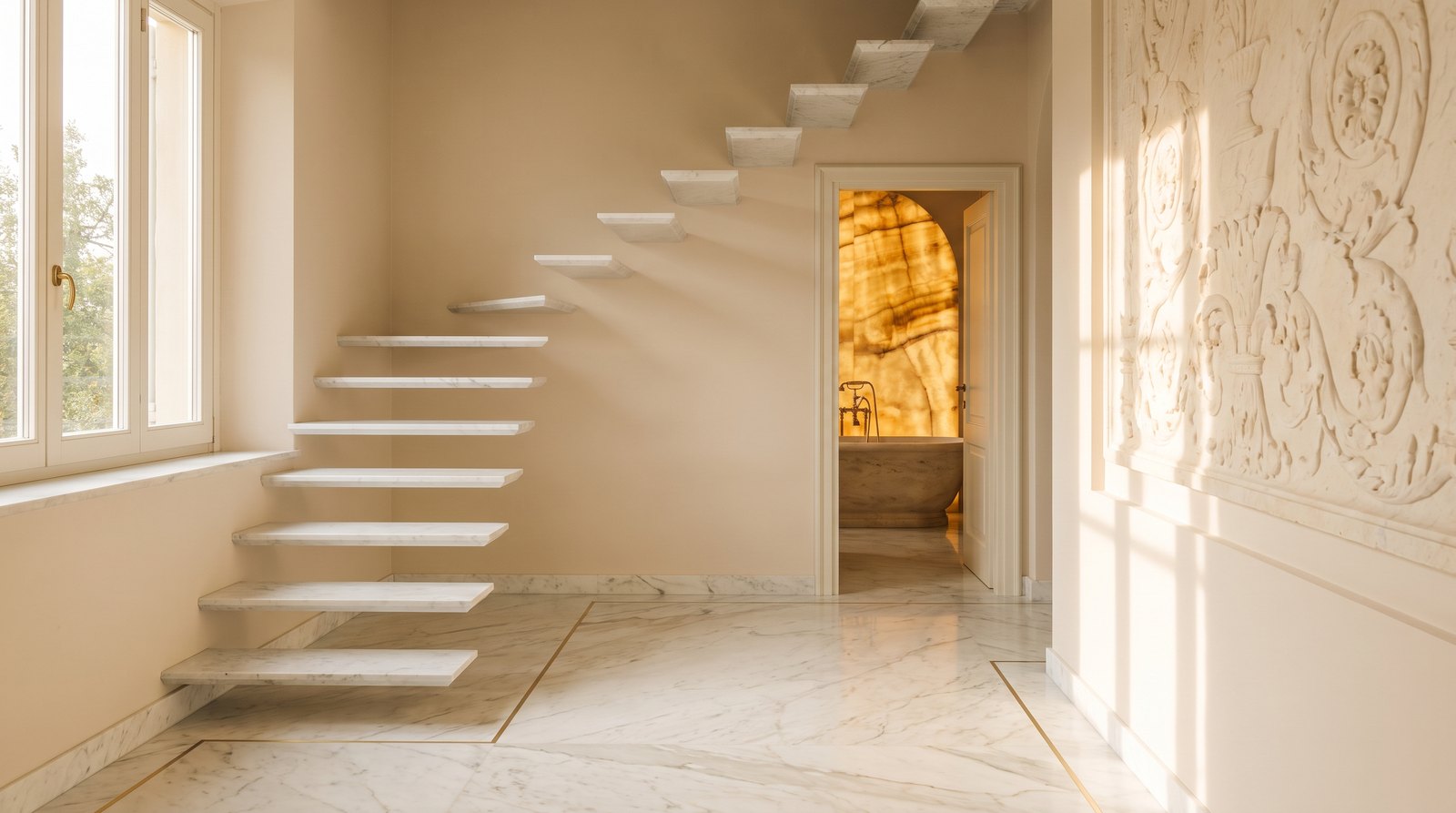
Michelessi SRL, stonemasons in Aprilia since 1976, between Rome and Latina, renovates with marble and stone: bathrooms, staircases, floors, 3D walls, fireplaces, cladding and thresholds, pools, kitchens in refractory stone and in marble, bespoke solutions and, for the outdoors, Gibus, KE and Pratic pergolas. One technical office with an in-house architect, a 3D project, slabs chosen one by one, numerical-control cutting and installation by our own team. Free survey and quotation in Lazio.
A renovation like this, with a single point of contact.Free survey and quotation in Lazio · marble, kitchen, bathroom, staircase and pergola designed together · installation by our own team
The bathroom reborn in marble — a Michelessi vision
From the stripped room,
slab after slab, the bathroom
01 A bathroom in a Roman house, stripped of everything: bare walls, bare floor, the old fittings taken away. Under the tall window the morning light falls on the Calacatta slabs stacked against the wall, edges in view, and on the stonemason’s tools. The new bathroom is still all there, inside those slabs.
02 Two stonemasons lay the floor, one large slab after another, from the far wall towards the door: bedding, tapping, checking with the level. Then they dress the walls with book-matched slabs, the veins opening like the pages of a book, and cut the shower niche into the stone. At last they work the basin block, a single piece with two basins hollowed from the solid, and fix it to the wall.
03 The brass taps go on, the shower head, the drain flush with the floor; everything is polished and the dust carried away. A mirror leans against the wall, a towel, a plant: a bathroom that was old and is now marble, in the same light from the same window.
Scroll — the scene follows you
Renovating with marble and stone: what we do
Michelessi SRL, stonemasons in Aprilia since 1976, between Rome and Latina, renovates with marble and stone: we design, work in our own workshop and install with our own team bathrooms, staircases, floors, walls, fireplaces, cladding, swimming pools and kitchens. The Renovations department brings together in a single path everything that can be rebuilt in stone: one company, one technical office with an in-house architect, one 3D project, one installation team.
Renovating with stone means redoing a part of the house in a material that can be restored: marble can be polished again, a worn step can be refinished, a floor can be honed and polished once more. For each area below you will find what is redone, which stones we use, how stone differs from ceramic and resin, and how the work on site unfolds. The detail pages are: bathrooms, staircases, floors, 3D walls, fireplaces and heating, building and cladding, pools, masonry kitchens, built in refractory stone, indoor marble kitchens and bespoke solutions; for the outdoors, the pergolas as well.
Renovating your home with marble: where to begin
You begin with a single room, the one you see and use most, or with the plan for the whole house: either way the first step is the free site survey, with measurements, photographs and your questions. You do not need a finished project: a floor plan, even a hand-drawn one, a few photographs and an idea of what you like and what does not work are enough. From there the technical office sets up the job.
Whoever redoes a bathroom often discovers that the same stone would look right in the corridor, and whoever redoes a staircase wants to find it again in the entrance hall. That is why it pays to choose a family of stones early: one or two, used consistently, are worth more than many different stones. The stones and finishes are described on the pages about marbles and finishes. Three questions help you start:
- What do you want to change? A cladding, a floor, a staircase or a whole area: the scope decides how many areas are involved.
- What does it have to withstand? Water and steam in a bathroom, constant footfall on a staircase, frost and rain outdoors, heat around a fireplace: stone and finish are chosen for the use.
- Who else is working in the house? Building services, plaster, windows and doors: the stone work is fitted around the others and scheduled together, because marble is laid when the substrate is ready.
Marble bathrooms: baths, basins, walls and floors
Redoing a bathroom in marble means dressing the room of water in stone: baths and basins carved from the solid block, walls in onyx or travertine, floors and worktops in Carrara, Calacatta or Statuario. We carve the bath from a single block or clad walls and tops with slabs chosen one by one, so that the veining runs on from one wall to the next. Compared with ceramic, uniform by definition, stone is a natural material and every slab is different; compared with resin, continuous but synthetic, it has the substance and depth of real stone. In a bathroom the finishes and treatments are chosen for steam and water, and the basin, top and drains are drawn in the 3D project from the start. All the work is on the page about marble bathrooms.
Marble and stone staircases: flights, floating steps, spirals
A staircase is renovated in two ways: by cladding the one you have, step after step, or by designing a new one in stone, straight, curved, spiral or with floating steps. Treads, risers, skirting and balustrades come from the same stone, so the design stays continuous; curved flights and spirals are cut by numerical control to the measurements taken in your home. Compared with ceramic and resin, a stone step withstands daily use and, when it wears, it can be polished again. For safety we choose finishes with more grip, such as brushed or flamed, and the right rounding of the edge. The examples are on the page about marble and stone staircases.
Marble floors: slabs, patterns, inlays
A marble floor is redone with large slabs, with patterns and inlays to a drawing, or laid on the diagonal; Carrara, Calacatta, Botticino, travertine and Nero Marquina are the stones we use most often. It starts with the substrate: the screed has to be checked and the levels have to match the doors and the neighbouring floors. If there is underfloor heating, tell us at the site survey: stone conducts heat well and the project takes it into account. After laying, the floor is honed and polished on site, and the joints close into a surface that looks continuous. In many ceramics the pattern is reproduced; in stone it is the veins themselves that make the floor. Details are on the page about marble floors.
3D walls: bas-reliefs, inlays and backlit surfaces
A 3D wall is a carved marble wall: bas-reliefs, inlays, stone mosaics and backlit surfaces that turn a wall into a piece of furnishing. It is made behind a bed, in the living room, in the hall, in a niche or around a fireplace. The pattern is studied in 3D before the stone is touched; the slabs are carved in our Aprilia workshop and fixed in your home, with the fixing checked against the substrate, because stone has a weight the wall must be able to carry. In resin or plaster panels that imitate relief, the relief is an effect; here it is in the stone, and raking light draws it differently at every hour. You will find the examples on the page about marble 3D walls.
Fireplaces and heating: surrounds, fireplace walls, hearths
Renovating the fireplace means dressing it in stone, with classic or modern surrounds and fireplace walls in marble and travertine, and choosing the right hearth: wood, gas, electric or bioethanol. The surround is the dress, the hearth is the heart. The first we work in our own workshop; for hearths and heating systems, monoblocs, thermo-fireplaces, inserts and gas fires, there is our dedicated portal michelessi.it. Distances from the fire, flue and protections are decided in the project, together with the qualified technician who installs the system: stone frames the fire, it does not produce it. Compared with resin, which is not suited to the proximity of fire, stone is the traditional material of fireplaces; beside the flame an inner refractory lining is still needed, provided by the maker of the hearth. Page: marble fireplaces and heating.
Building and cladding: thresholds, window sills, skirting, facades
The stone cladding of building work covers the parts of the house that are touched every day and exposed to the weather: thresholds, window sills, skirting, wall copings, balustrades, outdoor flights of steps and facades. A marble or travertine sill has its drip groove cut to measure; a threshold has the rounding and the non-slip finish; a skirting protects the lower part of the wall from knocks and water. Outdoors we choose stones suited to frost and sun, and facades are clad with slabs fixed according to the project, from the ground floor to the crowning cornice. Plaster has to be repainted and patched, resin marks and is hard to repair; stone, well chosen, ages well and, when needed, can be refinished. See the page about building and cladding in marble.
Pools clad in stone: edges, copings, steps
A swimming pool is renovated in stone by redoing what is seen and touched: cladding, infinity edges, copings, Roman steps and the paving around the pool. We use Carrara, travertine and Grigio Carnico, chosen for the water treatment (chlorine or salt), for frost and for bare feet, with non-slip finishes. The pool equipment and the water treatment remain with the pool technician; we take care of the stone and of making it meet the garden, the pergola and the outdoor kitchen. Compared with resin or ceramic cladding, a stone edge is a carved element that lasts: details are on the page about pools clad in stone.
Masonry kitchens: we build them in refractory stone, not in masonry
Whoever searches for a masonry kitchen finds with us a kitchen in the masonry style built in refractory stone: blocks interlocked dry, with no mortar and no cement, a marble worktop and wooden doors. It fits into a house being renovated, indoors; outdoors, beside the pergola, the same refractory stone builds barbecues and ovens. The reason for the choice is simple: with heat and damp, mortar and plaster tend to crack, whereas refractory stone is born for fire. The structure is assembled without water and without building dust, an advantage in a lived-in home. The full story is on the page about masonry kitchens, built in refractory stone.
Indoor marble kitchens: islands, worktops and complete kitchens
Redoing the kitchen in marble can mean replacing the worktop alone, adding an island in solid stone, or changing everything with a bespoke or modular kitchen. Worktops are made in Carrara, Calacatta, Nero Marquina and travertine, but also in Dekton, Fenix and quartz for those who want a surface different from natural stone. The modular kitchens are Domina, Noè, Era 02 and Volo 01; for those who love the character of masonry there is Francesca, with a refractory stone structure, a marble worktop and wooden doors. Site survey, 3D project and installation follow the same path: indoor marble kitchens.
Bespoke solutions: sills, thresholds, worktops and cladding
Bespoke solutions are the pieces no catalogue has: a sill with its own overhang, a threshold for an out-of-square opening, a top for a basin, a cladding for a niche. They are cut by numerical control in the Aprilia workshop to the measurements taken and finished by hand, in marble, travertine, natural stones and granites: the precision of industrial work and the hand of a craftsman. It is the simplest way to begin renovating with stone: a single piece, but made for your home. You will find them on the page about bespoke solutions.
For the outdoors, Gibus, KE Outdoor Design and Pratic pergolas
An outdoor renovation is completed by the cover: we are official dealers and installers of Gibus, of KE Outdoor Design and of Pratic, and we also design bespoke pergolas. Gibus is the first brand we propose: bioclimatic pergolas, fabric pergolas, awnings and enclosures, with models such as Movie, Velvet, Varia and Sway; the manufacturer states that they are designed and made in Italy, in the province of Padua. Next come KE Outdoor Design, from Noventa di Piave, with the Kedry family, and Pratic, from Fagagna in Friuli, with Opera and Brera. Pergola, stone outdoor kitchen, paving and pool come from the same 3D project and are installed by the same team. The department is on the page about Gibus, KE and Pratic bioclimatic pergolas.
On site: from the survey to installation by our own team
Every Michelessi renovation follows the same path: site survey, measurements, 3D project, choice of the slabs one by one, numerical-control cutting in the workshop and installation by our own team. A single technical office follows it, with an in-house architect, and our installation team completes it: whoever sells, whoever designs and whoever installs works within the same company. The slabs are not chosen from a sample but in person, in the Aprilia workshop, with the veining and tone that will end up in your home. In your home the stone arrives already cut to size, so there is less work and less mess on site. Timing depends on the area and on the stone and is defined with the quotation, after the survey. Here are the five steps.
How we renovate with marble: from the site survey to installation
- Site survey and measurements
We come to see the room, take the measurements, check the substrate (screeds, walls, drains, door levels) and listen to what you want to change. In Rome, Latina and throughout Lazio the survey and the quotation are free. - 3D project
The technical office, with the in-house architect, draws the space in three dimensions: stones, veining pattern, joints, finishes and details. We correct it together until it is right, and then the quotation is prepared. - Choosing the slabs
The slabs are chosen in person, one by one, in the Aprilia workshop, with the veining and tone that will end up in your home. - Numerical-control cutting and finishing
The stones are cut by numerical control to the measurements of the project and finished by hand: edges, drip grooves, curves, inlays and polished, honed or brushed surfaces. - Installation by our own team
Our team lays the stone, hones and polishes it on site, and schedules the work together with the other craftsmen in the house. We install across Italy and also follow projects abroad.
How much it costs to renovate with marble
The cost of a marble renovation depends on seven factors: the surface, the stone, the thickness and finish, the complexity of the work, the condition of the substrate, access to the site and the installation. We do not publish a price list per square metre, because two bathrooms of the same size can cost very differently. These are the factors, one by one:
- Surface. The square metres to clad, and how many different pieces are needed to cover them.
- Stone. A travertine, a Carrara, a Calacatta or an onyx have very different prices and availability.
- Thickness and finish. Polished, honed, brushed or flamed change the work in the workshop.
- Workmanship. Curves, inlays, bas-reliefs and floating steps take more hours than a straight slab.
- Substrate. Screeds to level, walls to prepare, services to move.
- Site. Floors to climb, a lift, access for the transport.
- Installation. The complexity of the design and the number of rooms.
The quotation is free, is prepared on the project after the survey and lists stone, workmanship, transport and installation line by line. Tax deductions exist for some renovation works: conditions, limits and deadlines change over time and should be verified with your accountant before ordering.
Where we work: Rome, Latina, Aprilia and all of Lazio
The Michelessi workshop is in Aprilia, on the Via Pontina at km 45.350, between Rome and Latina: Rome is less than an hour away. The survey and the quotation are free in Rome, in Latina, in Aprilia, in the Castelli Romani, on the coast, in Frosinone and throughout Lazio. We install with our own team across Italy and also follow projects abroad. To see the stones in person you only need to visit us: the page about the Aprilia workshop explains how to get here; for kitchens, marble kitchens in Rome and marble kitchens in Latina. The story of the workshop is in the guide made in Italy since 1976.
How to begin
For a first opinion a few photographs and two measurements are enough: write to us or call Michelessi SRL, Via Pontina km 45.350, Aprilia (Latina); telephone and WhatsApp +39 06 9275383. The survey and the quotation are free: quotation form.
Frequently asked questions
Frequently asked questions
What can be renovated with marble and stone?
Almost every part of the house: bathrooms, staircases, floors, walls, fireplaces, thresholds, window sills, skirting and facades, pools, kitchens and worktops, as well as bespoke pieces. For the outdoors, pergolas too. Michelessi, in Aprilia since 1976, designs, works in its own workshop and installs with its own team; each area has a detail page.
Does Michelessi renovate the whole house?
We do all the marble and stone part of the renovation: design, workmanship and installation. For whatever is not stone, such as building services, plaster, windows and doors, we work alongside the firms and technicians who look after the house, and we schedule the installation for when the substrate is ready.
How much does it cost to renovate with marble?
It depends on the surface, the stone, the thickness and finish, the complexity of the work, the condition of the substrate, access to the site and the installation. We do not publish a price list per square metre, because two bathrooms of the same size can cost very differently: the quotation is free and is prepared on the project after the survey, listing stone, workmanship, transport and installation separately.
How long does a marble renovation take?
It depends on the area, the stone and the work of the other craftsmen in the house. Timing is not promised at random: it is defined with the quotation, after the survey and the choice of slabs. Stone arrives already cut to size in the workshop, which limits the work to be done on site.
Is the survey free? Where do you work?
Yes: the survey and the quotation are free in Rome, in Latina, in Aprilia and throughout Lazio. We install with our own team across Italy and also follow projects abroad. The workshop is in Aprilia, on the Via Pontina at km 45.350; telephone and WhatsApp +39 06 9275383.
Which is better for a renovation: marble, ceramic or resin?
It depends on what matters most. Ceramic is uniform and needs little care; resin gives a continuous surface; marble is a natural stone, with veining that never repeats, and it can be polished again when it wears. If you want a material with character, choose stone; if speed and cost matter most, other materials may be enough, and we will tell you so at the survey.
Does marble stain? How is it protected?
Calcareous marbles are sensitive to acids, such as lemon, vinegar and some cleaning products, and to coloured liquids left for a long time. They are protected with a treatment suited to the stone and the finish: polished, honed or brushed behave differently, and in bathrooms and kitchens the most suitable one is chosen. If a mark appears, marble can be honed and polished again.
Can marble be laid over the existing floor?
Sometimes yes, sometimes no: it depends on the substrate, the height available under the doors and the obstructions. We check it at the survey, by measuring the levels, and we advise the best solution between laying over the existing floor and removing the old covering. The 3D project takes into account thresholds, doors and the neighbouring floors.
Are there tax deductions for a marble renovation?
Tax relief exists for some renovation works, but conditions, limits and deadlines change over time and depend on what is being redone. They should be verified with your accountant before ordering, because they change from one year to the next; we prepare a free, detailed quotation, line by line, that you can take to them.
Do you also supply pergolas for the outdoors?
Yes: we are official dealers and installers of Gibus, KE Outdoor Design and Pratic, and we also design bespoke pergolas. They come from the same 3D project as the outdoor kitchen, the paving and the pool and are installed by the same team. The department has a page of its own.