Skip to content
Made in Italy

Masonry kitchens

Masonry kitchens made to measure: we build them in refractory stone, not in masonry

Michelessi SRL, stonemasons in Aprilia since 1976, builds in refractory stone what you call a masonry kitchen. These are bespoke kitchens in the masonry style, with a structure of interlocking refractory stone blocks laid dry, a marble or stone worktop cut in our own workshop and wooden doors. No mortar, cement or plaster, which crack and fail with heat and damp. Indoor and outdoor; we install with our own team throughout Italy and also follow projects abroad.

A kitchen like this, made to measure for you.Free, no-obligation quotation · free site survey in Lazio · 3D design · since 1976

What a masonry kitchen is, and what we build in its place

Michelessi SRL, stonemasons in Aprilia since 1976, builds in refractory stone, and not in masonry, the bespoke kitchens you search for as "masonry kitchens": a fixed structure carries the worktop and frames the openings for doors, drawers and appliances, in place of the prefabricated units of a fitted kitchen. In the traditional version the structure is made of bricks or blocks bound with mortar, plastered and tiled. We do not build it that way: we make the same kitchen with interlocking blocks of refractory stone laid dry, a marble or stone worktop cut in our own workshop, and wooden doors.

The result is what you have in mind when you search for "masonry kitchens": a solid body, a continuous worktop, niches, wooden doors, a stone oven and barbecue if the kitchen is outdoors. What changes is what you do not see. No mortar, cement or plaster, because heat and damp make them crack and fail; in their place, a stone born for fire, laid without water and without adhesives. What you call a masonry kitchen, we build in refractory stone.

This page explains what we offer, in which styles, where and how we work. The sub-pages go deeper into each subject; the page masonry or refractory stone compares the two systems with facts and sources.

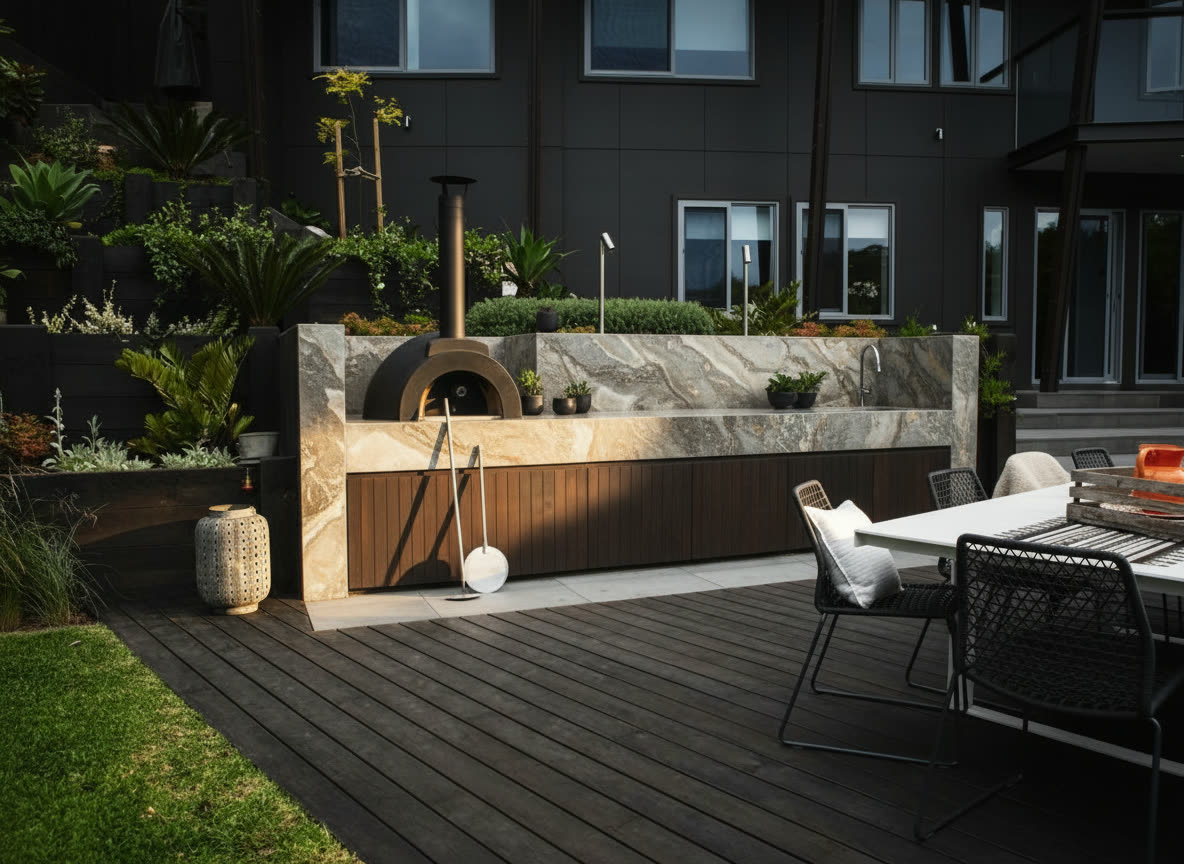
Terrace with stone and dark wood outdoor kitchen, pizza oven and dining table with seating

A Signature Terrace, Where the Kitchen Lives in Wood

A floor of dark decking stretches out like a stage, and the camera crosses it slowly: on one side the table laid with its light seating, on the other the outdoor kitchen running along the flowering wall, with dark wood doors and a pale worktop. Above, the dome of the oven stands against the facade of the building, a promise of long, fragrant evenings.
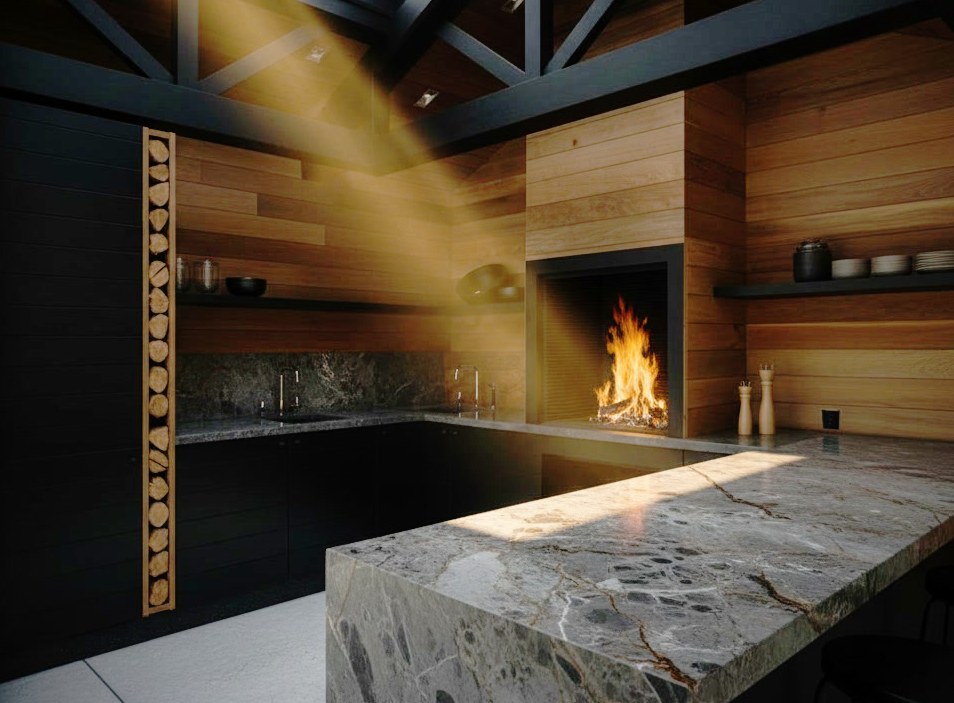
Outdoor kitchen with lit wood-fired barbecue, sink, black bases and lacquered wood worktop

The Black Fire, the Wood That Dresses It

The flame burns in its black frame and lights the wall clad in lacquered wood, which answers with amber reflections: a dialogue between darkness and warmth, orchestrated with an elegance almost worthy of an interior. Black bases run beneath the counter carrying the sink and the working spaces, shelves order tableware and objects on the wooden wall, and the dark beams of the covering close the scene above. The wood-fired barbecue, protagonist, promises fragrant cooking and long evenings.

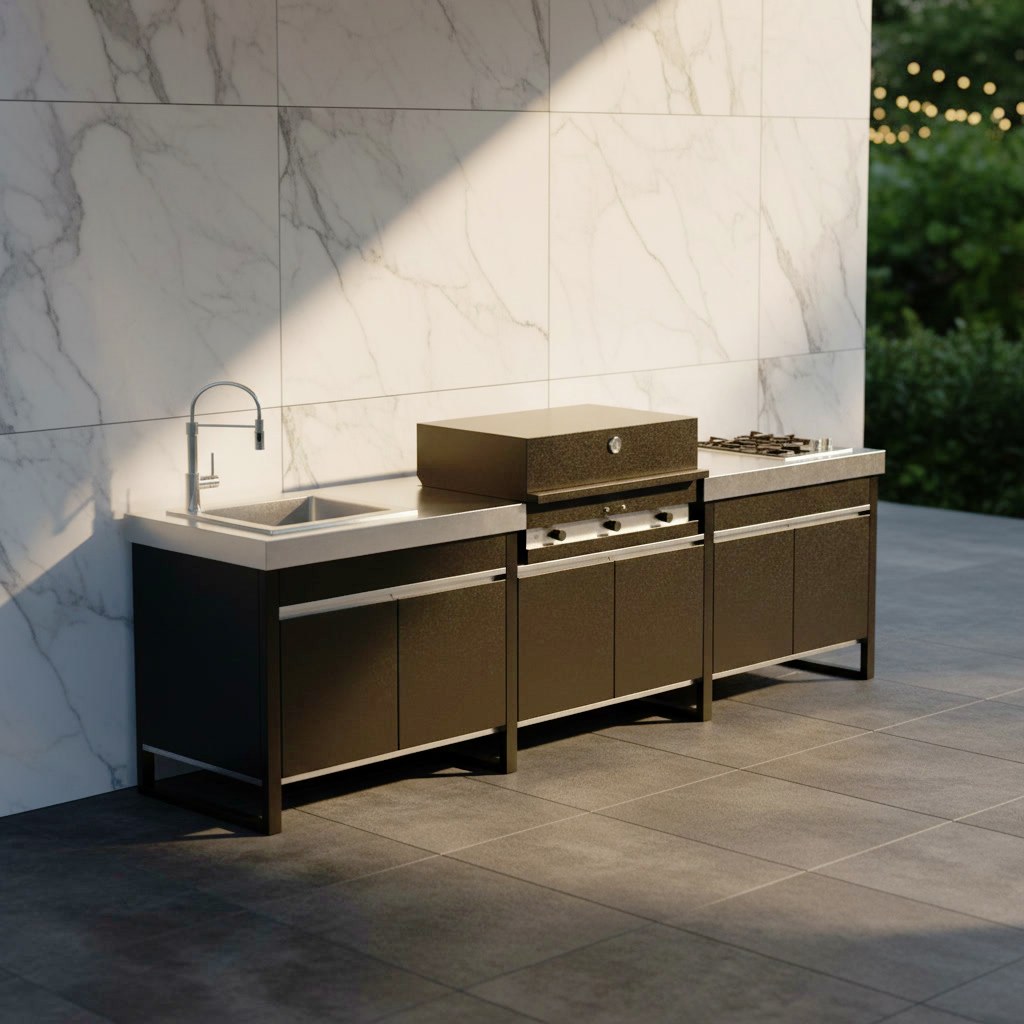
Fogher Larès modular FKC 023 in black with steel top, sink, barbecue and service module

Larès FKC 023: Steel Above, Black Below

The FKC 023 composition entrusts the top to steel and the structure to black: above, the technical surface runs uniform, carrying the sink with its spring tap and the built-in barbecue beneath its cover; below, door-fronted modules and a side service unit keep order and multiply the landing space. The contrast between the sheen of the top and the matt of the bases gives the line its clean, professional character. It is the configuration of those who work hard and clean fast: steel forgives everything and never ages.

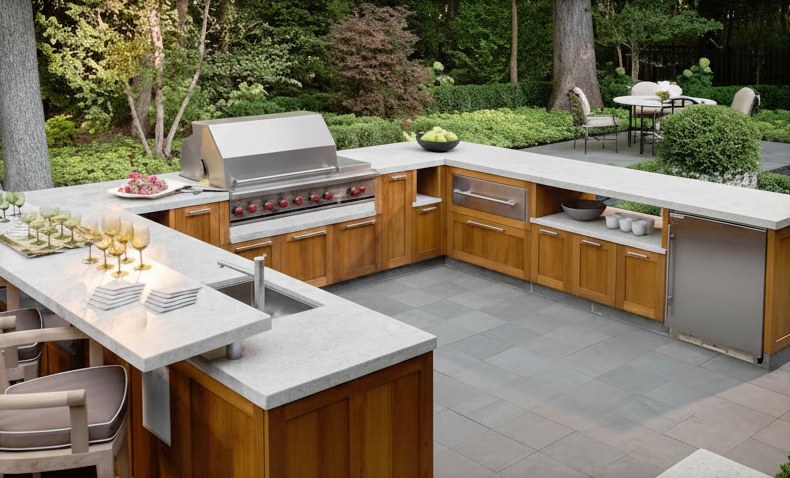
Outdoor kitchen with built-in appliances, light granite worktop and treated wood structure, U-shaped

The Great U of Teak and Granite in the Woods

The U spreads generously over blue stone paving and the woods embrace it on every side: the treated wood structure, with its warm, orderly doors, bears the light granite worktop running along three sides, carrying the barbecue with its steel hood, the sink, built-in appliances and the counter where high seats await company. Little plants on the tops add their domestic green to the great green of the trees.

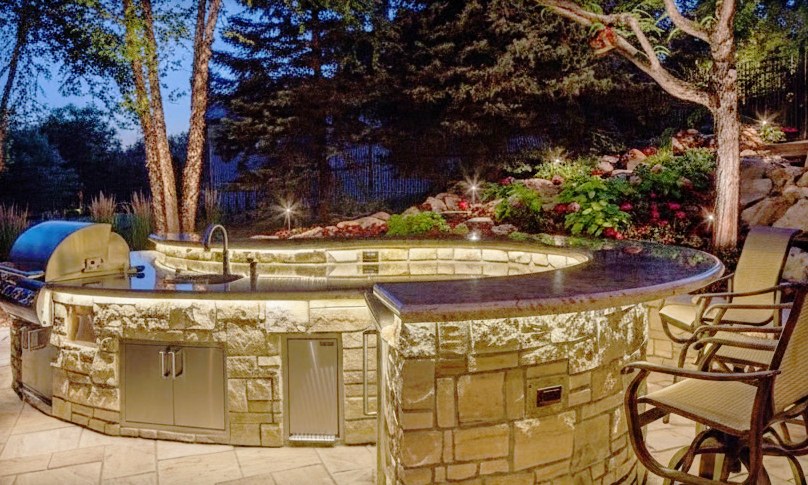
Circular outdoor kitchen in treated marble and granite with professional steel barbecue and night lighting

The Curve of Stone That Welcomes the Evening

The night is an accomplice: warm lights run beneath the counter and trace the curve of the kitchen like a luminous ribbon, while the base of stone in irregular courses anchors the composition to the garden. The dark stone counter follows the circumference without a single hard corner, receiving the professional steel barbecue on its left flank and then stretching toward the bar, where tall seats await the guests. Treated marble and granite, protagonists of the construction, withstand the seasons while keeping their depth; the built-in refrigerator works discreetly in the base.

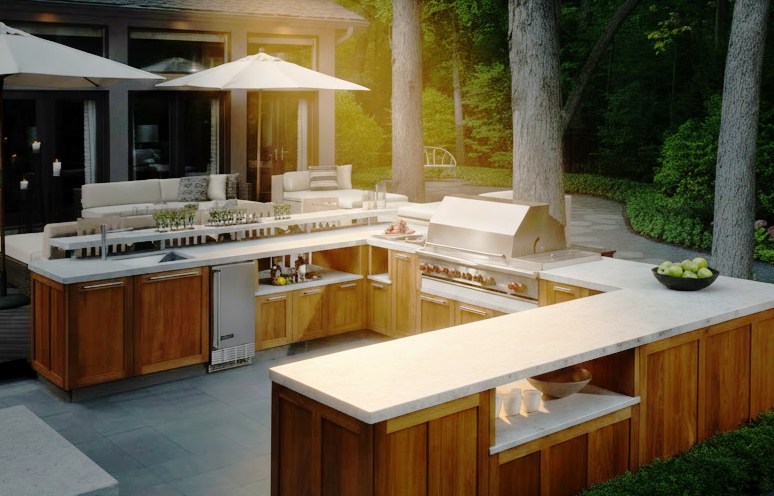
Modern U-shaped outdoor kitchen with light marble tops, wooden bases, fridge and built-in barbecue

The Great U with Marble Worktops

The U opens generously into the woods and lays out a true piazza of taste: great slabs of light marble run along three sides, luminous against the deep green of the trees, while wooden bases with classic doors pace the perimeter with ordered warmth. The built-in barbecue works beneath its steel hood, the fridge stands guard in the base, and white parasols open their corollas over the scene, ready to shade long lunches. The house with its great windows watches from behind.

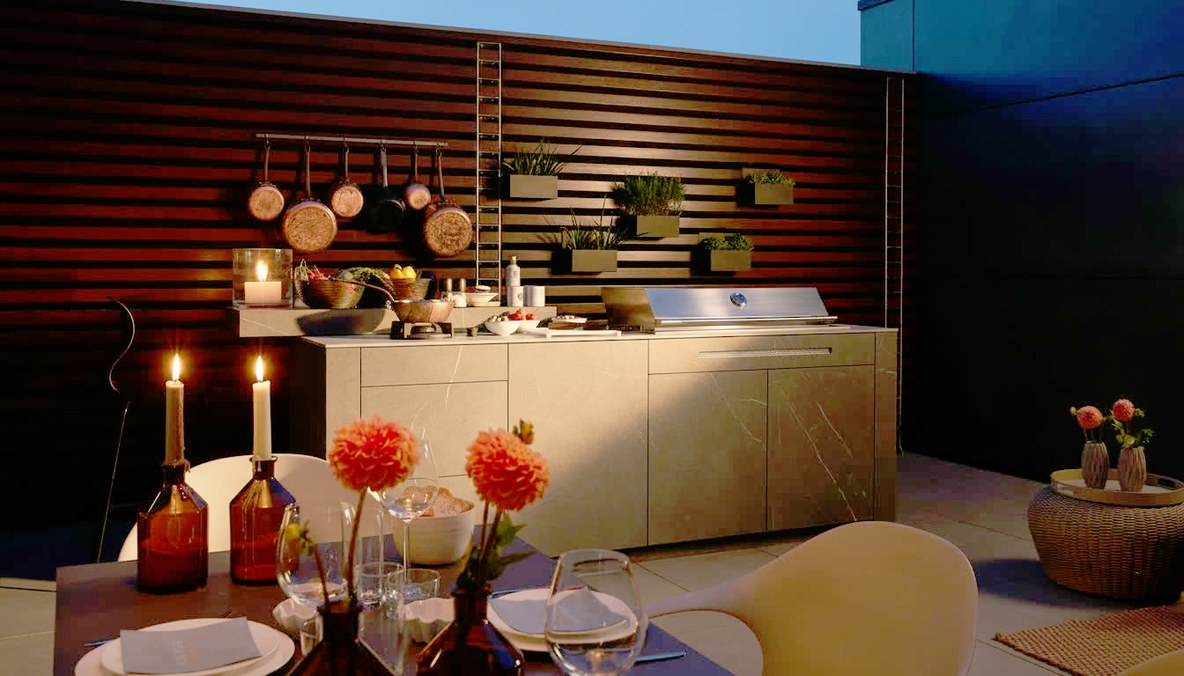
Stone-effect outdoor kitchen with copper pots hung on a wood-slat wall, table with candles and flowers

Copper, Candlelight and Refractory stone: Dinner Is Served

Candles burning in the foreground, orange flowers in the vase, glasses at the ready: the table is laid, and the camera lifts its gaze towards the protagonist. Against the wall of dark wood slats, the stone-effect kitchen extends its pale volumes; above it, copper pots hung in a row catch the light of the flames like small suns. Aromatic herbs in wall-mounted pots, the steel barbecue set into the worktop, the diffuse warmth of evening: every detail builds an atmosphere somewhere between alpine refuge and metropolitan terrace.

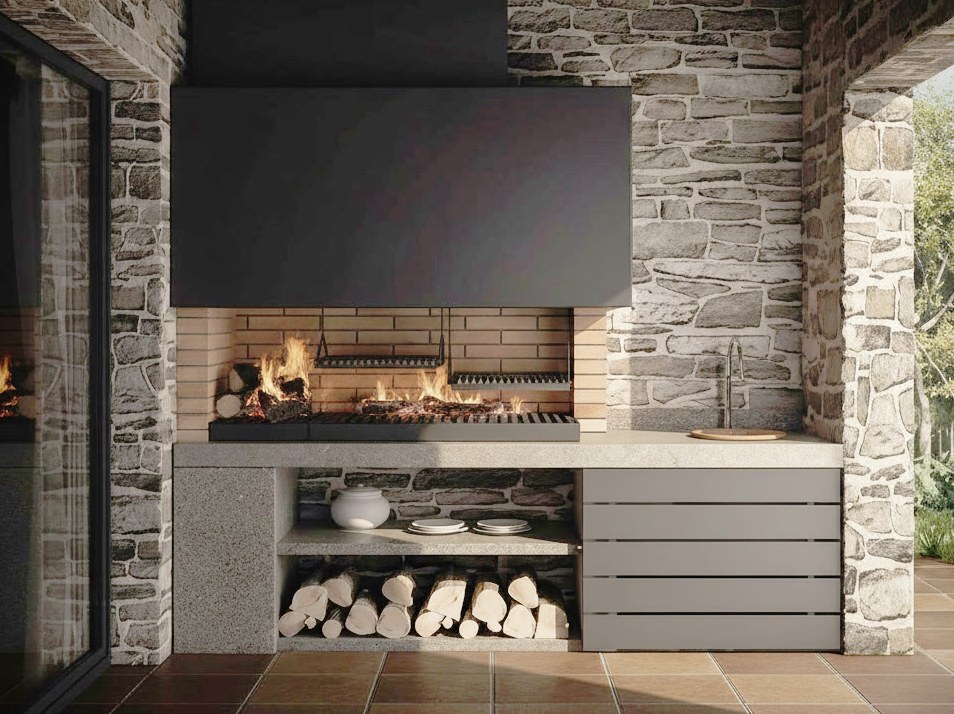
Large modern wood-fired barbecue with double grill, black metal hood, stone walls and log store

Wood-Fired, Beneath the Great Black Hood

The fire already lives within the mouth of the barbecue: embers glow beneath the double grill, ready to receive the meat, while the great black metal hood descends from the ceiling like a technical curtain, gathering the perfumes of the wood. At the sides, stone walls in irregular courses frame the scene with their ancient roughness; below, open bays keep logs stacked in order, beside drawers of contemporary line and the adjoining sink.

Stoneware-clad kitchen with island, integrated sink, induction hob, hood and oven

Indoor Kitchen in Wood 105

The island presents itself in its pale stone-effect stoneware dress, crossed by slender inserts that mark out its drawers; above, the top integrates sink and induction hob in a single working surface, served by burnished taps. Behind, a marble-effect stoneware wall rises beyond the cooking zone, while powder-blue columns — with black ovens recessed — add the colour that gentles the whole scene. Dark bell lamps, stools at the counter, tall windows of a stately apartment: the ensemble has an urban, serene elegance. A wooden structure clad in stoneware is a sound formula: the constructive warmth of wood, the resistance of ceramic at the surface. With hood and oven completing the equipment, it is an indoor kitchen ready for real life: Michelessi builds it to measure, attending to joints, recesses and tonal pairings with an artisan's care. The powder blue, then, is the touch that lingers in the eye.

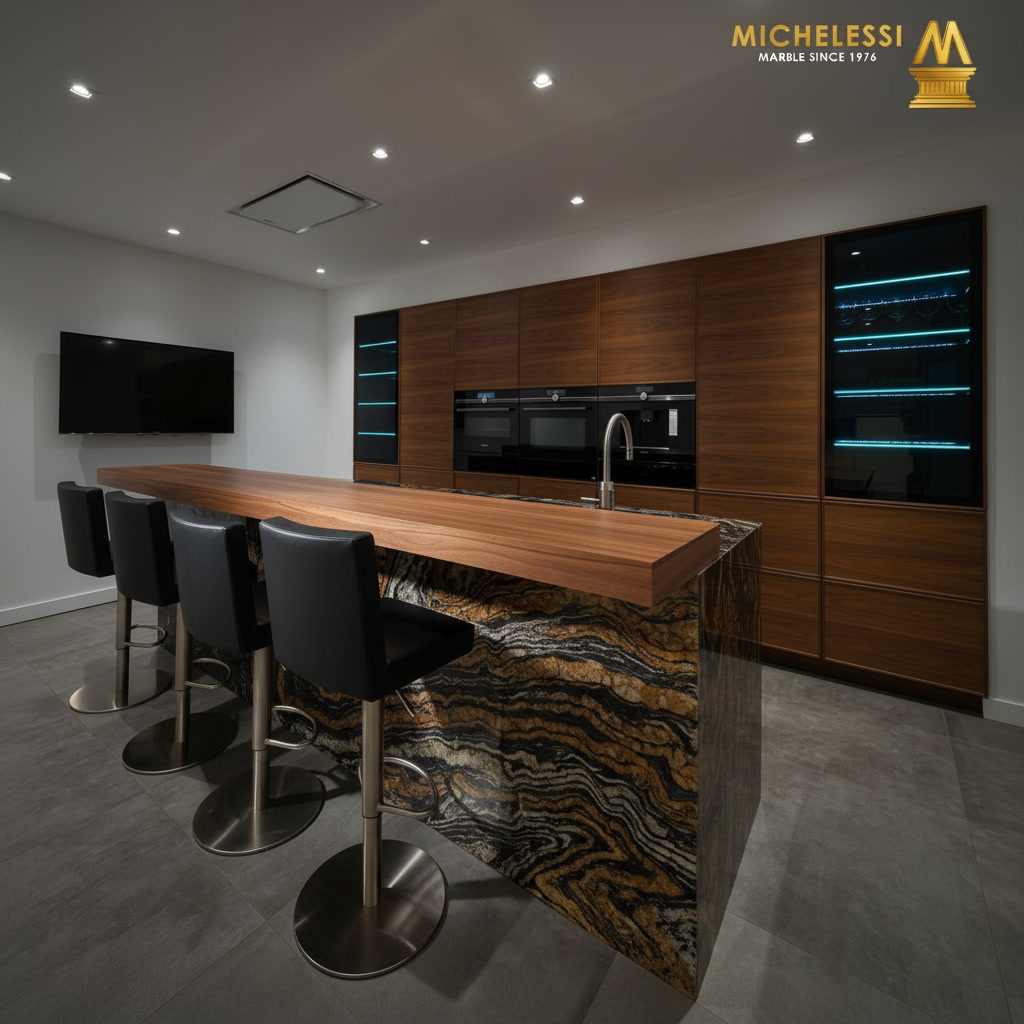
Central quartzite island with spectacular veining, wooden counter and black stools

Indoor Kitchen in Wood 169

The island is a fire made stone: quartzite with amber and black veining blazes along the flanks in its impetuous figuring, polished until it mirrors the room; above, a solid wood counter lays down its warm board and gathers black swivel stools. The sink sits flush in the top; behind, walnut boiserie conceals and reveals — black ovens, backlit vitrines of bottles, a recessed television. A pale floor leaves the whole stage to the material. This is the project for those who want a collector's stone at the heart of the home: quartzite, with its unrepeatable figure, is not chosen from a catalogue — it is encountered, slab by slab. Bespoke stonework orchestrates its veining across top and flanks, with cuts and joints that honour the natural movement. This is the art of Michelessi: craftsmanship that knows when a stone deserves the stage, and builds one around it.

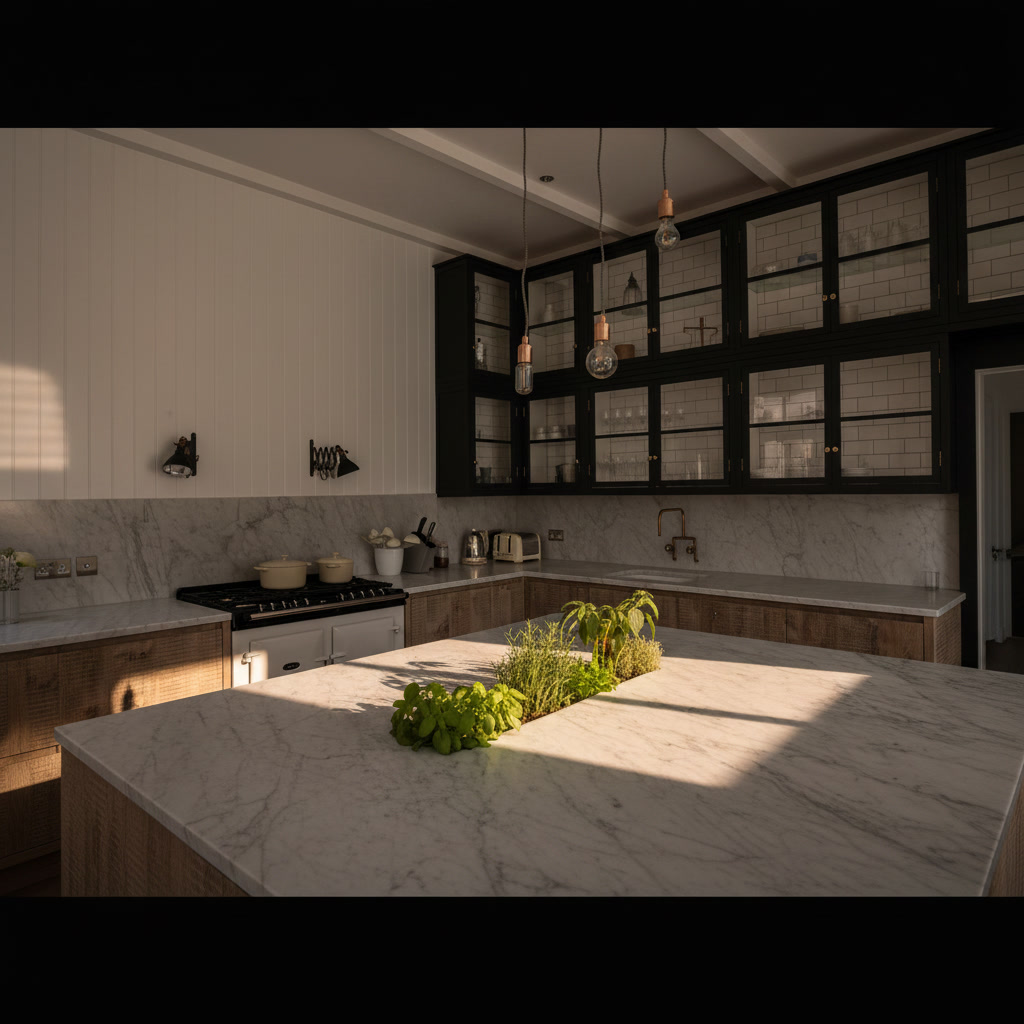
Carrara marble kitchen with contrasting black glass-front cabinets and island with fresh herbs

Carrara Farm Kitchen

There is a country soul in this kitchen, dressed in noble stone: the counters and central island are Carrara marble, grey veins running free beneath the industrial lamps; above, black cabinets with glazed fronts display glassware and crockery like a family dresser reimagined. The white plank wall, the natural wood drawers, the range with its black burners: each element plays the contrast between rustic and refined. And at the centre, on the island with its vegetable rack, bunches of fresh herbs bring the kitchen garden into the marble. This is the charm of the Italian farm kitchen: true materials, a domestic patina, and bespoke stonework holding it all together — balanced by Michelessi with the sure hand of Italian craftsmanship, because even a kitchen with a farmhouse heart deserves the dignity of the most celebrated stone in the world. Basil on cool marble completes the picture better than any frame.

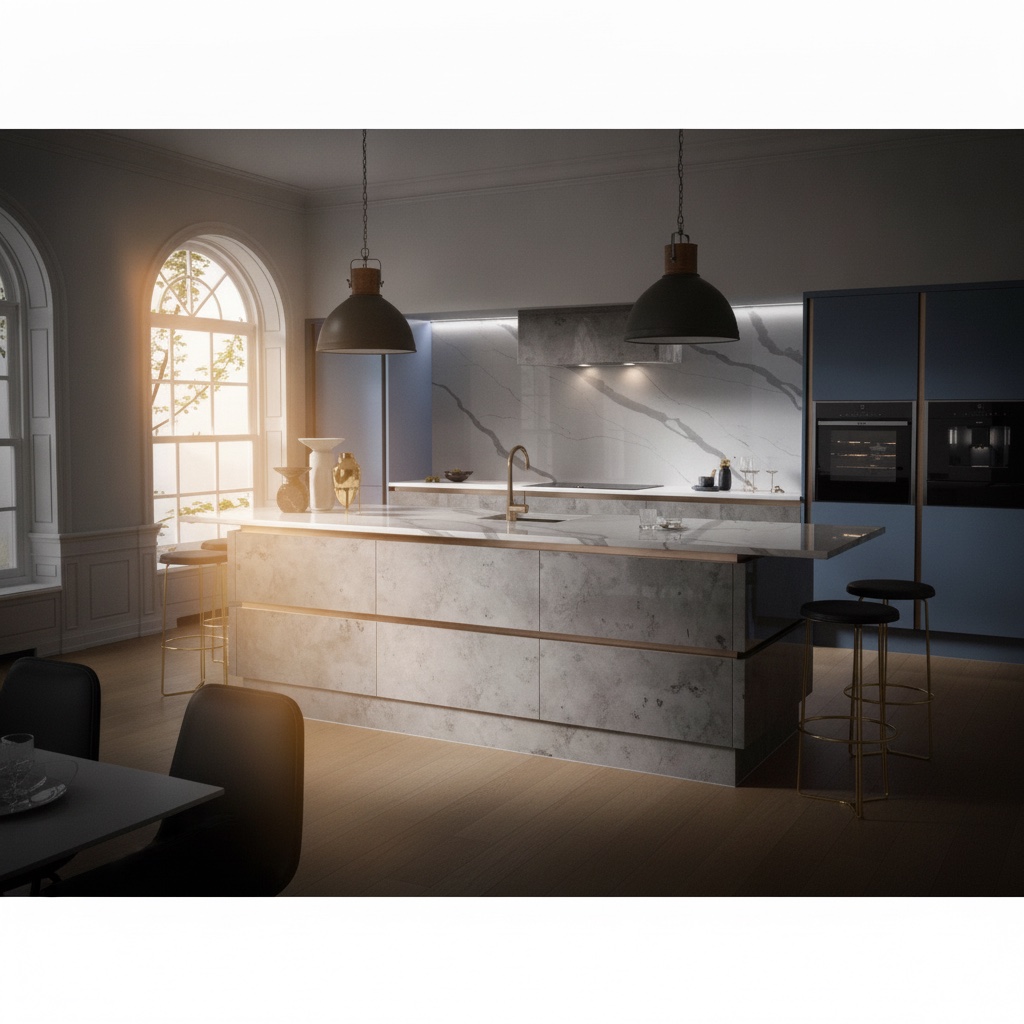
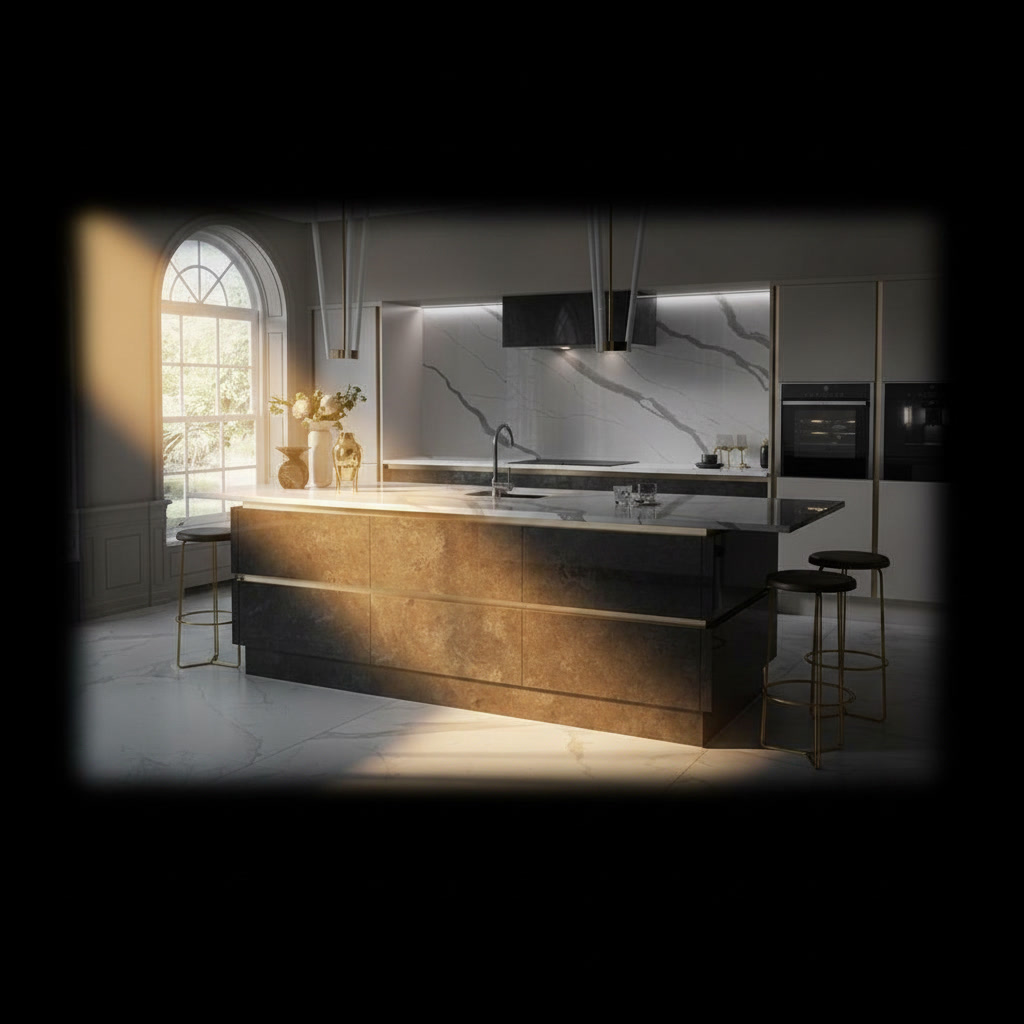
Kitchen with island clad in grey porcelain stoneware with golden profiles and marble wall

Indoor Kitchen in Wood 190

Arched windows and a wall of veined marble effect give the room the breath of a palazzo; at the centre, the island clad in stone-grey porcelain dresses itself in golden profiles — fine lines running along the volumes like threads of light — and carries the integrated sink with its gold tapware. Stools with gilded details complete the register, together with dark columns housing the built-in ovens. Fully equipped, this is a kitchen that plays the luxury card openly: technical materials treated like jewels, measured reflections, a curated scenography. The porcelain stoneware bears the practical side with its tireless surface; the gold does its own work, which is to shine. Made-to-measure holds it all in balance: proportions, alignments, cut-outs. This is the glamorous face of Michelessi indoor kitchens: artisan craftsmanship that knows how to be sober when needed — and magnificent when the project asks. The gold here is not ostentation: it is a line of light drawn with a ruler.

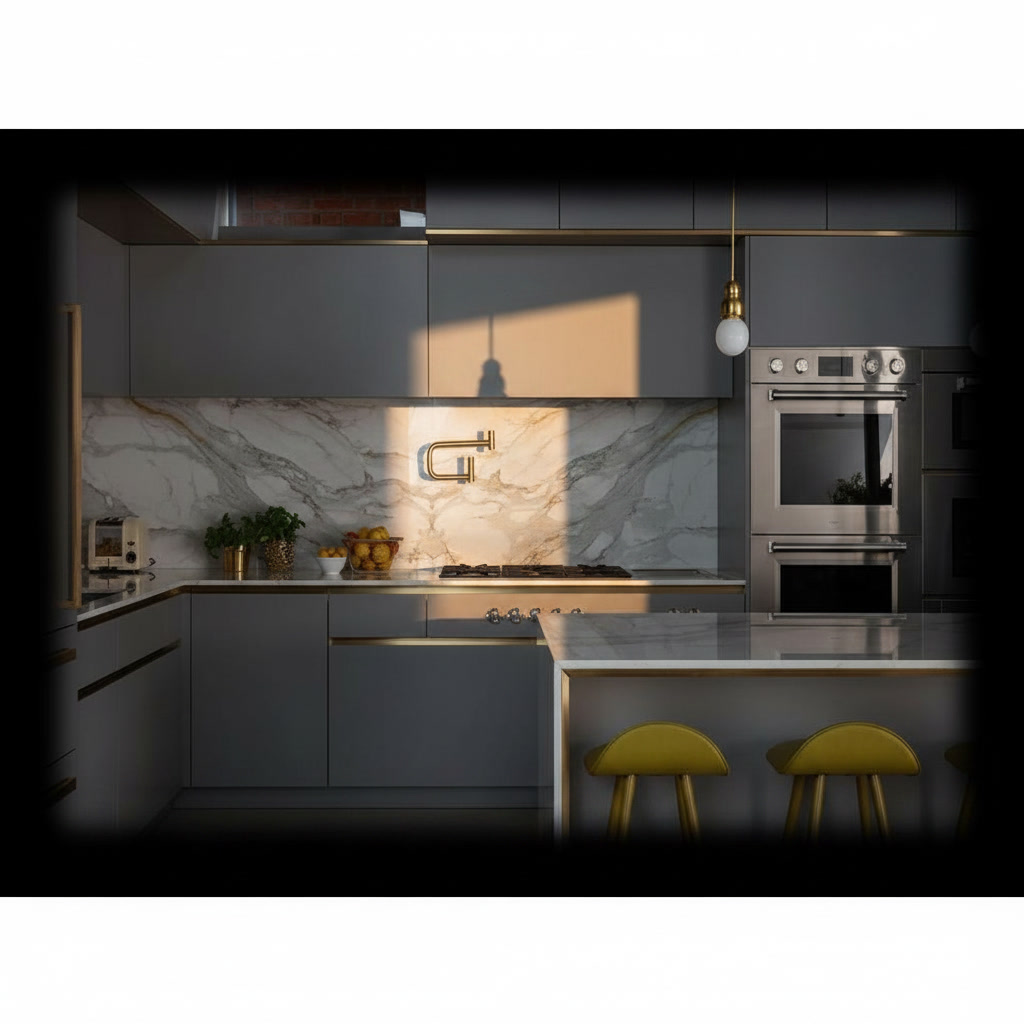
Classic grey kitchen with veined travertine top, oven, sink and yellow stools

Indoor Kitchen in Wood 20

The lines are elegant and the colour knows it: uniform grey doors, crossed by golden profiles that draw the handles and frames, meet a veined travertine counter — pale stone with a moving figure that also clads the wall behind the burners, as one single mineral gesture. Twin ovens sit in their column, the sink works beneath a suspended brass bulb, and yellow stools light the counter with their note of sun. Complete with oven, sink and range, this is a classic kitchen of contemporary proportions: few elements, all of them right. Veined travertine is the silent protagonist: Roman stone, warm and luminous, worked to measure in counters and cladding with the care its history deserves. This is the Michelessi métier: craftsmanship that sets gold against stone without ever sliding into excess — because true elegance is known by its restraint. The yellow stools confirm it: elegance, now and then, also knows how to smile.

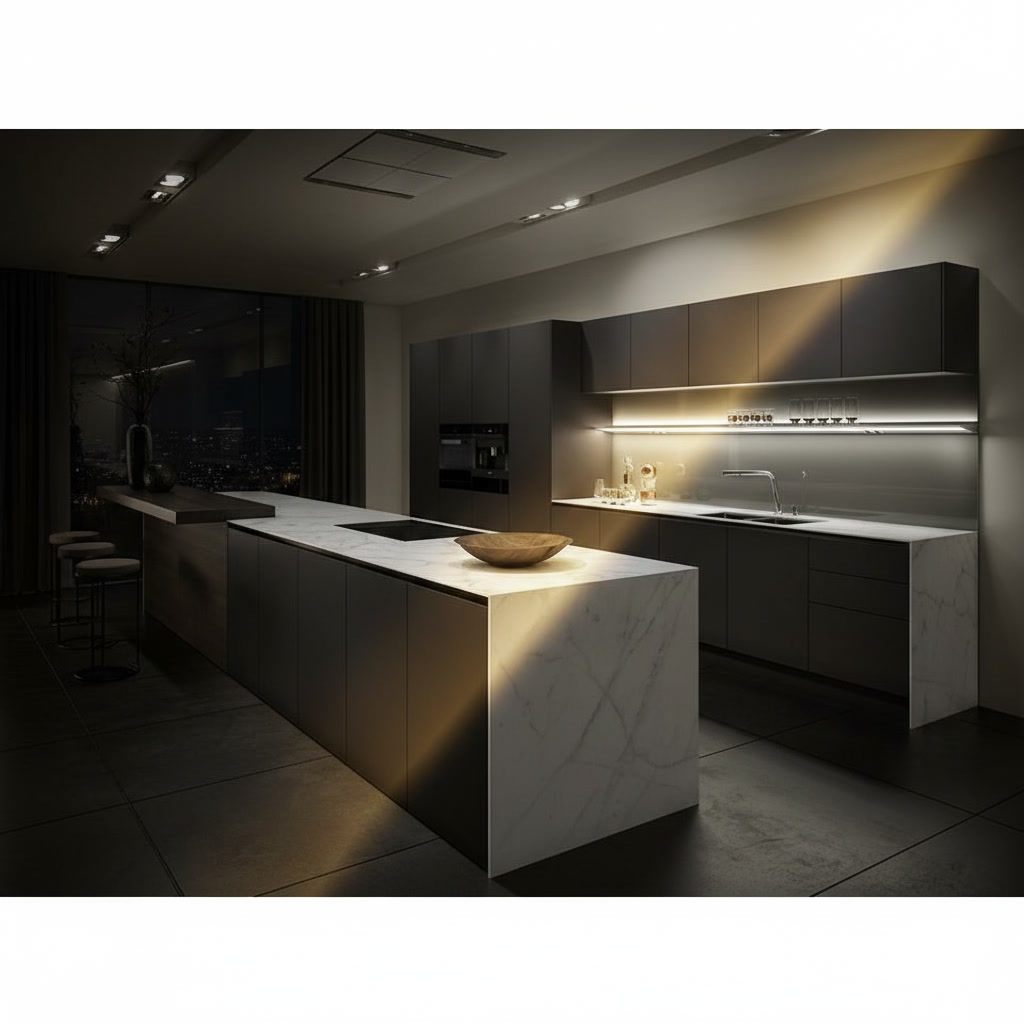
Dark lacquered wooden kitchen with veined travertine island with bar table and induction

Indoor Kitchen in Wood 28

It is the hour when the city lights up, and the kitchen answers with its veined travertine island: pale stone, crossed by grey veining, falls in a waterfall along the flanks and carries the integrated induction hob, extending into a bar table where dark stools wait. Around it, surfaces of dark lacquered wood absorb the spotlight; a fitted wall with its LED strip lights the worktop, and doors keep everything in its place. Complete with sink and oven, this is a kitchen of metropolitan charm: sharp contrasts, noble materials, a penthouse atmosphere. The veined travertine is the luminous heart of the dark: working it in a waterfall demands exact joints and orchestrated veining — the bespoke stonework Michelessi practises with the artisan craftsmanship of always. The result is an island that seems lit from within: stone that gives light, while everything around it chooses shadow. Elegant darkness plays the backdrop: the pale stone takes, deservedly, the stage.

The next step

Found your kitchen?

Tell us which one feels closest: we redraw it to your measurements, in the marble or stone you prefer, and send you the design and the quotation free of charge.

Why we do not build in masonry

We do not build in masonry because mortar, cement and plaster are the points where a kitchen cracks: heat makes them expand at a different rate from the bricks, water swells them, frost can split them. This is not an opinion: these are defects described in the technical literature.

  • Heat. According to trade guides, ordinary cement mortar crumbles above 300-400 °C. Refractory materials, by definition, withstand temperatures above 538 °C for long periods (ASTM C71); manufacturers declare a resistance of over 1,000 °C, and aluminosilicate refractories for ovens go up to 1,100-1,200 °C. This is why ovens and barbecue cooking chambers are made of refractory material: we use the same kind of material for the whole structure of the kitchen.
  • Water and frost. Mortars and plasters are porous and the grout lines are many: water from the sink, from cleaning and from rain gets in, stays in the plaster and lifts it off. Outdoors it can freeze and, as it turns to ice, grows in volume by about 9 per cent: with every winter the cracks can widen.
  • Shrinkage and movement. Mortars and screeds shorten as they dry; a rigid finish laid on a structure that moves can crack. The assembly manuals of some prefabricated barbecues also admit that micro-cracks are part of normal settling.
  • Hard to work on. A mortared kitchen does not open: to reach a pipe, remove the uprights and cladding or change a built-in oven, a controlled demolition may be needed.

A dry interlocking joint has no mortar to shrink and no water trapped in the joints, and lets every block expand freely when it warms up. If a block is damaged, it is replaced on its own. That is why we say a Michelessi kitchen is built to last a lifetime: there is no mortar to crumble with heat. The full comparison, with sources, is on the page masonry or refractory stone.

A refractory stone kitchen in place of masonry: how it is made

Our masonry-style kitchen is made of three parts: the structure of interlocking refractory stone blocks laid dry, the marble or stone worktop, and the wooden doors. Every part is designed and produced by Michelessi in Aprilia and installed by our own team.

The structure
Refractory stone blocks cut to size and slotted into one another without mortar or adhesives. The principle of dry laying is ancient: the art of dry-stone walling has been on UNESCO's list of intangible cultural heritage since 2018 (it is the dry-stone walling technique that is protected, not kitchens). We take up the same principle, stone on stone without binder, in the structure of the kitchen. The structure goes up without wet trades, without building-site dust and without drying days, and how the services are reached is settled in the design.
The worktop
A slab chosen one by one and cut in our workshop on numerically controlled machines, then finished by hand. Marble (Calacatta, Carrara, Statuario, Nero Marquina, Botticino), travertine, onyx, granite, quartzite or sintered stone such as Dekton and Laminam. With stone, the sink is integrated into the worktop and the upstand is made of the same material.
The doors
Wood, framed or flat, natural or coloured, with the hinges and runners of a present-day kitchen; drawers and deep pan drawers where they are needed. Details are on the page doors, hinges and finishes.
The appliances
Oven, hob, dishwasher and built-in fridge each have their own compartment, with the clearances and ventilation grilles the manufacturer specifies. They are chosen before the design, as in any bespoke kitchen, and can be replaced over the years without demolishing the structure.

Masonry, faux masonry or dry-laid refractory stone: the differences

Today the words "masonry kitchen" cover three different things: real masonry (bricks or blocks, mortar, plaster), faux masonry (clad panels of wood or plasterboard) and what we offer, which is not masonry: interlocking blocks of refractory stone laid dry. The table sums up how they behave.

AspectReal masonryFaux masonryDry-laid refractory stone (Michelessi)
StructureBricks or aerated concrete blocks bound with mortar and plasteredClad panels of plywood, chipboard or plasterboardRefractory stone blocks cut to size and interlocked without mortar
HeatOrdinary cement mortar crumbles above 300-400 °C; near the oven and barbecue it can crackDepends on the panels and the cladding: near the oven and hob suitable materials are neededA family of materials born for fire: by definition, refractories withstand over 538 °C for long periods
DampGrout lines and pores absorb water; plaster swells, condensation in closed compartmentsDepends on the panels and the cladding; the space under the sink is the point to protectNo mortar or plaster to hold water; stone worktop with integrated sink
CracksFrom mortar shrinkage, heat and frostWithout mortar there are no shrinkage cracks; joints and cladding still need checkingBlocks expand freely: no rigid joints to tear apart
Changes and repairsOften a controlled demolition is neededDismantled like a piece of furnitureOpened block by block; every block is replaced on its own
InstallationWet trades, dust, drying daysDry assemblyDry assembly, no water in the house
WeightWalls, screed, plaster and tiles: to be checked against the floor slabLightStone: the weight is assessed at the site survey and the design follows
LifespanDepends on joints, grout and seals, to be checked over the yearsDepends on the panels and the cladding; doors and appliances can be changedBuilt to last a lifetime; no mortar to crumble with heat; every block can be replaced

On the page faux masonry kitchen we explain why many kitchens sold as "masonry" are clad cabinets; on the page masonry or refractory stone you will find the facts with their sources.

The styles of masonry kitchens

Refractory stone does not impose a style: the same dry-laid structure takes flat modern doors or classic framed doors, a Calacatta or a granite worktop, and lives in a penthouse in Rome as well as in a farmhouse in the Pontine countryside. Every style has its own page.

Modern masonry kitchen

Clean lines, handleless flat doors, a slim worktop in marble or sintered stone, concealed appliances, an island at the centre of the open-plan room. The stone body gives a modern kitchen the visual weight a fitted kitchen lacks. Read more: modern masonry kitchen.

Rustic, country and classic masonry kitchen

Framed wooden doors, curtains, open niches, majolica tiles, a chimney hood and the wood-fired oven in its niche: the kitchen of the Lazio farmhouses, built however in refractory stone rather than bricks and mortar. Read more: rustic, country and classic masonry kitchen.

White masonry kitchen

White is the most searched-for colour: white doors on a Carrara or Statuario worktop, or white and wood, white and grey, white and black. With a continuous stone worktop there are fewer grout lines to clean than on a tiled top. Read more: white masonry kitchen.

Masonry and wood kitchen

Stone for the structure and the worktop, wood for the doors: walnut, oak, chestnut, ash. Wood suffers from damp: a dry base, without mortars and plasters to hold moisture, gives it a healthier support. Read more: masonry and wood kitchen.

Small, corner, linear, island or peninsula masonry kitchen

Traditional masonry walls take 8-10 centimetres for every upright and on a long wall eat up at least half a metre: that is why in a small room some people give it up. With stone blocks cut to size, the dimensions, block thickness included, are quoted in the design, on the real centimetres of the room: in a line, in a corner, with an island or a peninsula, with the worktop at 85-95 centimetres from the floor. Read more: masonry kitchen layouts.

Outdoor masonry kitchen? We make it in refractory stone

This is where dry laying matters most: rain, sun, frost and the fire of the barbecue put mortars, screeds and grout lines to the test. Structure in refractory stone blocks; steel for grills, sink and technical parts; worktops in granite, quartzite, sintered stone or travertine (marble outdoors needs to be chosen with the proper precautions); fridge, gas hob and larder. Read more: outdoor masonry kitchen, together with the general page on outdoor kitchens and the pergolas to shelter it.

Masonry barbecue? We make it in refractory stone

A barbecue in refractory stone blocks, with a cooking chamber in refractory bricks and a structure without cement, that is, without the material that, in cement barbecues, can split with winter frost and at the first lighting of spring. Read more: masonry barbecue; the models are on the page barbecues and ovens in refractory stone.

Masonry wood-fired oven? We make it in refractory stone

The dome and the arch are in refractory bricks, assembled according to the refractory manufacturer's instructions; the whole structure around them is dry-laid, in refractory stone blocks that match the rest of the kitchen. For pizza and bread, outdoors or indoors with the appropriate flue. Read more: masonry wood-fired oven.

Stone kitchen

Marble, travertine, granite, quartzite, lava stone, refractory stone: every stone has a right place, on the worktop, on the doors or in the structure, and a wrong one. As stonemasons, we explain them one by one. Read more: stone kitchen and the marbles section.

How we work: from site survey to installation

Every Michelessi masonry-style kitchen starts with a free site survey, goes through a 3D design and cutting in the workshop in Aprilia, and ends with dry installation by our own team. No bricklayers are needed: the people who design, cut and install belong to the same team.

  1. Site survey and measurements. We come to see the room or the garden, take the measurements, check the water, gas, drainage and power connections and, for outdoor kitchens, the base. In Rome, Latina and throughout Lazio the site survey and the quotation are free.
  2. 3D design. Our technical office draws the kitchen in three dimensions: layout, heights, compartments for the appliances, stone for the worktop, doors. We refine it together until it is the right one.
  3. Choosing the slab. The worktop is chosen in person, slab by slab, in our workshop in Aprilia: no two pieces of marble are the same.
  4. Cutting in the workshop. Refractory stone blocks and worktop slabs are cut on numerically controlled machines to the measurements of the design and finished by hand.
  5. Dry installation. Our team assembles the structure by interlocking the blocks, lays the worktop and fits doors and appliances. No mortar, no water, no building-site dust.

We install with our own team throughout Italy and also follow projects abroad. The full path, with the questions to ask before starting, is in the guide how to design a masonry kitchen.

How much does a masonry kitchen cost

The price of a masonry kitchen, and of the refractory stone kitchen we build in its place, depends on six factors: the linear metres, the stone of the worktop, the doors, the appliances, the services to be adapted, and whether the kitchen is indoors or outdoors. The structure and the installation enter the quotation as sub-items of the linear metres and of the location. That is why we do not publish a price list per metre: two kitchens of the same length can cost very differently depending on the marble and the number of drawers. The bill for a traditional masonry kitchen also includes items that can appear later: grout to redo, seals to check, plaster to patch, an oven that may be hard to change without altering the worktop. A dry-laid structure has no mortar or plaster to patch. The quotation is prepared on the design, after the site survey, and it is free. The factors, one by one, are on the page how much does a masonry kitchen cost.

Masonry kitchens in Rome, Latina and Lazio

The Michelessi workshop and showroom are in Aprilia, on the Via Pontina at kilometre 45.350, between Rome and Latina, less than an hour from Rome. Here you can see the refractory stone blocks and the slabs of marble and stone in person. The site survey is free in Rome, in Latina and across the region. We install with our own team throughout Italy and also follow projects abroad. Details are on the page masonry kitchens in Rome, Latina and Lazio.

The indoor kitchen Francesca, in the masonry style

The indoor kitchen Francesca is the Michelessi kitchen in the style of the masonry kitchen: refractory stone structure, marble worktop, wooden doors. It sits beside our marble kitchens and adapts to the room like a bespoke design: the stone for the worktop is chosen in person, slab by slab, in the workshop in Aprilia, and the body goes up dry, with no water in the house. You will find it on the page indoor kitchens; the fitted kitchens are on the page of the models.

DIY masonry kitchen: how it is really built

Many people searching for "masonry kitchen" plan to build it themselves, with aerated concrete blocks, plasterboard or hollow bricks. On the page DIY masonry kitchen we tell the whole story of how it is done, with materials, thicknesses and timings, and what happens after a few years to mortars, grout and plaster. It is a useful read even for those who then choose stone. The most frequent questions, all together and with sources, are on the page masonry kitchens: questions and answers.

The quotation is free.

How a refractory stone kitchen in the masonry style comes to life

  1. Free site survey
    We come to measure the room or the garden and to check the water, gas, drainage and power connections and, for outdoor kitchens, the base. In Rome, Latina and throughout Lazio the site survey and the quotation are free.
  2. 3D design
    The Michelessi technical office draws the kitchen in three dimensions: layout, heights, compartments for the appliances, stone for the worktop and doors. We refine it together until it is the right one.
  3. Choosing the slab
    The worktop is chosen in person, slab by slab, in the workshop in Aprilia: marble, travertine, onyx, granite, quartzite or sintered stone.
  4. Cutting in the workshop
    Refractory stone blocks and worktop slabs are cut on numerically controlled machines to the measurements of the design and finished by hand.
  5. Dry installation
    Our team interlocks the blocks without mortar or cement, lays the worktop and fits doors and appliances. No water, no building-site dust. We install with our own team throughout Italy and also follow projects abroad.

Frequently asked questions

Frequently asked questions

What is a masonry kitchen?

A masonry kitchen is a kitchen built to measure for the room, with a fixed structure that carries the worktop and frames the openings for doors and appliances. Traditionally the structure is made of bricks or blocks bound with mortar. Michelessi, in Aprilia, builds in its place a kitchen with interlocking blocks of refractory stone laid dry, a marble worktop and wooden doors.

Are Michelessi kitchens really masonry?

No, and we say so at once: they are kitchens in the style of the masonry kitchen, built in refractory stone. The structure is made of blocks cut to size and interlocked without mortar or cement, the worktop is marble or stone, the doors are wood. The look is that of the masonry kitchen; what is missing is the mortar and plaster, which are the weak points.

Why do you not use mortar and cement?

Because heat and damp work above all on mortar, joints and plaster. According to trade guides, ordinary cement mortar crumbles above 300-400 °C, mortars shrink as they dry, water enters through the grout lines and, if it freezes, grows in volume and can open the cracks. Refractory materials withstand over 538 °C for long periods and, interlocked dry, expand freely without tearing.

What is refractory stone?

A refractory material is a non-metallic material able to withstand temperatures above 538 °C for long periods, according to the definition in the ASTM C71 standard. Manufacturers declare a resistance of over 1,000 °C; aluminosilicate refractories for ovens go up to 1,100-1,200 °C. It is the kind of material wood-fired ovens and barbecue cooking chambers are made of. Michelessi uses it in blocks for the whole structure of the kitchen, indoors and outdoors.

Can a refractory stone kitchen be altered or repaired?

Largely, yes. The structure is laid dry: the blocks are interlocked, not mortared, so the kitchen can be opened without demolition and a damaged block is replaced on its own. How pipes and services are reached is settled in the design, because every kitchen is made to measure. In a traditional masonry kitchen, by contrast, removing uprights and cladding may call for a controlled demolition.

Can a masonry kitchen be modern?

Yes, in the masonry style but in refractory stone. The structure is neutral: it takes handleless flat doors, slim worktops in marble or sintered stone, concealed appliances, islands and peninsulas. The stone body gives a modern kitchen a presence a fitted kitchen lacks. Examples and colour pairings are on the page dedicated to the modern masonry kitchen.

Does it work outdoors too, with a barbecue and a wood-fired oven?

Yes. Outdoors the structure is made of refractory stone blocks; steel is used for grills, sink and technical parts. The worktops are granite, quartzite, sintered stone or travertine. The barbecue has a cooking chamber in refractory bricks and a structure without cement, the material that in cement barbecues can crack with frost and with repeated lighting; in the oven the dome and the arch are in refractory bricks, assembled according to the refractory manufacturer's instructions, and the whole structure around them is dry-laid. The first lighting should always be gradual.

How much does a refractory stone kitchen cost in place of a masonry one?

We do not publish a price list, because the price depends on the linear metres, the stone of the worktop, the doors, the appliances, the services and whether the kitchen is indoors or outdoors. The quotation is prepared on the design, after the site survey, and it is free. The six factors that move the price are explained on the cost page.

Which worktops can be chosen for a masonry kitchen?

As stonemasons we offer marble (Calacatta, Carrara, Statuario, Nero Marquina, Botticino), travertine, onyx, granites, quartzites and sintered stones such as Dekton and Laminam. Marble is beautiful but fears acids and hot pans: we say so honestly and, where needed, recommend granite or sintered stone. Outdoors, marble must be chosen with the proper precautions.

Where do you carry out site surveys and where do you deliver?

The site survey and the quotation are free in Rome, in Latina and throughout Lazio; the workshop and showroom are in Aprilia, on the Via Pontina at kilometre 45.350, between Rome and Latina. We install with our own team throughout Italy and also follow projects abroad. Telephone and WhatsApp: +39 06 9275383.

What is the difference between a masonry kitchen, a faux masonry kitchen and dry-laid refractory stone?

A real masonry kitchen has a structure of bricks or blocks bound with mortar and plastered. Faux masonry is a cabinet of plywood, chipboard or plasterboard clad to look like a low wall. Dry-laid refractory stone, which is what Michelessi builds, uses blocks cut to size and interlocked without mortar or cement: it opens block by block and has no rigid joints to tear apart. The full table, with sources, is on the page masonry or refractory stone.

Is a stone kitchen not too heavy for the floor slab?

A stone kitchen weighs more than a fitted one, which is why the weight is assessed at the site survey and the design follows. The issue is not limited to stone: a traditional masonry kitchen, made of walls, screed, plaster and tiles, also has to be checked against the floor slab.

WhatsApp