Skip to content
Made in Italy

Masonry kitchens

White Masonry Kitchen: Modern, with Wood, Grey or Black

A white masonry kitchen is a made-to-measure kitchen with a pale structure on show, white or wooden doors and a stone worktop, searched for above all in its modern version or paired with wood. Michelessi SRL, stonemasons in Aprilia since 1976, builds it without masonry: pale refractory stone blocks fitted together dry, a white marble worktop and wooden doors. The same look, but with no mortar or cement, the materials that give the most trouble where heat and water are at work.

A kitchen like this, made to measure for you.Free, no-obligation quotation · free site survey in Lazio · 3D design · since 1976

What a white masonry kitchen is

A white masonry kitchen is a kitchen built to measure, with a pale structure on show, white or wooden doors and a stone worktop, and Michelessi SRL, stonemasons in Aprilia since 1976, builds it differently from the usual way: not with bricks, mortar and cement, but with pale refractory stone blocks fitted together dry, a white marble worktop and wooden doors. Today people look for it above all in its modern version or paired with wood. The result is the white kitchen in the masonry style that you have in mind; the difference lies in what you do not see, the structure, built without mortar or cement, the materials that give the most trouble where heat and water are at work.

In this kitchen, white is not just a shade: it is the colour that makes a room feel larger, that copes well with changes of furniture and that ties together stone, wood and the steel of the appliances. This is why "white masonry kitchen" is the most frequent colour search, with its variants: white and wood, white and grey, white and black, white and blue. On this page you will find the colour pairings, the pale stones we use, the finishes that wipe clean, and the reason our white kitchen in the masonry style is built in refractory stone; we explain it in full on the page masonry or refractory stone.

Elegant lacquered wooden kitchen with Laminam and glass top and LED-lit shelves

Indoor Kitchen in Wood 27

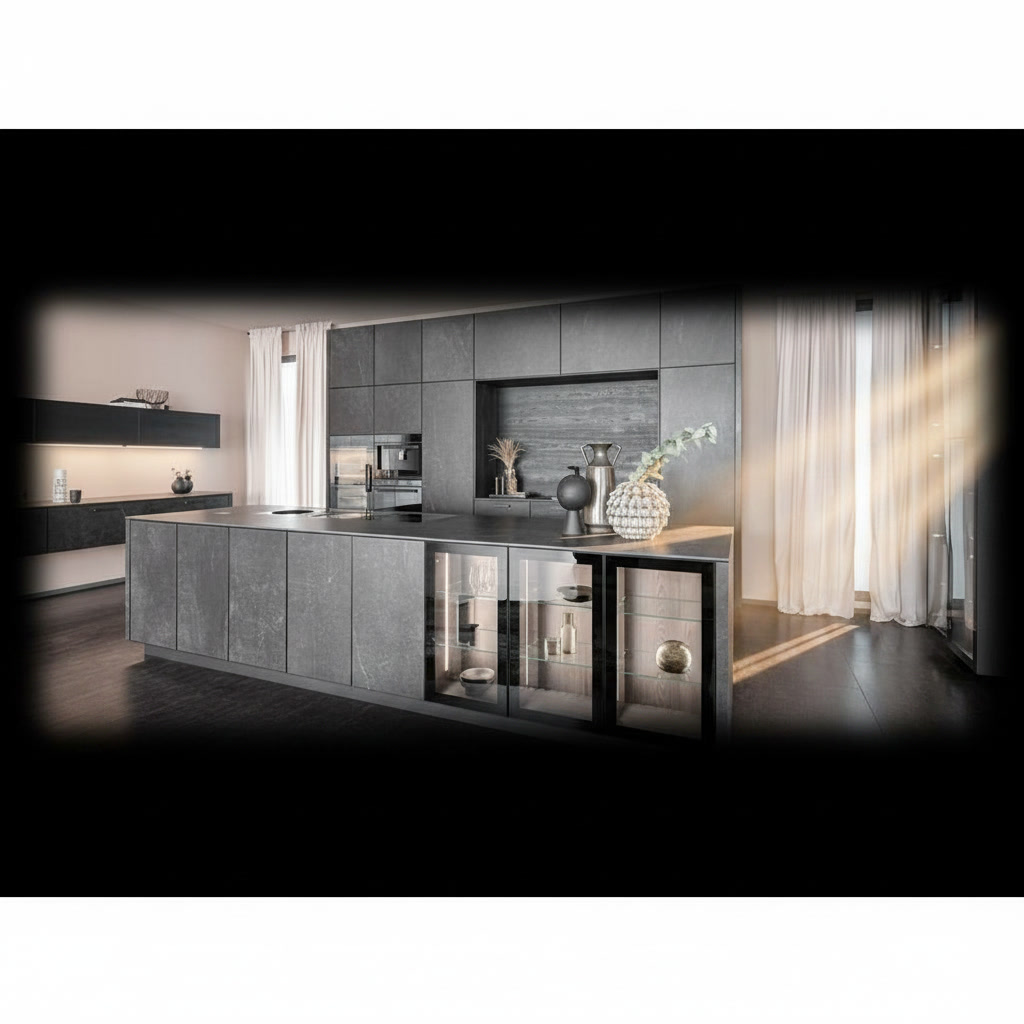
Pale curtains frame the scene like a curtain just raised: the lacquered kitchen in stone-grey finishes composes its central island and bases with glass shelves lit by LED — low vitrines where glasses and bottles shine with their own light. The Laminam and glass top runs dark and thin; a vase of dried branches signs the composition. Above, a black shelf with spotlights directs the light. This is the nocturnal elegance of houses that love to entertain: surfaces that barely reflect, measured transparencies, a calibrated atmosphere. Laminam provides the service; glass and LED provide the scenography. To design illuminated vitrines within base units demands planned wiring and clean assembly: no visible cables, no misplaced shadows. It is the care Michelessi brings to its made-to-measure indoor kitchens: a wooden structure, Italian craftsmanship, and light treated as a material — the most precious of them all.
Modern black and white kitchen with dark wood wall units, black hood and metal table

Black and White with an Inlay of Dark Wood

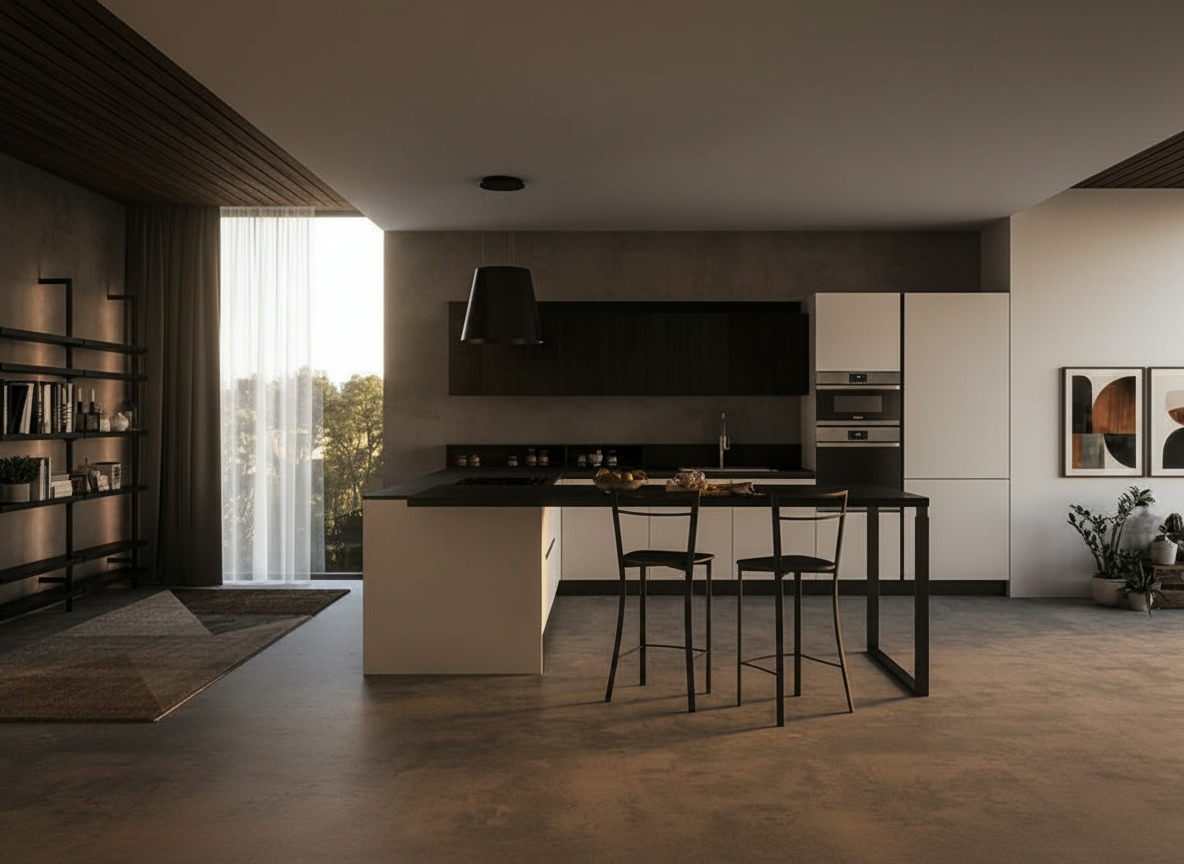
The stone-effect wall stands as a neutral ground and lets the volumes speak: the white peninsula with its thin black worktop, dark wood wall units aligned beneath the black hood, white columns with built-in ovens. To one side, the black metal bookcase carries its light shelves, and the black-framed table with slender chairs draws the dining area on the grey floor. A composition in black and white, warmed by wood and measured like an architectural photograph. It is the graphic register of contemporary design, living on exact proportions and well-chosen surfaces. Michelessi indoor kitchens interpret it to measure: every contrast is dosed with the right materials — matte laminates, dark wood species, technical worktops, up to marble worked in the tradition of Italian craftsmanship — so that the result stays sharp without turning cold. The home, in the end, is grateful: with order, light and character.

Contemporary U-shaped kitchen with peninsula, top and sides in sharp-edged Carrara marble

Contemporany Kitchen

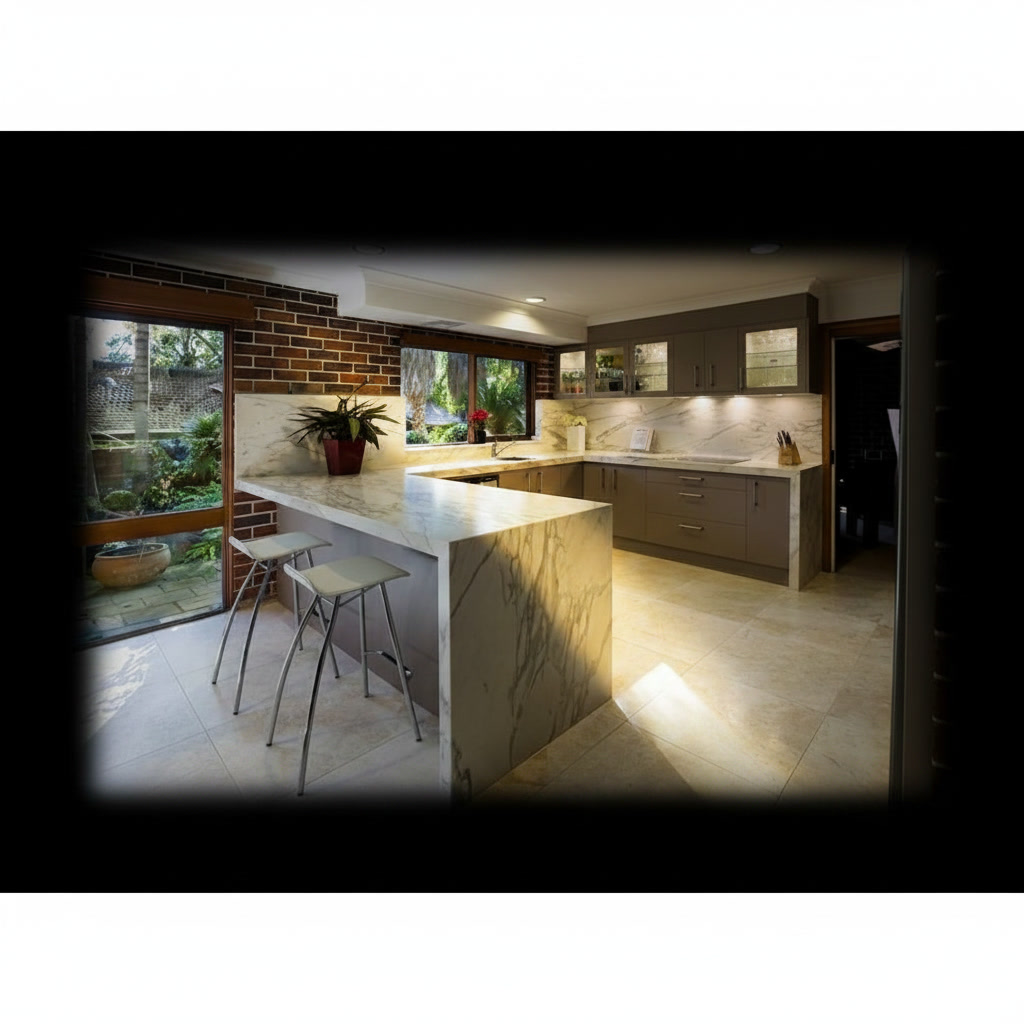
The kitchen folds into a welcoming U, and the peninsula advances toward the living room with its Carrara marble sides cut to a sharp edge: the stone falls from counter to floor in a single cascade of veining, while transparent stools keep it company without stealing the scene. Dove-grey base units, an exposed brick wall, a great window onto the garden: every element adds warmth to a rigorous design, and the pale polished stone floor carries the material continuity through. The sharp-edged detail is a declaration of faith in the stone and in those who cut it: no rounded edges to hide behind, only exact mitres and aligned veins. Michelessi executes it to measure in its own workshops — marble genuinely made in Italy, from quarry-fresh slab to finished edge. The result is this naturalness: a contemporary kitchen that seems born together with the house, the garden watching over it.

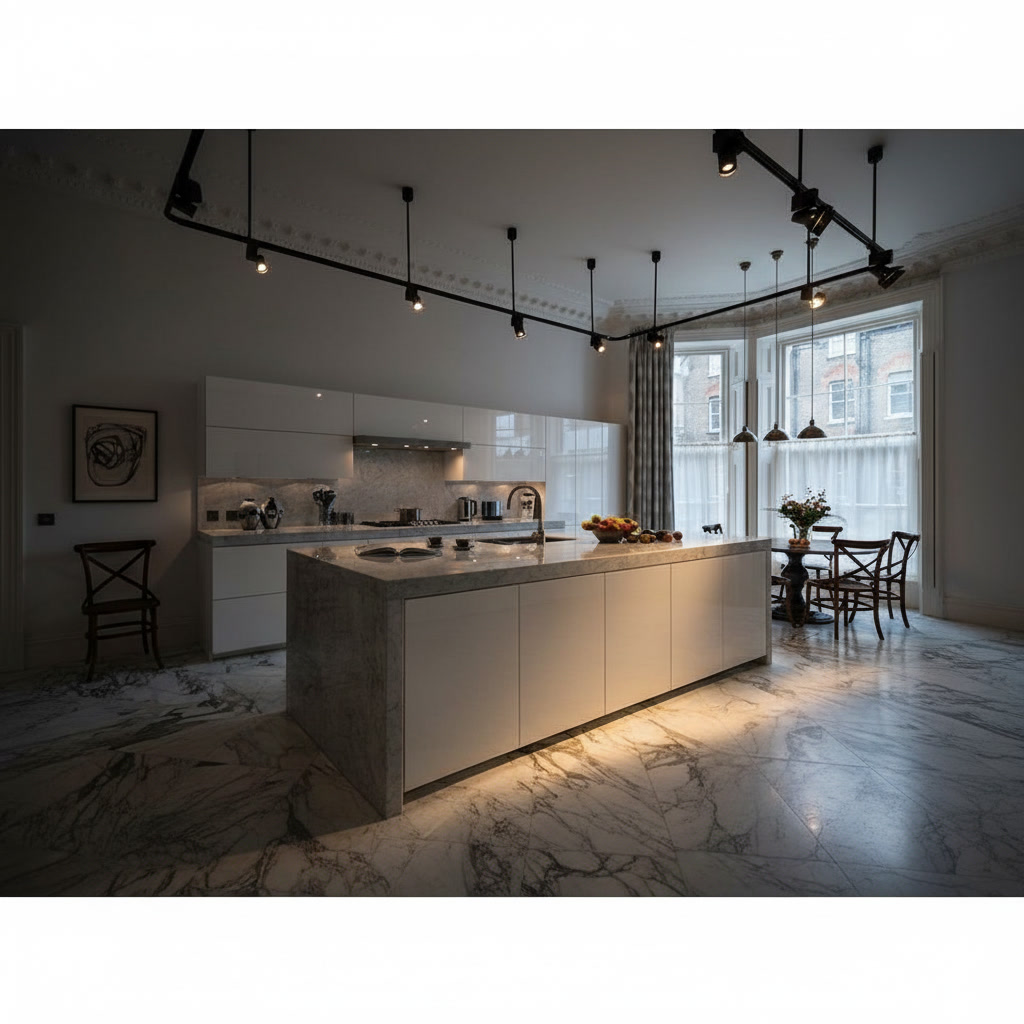
Kitchen with grey veined marble floor and island with matching marble top and sides

Full Marble Kitchen

Here the marble begins at the floor: great grey-veined slabs running beneath the entire room, rising ideally onto the island — top and sides in matching stone — and turning the kitchen into a monolithic, luminous environment. White lacquered wall units dissolve into the walls, the black track lighting crosses the ceiling with its suspended lamps, and the fruit on the island strikes the single note of vivid colour. Tall windows with light curtains complete the air of a period house renewed. Creating a full marble kitchen means governing the stone on every plane of the space: selecting coherent slabs for floor and island, aligning the veining, calibrating the polish so the light flows evenly. It is bespoke marble work in its most complete form, which Michelessi undertakes with the experience of a lifetime among slabs: marble everywhere, yes — but with the light hand of those who have always known it.

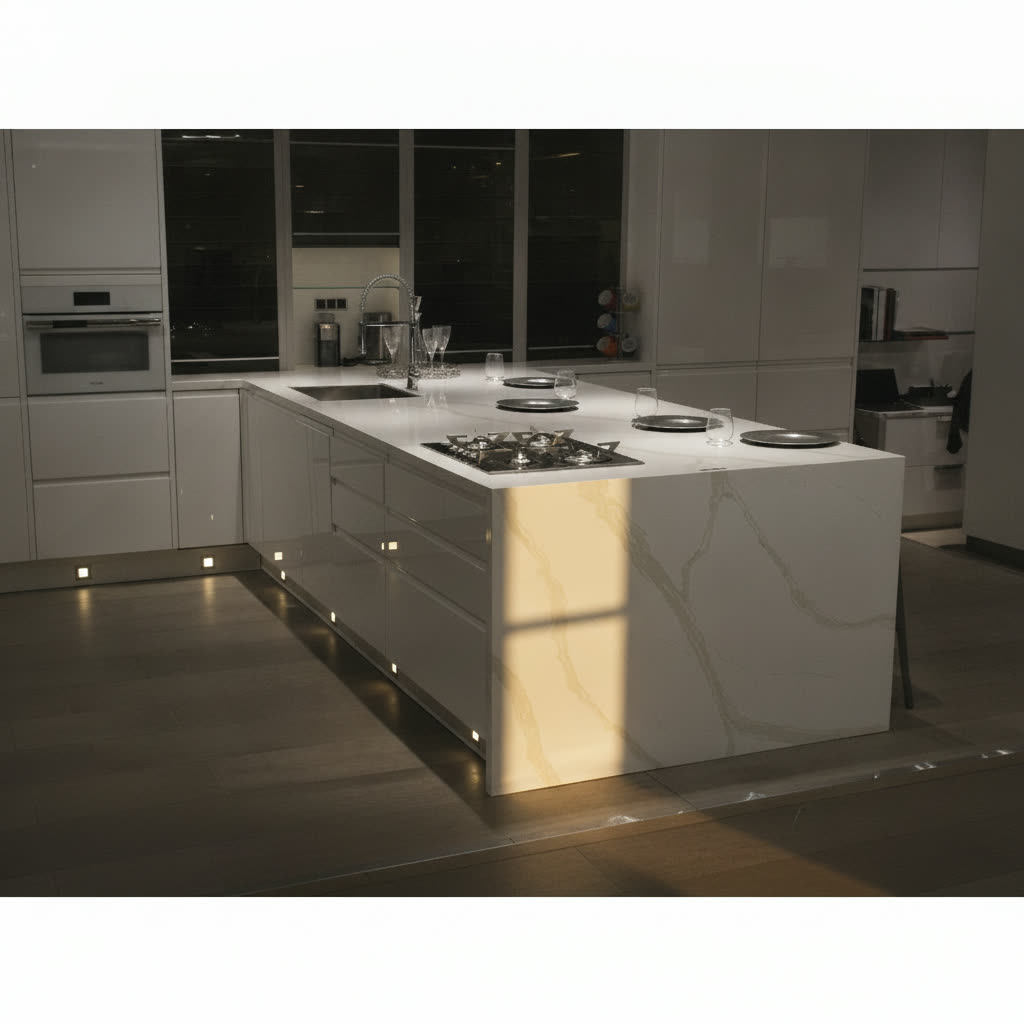
White marble peninsula with grey veining and plinth with pointed accent lighting

White Elegance Kitchen

The peninsula advances like the prow of a white ship: marble with broad, sinuous grey veins dresses the top and descends the side in a single cascade of stone, while at the base the plinth with its pointed lighting kindles small beacons on the floor, lending the volume the appearance of floating. Above, the gas hob and dark cookware ready for use; around, glossy white handle-free drawers and the column with its built-in oven complete the contemporary register. It is a project that attends to the scenography down to the lowest details — literally: raking light at the foot of the stone is a stage gesture, exalting the verticality of the veins. Bespoke marble work governs the whole: selected slabs, masterful joints, exact recesses. Michelessi signs it with the pride of Italian craftsmanship: because even a plinth, where there is vision, becomes part of the poetry. And at night, with the lights glowing at the foot of the stone, the peninsula seems to set sail.

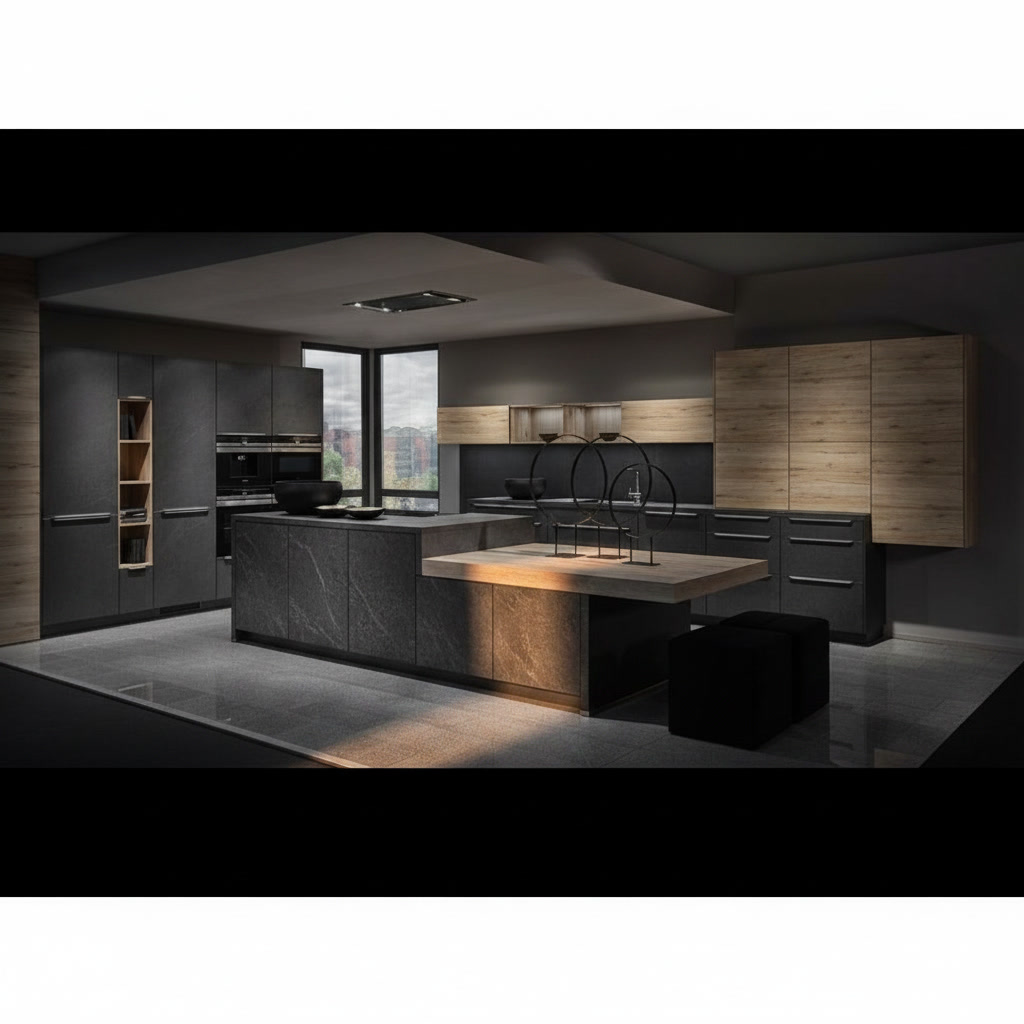
Lacquered wooden kitchen with Laminam top and doors, island with table and ovens

Indoor Kitchen in Wood 26

The composition alternates stone grey and pale oak with a sure rhythm: dark columns house the twin ovens, wooden wall units lighten the wall, and at the centre a Laminam island stretches its top into an adjoining table, where dark poufs wait for breakfast. Black lamps descend in a cluster; a ribbon window brings light onto hob and sink. Complete with oven, hob and sink, this is a kitchen that thinks horizontally: long surfaces, distributed functions, conviviality drawn into the design itself. Laminam on top and doors guarantees uniformity and resistance — the technical material that serves the project without limiting it. The lacquered wooden structure keeps the volumes true. It is the practical contemporary of Michelessi indoor kitchens: made to measure in its proportions, craftsmanship in its joints, and an island that never divides — it unites, from the morning coffee to the last conversation. An island that invites you to linger: the poufs, not by chance, are already there.

Lacquered wooden kitchen with white travertine island, integrated sink, oven and burners

Indoor Kitchen in Wood 31

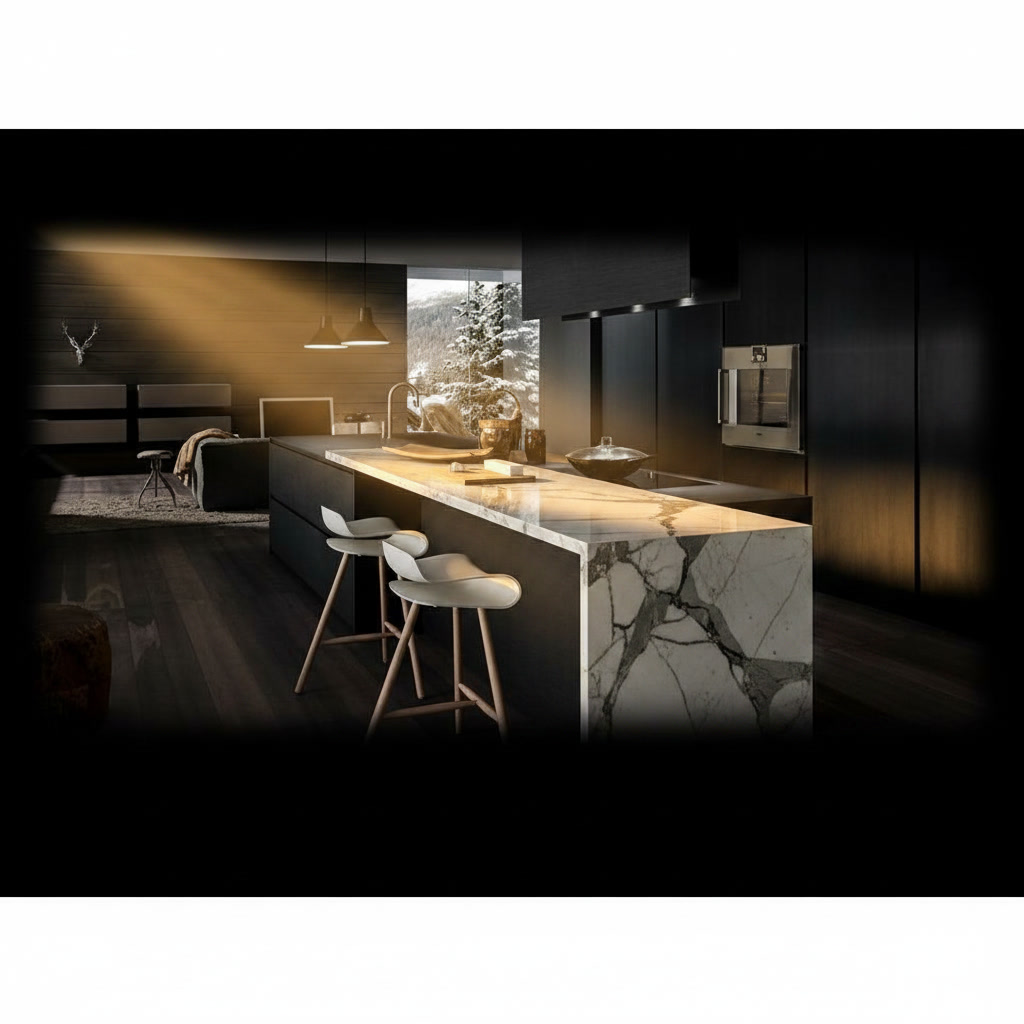
Three blown-glass lamps descend over the island like transparent bells: beneath them, a white travertine top spreads its luminous stone and receives the ceramic basin that projects from the pale wooden volume — the sink integrated into the counter, a steel mixer at its service. Black stools line the bar; behind, dark grey bases and pale boiserie with a long hood compose the working wall with oven and burners. An oak floor warms the scene. This is the contemporary that does not forget its memory: the farmhouse basin within a modern design, Roman stone above present-day joinery. The white travertine, cut to measure with the basin set in to perfection, is the bridge between the eras — the Michelessi speciality, Italian craftsmanship in stone. And the effect, beneath those bells of glass, is that of things done right: timeless. The white basin, under that suspended glass, seems to have been waiting forever for your hands.

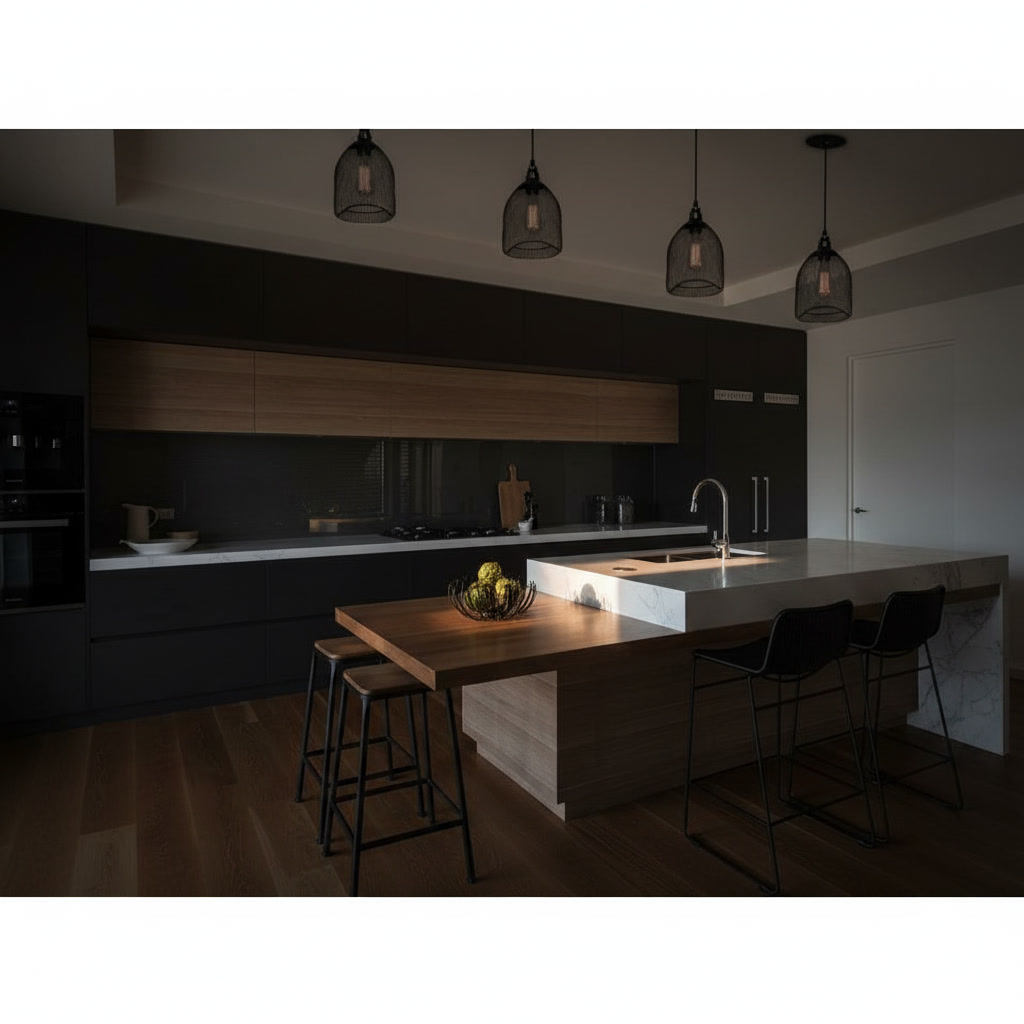
Black kitchen with solid wood and Laminam top, integrated sink and induction hob

Indoor Kitchen in Wood 160

The counter tells two materials in one: a black Laminam top, thin and technical, that integrates the sink and the induction plate, and a thick slab of solid wood laid over it like a noble butcher's block, ready for breakfast served on white stools. Around it, the black kitchen stretches its matte columns, while behind, the space continues towards a sleeping area in pale wood: a loft where functions cohabit with ease. Black bell lamps aim at the scene. This is a project that plays on contrasts of thickness and temperature: black that sharpens, solid wood that warms, light that chooses where to rest. Fully equipped, the kitchen shows the maturity of contemporary made-to-measure: the right materials in the right places. It is the Michelessi method for indoor kitchens, with Italian craftsmanship pairing Laminam and solid timber the way one pairs two strong characters: with respect, and with memorable results.

The next step

Found your kitchen?

Tell us which one feels closest: we redraw it to your measurements, in the marble or stone you prefer, and send you the design and the quotation free of charge.

Modern white masonry kitchen: clean lines, pale stone, no wall units

A modern white masonry kitchen is recognised by a few things: continuous base units with no breaks between one module and the next, flat doors without frames, a thin pale stone worktop, few wall units or none at all, with stone or wooden shelves in their place. It is one of the most searched-for versions of the masonry kitchen and it works well in rooms open to the living area.

Built from pale refractory stone blocks, this kitchen has an advantage that plastered masonry does not: the surfaces are already flat and even, because the blocks leave the workshop cut square, whereas hand-built walls always hide some out-of-square and tolerances that the joiner then has to make up. Flat doors, lacquered white or in light wood, therefore find a flat base on which to close flush. The worktop can be Carrara marble, Calacatta or white sintered stone, depending on how you will use it. For the lines, lighting and concealed appliances, see the page on the modern masonry kitchen.

White and wood masonry kitchen

White and wood is among the most searched-for pairings and the most natural for a kitchen born from stone: pale structure and worktop, solid wood doors that warm the whole. The timbers that sit best with white stone are natural oak, ash, chestnut and, for those who want a darker contrast, walnut.

There is also a practical reason why wood holds up better on our blocks than on a plastered wall. A masonry structure is a wet build: mortar, plaster and skim coats bring water into the house and release it as they dry, and wooden doors hung on a base that is still damp can swell and twist. Refractory stone blocks are fitted dry, with no water: the wood does not have to live with the water of mortar and plaster. The timbers, framed or flat doors, drawers and deep drawers are described on the page masonry and wood kitchen; finishes and hinges on the page doors, hinges and finishes.

White and grey, white and black, white and blue: the pairings that work

The white of this kitchen pairs well with a second colour, provided each has its place: the pale stone structure remains the background, the colour goes on the doors, the island or the worktop. The table sums up the pairings we are asked for most and where we put each colour.

PairingWhere the colour goesSuggested worktop stoneEffect
White and woodDoors and shelves in oak, ash, chestnut or walnutCarrara, Calacatta, pale travertineWarm, farmhouse or seaside home
White and greyMatt grey doors, plinth and island in grey stoneCarrara (white ground, grey veining)Modern and restful, hides everyday use better
White and blackBlack doors or island, iron handles and lampsCalacatta or Statuario for contrast; Nero Marquina on the islandGraphic, for a kitchen open to the living room
White and blueMidnight blue or light blue doors, majolica splashbackCarrara or white sintered stoneMediterranean, holiday home
White and beigeTravertine on worktop and cladding, white doorsPale honed travertineSoft, suited to the classic kitchen

One rule applies to every pairing: the strong colour sits low down or on a single element, the island or the oven housing; white and pale stone stay on the large surfaces. The kitchen stays bright and the colour does not tire.

The pale stones: Carrara, Calacatta, travertine and pale refractory stone

In a white kitchen in the masonry style, built in stone, every material has its job. The structure is in pale-toned refractory stone blocks, left exposed or clad, according to the style. The worktop is in marble or stone: white Carrara marble, with its light grey veining, is the most used; Calacatta, with a warm white ground and broad veins, is the most striking; Statuario is the purest, with a bright white ground and a few sharp grey veins. Those who want a slightly warmer white choose pale travertine, honed. All the marbles in the workshop are described on the marbles page.

About white marble we say things as they are: it dislikes acids (lemon, vinegar, wine), stains left for a long time and boiling pans set straight down on it. Those who cook a great deal and do not want to think about it choose a white sintered stone or a light quartz, which are far less affected by acids. We choose the slabs one by one in the Aprilia workshop, cut them by numerical control and finish them by hand, with the sink integrated into the worktop if you wish, something a tiled top does not allow. For the other stones, pale and dark, and for the long-term care of marble, see the page stone kitchen.

White masonry kitchen? We build it in refractory stone

A traditional masonry kitchen is made of hollow bricks or aerated concrete blocks, bound with mortar, plastered, skimmed and then finished with resin or tiles. On white, this system shows its limits sooner than anywhere else: grout lines hold dirt and have to be cleaned and redone at regular intervals, micro-cracks appear over the years in the areas most exposed to steam and moisture, and hollow bricks are prone to mould and damp; aerated concrete is less so, but it is porous and has to be plastered and protected from damp. A rigid finish laid on a structure that flexes can also crack, and on a white surface a hairline crack shows at once.

That is why Michelessi has taken mortar and cement out of the kitchen. The refractory stone blocks are fitted together dry: there is no mortar to shrink as it dries, no plaster to swell as it takes in water, no cement joint to hold dirt. Ordinary mortar crumbles above 300-400 °C, whereas refractory stone is made to work with heat: manufacturers declare that it withstands more than 1,000 °C, and aluminosilicate refractories for ovens go up to 1,100-1,200 °C. Around the hob and oven, therefore, there is no mortar to crumble; and every block can be taken out and put back, so the kitchen can be inspected and repaired without demolition.

What happensMasonry (bricks, mortar, cement)Faux masonry (clad furniture)Dry-fitted refractory stone (Michelessi)
White that loses its toneGrout and plaster hold dirt and water: they need cleaning and redoingDepends on the cladding and the panel edgesStone with no cement joints; the marble wipes clean
Grout and jointsTile grout and mortar joints to be checked and redone at regular intervalsNo true joints: what matters is the panel joins and edgesBlocks fitted dry: no mortar joints
Hairline cracks on whiteA rigid finish on a structure that flexes can crack, and on white the crack shows at onceDepends on the cladding and on dampNo mortar to shrink and no plaster to swell

The full comparison, with facts and sources, is on the page masonry or refractory stone; the differences from faux masonry, that is from furniture made of plywood or plasterboard and clad, are on the page faux masonry kitchen.

Does white get dirty? Washable finishes and how to keep it pale

White gets as dirty as any other colour but shows it more: the real question is which surfaces clean and which do not. In a traditional white masonry kitchen the weak points are the tile grout (it holds dirt, needs checking near water and heat and, outdoors, has to be epoxy), the tiled worktop (more grout lines to clean) and exposed plaster (porous, it absorbs water and swells). In our refractory stone kitchen there are three surfaces, and all of them wash.

  • The stone structure: the blocks have no mortar joints, so there is no grout line to hold dirt; exposed stone is cleaned with a damp cloth.
  • The marble or stone worktop: white marble is dried at once and cleaned with warm water and neutral soap, with no acids or abrasives (full care is on the page stone kitchen); sintered stone takes ordinary household cleaners too.
  • The doors: painted wood, white lacquer or oiled natural wood; a door can be replaced on its own without touching the structure.

For the rest, the rules of every kitchen apply: an adequate extractor hood, oven and fridge housings with the vents and clearances the manufacturer specifies, removable plinths. The other questions on cleaning are gathered on the page questions and answers.

Small, corner or island white masonry kitchen

White is the right colour for a small masonry kitchen because it visually widens the space, but there is one figure to know: in traditional masonry every upright wall takes up 8-10 cm, and along a long wall tens of centimetres are lost. It is a figure to allow for in narrow rooms. With our blocks the thickness of the structure is dimensioned in the design; in a small kitchen the pale stone is left exposed and the worktop runs continuous, with no breaks between the units.

In a corner kitchen the white stone joins the two sides in a single piece; in a kitchen with an island, the island is the ideal place for the second colour, grey or black stone, or for wood. In every case the worktop sits 85-95 cm from the floor, as the design guides prescribe. Dimensions, layouts and cases (linear, corner, peninsula) are on the page small, corner, island or peninsula masonry kitchen.

Francesca: the Michelessi indoor kitchen in the white masonry style

To see what a white kitchen built in refractory stone looks like, you can start from Francesca, the Michelessi indoor kitchen in the masonry style: a structure of refractory stone blocks, a marble worktop, wooden doors. It is made in white, in white and wood, or in the other pairings on this page. You will find it, with the other indoor kitchens, on the page indoor marble kitchens and, for the starting shapes, on the page kitchen layouts to start from. The images on this page are design visions: they show how the kitchen sits in different rooms, not delivered projects.

How your white refractory stone kitchen comes about

The path, from the site visit to the fitting, is the same for every Michelessi kitchen and is told step by step on the main page masonry kitchens, where you will also find all the other kitchens in this section. A white kitchen calls for one thing more: at the site visit, which is free in Rome, Latina and throughout Lazio, we look at the light in the room and the service points and decide the right white together, because a Carrara, a Calacatta and a white lacquer are three different whites; the 3D design then lets you see the kitchen in your room before the stone is cut. The fitting is dry, with no wet trades: we fit the kitchen with our own team throughout Italy and follow projects abroad too.

To learn what the cost depends on, read the page how much does a masonry kitchen cost; for the design steps, the guide how to design a masonry kitchen.

The quotation is free.

Frequently asked questions

Frequently asked questions

Does a white masonry kitchen get dirty easily?

It gets as dirty as any kitchen, but shows it more. The point is not the colour but the surfaces: in traditional masonry it is the tile grout and the porous plaster that hold dirt and water. In the Michelessi kitchen in refractory stone and marble there are no cement joints: a damp cloth for the structure, warm water and neutral soap for the marble.

Which worktop should I choose for a white masonry kitchen?

White Carrara marble is the classic choice, Calacatta the most striking, Statuario the purest; pale travertine gives a warm white. Those who cook a great deal and fear acid stains prefer a white sintered stone or a light quartz. Michelessi, stonemasons in Aprilia since 1976, shows you the slabs in the workshop before cutting.

Does the white of a masonry kitchen yellow over the years?

In a traditional masonry kitchen the white changes tone where dirt and water linger: in the tile grout, which has to be cleaned and redone at regular intervals, and in the plaster, which absorbs moisture and swells. In a white kitchen built in refractory stone there are no cement joints: exposed stone is cleaned with a damp cloth, the marble with water and neutral soap, and white lacquered doors can be replaced on their own if one day you wish to change them.

How is a white marble worktop cleaned?

With warm water and neutral soap, drying it at once. Acids (vinegar, lemon, limescale removers) and abrasives (bleach, scouring pads) must be avoided, because marble is a calcareous stone and acids dull it. Wine, coffee or oil stains are removed as soon as they fall. Those who do not want this care choose white sintered stone, which takes ordinary cleaners. The long-term care of marble is explained in full on the stone kitchen page.

White and wood masonry kitchen: which wood looks best?

Natural oak, ash and chestnut sit well with white stone, being pale with a visible grain; walnut gives a darker, more elegant contrast. In the Michelessi kitchen the solid wood doors are hung on a stone structure fitted dry, with no water from mortar or plaster: the wood does not suffer from site damp and the doors can be adjusted flush.

Can a white masonry kitchen be modern, with no wall units?

Yes, and it is one of the most searched-for versions: continuous base units, flat doors, a thin pale stone worktop, stone or wooden shelves instead of wall units, an extractor hood on show or concealed. Refractory stone blocks cut in the workshop give flat surfaces that hand-plastered masonry does not guarantee. The examples are on the modern masonry kitchen page.

White and grey or white and black: how is the colour divided?

White and pale stone stay on the large surfaces, structure and worktop; grey or black goes on a single element, the doors, the island or the oven housing. In white and grey, Carrara ties the two tones together with its veining; in white and black, Calacatta on the worktop and Nero Marquina on the island make the contrast.

Is a white masonry kitchen suitable for a small kitchen?

White is the best colour for a small space, because it widens it to the eye. The limit of traditional masonry is another: every upright wall takes up 8-10 cm and along a long wall tens of centimetres are lost. With our blocks the thickness of the structure is dimensioned in the design, the worktop is continuous and the pale stone stays exposed.

Why does Michelessi not build the white masonry kitchen with bricks and mortar?

Because mortar, cement and plaster are the materials that give the most trouble where heat and water are at work: ordinary mortar crumbles above 300-400 °C and plaster swells as it takes in water, and on a white kitchen every crack shows at once. Michelessi uses refractory stone blocks fitted together dry, with a marble worktop and wooden doors: the same look as a masonry kitchen, no mortar, every block replaceable. The comparison is on the masonry or refractory stone page.

Where can I see a white masonry kitchen built in refractory stone?

In the showroom and workshop of Michelessi SRL, at Via Pontina km 45.350 in Aprilia, between Rome and Latina, where you can see the refractory stone blocks and the white marble slabs the kitchen is born from. The site visit and quotation are free throughout Lazio; we fit with our own team throughout Italy and follow projects abroad too.

How much does a white masonry kitchen cost?

We do not publish a price list, because the price depends on six factors: the linear metres, the stone chosen for the worktop (a Carrara and a Calacatta do not cost the same), the type of doors, the appliances, the services to be prepared and whether the kitchen is indoor or outdoor. White in itself makes no difference. The factors are explained on the cost page; the quotation, with site visit, is free in Lazio.

Call us WhatsApp