Skip to content
Made in Italy

Masonry kitchens

Outdoor Masonry Kitchen? We Build It in Refractory Stone

An outdoor masonry kitchen is a fixed kitchen for the garden or the terrace, with a barbecue, a wood-fired oven, a sink and a worktop: Michelessi SRL, stonemasons in Aprilia near Rome since 1976, builds it without masonry, in refractory stone blocks interlocked dry. The worktops are in granite, quartzite, sintered stone, travertine or marble and the doors in wood for outdoor use; steel is used for grills, sink and technical parts. What you call a masonry kitchen, we build in refractory stone.

A kitchen like this, made to measure for you.Free, no-obligation quotation · free site survey in Lazio · 3D design · since 1976

What is an outdoor masonry kitchen

An outdoor masonry kitchen is a fixed kitchen built on site for the garden, the terrace or the poolside, with a barbecue, a wood-fired oven, a sink and a worktop set into a structure of blocks: Michelessi SRL, stonemasons in Aprilia, between Rome and Latina, since 1976, builds the same kind of kitchen without masonry. In everyday language "masonry" means bricks or blocks bound with mortar, then rendered and tiled; with us the structure is made of refractory stone blocks interlocked dry, the worktops are in stone and the doors in wood for outdoor use.

The sentence that sums up our way of working is simple: what you call a masonry kitchen, we build in refractory stone. The look is the one you have in mind for a garden masonry kitchen; what changes is what lies inside, because outdoors the structure works under fire, rain and frost all year round. It is the same choice we make for all our outdoor kitchens and for our barbecues and ovens in refractory stone.

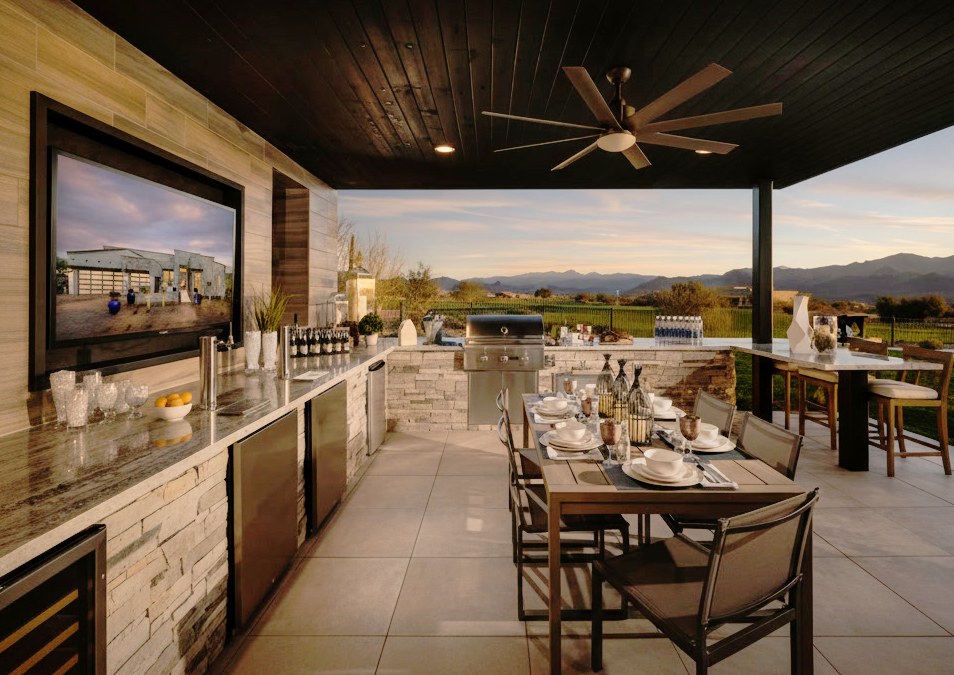
Outdoor kitchen in marble and brick-format marble with sink, barbecue, refrigerator and wooden canopy

Beneath the Canopy, Marble Facing the Hills

The dark wooden canopy frames the landscape like a panoramic screen: beyond the counter, the hills fade into the sunset light and the evening begins. Beneath this built sky, the kitchen works with elegance: marble counters, brick-format marble cladding giving rhythm to the vertical surfaces, the sink, the barbecue and the refrigerator each recessed in its place. The great screen at the side accompanies the evenings, the fan stirs the air, and the table laid at the centre awaits its guests with glasses ready.
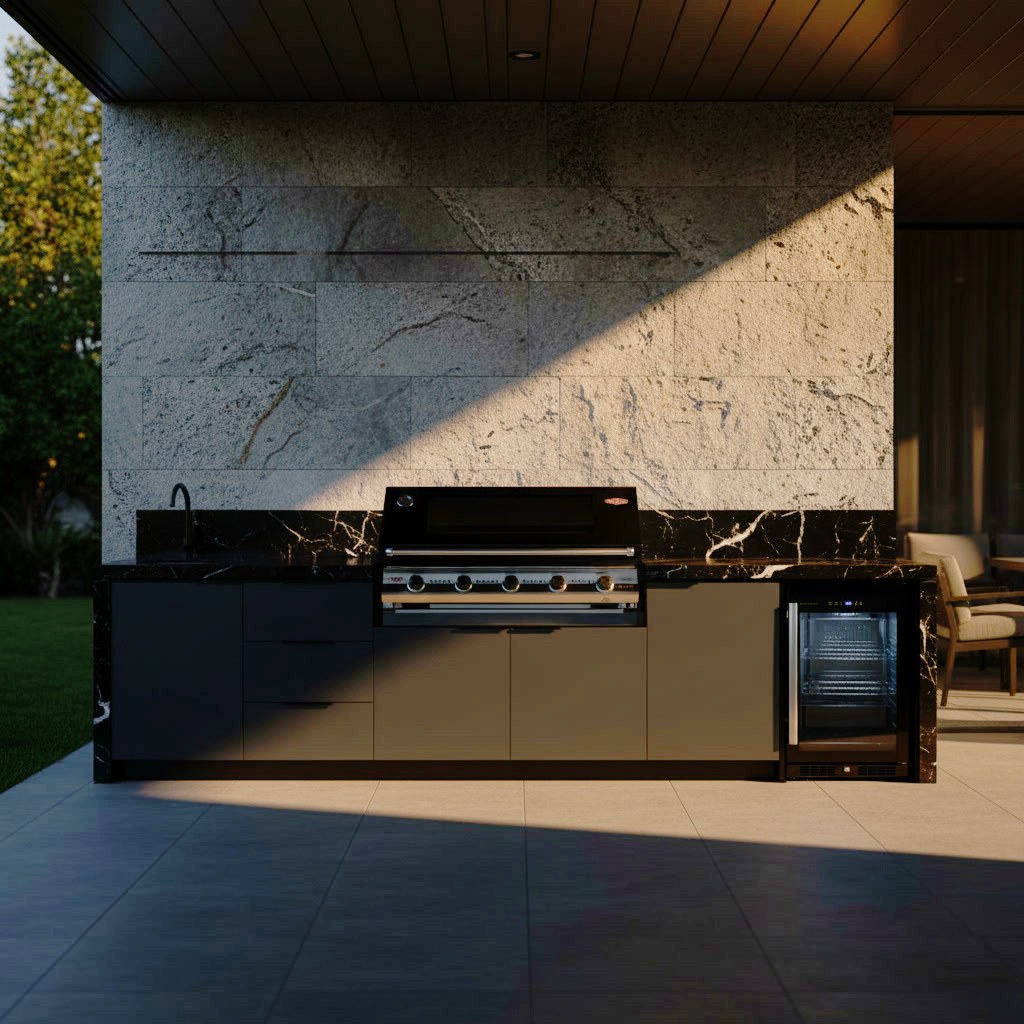
Cabinex Premium series outdoor kitchen with 5-burner BeefEater barbecue, drawers, black sink and fridge display

Premium with 5 Burners, the Brigade Grows

Five BeefEater burners at the centre of the anthracite line: the Premium series in this size allows parallel cooking and true service tempo, the generous grill beneath its black lid and the row of steel controls within reach. At the sides, the kitchen organises the trade: the black sink with its flexible tap, the column of drawers that distinguishes the Premium series, doors guarding provisions and gas bottle, the refrigerated display keeping the evening cool.

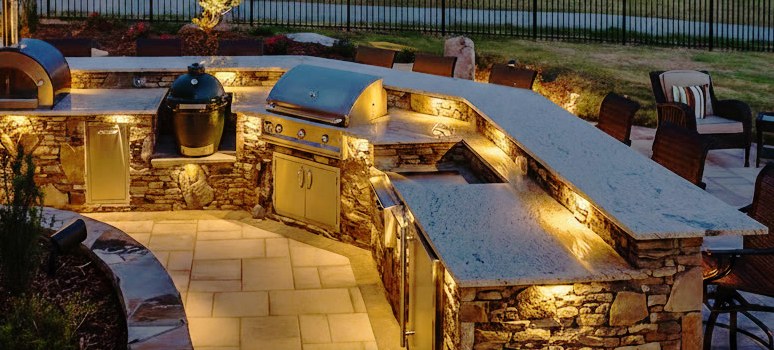
Outdoor kitchen in irregular stone with marble counter, oven, hooded barbecue and warm night lighting

Irregular Stone, the Evening Turns to Theatre

The night lights sculpt the irregular stone and exalt its every protrusion: the base of the kitchen becomes a warm bas-relief winding through the garden, crowned by the marble counter that softly reflects the glimmers. Along the curve work the oven with its mouth at the ready, the hooded barbecue, and the round built-in grill adding its fire to the brigade; further on, the bar receives tall seats for those who watch and raise a glass. Pale paving draws the stage; the dark fencing and the trees close the wings.

Complete outdoor kitchen with sink, wood-fired stone barbecue, bar table with stools and wooden pergola

The Pavilion of Fire, Stone and Pergola

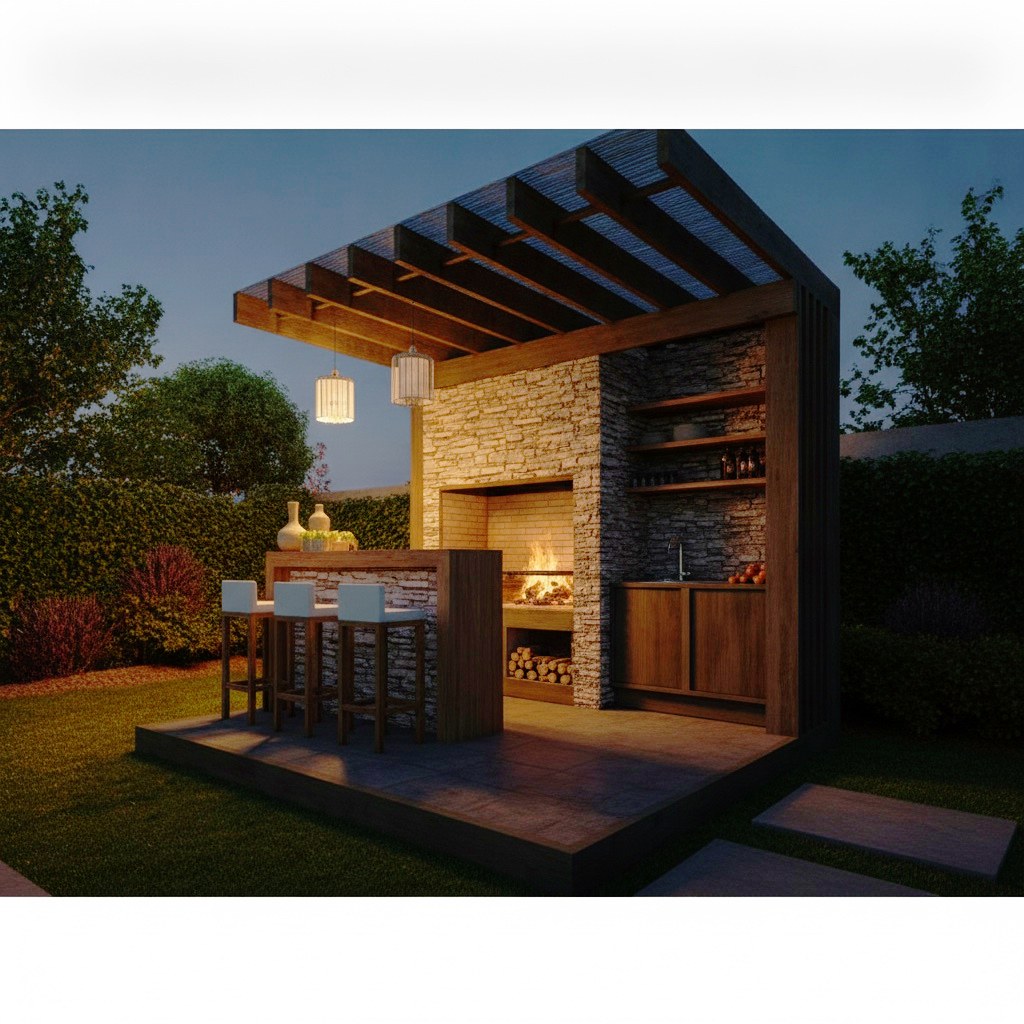
It is a small pavilion devoted to fire: the wooden pergola with its bold beams covers the space, the wall of stone in irregular courses receives the wood-fired barbecue with its mouth at the ready, and before it the bar table with tall stools invites you to sit exactly where everything happens. Hanging lanterns, shelves set into the stone and the service sink complete the equipment, while the lawn breathes around in the sunset light.

Detail of outdoor kitchen with integrated sink, lively grained stone counter and sliding doors

Detail of a Counter: The Grain That Tells

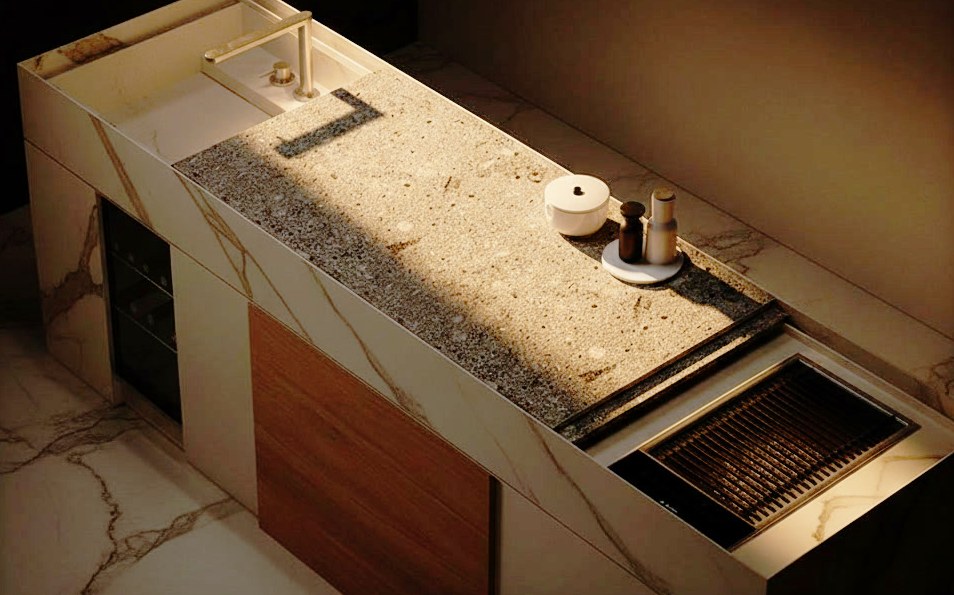
The camera drops to the counter and discovers its grain: a surface of minute pebbles, alive as a polished riverbed, receiving the pepper mills and the cooking grill with material ease. The integrated sink opens in the surface with its flush lid, ready to disappear when a resting surface is needed; below, sliding doors — here in a pale wood tone — glide silently on the cream-coloured base.

Complete outdoor kitchen with gas barbecue, rotisserie, burner, sink and lacquered wood doors

Rotisserie and Refractory stone Beneath the Green

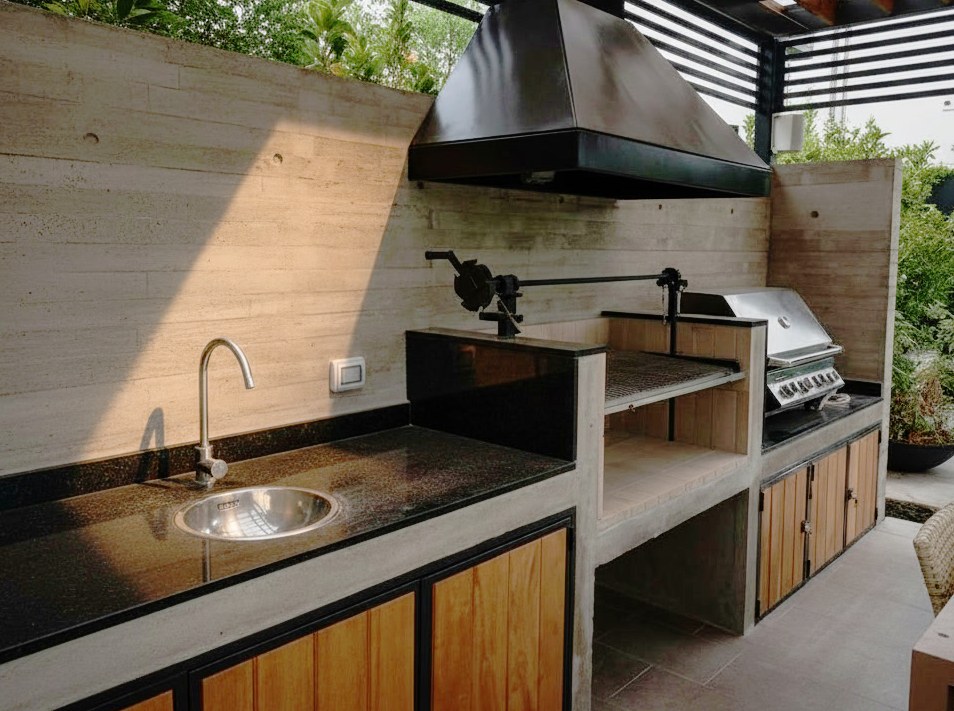
The great black hood descends over the barbecue and its rotisserie, ready to gather the aromas of slow cooking; beside them, the burner and the gas barbecue add their quick fires, while the round sink carved into the black counter awaits the service. The refractory stone structure with its living surfaces carries everything with solidity, and lacquered wood doors warm the bases with their golden grain. Above, the pergola filters the light; around, the green presses in generously.

Outdoor kitchen complete with burner, wine cooler, shelves and worktop, with sliding wooden doors

The Dresser of Fire, Wood and Anthracite

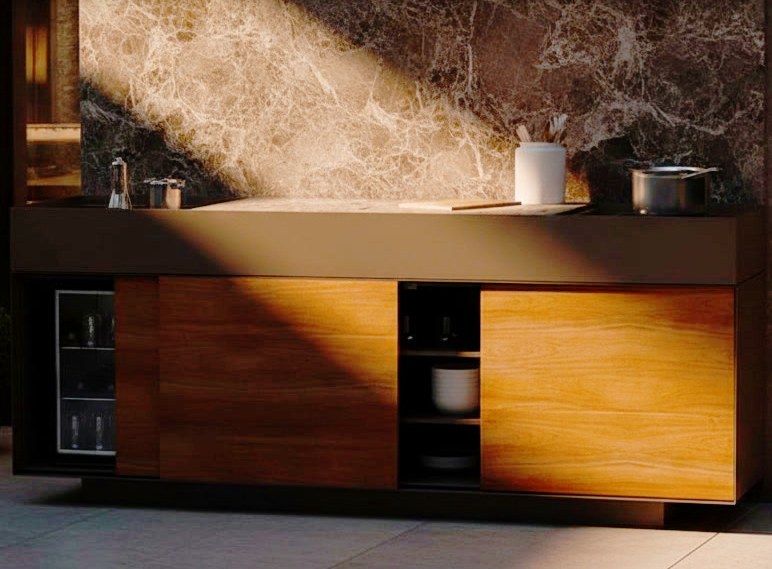
It looks like a designer dresser, and it is a complete kitchen: the anthracite body with its rigorous profile receives great sliding doors of warm wood, opening onto inner shelves and onto the wine rack where bottles rest horizontally, visible as in a small wine shop. On the counter work the burner and the preparation spaces, the pot already on stage and the tray at the ready. Everything glides, everything closes, everything stays in order.

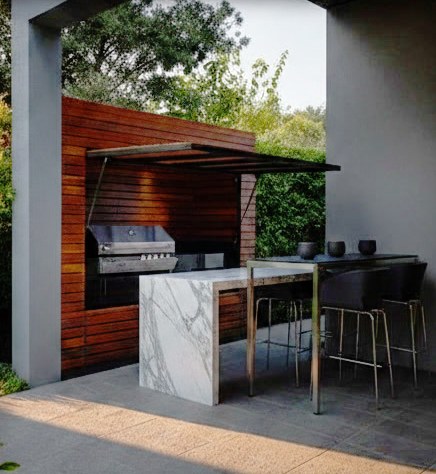
Complete outdoor kitchen with gas barbecue and closable wooden structure, beneath canopy with tall table

Closed It Is Furniture, Open It Is a Kitchen

At first glance it is an elegant piece of slatted wooden furniture beneath the refractory stone canopy: the closed doors protect everything — the gas barbecue, the counters, the tools — and leave the patio its architectural composure. But open the closable structure and the complete kitchen comes into service, ready for the grill and for the guests meanwhile settling at the tall table with its stools. The green around the canopy frames the scene with discretion.

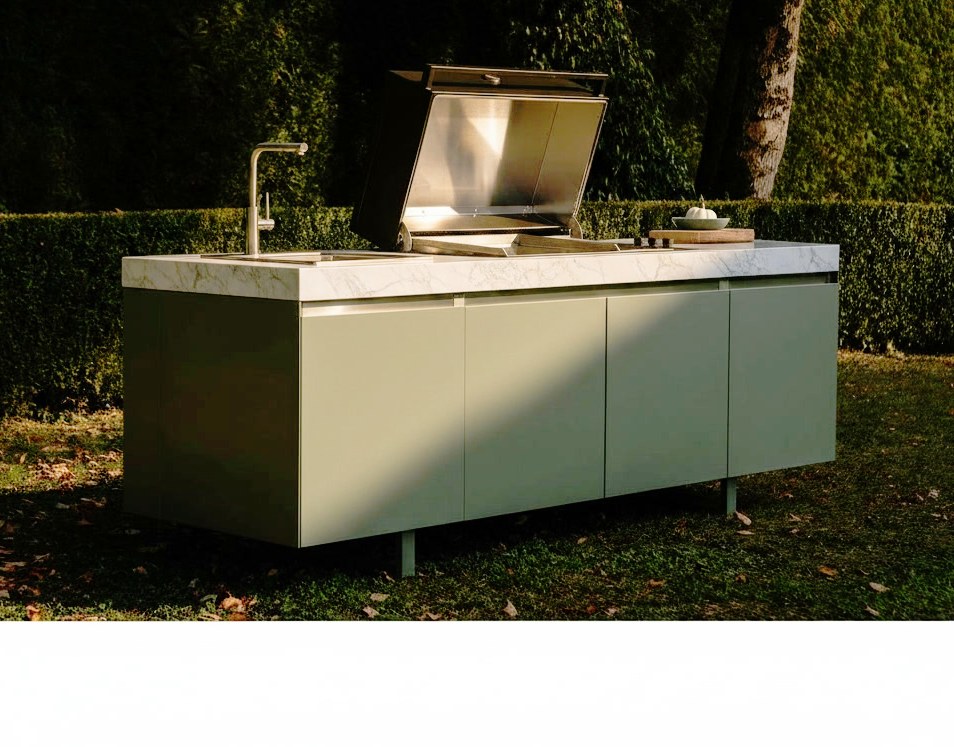
Fogher Agher modular outdoor kitchen in Salvia Antica with open barbecue and sink, in a garden

Agher Salvia Antica: Green at Home in Green

Among hedges and lawn, the Salvia Antica finish proves its vocation: a dusty, gentle green that does not compete with nature but stands beside it, as an equal. The steel lid of the built-in Fògher barbecue is raised and ready; the sink and tap wait at the side, and doors beneath the top close the volume with formal clarity.

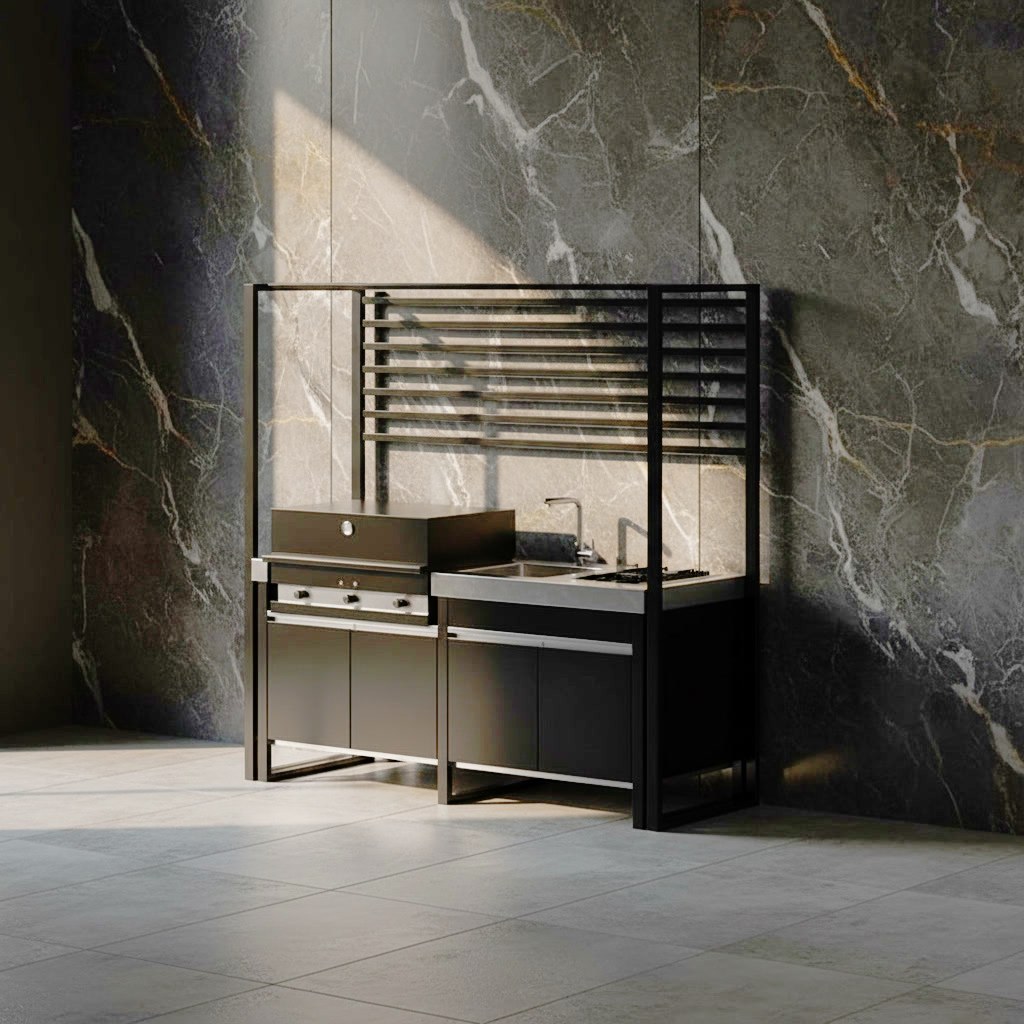
Fogher Larès composition FKC 021 in black with overhead grid structure, barbecue and burner

Larès FKC 021: the Technical Pergola

The FKC 021 composition gives the Larès its third dimension: above the black modules with built-in barbecue and burner top rises the grid structure — a technical pergola in metal, ready for hooks, shelves and lights, turning the kitchen into a small self-standing architecture. The exposed frame lightens the volumes, doors guard the equipment, the steel top works tirelessly.

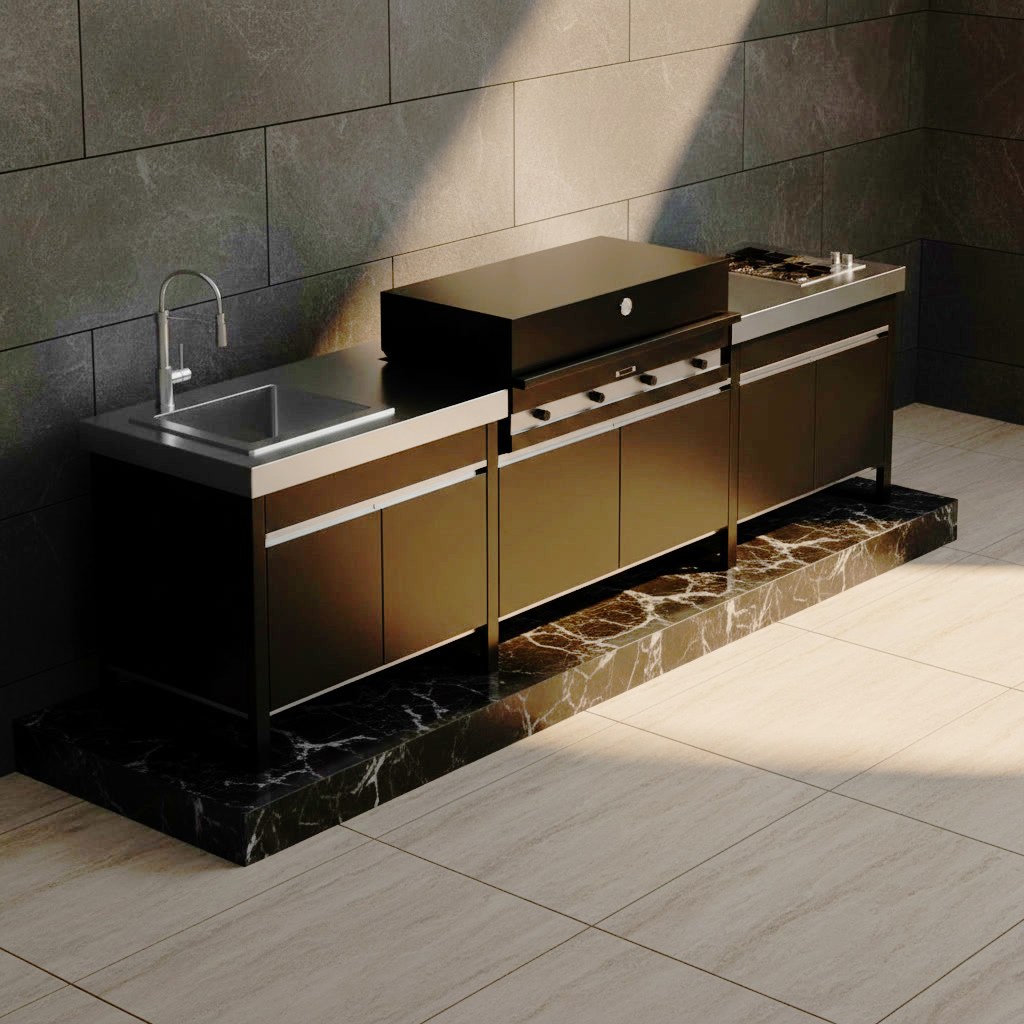
Fogher Larès modular composition FKC 004 in black with sink, built-in barbecue and burner

Larès FKC 004: the Long Line of Service

The FKC 004 composition stretches the Larès into one long, complete line: the sink with its professional spring tap opens the sequence, the built-in barbecue under its dark cover holds the centre, and the auxiliary burner closes the flank. The steel top runs unbroken above black modules and their doors, while the exposed frame lifts everything from the ground with technical lightness. It is the configuration for those who work in sequence — wash, prepare, cook — without a single wasted step.

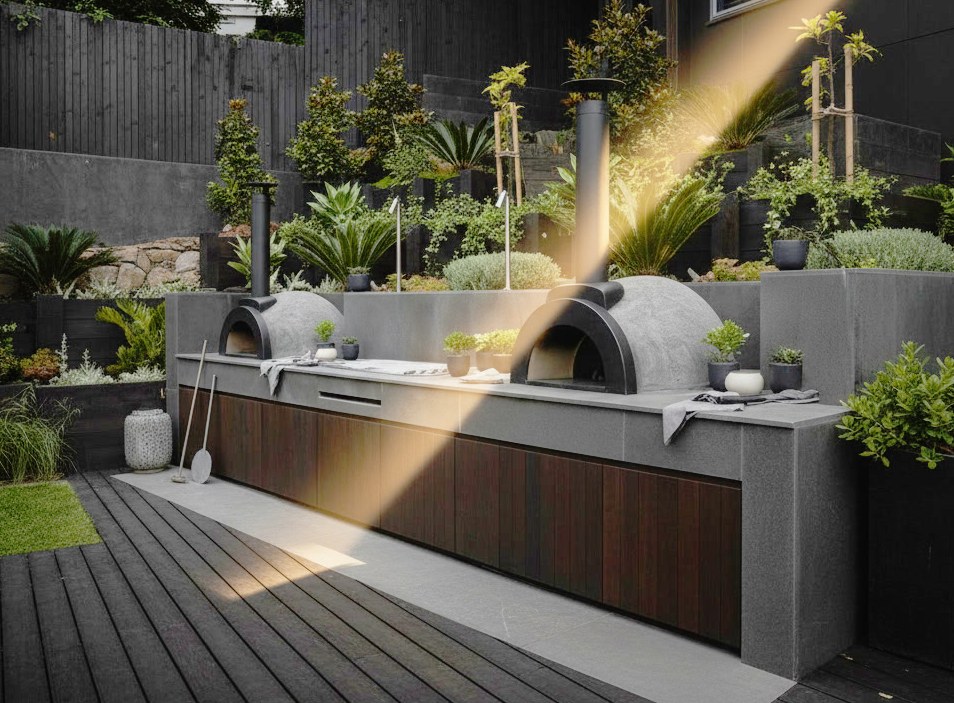
Outdoor kitchen in stone-effect stoneware with exposed dome oven and treated wood doors, among planters

The Roof Garden with the Black Dome

Planters overflow with succulents and herbs, and amid this hanging garden the oven's black dome rises like an almost ancestral presence: its mouth ready for flame, its perfect form promising pizzas and breads as tradition demands. Around it, the kitchen extends its volumes in stone-effect stoneware — textured grey surfaces, resilient and discreet — with treated wood doors adding their measured warmth. Dark decking and buildings blurred on the horizon tell of an urban refuge reclaimed from refractory stone.

The next step

Found your kitchen?

Tell us which one feels closest: we redraw it to your measurements, in the marble or stone you prefer, and send you the design and the quotation free of charge.

Why we do not build in masonry: heat, water and frost

We do not build in masonry because, outdoors, heat and water work exactly where masonry is weakest: in the mortars, the joints, the screeds and the render. A good-quality brick holds up on its own; it is the binders and the glued-on finishes that give way, tested every time the fire is lit and every time it rains. In three lines, documented by technical guides and by the manufacturers' own manuals:

  • Heat. Ordinary cement mortar crumbles above 300-400 °C, and concrete, brick and tiles, expanding by different amounts, tend to tear each other apart every time the fire is lit.
  • Water. Rain and splashes from the sink get in through the joints and stay in the mortar and the screed: a masonry kitchen is a porous mass crossed by many joints.
  • Frost. Water expands by about 9 % as it freezes and widens the cracks at every cycle; why a masonry barbecue can crack after the winter is explained on the page masonry barbecue.

The full reasoning, with sources, is on the parent page masonry kitchens.

An outdoor kitchen in refractory stone: how it is built

The Michelessi outdoor kitchen in the masonry style is made of refractory stone blocks that interlock dry, with no mortar and no cement. Refractory stone is the material of ovens: by definition a refractory material withstands temperatures above 538 °C for long periods (ASTM C71). Manufacturers declare a resistance above 1,000 °C; aluminosilicate refractories for ovens reach 1,100-1,200 °C. Oven firebricks also cope well with thermal shock. The assembly of the structure is dry: no mixing water, no days waiting for it to dry, no render to redo.

Interlocking dry means three concrete things:

  • the blocks expand freely: there is no rigid joint holding them still while the oven heats up, so the very point where a structure usually splits is missing;
  • water is not trapped: without mortars, screeds and render, the very materials that frost destroys are simply not there; the blocks are protected by the worktops and the finishes;
  • each block is replaced on its own: if a piece chips, it comes out and a new one goes in, without demolishing the kitchen. With masonry that is far harder.

The structure is made of refractory stone blocks; steel is used for grills, sink and technical parts. On top of the structure we lay the stone worktop cut in our own workshop; at the front, doors in wood for outdoor use; inside, the barbecue and the oven with their cooking chamber in refractory stone. In the wood-fired oven the dome and the arch are in refractory bricks, assembled according to the refractory manufacturer's instructions; all the structure around them is dry-laid. The interlocking system is our own method: in the barbecue market, dry laying is prescribed only for the parts in direct contact with the fire; we have extended it to the whole structure of the kitchen.

On the practical side, for anyone who has to choose, three lines compare the masonry kitchen, the prefabricated concrete kit and our dry-laid structure:

What happens outdoorsMasonry kitchen (blocks and mortar)Prefabricated concrete kitDry-laid refractory stone (Michelessi)
RepairThe damaged part often has to be demolished and rebuiltDepends on the model: elements joined with adhesive or tie rodsThe single block is replaced
Building siteWet: mixes, drying days, dustAssembly with adhesives and curing timesDry: interlocking, spirit level and wedges
Over the yearsGrout, seals and render to check and redo; repairs are hard once cracks appearWater-repellent paint prescribed by the makersBuilt to last a lifetime: no cement joint to redo, every block can be replaced

The full table, with heat, water, frost and faux masonry as well, is on the page masonry or refractory stone.

With barbecue, wood-fired oven, sink and fridge: the modules

The kitchen with barbecue and wood-fired oven is the classic composition of what people search for as an "outdoor masonry kitchen"; we compose it from refractory stone modules that combine to fit the space and the way you cook.

  • Wood or charcoal barbecue with a cooking chamber in refractory stone, a steel grill and a hood; a rotisserie on request. We go into it on the page masonry barbecue.
  • Wood-fired oven with dome and floor in refractory material, an arched mouth and a log store below: for pizza, bread and slow cooking. The dedicated page is masonry wood-fired oven.
  • Gas hob set into the stone, for everyday pans and pots.
  • Sink in stone or steel, with tap and waste connected to the garden supply.
  • Outdoor fridge in a ventilated recess, with the clearances the manufacturer specifies.
  • Larder, drawers and log store behind doors in wood for outdoor use or left open.
  • Worktop in granite, quartzite, sintered stone, travertine or marble, with an upstand where needed.

Which worktop for an outdoor kitchen: granite, quartzite, sintered stone, travertine or marble

Outdoors the worktop works under rain, frost, sun, salt air and cooking fats, and not all stones react in the same way. Granite and quartzite are the safest choices: compact, low in absorption, not very sensitive to temperature swings and to the acids of lemon and wine. Sintered stone is ultra-compact: it does not absorb and it resists scratches. Travertine is the Roman stone of the outdoors, warm and textured, and asks for a water-repellent treatment renewed over time. Marble remains the most beautiful and we recommend it with a honed or brushed finish, a water-repellent treatment every season and, if possible, under a pergola: with frost and sharp temperature swings marble can crack, so it should be chosen knowingly. You can see the stones one by one on the natural stones page.

The stone of the worktop and the refractory stone of the structure are two materials with two jobs: the worktop has to be beautiful and resist stains, the structure has to withstand fire and the years. That is why under the worktop, in marble or in any other stone, there is always the structure of refractory stone blocks. The care of marble and of the other stones is explained at length on the stone kitchen page.

Masonry kitchen for the garden, the terrace, the poolside or the seaside: the refractory stone version

The garden is its natural place: the kitchen rests on a solid, level base, with the fire zone facing away from walls and plants. On a terrace or balcony what counts is the load on the slab: a dry-laid structure, with no screed and no render, is carried up in pieces and sized precisely; before the design we have the load and the smoke outlet assessed. At the poolside we choose worktops and finishes suited to chlorine and wet conditions, with non-slip surfaces around them. In a house by the sea, salt air is hard on steel and on porous stones: granite, quartzite and sintered stone are the safest choices.

An outdoor kitchen is truly used when it has a roof: against the July sun, the August downpour and the evening dew. Our technical office designs the kitchen and the bioclimatic pergola together, to the same dimensions, and the same team installs them.

Design and dimensions: how much space is needed

For a complete outdoor kitchen, with barbecue and worktop, the trade guides indicate a minimum length of 135-150 cm; at 3 metres the kitchen becomes comfortable and the wood-fired oven finds its place too. The worktop height is the same as indoors, 85-95 cm from the ground, chosen on the height of whoever cooks.

The design starts from the site visit: we measure the garden or the terrace, check the base, water, gas and power, the direction of the wind and the view from the house. Then we draw the kitchen in 3D and correct it with you before cutting the first stone; the complete route, from the site visit to installation, is told on the parent page masonry kitchens. For standard measurements and for straight, corner, island and peninsula compositions we refer you to the page on masonry kitchen layouts and, for the method, to the guide how to design a masonry kitchen.

Modern, rustic or small: the style of the outdoor kitchen

Light refractory stone left exposed, with a grey sintered stone worktop and flat doors, gives a modern, linear outdoor kitchen in the masonry style. With travertine, framed wooden doors and the oven with its arched mouth it becomes the rustic kitchen of the farmhouses of Lazio. In a small space one module with a barbecue and a resting surface is enough, against a wall or in a corner. We describe the styles on the pages modern masonry kitchen and rustic, country and classic; the stone kitchen page explains the differences between the stones.

Permits for an outdoor masonry kitchen

An outdoor kitchen that simply rests in place, with no building work and no change to the structure of the house, normally counts as free building activity in Italy; when a fixed structure is built, a flue is installed or the façade is altered, the municipality may require a notice or a building permit, so a fixed kitchen should be assessed case by case. In a block of flats the building regulations and the appearance of the façade also count, as do the distances of the smoke from the neighbours' windows. The rules change from one municipality to another and in historic centres: before building, ask your surveyor or the municipal technical office.

Prefabricated outdoor kitchen kit or made to measure?

The prefabricated kits sold by the DIY chains are modules in concrete or cement-based aggregate to be glued, with fixed sizes and a finish to be painted. The assembly manuals of several makers prescribe water-repellent paints and winter covers and describe micro-cracking as normal settling. A made-to-measure kitchen in refractory stone blocks starts from your measurements, from the stone worktop chosen from the slab, from the barbecue and the oven you really use, and our own team installs it. The price depends on the metres, the stone of the worktop, the built-in modules and the structure: we discuss it without invented figures on the page how much does a masonry kitchen cost.

Care through the seasons

Refractory stone too wants a fire that grows slowly: the first times the oven and the barbecue are lit, the fire is built up gradually, with a moderate flame until the structure is evenly warm. After cooking, fats are cleaned off with water and a neutral detergent; marble and travertine receive their water-repellent treatment every season, as we explain on the stone kitchen page; in winter the fire parts are covered, without sheets that seal everything and trap moisture. The dry-laid structure has no grout to regrout and no render to redo.

Where we build it and where we install it

The kitchen is born in the workshop in Aprilia, on the Via Pontina at km 45.350, between Rome and Latina, where Michelessi has worked stone since 1976; the showroom is in the same place. The site visit in the garden or on the terrace and the quote are free in Rome, in the Castelli Romani, along the coast, in Latina and throughout Lazio; we install with our own team throughout Italy and follow projects abroad as well. The areas we serve are on the page masonry kitchens in Rome, Latina and Lazio; the other questions are on the questions and answers page and, for the overall picture, on the parent page masonry kitchens.

The quote is free.

Frequently asked questions

Frequently asked questions

What is an outdoor masonry kitchen?

It is a fixed kitchen built on site for the garden or the terrace, with a barbecue, a wood-fired oven, a sink and a worktop set into a structure of blocks. In everyday language masonry means bricks or blocks bound with mortar and cement. Michelessi, in Aprilia near Rome, builds the same kitchen with refractory stone blocks interlocked dry and stone worktops.

Does an outdoor masonry kitchen last?

It depends on the materials it is made of. In a masonry kitchen, cement mortars, screeds and render suffer from the heat of the fire and from water that freezes: that is where cracks and lifted tiles begin. A structure of dry-laid refractory stone blocks has no cement joints to split and every block can be replaced on its own: it is built to last a lifetime.

How do you protect an outdoor kitchen in winter?

The fire parts, the barbecue and the oven, are covered in winter, but without sheets that seal everything: under a closed cover moisture stays trapped. The marble or travertine worktop receives its water-repellent treatment every season and, if possible, sits under a pergola. A dry-laid structure has no cement joints where water can freeze; why a masonry barbecue cracks after the winter is explained on the masonry barbecue page.

What is refractory stone and why do you use it for outdoor kitchens?

A material is refractory when it withstands temperatures above 538 °C for long periods (ASTM C71): it is the material of ovens and fireplaces. Manufacturers declare a resistance above 1,000 °C; aluminosilicate refractories for ovens reach 1,100-1,200 °C. We use it for the whole structure of the outdoor kitchen, not just for the oven chamber, because it is born to sit next to the flame, copes with thermal shock and interlocks dry, without cement. In the wood-fired oven the dome and the arch are in refractory bricks, assembled according to the refractory manufacturer's instructions; all the structure around them is dry-laid.

Do I need a permit for a masonry kitchen in the garden or on the terrace in Italy?

A kitchen that simply rests in place, with no building work, normally counts as free building activity; a fixed structure, a flue or a change to the façade may require a notice to the municipality, and a fixed kitchen should be assessed case by case. In a block of flats the building regulations and the distance of the smoke from windows also count. Rules change from one municipality to another: ask your surveyor before building.

How much space does an outdoor kitchen with a barbecue need?

Trade guides indicate a minimum length of 135-150 cm for a barbecue and a resting surface; at 3 metres the kitchen also takes the wood-fired oven and the sink. The worktop height stays the same as indoors, 85-95 cm. During the site visit we measure the space and draw the kitchen in 3D before building it.

Which worktop for an outdoor masonry kitchen: marble, granite or sintered stone?

Granite and quartzite are the safest choices: compact, low in absorption, not very sensitive to frost and acids. Sintered stone does not absorb and it resists scratches. Travertine and marble are the most beautiful and ask for a water-repellent treatment every season; marble can crack with frost, and we recommend it under a pergola.

Can a masonry kitchen go on a terrace?

Yes, with two checks: the load on the slab and the smoke outlet of the barbecue. A structure of dry-laid refractory stone blocks, with no screed and no render, is carried up in pieces and sized precisely; before the design we have the load assessed by a surveyor and check the building regulations.

Is a prefabricated outdoor kitchen kit better than a made-to-measure one?

The kit is in concrete or cement-based aggregate, in fixed sizes, to be glued and painted; the manuals of several makers prescribe winter covers and treat micro-cracking as normal. The made-to-measure kitchen in refractory stone starts from your measurements, from the worktop chosen from the slab and from the modules you really use, and our own team installs it.

Outdoor kitchen in refractory stone or stainless steel?

Stainless steel is light and hygienic, but it burns in the sun, scratches and must be chosen with care in salt air. Refractory stone gives a solid kitchen that stores the heat of the oven and gives it back evenly, with the look of a masonry kitchen. We use each where it works best: the structure is in refractory stone blocks and the worktops in stone; steel is used for grills, sink and technical parts.

How much does an outdoor masonry kitchen cost?

We do not publish price lists because the price depends on several things: the metres of worktop, the stone chosen and its thickness, the structure and the built-in modules, from the barbecue to the fridge. Two kitchens of the same size can cost very differently. The quote is free and starts from a plan and a few measurements.

Do you make site visits for an outdoor kitchen in Rome and Latina?

Yes. The workshop and showroom are in Aprilia, on the Via Pontina, between Rome and Latina; the site visit in the garden or on the terrace and the quote are free in Rome, in the Castelli Romani, along the coast, in Latina and throughout Lazio. We install with our own team throughout Italy and follow projects abroad as well.

Call us WhatsApp