Skip to content
Made in Italy

Masonry kitchens

Masonry Barbecue? No, Refractory Stone Blocks, Without Cement

A masonry barbecue is a fixed outdoor barbecue built from bricks or blocks and cement, whose mortar joints tend to crack with heat and frost: Michelessi SRL, stonemasons in Aprilia since 1976, does not build it in masonry but from dry-fitted blocks of refractory stone, with a cooking chamber in refractory bricks and worktops in stone. It is the same fixed barbecue, with a structure that has no mortar or cement to crack, built to last a lifetime.

A kitchen like this, made to measure for you.Free, no-obligation quotation · free site survey in Lazio · 3D design · since 1976

What a masonry barbecue is and what Michelessi builds in its place

A masonry barbecue is a fixed outdoor barbecue built on site from bricks or blocks bound with mortar or cement, and Michelessi SRL, stonemasons in Aprilia since 1976, builds it by a different method: dry-fitted, interlocking blocks of refractory stone. It is the same barbecue, with a base, a cooking chamber with the grill, a fire floor and a hood that collects the smoke; what changes is what it is made of. The structure is in refractory stone blocks, the cooking chamber is lined with refractory bricks and the worktops are in stone; steel is for grills, sinks and technical parts such as the hood, which in the country models is in refractory stone. What you call a masonry barbecue, we build not in masonry but in refractory stone.

The difference does not show in a photograph, but it decides how long the barbecue lasts. In a masonry barbecue, heat and water work on the mortar joints and on the cement, and season after season they tend to open them up. The structure of a refractory stone block barbecue has no mortar to shrink and no cement to crumble in the fire, and every block is free to expand: it is built to last a lifetime. The cooking chamber in refractory bricks and, in the complete kitchens, the dome and the arch of the oven are assembled according to the refractory manufacturer's instructions; the whole structure around them is dry-fitted. The full comparison is on the page masonry or refractory stone.

Outdoor kitchen in rough stone and granite with professional barbecue, counter and stools under a lit pergola

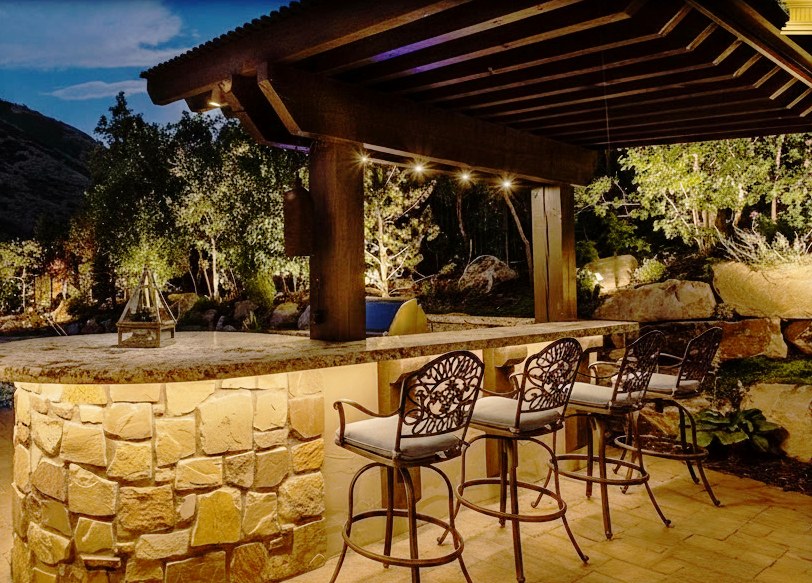
Golden Stone Beneath the Pergola, by Night

Night kindles the scene and the stone answers in tones of gold: the curved counter, built in rough stone, runs beneath the dark-beamed pergola while warm lights sculpt each block. Above, the granite top spreads its dark, patient surface; stools with wrought-iron scrolls await the guests, and the professional barbecue works in the shelter of the structure. Beyond the perimeter, the lit garden climbs towards the rocks like a small natural amphitheatre.
Custom terrace kitchen with barbecue, sink and burners under a white pergola, dining table and sea view

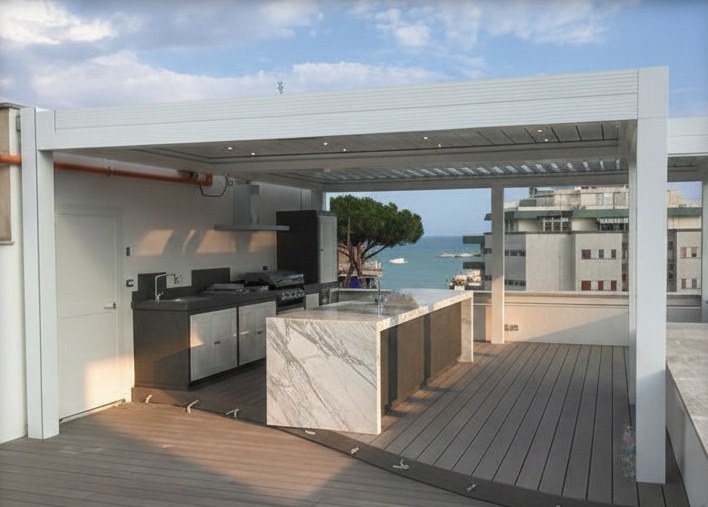
A Terrace over the Sea, the Table Already Set

The white pergola with its adjustable louvres governs the light, and beneath it the kitchen stretches its grey line along the parapet: barbecue, sink, burners and serving counters, all turned towards the horizon where the sea closes the view. At the centre of the timber-decked terrace, the table is already open, waiting for chairs and company.

Poolside stone and steel kitchen counter with steel barbecue, wine cooler and aqua-green parasols

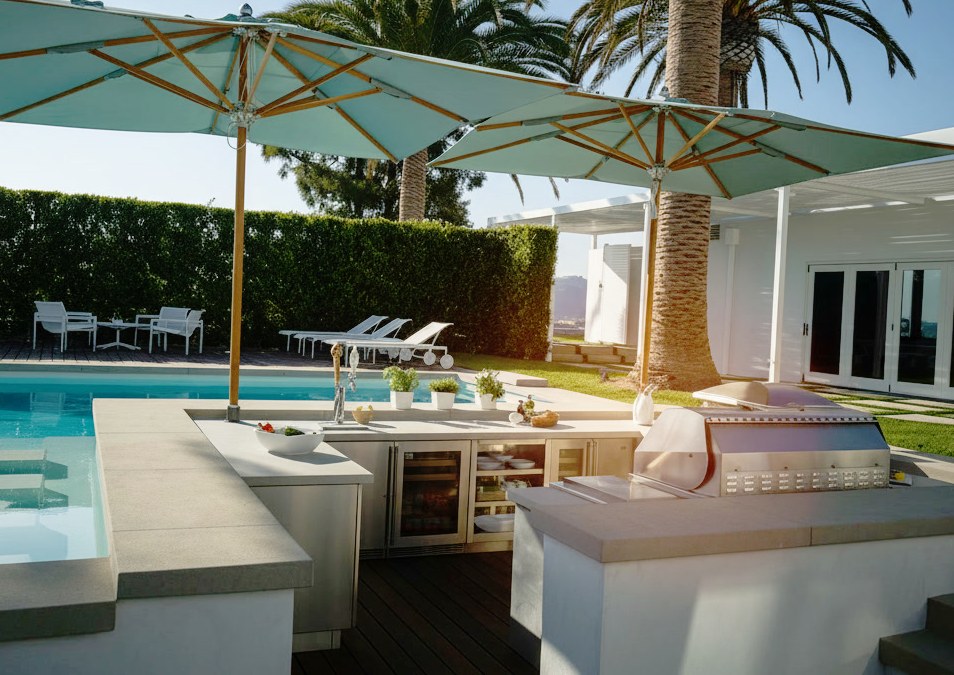
Stone and Steel Beneath the Parasols

Aqua-green parasols open their corollas above the pool's edge, and the kitchen works in their shade: pale stone counters spread across white volumes, the steel barbecue lifts its lid with the grill ready, the glass-fronted wine cooler keeps its chill in view. Beyond the water, a white villa and a palm complete a scene of perfect holiday; the sunloungers await the after-lunch hour.

Outdoor kitchen with marble cladding and steel worktop, gas barbecue and glass-front fridge under a pergola

The Marble Kitchen, Elegance Beneath the Pergola

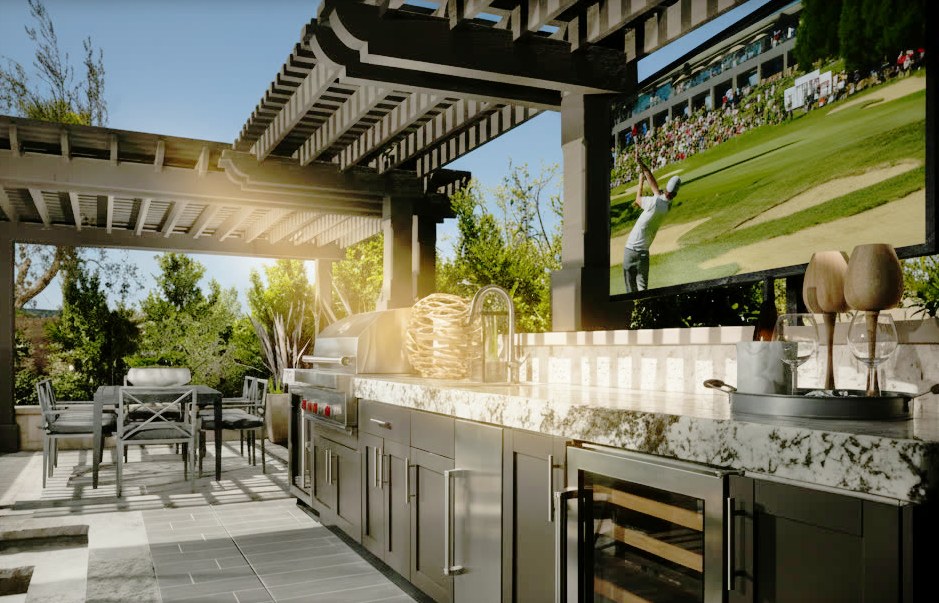
Beneath the woven shade of the pergola, the Marble Kitchen extends its line along the terrace: marble cladding with restless veining wraps the modules like a tailored suit, while the steel worktop runs above them, polished and professional. The glass-front refrigerator reveals bottles chilling; the semi-professional gas barbecue waits behind its clean lines. All around, the scene is that of an open-air salon: the screen framed in wood, the seating, the green landscape opening beyond the balustrade.

Outdoor island kitchen in marble with dry-stone base, round built-in barbecue and terracotta floor

The Marble Island on Red Terracotta

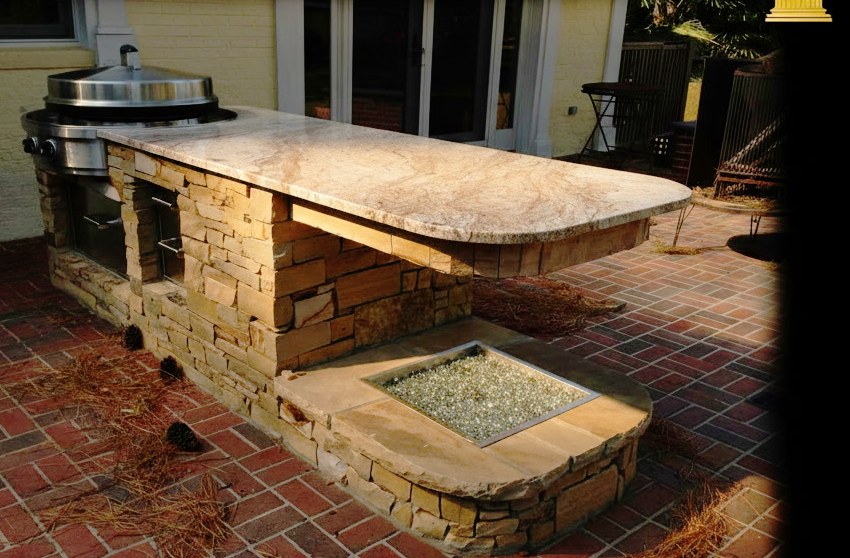
The marble slab spreads over the stone base like a precious mantle: thick, shaped with a soft edge, crossed by clouds and veining that no imitation could ever invent. Below, dry-laid stone blocks tell of patient construction; above, the round built-in barbecue opens its steel lid, ready for service. The red terracotta floor, laid in herringbone, warms the entire scene, while in the foreground the small fire bowl awaits the evening.

Outdoor kitchen built in veined marble with thick worktops and built-in barbecue, on a wooden terrace

Marble Becomes Kitchen, Vein After Vein

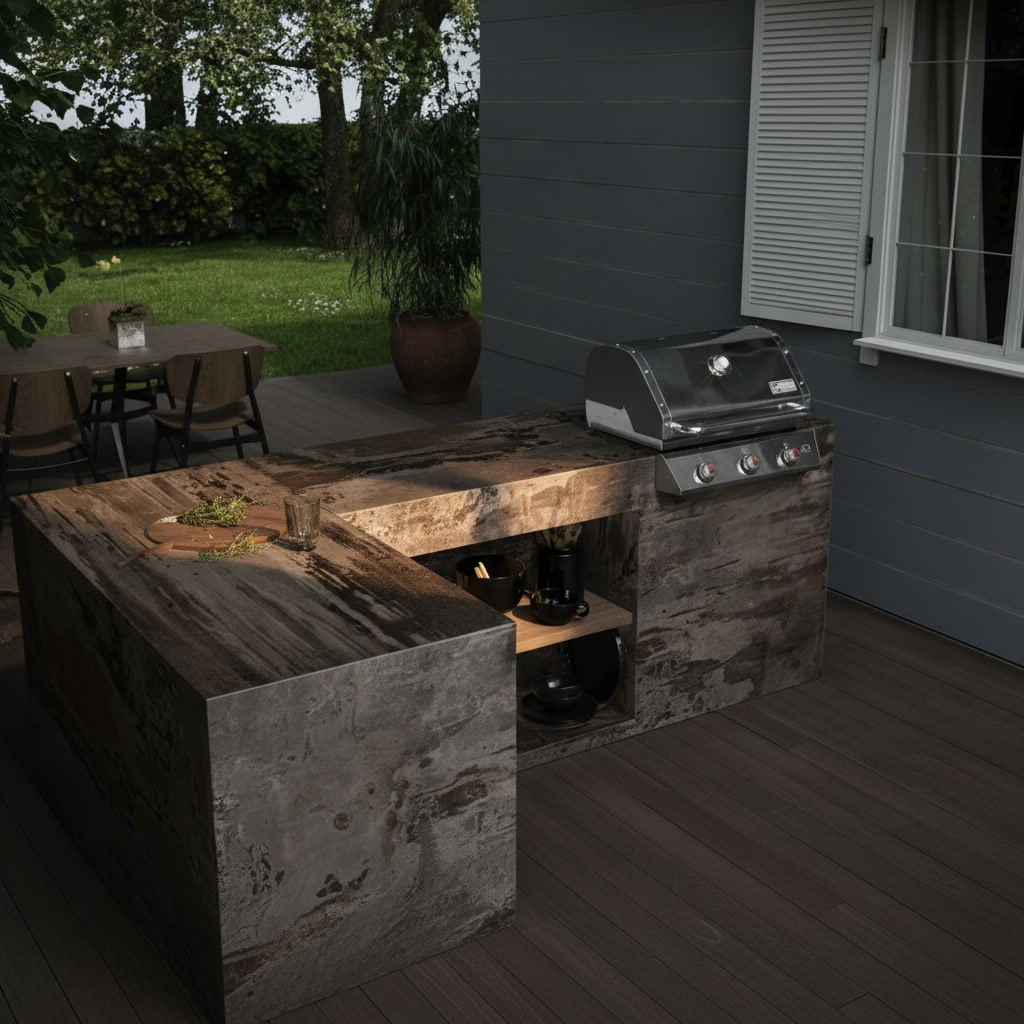
Here marble is no detail: it is the entire kitchen. Slabs veined in brown and grey, stirred like a landscape seen from above, clothe bases and worktops in a single narrative of stone; the generous thickness of the tops declares the project's substance, and the built-in barbecue opens in the material like a window of steel. The wooden terrace and the grey-toned house form a sober frame, leaving the veining as absolute protagonist.

Outdoor kitchen with dark Dekton wall, wood-slat base, gas barbecue and steel hood

Tech Kitchen, Dekton and Wood in Dialogue

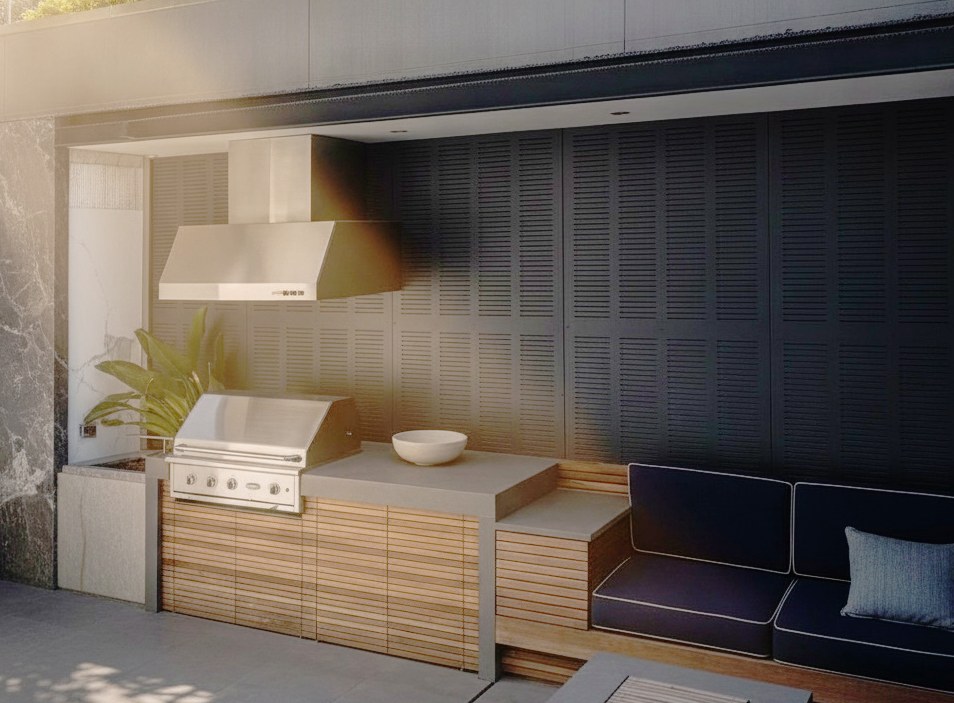
The graphite-toned Dekton wall rises compact and technical — the great ultra-compact slab that fears neither scratches, frost nor sun — and the kitchen answers with the warmth of the wooden slats that clad its base. Between them, the stainless gas barbecue works beneath the professional hood descending from the wall; to the side, a bench faced in blue tiles adds an accent of colour that surprises. Above, a planter lets the green spill down.

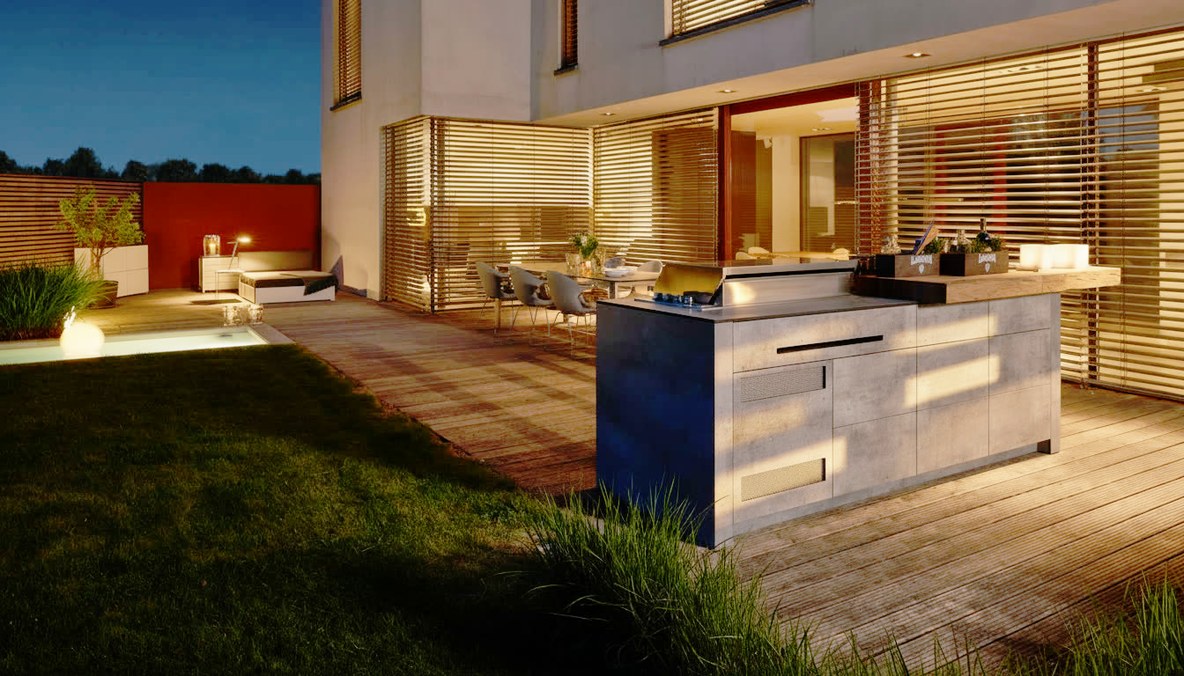
Stone-effect outdoor kitchen island with barbecue on a wooden deck, modern house lit at dusk

A Refractory stone-Effect Island on a Summer Evening

Dusk stains the sky a deep blue and the house lights up behind: great warm windows, horizontal timber, the pool reflecting the last light. In the foreground, on the broad wooden deck, the stone-effect kitchen island waits with the barbecue already prepared and bottles on the counter — a compact, tactile block that seems sculpted in a single gesture. The scene has the suspended quality of the best summer evenings, when the air stands still and dinner outdoors becomes a ritual.

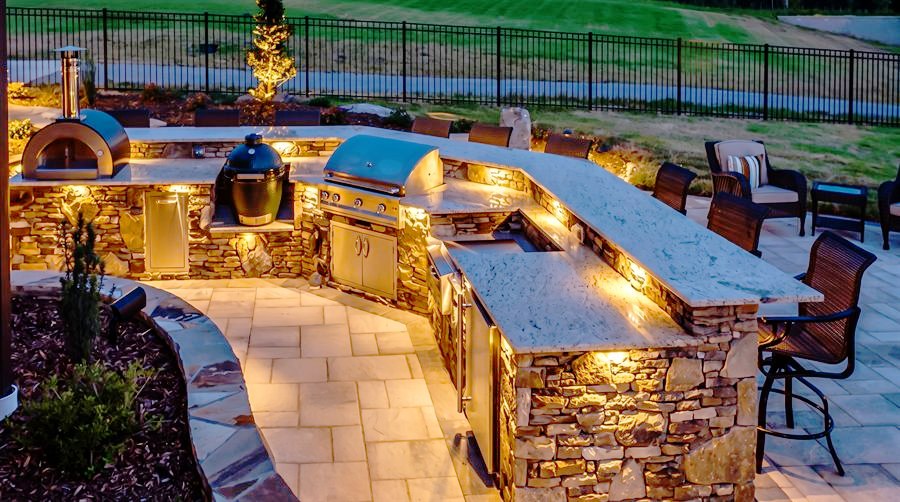
Project vision: large curved stone outdoor kitchen with illuminated granite worktops, pizza oven and barbecue, at night

The Stone Curve That Lights Up the Night

Night is its moment: the great curved stone kitchen ignites with warm lights that run beneath the granite worktops and turn the garden into a convivial amphitheatre. The composition describes a broad, generous curve — the pizza oven at one end, its mouth ready; at the centre the steel barbecue and its hood; all around, the counter inviting guests to draw near with a stool and a glass.

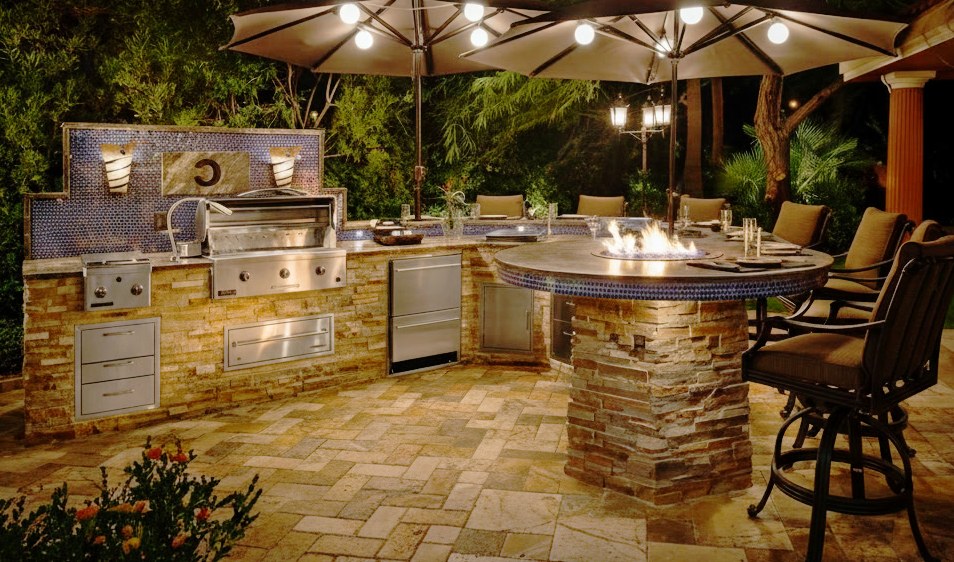
Outdoor stone kitchen with hooded gas barbecue, minifridges and round table with central fire pit, by night

The Convivial Fire Pit Amid Stone and Parasols

At the centre of the round stone table, the flame of the fire pit dances and gathers the tall seats around it: this is where the evening ignites. Behind, the kitchen works along its counter clad in exposed stone: the gas barbecue with its illuminated hood, steel minifridges glinting beneath the counter, lights raining softly from the open parasols like private constellations. Pale stone paving binds every element into a single open-air salon.

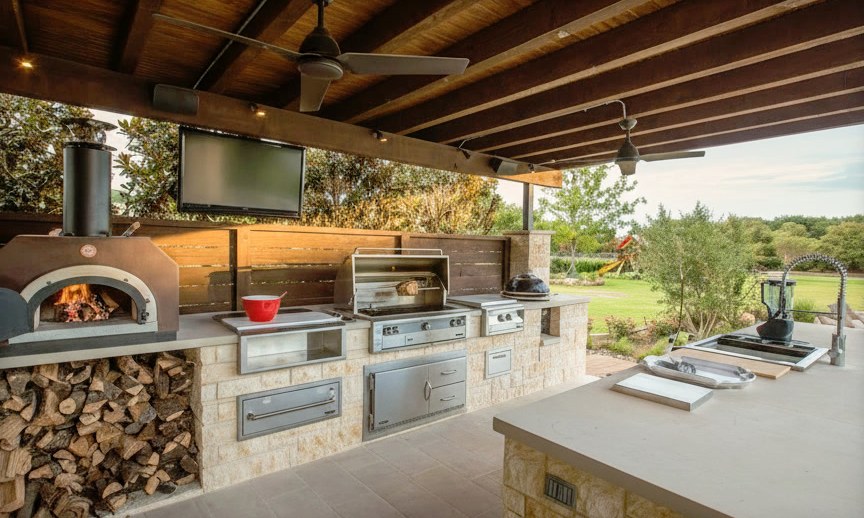
Outdoor stone kitchen with wood-fired oven, burners, barbecue, island with sink and wooden canopy

The Oven, the Firewood and the Countryside Beyond

The wooden beams of the canopy draw the ceiling of this open-air room, and beneath them every instrument is in its place: the wood-fired oven with its dark dome and logs stacked in the bay below, burners and barbecue in file along the counter, the fryer for feast days, and at the centre the island with the sink governing the service. The pale stone base gives solidity and character, while beyond the edge of the roof the countryside spreads its green to the distant trees.

Minimal budget outdoor kitchen with gas barbecue, worktop and aluminium doors beneath an awning

Minimal Beneath the Awning, Between Stone and Wood

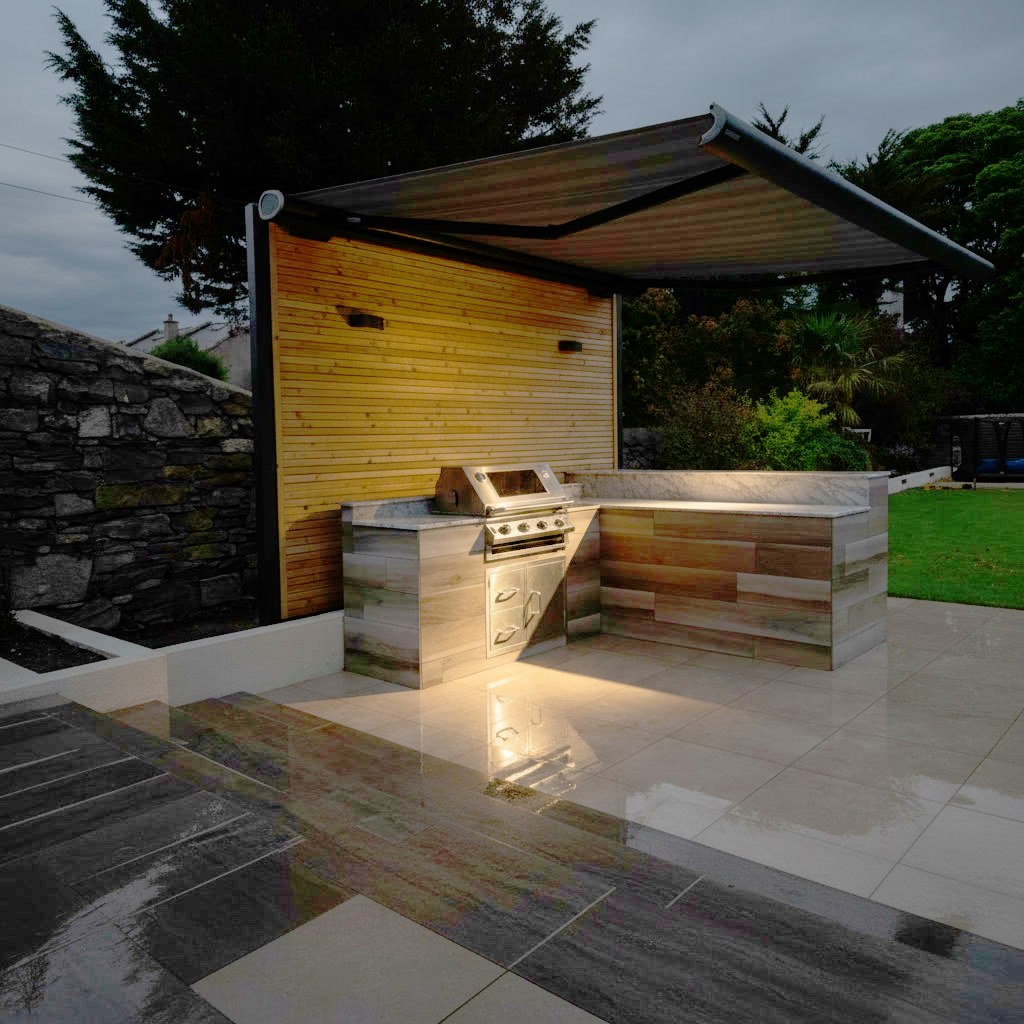
The great awning opens above the kitchen like a protective wing, and beneath it the minimal composition stretches between the wooden slat wall and the dry-stone wall: modules in a material finish, grained like brushed wood, the essential worktop, the steel gas barbecue presiding at the centre with its lid at the ready. Beyond the edge of the polished patio, the lawn spreads its green.

The next step

Found your kitchen?

Tell us which one feels closest: we redraw it to your measurements, in the marble or stone you prefer, and send you the design and the quotation free of charge.

Why a masonry barbecue cracks, above all after the winter

A masonry barbecue cracks where heat and water do their work, that is in the mortar joints and the cement, which are made neither for fire nor for water. In short: bricks, mortar and cement expand by different amounts at every lighting and, when rigidly bound together, they tear each other apart; ordinary cement mortar crumbles above 300-400 °C. For refractories, the manufacturers declare a resistance above 1,000 °C; aluminosilicate oven refractories reach 1,100-1,200 °C. Kit manuals even forbid high-strength and fast-setting cements near the fire, because they do not let the elements expand, and some of them declare micro-cracks normal: in a cement system the crack is expected. The full picture of heat, water and frost is on the page masonry or refractory stone.

The "after-winter" crack: frost, spring, first lighting

It is the typical failure of an outdoor barbecue, and it happens in three moves. Cement and mortars are porous: they absorb rain, condensation and washing water and hold it in the joints. When that water freezes in winter it expands by about 9 per cent and pushes from inside; with every freeze-thaw cycle the micro-crack grows, even if it cannot be seen from outside. In spring, at the first lighting, the structure heats up and expands: if there is still water in the pores it turns to steam and opens the cracks at once, and the winter's micro-cracks become obvious. This is why the barbecue looks sound in late autumn and cracked at the first spring grill.

How to recognise it, and how to prevent it

  • The sign: fine lines along the joints, at the base of the cooking chamber and under the hood, which widen at the first lighting after the winter break.
  • The cover and the drain: a cover that shelters from the rain but lets air circulate, since sealed plastic sheets trap damp, and a drain hole in the firebox so that water does not stand and freeze at the bottom.
  • The restart: at the first spring lighting, a moderate, growing fire, never a lively fire on a structure that is still damp.

In a barbecue of dry-fitted refractory stone blocks the structure has no mortar joints or screeds to hold water, which is where the "after-winter" crack begins; the cover, the drain and the gradual restart remain valid, because they serve every outdoor barbecue.

Masonry barbecue, cement kit or dry-fitted refractory stone: the comparison

There are three ways to have a fixed barbecue in the garden: build it in masonry with bricks and mortar, assemble a prefabricated cement kit, or compose it from dry-fitted blocks of refractory stone, as Michelessi does in Aprilia. The table compares the three systems on the points that matter over the years.

AspectMasonry barbecue (bricks and mortar)Prefabricated cement kitMichelessi barbecue in dry-fitted refractory stone
StructureBricks or blocks laid on siteCast cement elements to be gluedInterlocking refractory stone blocks, no mortar and no cement
Cooking chamberOrdinary or refractory bricks with mortarRefractory slabs resting inside a cement fireboxRefractory bricks, assembled according to the refractory manufacturer's instructions, in a dry-fitted structure
With heatMortar and ordinary bricks tend to crack with the lighting cyclesMicro-cracks declared normal by the manualsEvery block of the structure expands freely, with no binder to restrain it
With water and frostJoints hold water that freezes and pushesCement absorbs water; water-repellent paint prescribed by the manualStructure with no mortar joints or screeds to hold water; to be covered in winter like any barbecue
RepairThe cracked section is demolished and rebuiltElements glued together: to change one, the adhesive must be brokenEach block slides out and is replaced on its own
InstallationWet site: mortar, curing, days of dryingAssembly with adhesive and a wait before lightingStructure assembled dry by the Michelessi team, no mortar and no water

Outdoor barbecues in the masonry style, built in refractory stone: the Michelessi models

The Michelessi range of barbecues and outdoor kitchens in refractory stone runs from model 70 to model 113: single barbecues with hood and side worktops, and complete compositions with wood-fired oven, sink, griddle, refrigerator and log stores. Every model adapts in size, materials and elements to your space; the individual sheets are on the page of barbecues and ovens in refractory stone.

  • Wall-mounted barbecues (such as model 71): lifted off the floor and fixed to the wall of the house with steel brackets, once the site visit has confirmed that the wall can carry the load; steel hood, side shelf in refractory bricks.
  • Barbecues with base and log store (models 88, 89, 96 and 111): cooking chamber in refractory bricks, light or dark hood, side worktops, firewood kept in the refractory stone base.
  • Barbecues with contemporary lines (models 108, 112 and 113): uprights in grey or anthracite refractory stone, square steel hood, round sink or side shelf.
  • Country barbecues (model 95): exposed red refractory bricks, a hood in rough-textured refractory stone, an arched log store.
  • Complete outdoor kitchens (models 70, 82, 83, 85, 86, 87 and 109): barbecue, wood-fired oven with an arched mouth, sink carved into the worktop, griddle, glass-fronted refrigerator and shelves, composed in a single architecture.

The models with a base are held, like every Michelessi dry-fitted structure, by their own weight and by the shape of the interlock between the blocks; only the wall-mounted model needs brackets. The refractory stone of the blocks is light, grey or anthracite. The worktops that go with it leave the Aprilia workshop: granite, quartzite, sintered stone and travertine for everyday use outdoors; marble for those who accept its care, because it is sensitive to acids and frost and must be protected (its care is explained on the page stone kitchen). The dimensions of each model, including the thickness of the blocks, are given in the project drawings, which we prepare in 3D before cutting a single block.

DIY brick barbecue, or handmade: how it is built and where it goes wrong

A DIY masonry barbecue, built brick by brick by hand, goes up on a level concrete base, with refractory bricks and refractory mortar in thin joints for the cooking chamber, observing the mortar's curing time and the progressive lightings indicated by the manufacturer before use. It is a feasible job for experienced hands; the problems almost always come from the same mistakes.

  1. The base. A barbecue standing directly on the ground settles and cracks, especially with winter frosts: it needs a level concrete slab of adequate thickness, sized for the weight.
  2. The binder. Ordinary mortar or fast-setting cement in the cooking chamber: the joints open with repeated lightings, because cement mortar crumbles with heat and does not let the bricks expand.
  3. Thick joints. The more mortar there is, the more weak points there are: in joints that are too wide the mortar crumbles cycle after cycle.
  4. Haste. A lively fire on a structure that is still damp makes the water evaporate at once and opens visible cracks.
  5. Water. Without a drain hole in the firebox and without protection from rain, water stands, freezes and widens every crack.

In the dry-fitted block structure points 2 and 3 do not exist: no mortar, no thick joints between the blocks; the cooking chamber in refractory bricks is assembled according to the refractory manufacturer's instructions. Point 5 is reduced, because there is no porous binder to hold water; what remains is a solid base, to be checked at the site visit, protection from the rain and a gradual first lighting, which applies to every barbecue. How a masonry kitchen is really built, with bricks, aerated concrete or plasterboard, is explained on the page DIY masonry kitchen.

Masonry barbecue offers and prefabricated kits: what you actually buy

The masonry barbecues "on offer" from DIY chains and specialist makers are generally prefabricated kits: according to their assembly manuals, elements in cast cement, sometimes with refractory slabs in the firebox, to be glued with an adhesive or a refractory mortar and protected with a water-repellent paint. DIY chains and some barbecue makers sell them as kits; we do not quote their prices, because they change.

A kit is quick to assemble, and that is its merit. In the assembly manuals, however, the structure is to be protected with water-repellent paint and covered in winter, and micro-cracks are declared normal. A Michelessi barbecue in the masonry style, built from refractory stone blocks, has a structure that is assembled dry and has no binder that can fail; a chipped block is slid out and replaced. All the factors that move the price of a barbecue or a masonry kitchen are explained, without price lists, on the page how much a masonry kitchen costs.

Hood, flue and draught of a fixed barbecue in the masonry style

The hood collects the smoke above the cooking chamber and draws it upwards; the flue or chimney pot carries it away from the area where people sit and eat. In Michelessi barbecues the hood is in steel, with taut or square lines, or in refractory stone in the country models; the cooking chamber beneath it is always lined with refractory bricks, which hold the heat and return it evenly to the food.

At the site visit we assess what affects the draught: the proportion between the mouth of the chamber and the hood, the height of the chimney pot in relation to nearby canopies and pergolas, the position of the barbecue in relation to prevailing winds and the windows of the house. If the barbecue is born under a pergola or next to the house, the chimney pot must rise above the roof and the distance from plants and combustible materials must be respected. For permits, which vary from one municipality to another, the short answer is in the questions and answers on masonry kitchens.

The first lighting and the care of the barbecue over the years

Even a refractory stone barbecue is lit for the first time gently: a moderate fire, brought up to temperature slowly, over several progressive lightings. Refractory stone is made for heat, but every material that stores heat prefers to receive it by degrees, and barbecue makers prescribe a slow first lighting.

  • Wood or charcoal: the Michelessi barbecue can be lit with wood, which burns hotter than charcoal, because the structure and the cooking chamber are entirely refractory.
  • Putting out: never pour water on hot stone to put out the embers; a sudden shock tests even refractory materials.
  • Cleaning: grill and chamber are cleaned when cold; refractory stone is washed with water and a neutral detergent.
  • Winter: the cover that lets air circulate, described above in connection with the "after-winter" crack, applies here too.
  • Over the years: no mortar joint to repoint between the blocks of the structure; if a block chips, that block is replaced.

Barbecue with wood-fired oven and outdoor kitchen with barbecue, in the masonry style

The barbecue is often the first module of a complete outdoor kitchen: alongside it go the wood-fired oven, the sink, the griddle, the refrigerator and the worktops, all on the same refractory stone structure. The oven, with its dome and floor in refractory material, has its own page: masonry wood-fired oven. The dome and the arch are in refractory bricks, assembled according to the refractory manufacturer's instructions; the whole structure around them is dry-fitted. The whole composition, with materials, dimensions and layout of the modules, is on the page of the outdoor masonry kitchen.

Outdoor kitchens in marble and stone, with their galleries and project visions, have their own page: outdoor kitchens. The Francesca indoor kitchen, with a marble worktop, is presented on the page of indoor kitchens; the section, with all its in-depth pages, is on the parent page of masonry kitchens.

Masonry-style barbecues in Rome, Latina and Lazio: the Aprilia workshop

Michelessi SRL designs, builds and installs refractory stone barbecues from its workshop in Aprilia, on Via Pontina km 45.350, between Rome and Latina. In the showroom you can see the blocks, the refractory bricks, the hoods and the stones for the worktops. In Rome, Latina and throughout Lazio the site visit and the quote are free; we install with our own team throughout Italy and follow projects abroad as well. The areas served are on the page masonry kitchens in Rome, Latina and Lazio.

The quote is free: request it with a measurement or a photograph of your garden.

Frequently asked questions

Frequently asked questions

Does a masonry barbecue crack?

Yes, over time it is common: mortar joints and cement crack with the heating cycles and with water freezing in the pores, and some cement-kit manuals declare micro-cracks to be normal. The typical crack appears at the first lighting after the winter, once the frozen water in the pores has done its work. The Michelessi barbecue in dry-fitted refractory stone blocks has a structure with no mortar or cement to crack: the blocks stay free to expand with the heat.

Does cement withstand the heat of a barbecue?

Not for long, if it is ordinary cement or mortar: ordinary cement mortar crumbles above 300-400 °C, and assembly manuals ban high-strength and fast-setting cements near the fire, because they do not let the elements expand. For refractories, the manufacturers declare a resistance above 1,000 °C; aluminosilicate oven refractories reach 1,100-1,200 °C. They are the material of ovens, and Michelessi uses them for the whole structure of the barbecue, not only for the firebox.

What is the difference between a masonry barbecue and a refractory stone barbecue?

A masonry barbecue is made of bricks or blocks bound with mortar or cement, laid on site. The Michelessi refractory stone barbecue is composed of dry-fitted refractory blocks, with a cooking chamber in refractory bricks and worktops in stone: the fixed barbecue as you know it, but with a structure that has no binders that can crack and with every block replaceable on its own.

Are Michelessi barbecues built in masonry?

No. Michelessi, in Aprilia, does not build masonry barbecues and does not use cement in the structure: with heat and damp, masonry tends to crack and give way, above all in its joints and binders. We build the barbecue in the masonry style with dry-fitted refractory stone blocks, a hood in steel or refractory stone, and worktops in granite, quartzite, sintered stone, travertine or marble.

Can I burn wood, or only charcoal?

Yes, wood can be used. Some cement kits are declared by their makers suitable for charcoal only, because wood burns hotter than charcoal. In the Michelessi barbecue the structure and the cooking chamber are entirely refractory, so it is lit with wood, remembering that the first lighting must be done with a moderate, gradual fire.

Does a refractory stone barbecue withstand frost and rain?

It has a constructional advantage: the structure is dry-fitted, with no mortars or screeds to hold water, which are the materials that frost destroys. No material left outdoors is immune to the weather, however: in winter it is wise to cover the barbecue with a sheet that lets air circulate, as with any outdoor barbecue; and if one day a block chips, it is replaced on its own, without demolishing anything.

How is a refractory stone barbecue lit for the first time?

Gently: a moderate fire brought up to temperature slowly, repeated over several progressive lightings before the first real barbecue. Refractory stone is made for heat, but every material that stores heat prefers to receive it by degrees, and barbecue makers prescribe a slow first lighting. Never pour water on hot stone to put out the embers.

Does a masonry barbecue need a hood and a flue?

Yes, as a rule, on a fixed barbecue: the hood collects the smoke above the cooking chamber and the chimney pot carries it away from the area where people eat. In Michelessi barbecues the hood is in steel or refractory stone; the height of the chimney pot and its position in relation to pergolas, windows and prevailing winds are decided at the site visit, which is free in Rome, Latina and throughout Lazio.

Can a wood-fired oven, a sink or a refrigerator be added?

Yes: the barbecue is often the first module of a complete outdoor kitchen. A wood-fired oven with an arched mouth, a sink carved into the worktop, a griddle, a glass-fronted refrigerator and log stores are composed on the same refractory stone structure, in models 70 to 113 or in a bespoke configuration designed in 3D.

How much does a masonry barbecue cost?

It depends on what makes it up: the barbecue alone or the complete kitchen, the dimensions, the hood, the stone worktops, the oven and the services. We do not publish price lists because every project is different; the factors are explained on the price page, and the quote, from a measurement or a photograph of the garden, is free.

Do I need a permit for a masonry barbecue in the garden or on a terrace?

It depends on the municipality and, in a block of flats, on the building's rules. A free-standing, removable barbecue is generally treated as furniture; a fixed structure may require a building notification, and the chimney pot must respect the distances from windows and neighbouring properties. It is wise to ask your municipality's technical office before starting; for our part, we check it together at the site visit.

Do you carry out site visits in Rome and Latina, and do you install the barbecue yourselves?

Yes. The Michelessi workshop is in Aprilia, on the Via Pontina, between Rome and Latina: throughout Lazio the site visit and the quote are free and the project is in 3D. We install with our own team throughout Italy and follow projects abroad as well.

Call us WhatsApp