Skip to content
Made in Italy

Masonry kitchens

Masonry Kitchen or Refractory Stone? Pros, Cons and Lifespan

Michelessi, stonemasons in Aprilia since 1976, does not build its kitchens in masonry: it builds them from blocks of refractory stone interlocked dry, with a marble worktop and wooden doors, because heat and damp do their work in the mortar and the joints, where masonry cracks. Here you will find the three-column comparison of masonry, faux masonry and refractory stone, the facts with their sources and twelve answers.

A kitchen like this, made to measure for you.Free, no-obligation quotation · free site survey in Lazio · 3D design · since 1976

Masonry kitchen or refractory stone: the short answer

Michelessi SRL, stonemasons in Aprilia since 1976, does not build its kitchens in masonry: it builds them in refractory stone, because heat and damp do their work in the mortar and the joints, and that is where masonry cracks. A masonry kitchen is built on site from brick or block walls bonded with mortar or cement, then plastered and tiled. Ours looks the same but is made of blocks of refractory stone that interlock dry: no mortar, no cement, no plaster. A dry joint does not shrink and has no mortar to hold water.

What you call a masonry kitchen, we build in refractory stone; here you will find why, with the facts and the sources. The department's main page is Masonry kitchens; the factors behind the cost are on How much does a masonry kitchen cost.

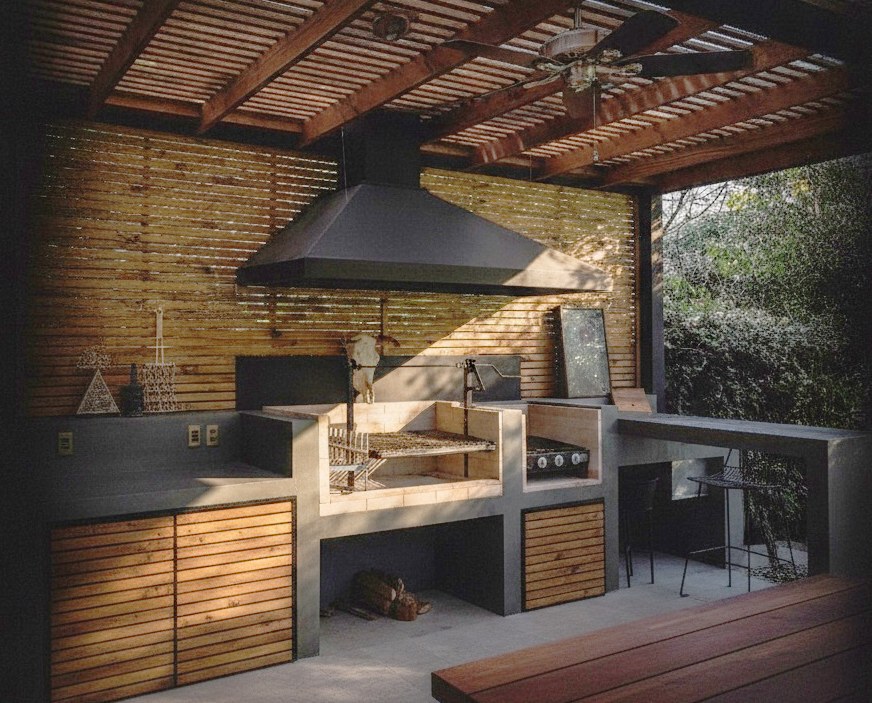
Outdoor kitchen with wood-fired barbecue with rotisserie, black hood, lacquered wood doors and side table

The Rotisserie Beneath the Hood, Theatre of Embers

Beneath the great black hood, the wood-fired barbecue mounts its rotisserie: this is the theatre of slow cooking, the kind that fills the garden with aroma and anticipation. The grey stone structure carries the counter with its wooden edge, while lacquered wood doors mark the bases with their warm rhythm and the side table offers a place for service. Above, the copper-toned slatted pergola filters and colours the light; the wall of green at the back closes the open-air room.
Exposed stone outdoor kitchen with two stainless steel barbecues, dark worktops, planters and wooden fence

Exposed Stone and Steel, the Corner of Fire

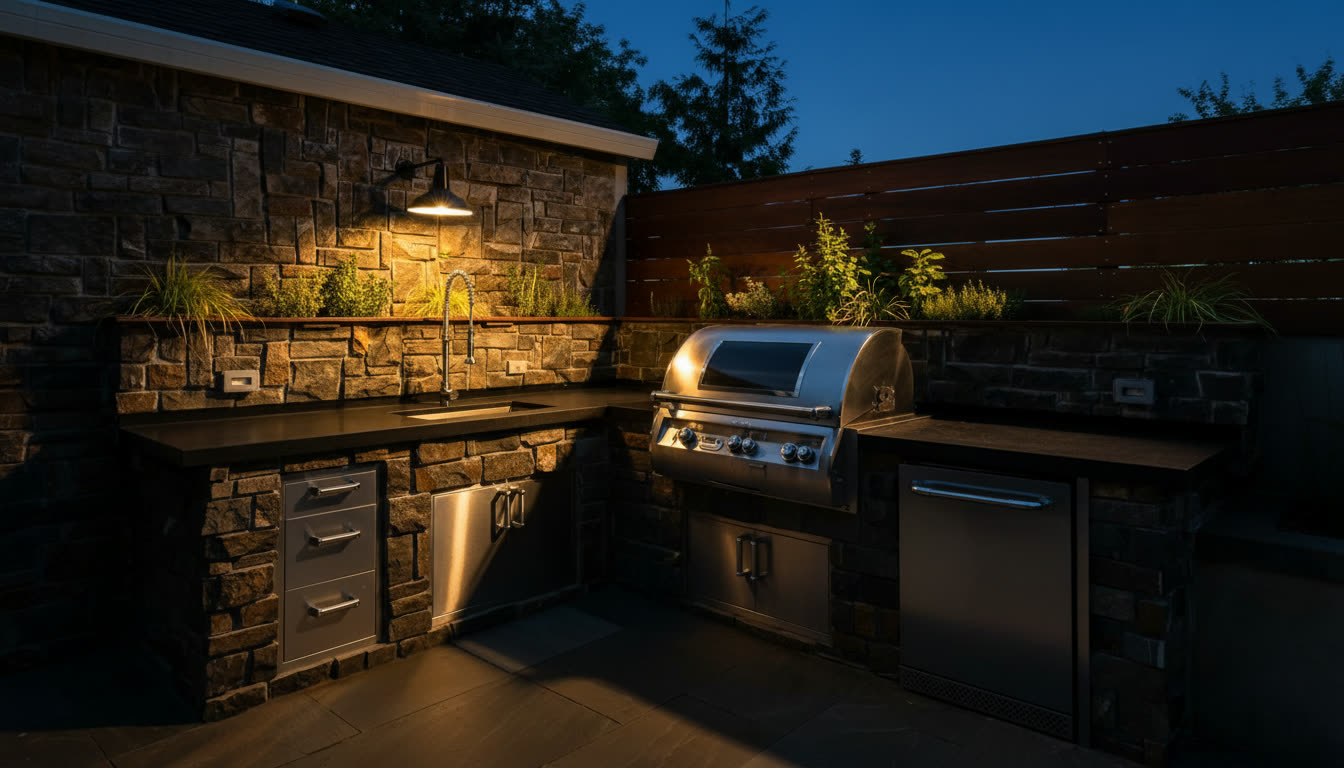
Exposed stone rises from the floor and builds the entire scene: walls and bases in warm-toned blocks, laid with the knowledge of one who understands the weight and grain of every element. Set into the stone structure, two stainless steel barbecues gleam beneath the sun alongside technical doors and drawers, while dark worktops run along the working corner, drawing a clean, professional line. Above, planters overflow with green and the wooden fence encloses the space with intimacy.

Modern barbecue with sintered stone sink and treated wood front finish, white terrace

Modern Barbecue, Refractory stone and Wood Set Flush

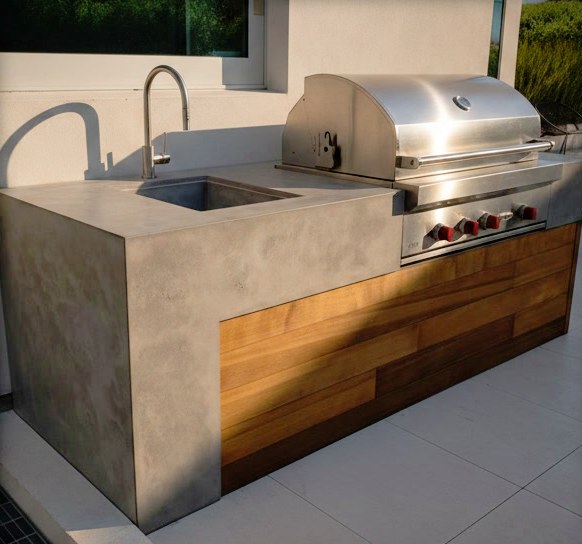
The volume presents itself as a block drawn in a single gesture: sintered stone with a stone-effect wraps the counter and the flanks, while the treated wood front inserts a warm band that breaks the mineral severity. The sink is hollowed directly out of the mass, its slender tap bending like a reed; beside it, the steel barbecue raises its polished lid, ready for service. Around it, the white terrace and the floor-level drainage grille speak of a contemporary, clean setting where every detail is in its place.

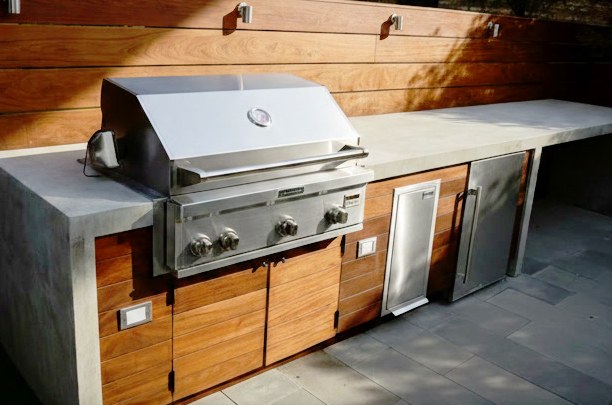
Outdoor kitchen with pale refractory stone counter, dark wood wall and doors and steel gas barbecue

Pale Refractory stone, Dark Wood: The Right Contrast

Two materials share the scene and exalt each other: the pale refractory stone of counter and structure, honed and luminous, and the dark wood cladding the back wall and the doors, warm as a countermelody. Between them, the steel gas barbecue lifts its lid and shines, flanked by technical doors that guard the essentials. Lights recessed into the base graze the strip of green at the kitchen's feet, sketching a nocturnal detail that promises atmosphere.

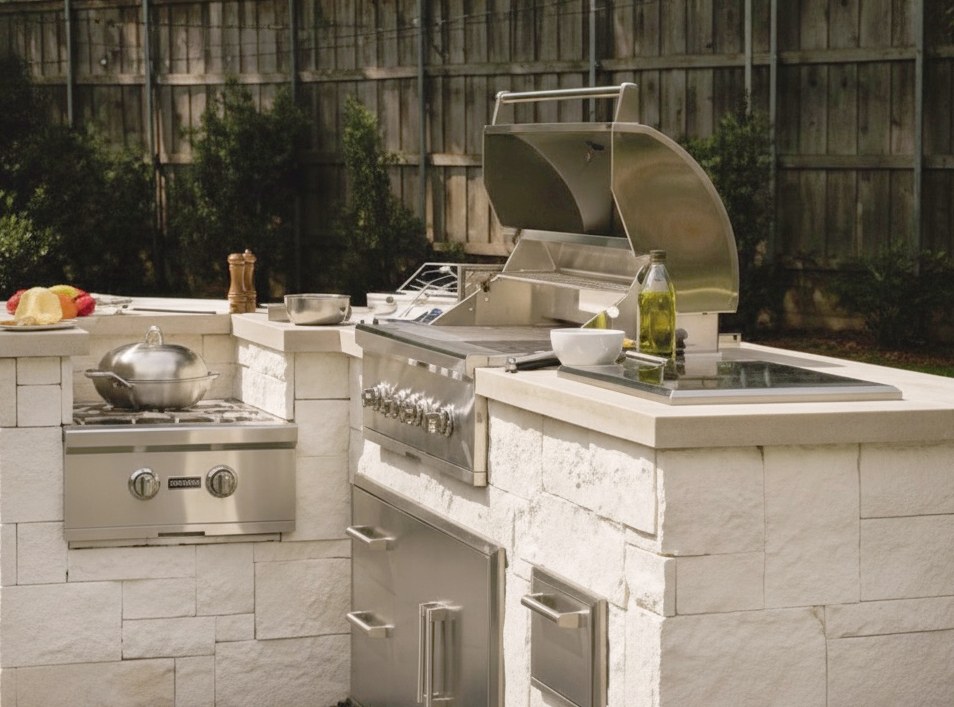
Outdoor kitchen in white block stone with open built-in barbecue and side burner with pot

White Blocks, the Embers Already Waiting

White stone blocks build the scene with their limestone light: squared and laid in regular courses, they compose the kitchen's volumes like a Mediterranean architecture in miniature. The built-in barbecue already has its lid raised — grates ready, herbs within reach — and on the flank the side burner bears its waiting pot. Pale worktops link the stations; the dark hedge sets off every whiteness.

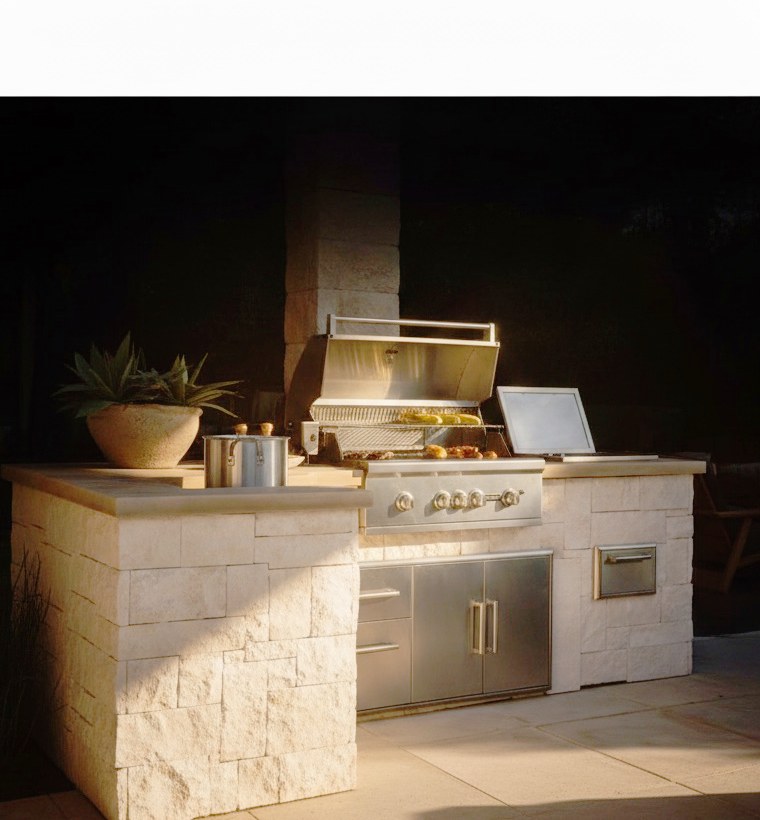
Outdoor kitchen in white block stone with built-in barbecue, steel drawers and doors

Limestone White with Drawers of Steel

Blocks of white stone rise in orderly courses and frame the technical equipment: the column of steel drawers, double doors, the built-in barbecue with its domed lid and row of controls, even the small countertop appliance waiting for breakfast. Potted plants punctuate the pale worktops, the roof shades the scene and dark green closes the backdrop.

The next step

Found your kitchen?

Tell us which one feels closest: we redraw it to your measurements, in the marble or stone you prefer, and send you the design and the quotation free of charge.

What a "masonry kitchen" is really made of

Three different things are sold under the word "masonry": true masonry, faux masonry and, in our case, dry-laid refractory stone.

True masonry: bricks, blocks, mortar, plaster, tiles

Supporting walls in brick or in aerated concrete blocks, usually 8 to 10 centimetres thick, bonded with cement mortar, plastered and skimmed; the worktop is finished with tiles, resin or stone. It is a wet building site: Edilizia.com speaks of "more time, dust and wet work". Done well, it is sturdy, but it is held together by mortar, which shrinks as it dries, moves with heat and lets water in.

Faux masonry: a clad cabinet that imitates the wall

Many of the "masonry kitchens" on sale are cabinets in plywood, chipboard or plasterboard, clad to look like masonry. According to Arredamento.it the side panels measure around 5 to 8 centimetres, against 8 to 10 for true masonry, and the kitchen can be dismantled and moved without demolition. It is light and reversible; it remains a cabinet. We cover it on Faux masonry kitchen.

Dry-laid refractory stone: the Michelessi method

Our masonry-style kitchen is built from blocks of refractory stone shaped in our workshop in Aprilia and interlocked dry, with no mortar or adhesive; above them, a worktop in marble or stone cut by us; in front, wooden doors. Among the barbecue and oven makers we examined, dry laying is prescribed only for the parts in contact with fire; we found none that builds a whole kitchen by interlocking. We have extended the principle to the entire structure.

Masonry, faux masonry or refractory stone: the comparison table

What mattersMasonry (bricks, blocks, mortar, cement)Faux masonry (clad cabinet)Dry-laid refractory stone (Michelessi)
HeatOrdinary cement mortar crumbles above 300-400 °C; the binder of Portland cement loses its function between 300 and 700 °C.Clad panels: the sources give no working temperatures.By definition (ASTM C71) a refractory withstands over 538 °C for long periods; manufacturers declare a resistance above 1,000 °C; aluminosilicate oven refractories reach 1,100-1,200 °C.
DampGrout, plaster and mortar are porous; hollow bricks are prone to mould and damp.Depends on the panel and the cladding chosen.No mortar or screed to hold water; the structure opens and can be inspected.
CracksFrom mortar shrinkage, restrained expansion, frost; cement barbecue makers speak of "normal settling".No brick walls or screeds to shrink; the cladding is fixed to the panel.No mortar joint to shrink; each block expands freely in its seat.
Dismantling and changesFixed: removing walls and claddings may call for controlled demolition.Dismantles and moves without demolition.Opens, can be inspected and comes apart block by block, because nothing is glued.
MaintenanceGrout and porous surfaces to treat and check at regular intervals.That of a cabinet: hardware, edges and cladding.Ordinary cleaning; a marked block is replaced on its own.
WeightWalls, plaster, screed and tiles: full load on the floor slab; outdoors a foundation is needed.Light.It is stone, so it is heavy: the load is checked at the site survey, with no extra screed or plaster.
Building timeWet site, with drying days.Assembly without bricklayers.Dry laying: no water in the house and no waiting for things to dry.
LifespanDepends on joints and seals: where heat and water are at work it ages sooner.That of a well-kept cabinet.Built to last a lifetime: no mortar to shrink, no cement to waterproof.

Why a masonry kitchen cracks: heat

Masonry cracks under heat because its materials expand by different amounts while being rigidly bonded to one another, and because cement mortar, above a certain temperature, stops binding. The Brick Industry Association gives the coefficients of thermal expansion: clay brickwork 7.2 millionths per degree, concrete blockwork 8.1, concrete 9.9, marble 13.1; and it warns that, if these movements are restrained, the masonry may crack.

On cement there are three facts. A building merchant's guide to barbecues states that ordinary cement mortar "crumbles above 300-400 °C". A study at Delft University of Technology places the loss of the binding property of Portland cement between roughly 300 and 700 °C. The third fact is the most telling: makers of cement and refractory barbecues, in their assembly instructions, forbid high-strength cements "since they do not allow thermal expansion", prescribe laying the refractory slabs of the firebox dry and write that "the presence of micro-cracks is part of the normal settling". We preferred to take cement out of the kitchen.

In an indoor kitchen the real heat sits around the oven and the hob, and refractory stone is a choice of stability more than a necessity; it becomes one in outdoor kitchens, barbecues and wood-fired ovens.

Why a masonry kitchen cracks: damp, leaks and mould

Indoors, masonry's everyday enemy is not fire: it is water. Grout, plaster and mortar are porous; water from the sink, from cleaning and from condensation enters through the joints and stays inside. Edilizia.com writes: "a small leak behind a closed base unit can damage the substrate and the floor", "a rigid finish laid on a structure that flexes can crack", and a structure with a badly sealed worktop or walled-in pipes can "age worse than a good modular cabinet". Brick, according to the Brick Industry Association, expands irreversibly as it absorbs moisture while mortar shrinks as it dries. Hollow bricks are "prone to mould and damp"; aerated concrete (gasbeton) is less prone to mould than hollow bricks, but it is porous: it must be plastered and protected from damp. In the closed compartments behind the fridge and the dishwasher steam can condense on a cold mass.

The cost over time is described by a Lombard renovation firm: porous surfaces to be treated every 6 to 12 months, grout every 12 to 18 months, bases and junctions every 1 to 2 years, with "micro-cracks that over the years could cause problems" in the areas most exposed to steam and damp. That is not a verdict against masonry: it is its running cost. A dry structure has no mortar joints to reseal.

The masonry barbecue that cracks after winter

Outdoors, frost joins heat and water: water that has entered the pores of the cement and the joints expands as it freezes and pushes from inside, and the first lighting in spring makes the winter's cracks visible. The mechanism, with the manufacturers' figures, is explained on Masonry barbecue. The principle is enough here: Michelessi barbecues and ovens are built in refractory stone, on a dry-laid structure, and there is no mortar to hold water until it freezes. We do not claim that refractory stone is immune to frost, because no data sheet we have read proves it; we say that we remove from the kitchen the mortars and screeds, the materials frost damages. The models are among our barbecues and ovens in refractory stone.

What refractory stone is and why it withstands heat

A refractory material, under the American standard ASTM C71, is a non-metallic material able to withstand temperatures above 538 °C for long periods. Refractory bricks and blocks are based on fired refractory clay (chamotte) with alumina and silica. Manufacturers declare a resistance above 1,000 °C; aluminosilicate oven refractories reach 1,100-1,200 °C. For the dense grades they also declare a high resistance to thermal shock. It is the material of bread and pizza ovens, combustion chambers and chimneys.

It withstands heat better than cement for two reasons: it is a ceramic material already fired at high temperature, working where the binder of cement is already chemically spent; and dense refractories have a high thermal mass, that is, they hold heat even after the fire has gone out and release it slowly. Even refractory stone, however, must be heated gradually at its first lighting, as oven and barbecue manufacturers prescribe.

How we build the kitchen in refractory stone, with no mortar and no cement

We build the kitchen the way a dry-stone wall is built: blocks of refractory stone shaped in the workshop, interlocked one into the other and held by their weight and by the shape of the joint; the wall-mounted barbecue is the exception, fixed to the masonry of the house with steel brackets. The art of dry-stone walling has been on UNESCO's list of intangible cultural heritage since 2018, with Italy among the proposing countries: it is the dry-stone walling technique that is protected, not kitchens. What changes:

  • No shrinkage. An interlocking joint does not shorten as it dries, because there is no mixing water.
  • Every block moves freely. Under heat the stone expands within its seat and returns as it cools.
  • No water in the joints. There are no porous mortars or screeds to hold water.
  • A dry site. No wet work in your home.
  • Reachable services. The structure is designed to open, let you inspect pipes and drains, and close again.
  • Replaceable blocks. A marked block comes out and goes back in, on its own.

A note on wood-fired ovens: the dome and the arch are in refractory bricks, assembled according to the refractory manufacturer's instructions; all the structure around them is dry-laid. The detail is on Masonry wood-fired oven.

On top goes the worktop, cut in our workshop in Aprilia: marble (Calacatta, Carrara), travertine, granite, quartzite or sintered stone. According to Arredamento.it marble is sensitive to food acids such as lemon and vinegar; for those who prefer not to think about it, we offer granite or sintered stone. In front, the wooden doors, made to measure. The Francesca indoor kitchen, with a marble worktop, is our proposal in the masonry style; the stones and the care of the worktop are described on Stone kitchen.

Masonry kitchen: pros and cons, yes or no, is it worth it?

A masonry kitchen is worth it for those who want a one-off piece, made to measure, that no mass-produced cabinet offers; it is not worth it for those who will need to change it, move it or reach a pipe, for those short of space, and for those who do not want maintenance on the grout. The sources grant well-built masonry solidity and durability: the documented faults lie in the joints, the mortars, the plaster and the tiles, where heat and water are at work.

The pros, which refractory stone keeps: a made-to-measure design, a single unbroken piece, niches and open bays, a chimney hood, a stone worktop. The cons, which dry-laid refractory stone reduces or removes: fixed and unchangeable; walled-in services; grout and plaster to seal; micro-cracks from heat, shrinkage and damp; a wet site; demolition for every change. Two honest cons remain for us too: a stone kitchen is heavy, and the weight is checked at the site survey; a marble worktop asks for care. If you are thinking of building one yourself with blocks and mortar, the guide is on DIY masonry kitchen.

How long does a masonry kitchen last, and how long does one in refractory stone last?

No technical source gives a number of years, and neither do we. Edilizia.com writes that "durability does not depend on the mere fact that the kitchen is masonry" but on joints, seals and access to services. Masonry ages in the grout that needs resealing, in the plaster that swells, in the mortar that crumbles near heat, in the cement that frost splits. A dry-laid refractory stone kitchen is built to last a lifetime because it contains none of those materials. There is no mortar to shrink, no cement to waterproof, no grout line to let water in, and the day a block marks, that block is replaced.

Can a masonry kitchen be dismantled?

A true one cannot: Edilizia.com writes that it "is rarely moved whole without demolition" and that removing walls and claddings may call for "controlled demolition". Faux masonry can, like a cabinet. A Michelessi refractory stone kitchen opens and comes apart block by block, because nothing is glued: to inspect a pipe, change a built-in oven, replace a block. Moving it to another house is assessed at the site survey, because the stone worktop and the bays are cut to your room. The other questions have an answer and a source on Questions and answers; to see the blocks and the joint for yourselves, workshop and showroom are in Aprilia, Via Pontina km 45,350, between Rome and Latina.

To choose the style and the room: the masonry-style kitchen comes modern, white, rustic and country or with wood; dimensions and layouts are in the guide How to design one; and if you are near us, there is the page on Rome, Latina and Lazio.

The quote is free: request it here.

Frequently asked questions

Frequently asked questions

Are Michelessi kitchens masonry kitchens?

No. Michelessi SRL, in Aprilia since 1976, builds kitchens in the style of the masonry kitchen, but from blocks of refractory stone interlocked dry, with a marble or stone worktop and wooden doors. No bricks, no mortar, no cement: those are the materials in which heat and damp open cracks. The look is that of the masonry kitchen; the structure is built to last a lifetime.

What is the difference between masonry, faux masonry and refractory stone?

True masonry is bricks or blocks bonded with mortar and cement, plastered and tiled: fixed, with porous joints. Faux masonry is a clad cabinet in plywood or plasterboard: light and dismountable, but still a cabinet. Dry-laid refractory stone is a structure of stone blocks interlocked without mortar: a mass of stone like masonry, as easy to open and dismantle as a cabinet.

Why does a masonry kitchen crack?

Because its materials work against one another. Mortar shrinks as it dries while the wall holds it still; bricks, blocks and cement expand under heat by different amounts and, rigidly bonded, tear at each other; water enters the grout, swells the plaster and freezes in winter. The cracks open in the joints and the mortar, which is where heat and water are at work.

What is a refractory material?

Under the American standard ASTM C71 it is a non-metallic material able to withstand temperatures above 538 °C for long periods. Refractory blocks are based on fired refractory clay with alumina and silica: it is the material of bread and pizza ovens and of fireboxes. Michelessi uses it for the whole structure of the kitchen, not only for the hearth.

What temperature can refractory stone withstand?

Refractory manufacturers declare a resistance above 1,000 °C; aluminosilicate oven refractories reach 1,100-1,200 °C. By comparison, ordinary cement mortar crumbles above 300-400 °C and the cement binder loses its function between 300 and 700 °C. Even refractory stone, however, must be heated gradually at its first lighting, as every oven maker prescribes.

Can a masonry kitchen be dismantled?

A true one cannot: only doors, drawers and appliances come out, while walls and claddings may need demolition. Faux masonry dismantles like a cabinet. A Michelessi kitchen in dry-laid refractory stone opens and comes apart block by block, because nothing is glued: to reach a pipe, change an oven or replace a block, without demolition.

How long does a masonry kitchen last?

No technical source gives a number of years: lifespan depends on joints, seals and access to services, not on the kitchen being masonry. Masonry ages where heat and water are at work: grout to reseal, plaster that swells, mortar that crumbles near the hob. A dry-laid refractory stone structure has none of those materials and is built to last a lifetime.

Masonry kitchen: what are the pros and cons?

Pros: a made-to-measure design, a single unbroken piece, niches and open bays, a chimney hood, a stone worktop. Cons: fixed and unchangeable, walled-in services, grout and plaster to seal, micro-cracks from heat and damp, a wet site, demolition for every change. Dry-laid refractory stone keeps the pros and reduces or removes the cons, except the weight, which is checked at the site survey, and the care a marble worktop asks for.

Masonry kitchen, yes or no: is it worth it?

Yes, if you want a one-off piece made to measure that no mass-produced cabinet offers; no, if you will need to change it, move it or reach a pipe, if you are short of space or do not want maintenance on the grout. Michelessi, in Aprilia, offers the third way: a kitchen of the same style built in dry-laid refractory stone, which opens, can be inspected and has no mortar joints to crack under heat.

Does a masonry kitchen suffer from damp and mould?

Yes, it can: indoors it is one of its most delicate points. Grout, plaster and mortar are porous: water from the sink and from condensation gets in and stays, and a small leak behind a closed base unit can damage the substrate and the floor. Hollow bricks are prone to mould, and in closed compartments with no air steam can condense. A dry structure has no mortar to hold water.

Why does a masonry barbecue crack after winter?

Because water that has entered the pores of the cement and the joints freezes, expands by about 9 per cent and pushes from inside; with every frost cycle the micro-crack widens, and at the first lighting in spring the heat makes it plainly visible. In Michelessi barbecues the structure is dry-laid refractory stone: there is no mortar to hold water until it freezes. The full mechanism is on the masonry barbecue page.

What does building the kitchen "dry" mean?

It means interlocking the refractory stone blocks one into the other with no mortar, glue or cement, as in a dry-stone wall: stability comes from the shape of the joint and the weight of the stone. No mixing water, so no shrinkage; no rigid joint, so every block expands freely; no porous screed, so no trapped water. And every block can be replaced on its own.

Call us WhatsApp