Skip to content
Made in Italy

Masonry kitchens

Masonry Wood-Fired Oven? We Build It in Refractory Stone

A masonry wood-fired oven is a domed oven with a floor and cooking chamber in firebricks, enclosed in a supporting structure: tradition builds that structure in bricks and mortar; Michelessi SRL, stone masons in Aprilia near Rome since 1976, builds the structure around the oven in refractory stone blocks fitted dry, with the dome and arch in firebricks laid to the refractory maker's instructions. It does what the oven of a masonry kitchen does, pizza and bread, outdoors or indoors, but with no cement mortar to crumble with heat: it is built to last a lifetime.

A kitchen like this, made to measure for you.Free, no-obligation quotation · free site survey in Lazio · 3D design · since 1976

What a masonry wood-fired oven is

A masonry wood-fired oven is a domed oven built on site, and Michelessi SRL, stone masons in Aprilia near Rome since 1976, builds it with the structure around it in refractory stone blocks fitted dry, in place of masonry. It has a cooking floor and a vault in refractory material, a mouth with a flue and, all around, a supporting structure that carries the oven and insulates it. The wood fire heats the refractory mass; it is the mass, not the flame, that bakes pizza and bread. In the traditional version the surrounding structure is masonry: bricks, blocks, mortar and cement. With us the dome and the arch are firebricks, laid to the instructions of the refractory maker; the whole structure around them is dry-fitted, with no mortar and no cement.

The parts of a wood-fired oven, from the inside out:

  • The cooking floor (the hearth): refractory bricks laid dry, on which pizza and bread rest.
  • The dome and the arch: the firebrick vault that stores the heat and returns it from above, laid to the instructions of the refractory maker.
  • The mouth and the flue: the opening through which the wood goes in and the duct that carries the smoke away.
  • The insulation: the layer that keeps the heat inside the dome instead of letting it escape.
  • The supporting structure: the base, the log store, the landing in front of the mouth. This is where traditional masonry and refractory stone part ways.
Stone-effect stoneware outdoor kitchen with black dome oven and treated wood doors, on a green terrace

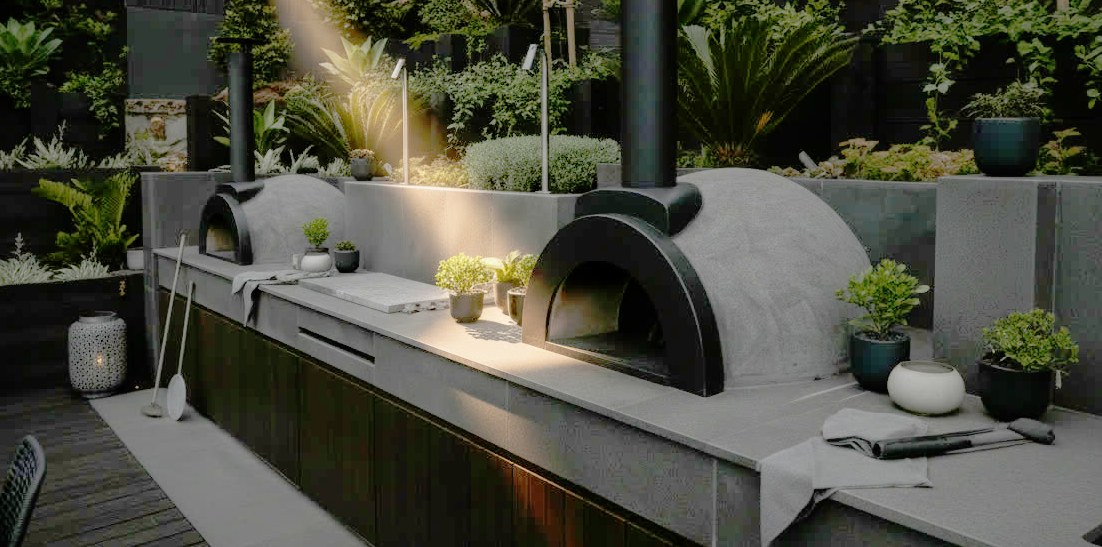
The Open Oven Above a Roof Garden

Among the lush planters of a roof garden, the black dome of the oven rises like a small ancestral architecture. This stone-effect stoneware outdoor kitchen stretches its grey volumes along the terrace: tactile, mineral-toned surfaces in dialogue with the treated wood of the small doors and the exuberant green of the plants. The open oven is the undisputed centrepiece — promising bread, pizzas, slow-rising dough and evenings around the fire — while the rest of the composition works in silence, ordered and resilient.
Corner budget outdoor kitchen with barbecue, oven, sink and minifridge, wooden structure with drawers

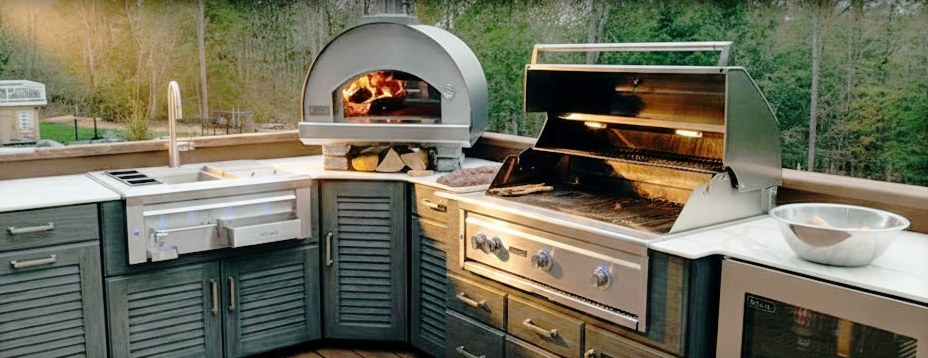
The Complete Corner Facing the Woods

Before the dense green of the woods, the kitchen bends into a corner and wants for nothing: the sink with its rounded steel front, the oven with its coppered dome promising pizzas and loaves, the barbecue with lid raised and grills at the ready, the minifridge for the evening's provisions. The wooden structure, with slatted doors in a grey-green tone and orderly drawers, carries the pale counters and gives the whole a rustic, well-tended elegance.

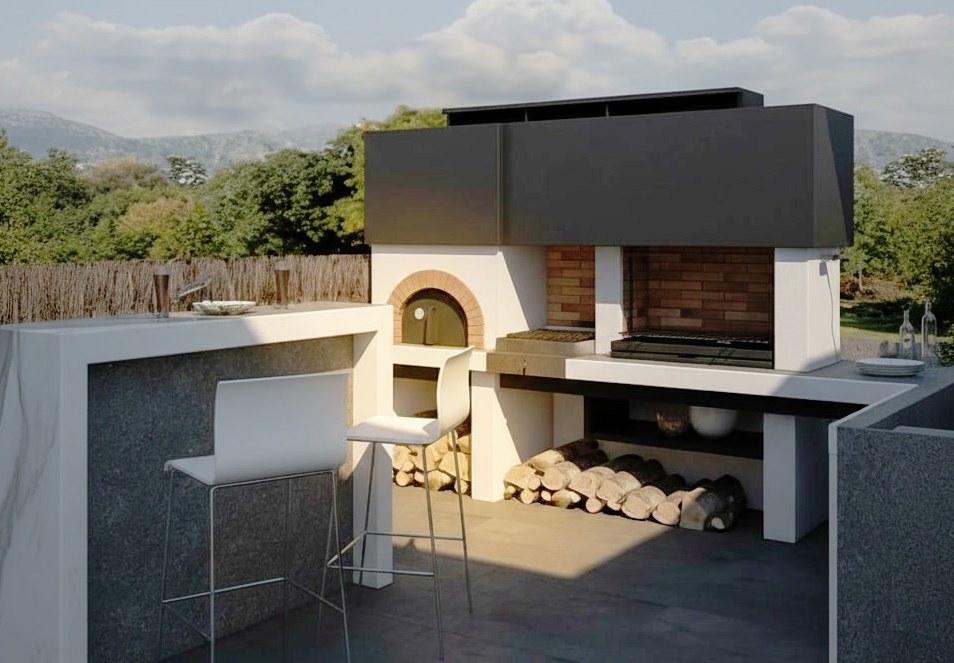
Outdoor barbecue with oven in modern style with shelf and side counter, on a panoramic terrace

Oven and Barbecue on the Roof, Modern Style

On the terrace overlooking the hills, the composition presents its modern profile: the dark volume of the hood crowns the mouth of the barbecue and the oven with its arch ready for the flame, while the white and grey structure spreads shelf and side counter for preparation and service. Firewood stacked in the bay warms the scene; the small table with black seats promises pauses between one course and the next. The open sky does the rest.

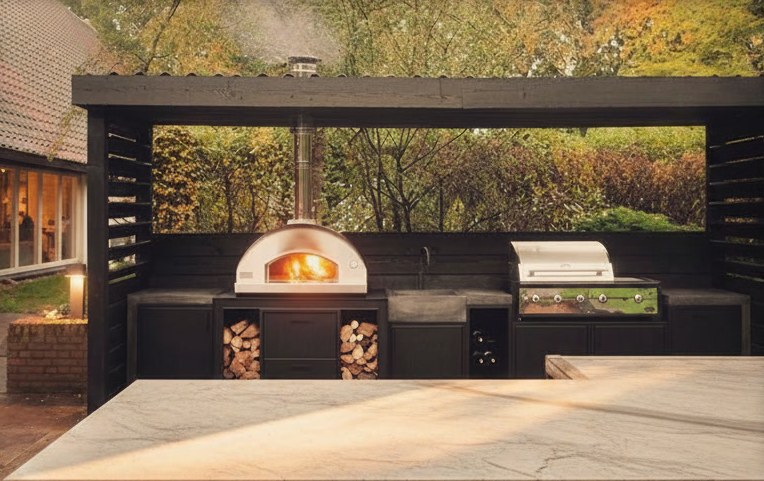
Black bespoke outdoor kitchen with push-pull doors, gas barbecue, wood-fired oven and sink

Night Black, with Oven and a Cellar of Wood

The black of the structure makes every protagonist stand out: the dome of the wood-fired oven in its pale finish, two niches where logs weave their golden texture, the bottle rack awaiting the toast, and on the right the gas barbecue with its service sink. Push-pull doors keep the surfaces clean, no handles breaking the rhythm; the slatted wall filters a garden dissolving into sunset.

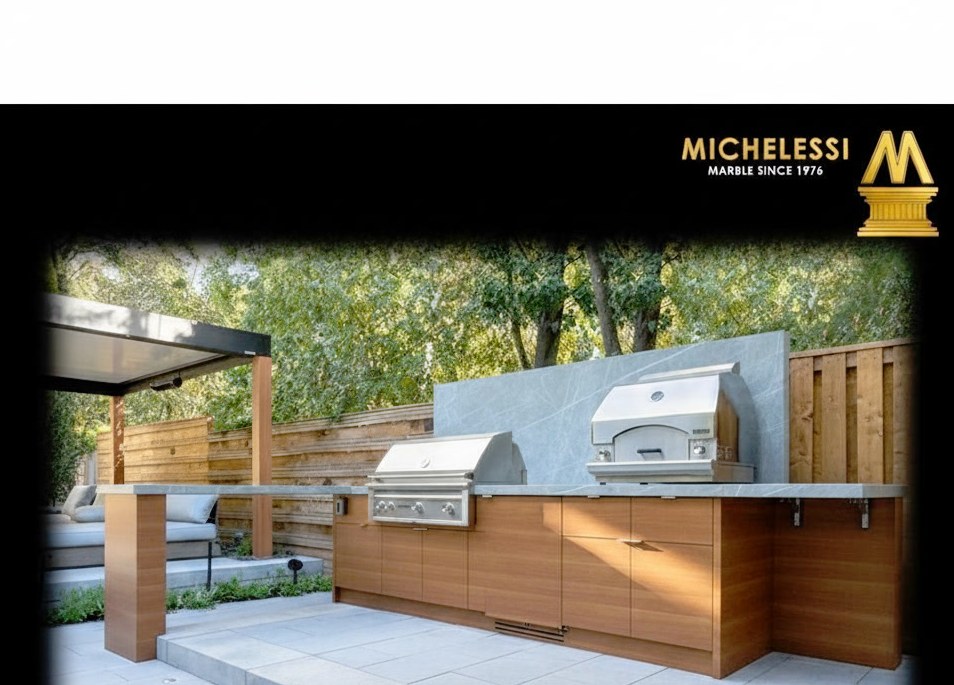
Minimal budget outdoor kitchen with gas barbecue and oven, wooden structure and stoneware counter

Wood and Stoneware, Two Fires in a Line

The warm wooden structure stretches along the low wall and carries its two fires with ease: the gas barbecue with its steel lid and, a little further on, the oven that doubles the brigade's possibilities. The pale stoneware counter runs above doors with lively grain, resistant to the seasons and easy to live with; the side counter offers the resting space that is never enough.

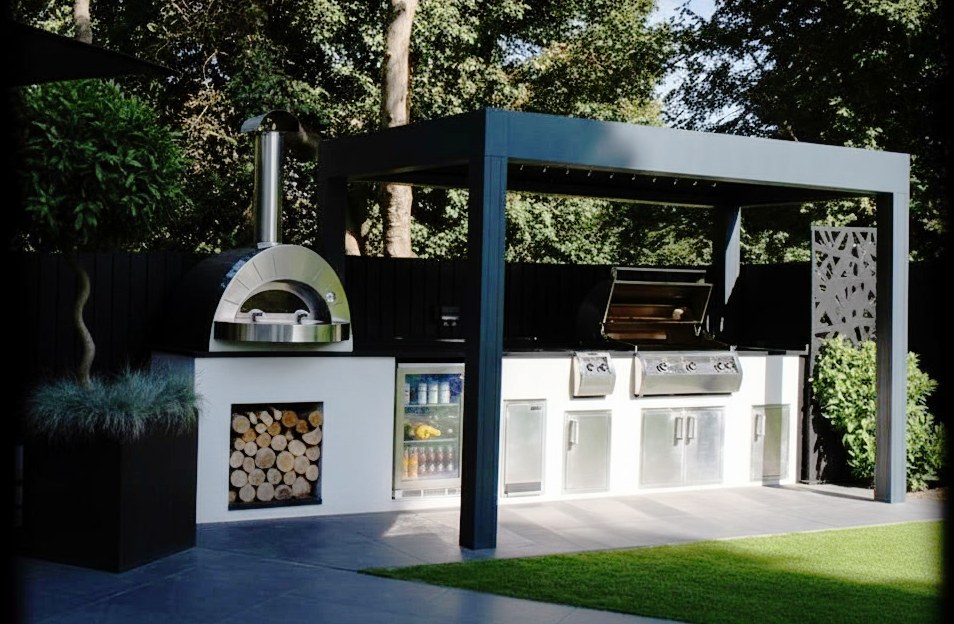
Budget outdoor kitchen with gas barbecue, wood-fired oven, wine cooler, aluminium doors and stoneware counter

Beneath the Black Pergola: Oven, Grill and Wine Cooler

The black pergola draws the open-air room, and beneath its beams the kitchen fields a complete brigade: the wood-fired oven with its dome and soaring chimney, the gas barbecue with its lid open and ready, the wine cooler glowing in the white base, firewood stacked in its niche like a decorative wall. The grey stoneware counter runs above aluminium doors and binds every function, while the lawn breathes green all around.

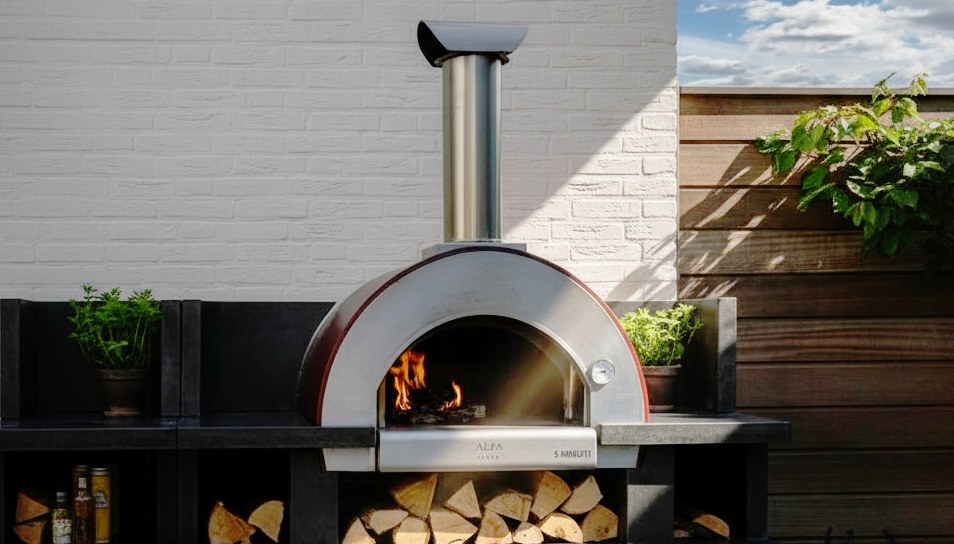
Outdoor wood-fired oven with copper dome, steel chimney and log shelf, on a grey base

The Wood-Fired Oven, Copper and Living Flame

The flame already burns within the mouth of the oven and gilds the coppered dome, while the steel chimney rises straight to sign the profile. Below, the grey base with its essential design offers the log shelf where the wood waits in fine order, ready to feed the cooking. The white brick wall behind sets off every detail, from the gleam of the copper to the weave of the firewood.

Complete budget outdoor kitchen with barbecue, oven, sink, log counter and shelves, on wooden terrace

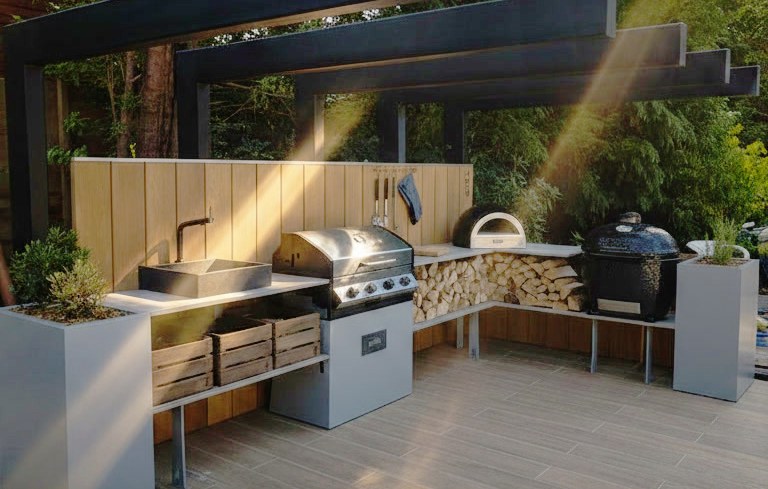
The Great L Beneath the Black Beams

The black beams of the pergola cut across the sky, and beneath them the kitchen opens its generous L: pale modules follow one another along two sides of the wooden terrace, carrying the barbecue with its lid open, the dark oven in the corner, the sink and counters that never seem to end. The firewood, ordered in crates beneath the counter, is supply and decoration at once; aromatic plants dot the composition with green. The pale slatted wall closes the open-air room with intimacy.

Open patio outdoor kitchen with glass-door fridge, sink, steel burners with hood and wood-fired oven with log rack

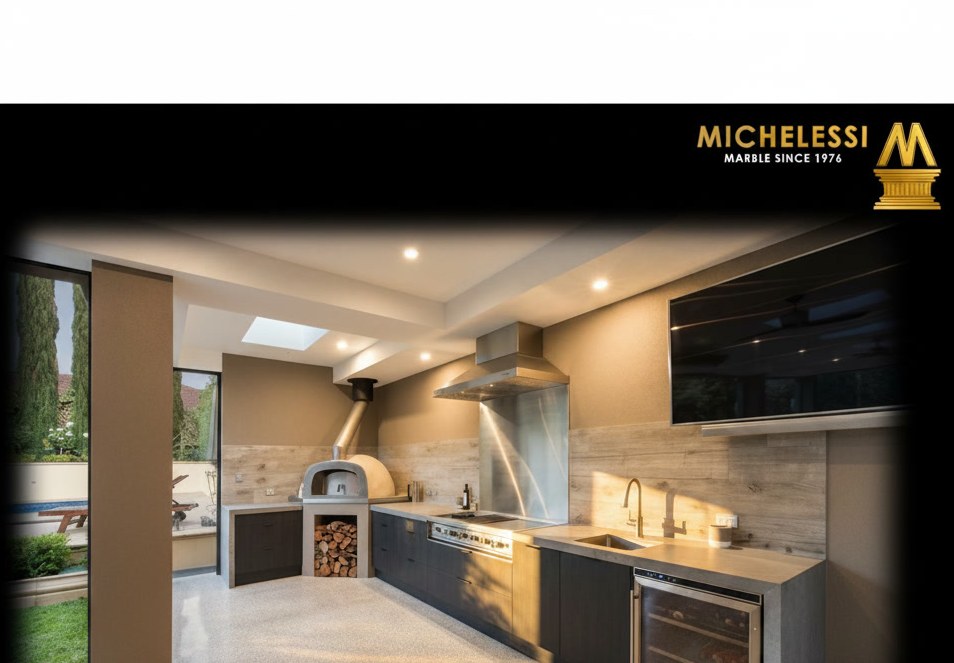
The Open Patio, with Oven and Glass Display

The patio opens onto the garden with the poise of a great house: a dark run of base units carries the pale counter, bearing the steel burners beneath their professional hood, the sink, and the refrigerator whose glass door displays its chill like a small vitrine. At the far end, the wood-fired oven waits with its mouth ready and the log rack stacked with orderly rounds; the wall-mounted screen promises long evenings. Light rains softly through the skylight; the travertine floor spreads it wide.

Outdoor kitchen with vaulted wood-fired oven, black-hooded barbecue, round sink and refrigerator

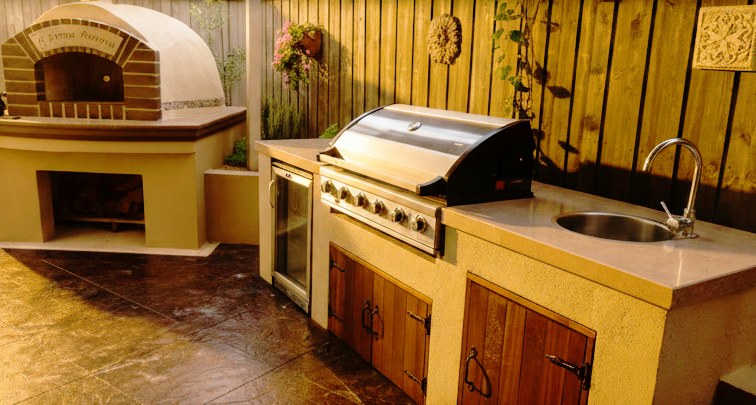
The Wood-Fired Oven's Dome, White and Red

The white dome of the wood-fired oven, ringed by the red bricks of its arch, presides over its corner like a small basilica of taste: within the vault, flame will turn simple doughs into aromas that summon the neighbours. Beside it, the kitchen spreads its pale refractory stone counter: the barbecue with its black hood, doors in reddish wood, the round steel sink with its tap at the ready, the recessed refrigerator for provisions.

The next step

Found your kitchen?

Tell us which one feels closest: we redraw it to your measurements, in the marble or stone you prefer, and send you the design and the quotation free of charge.

Refractory material is already inside every oven: we bring it outside

A wood-fired oven has a dome and a floor in refractory material, kits included: a cooking chamber in ordinary cement would not withstand the fire. But the refractory usually stops there. Everything else, the base, the sides, the landing in front of the mouth, the hood, is usually made of cement blocks or bricks bound with mortar and rendered. It is in that part, made of mortars and joints, that the cracks open over time.

Michelessi SRL takes the refractory outside the cooking chamber: the dome and the arch stay in firebricks, laid to the instructions of the refractory maker; the whole structure around them is made of refractory stone blocks cut in our workshop in Aprilia and fitted dry. If you wish, the same goes for the whole outdoor kitchen: a structure of refractory stone blocks, with steel for grills, sink and technical parts; a landing in granite, quartzite, travertine or marble, and wooden doors. What you call a masonry kitchen with a wood-fired oven, we build in refractory stone. The reasons, with facts and sources, are on the page masonry vs refractory stone.

Why the masonry around an oven cracks

The dome of an oven is refractory in any case: what cracks is the masonry around it, because heat and water work on its weak points, which are mortars, joints and render. Three things matter for an oven:

  • The heat near the mouth and the hood. It is the hottest zone of the surrounding structure: ordinary cement mortar crumbles above 300-400 °C, according to the guide of a building-materials supplier.
  • Expansion. Cement, ordinary brick and mortar each expand and contract at their own rate; glued rigidly together, they tear each other apart with every firing. This is why the assembly manuals of kit barbecues forbid high-strength and fast-setting cements, which do not allow thermal expansion between the elements in contact with the heat.
  • Frost on the outside. Mortars and renders hold rainwater; when it freezes it grows in volume by roughly 9 % and widens every hairline crack, so that at the first lighting in spring the winter's cracks open fully.

Even the manual of a kit-barbecue maker writes that hairline cracks are part of the product's normal settling. A dry-fitted structure has no mortar to shrink as it dries and no binder to crumble with heat. What changes, part by part, in an oven:

Part of the ovenOven with a masonry structureMichelessi oven
Dome and archFirebricksFirebricks, laid to the instructions of the refractory maker
Surrounding structure: base, sides, hoodBlocks or bricks, mortar, renderRefractory stone blocks fitted dry: each block expands freely within its own joint
RepairsDemolition, because everything is bound into a single massEach block slides out and is replaced on its own

The full comparison of masonry, faux masonry and dry-fitted refractory stone, row by row and with sources, is on the page masonry vs refractory stone.

Wood-fired oven for pizza and bread: temperatures and heating times

A material is refractory when it withstands high temperatures for long periods: manufacturers declare resistance beyond 1,000 °C; the aluminosilicate refractories used for ovens reach 1,100-1,200 °C. Ordinary cement mortar, by contrast, crumbles already above 300-400 °C. That gap is the reason every oven's cooking chamber is refractory, and the reason Michelessi builds everything else in refractory material too.

Dense refractories have a high thermal mass: they heat up, hold the heat even after the fire is out and release it evenly. That is the physics that makes a wood-fired oven work:

  • Pizza bakes with a live fire, the flame licking the dome and the floor scorching hot under the dough.
  • Bread bakes with the fire out: the embers are moved aside, the floor is swept clean and the loaves go in; the heat stored in the refractory mass bakes slowly and evenly, as in the ovens of old farmhouses.
  • Roasts, vegetables and focaccia use the residual heat of the following hours.

Heating time depends on the oven's mass, its insulation and the wood: an oven with a lot of refractory mass takes longer to come up to temperature and holds it longer. During the first firings the oven must be heated gradually, with moderate and growing fires: the manufacturers' manuals prescribe it, and it applies to ours. At handover we explain how to do the first firing.

Wood-fired or gas-fired masonry oven?

The wood-fired oven is the traditional one: flame, embers, smoke that flavours, heat stored in the mass. A gas burner lights quickly and can be regulated, but the baking is different: no embers and no smoke to flavour the food. The refractory stone structure is designed for a wood fire; if you prefer gas, tell us during the site visit and we will look at it together.

Outdoor masonry oven: in the garden, on the terrace, in the outdoor kitchen

The outdoor oven stands in the garden under a pergola, on the terrace of a seaside house, or inside a complete outdoor kitchen in refractory stone with a barbecue, hob, sink and larder. Outdoors the oven lives with rain, sun, frost and fire, which is exactly what puts mortars and joints under strain.

What matters outdoors:

  • A flat, solid base. An oven is heavy; if it rests on ground that moves, it settles and cracks right at the hood. The site visit serves this purpose too.
  • A cover. A roof or a pergola protects the mouth and the hood; in winter the oven is covered and, before relighting, dried out with small fires.
  • The right stone for the worktop. In front of the mouth and on the modules beside it: granite, quartzite, sintered stone, travertine. Marble remains the most beautiful, but outdoors it dislikes frost and sudden changes of temperature: it should be chosen knowingly, ideally under a pergola. We discuss it plainly during the site visit; the stones and how to care for them are covered on the stone kitchen page.
  • No exposed mortar. Mortar joints are where water gets into an outdoor kitchen. The dry-fitted structure around the oven has none.

Indoor masonry oven: in the kitchen alcove

A wood-fired oven can also be built indoors, provided it has its own flue, properly sized and compliant, and a wall to receive it. It is the oven of the old farmhouses of Lazio: set in an alcove, with the mouth at working height and a marble landing in front. It follows the same building logic as the Francesca indoor kitchen, a refractory stone structure with a marble worktop: a dry-fitted structure even indoors, where the everyday enemy is not fire but damp and pipes you cannot reach. The oven in an alcove is also typical of the rustic kitchen, covered on the page rustic, country and classic masonry kitchens.

Before deciding on an indoor wood-fired oven, three points need checking: the route of the flue up to the roof, the air intake of the room, and the building's rules if the house is not detached. The site visit checks the first two; the third is a question for the building manager.

DIY, prefabricated or custom-built masonry oven

Whoever searches for "masonry oven" finds three routes: build it yourself with firebricks and mortar, buy a prefabricated kit, or have it built to measure. As a rule the first two use refractory material only in the cooking chamber and masonry all around; the third, when Michelessi builds it, does for the cooking chamber what any good oven does and uses dry-fitted refractory stone for the whole structure around it.

AspectDIYPrefabricated kitCustom-built by Michelessi
Cooking chamberFirebricks and refractory mortar, thin jointsDome and floor in refractory materialDome and arch in firebricks, laid to the instructions of the refractory maker; floor laid dry
Surrounding structureCement blocks or bricks, mortar, renderPrefabricated elements in aggregate, joined with adhesive or mortarRefractory stone blocks fitted dry
Cracks from heatIn the joints and render of the structure, more than in the cooking chamberHairline cracks admitted by some assembly manualsNo mortar in the surrounding structure: each block expands freely
RepairsDemolitionElements glued with mortar or adhesiveThe single block is replaced
Size and shapeFree, but you design everything yourselfFixed, from the catalogueDrawn on your space, in 3D
Building siteWet, slow, dustyGlued assembly with drying timesDry, with our own team

If you still want to build it yourself, first read how a masonry kitchen is really built: it covers materials, thicknesses and the mistakes to avoid. Whoever builds with firebricks and refractory mortar, thin joints and a dry-laid floor gets a good oven; the problem stays entirely in the cement structure around it.

Do you need planning permission for a masonry oven?

It depends on the municipality, the size and the location. In Italy, for a domestic garden oven the rule is set by each municipality's building regulations, and it changes if the house is in a protected area, if the oven has a tall flue, or if it stands on the terrace of a block of flats. Ask the municipal technical office before you start; in a shared building, read the house rules too, which may have a say on smoke and common parts.

A structure of dry-fitted blocks can be dismantled and reassembled, and every block can be replaced. If an application is needed, Michelessi gives you the drawings of the 3D project, with dimensions and flue, to attach to it.

The masonry kitchen with a wood-fired oven: Michelessi composes it in refractory stone, not in masonry

An oven rarely stands alone. The most natural way to have one is inside a modular outdoor kitchen: wood-fired oven, refractory stone barbecue with a cooking chamber in firebricks, gas hob, sink, fridge, larder with wooden doors, all under a single stone worktop. The structure is in refractory stone blocks; steel is used for grills, sink and technical parts. The dimensions are drawn on your space in the 3D project: the oven goes where the hood can draw, the barbecue beside it, the worktop between the two and the sink on the water side.

The process, from the free site visit in Rome, Latina and throughout Lazio to the first pizza, is the same as for every kitchen in this section and is set out in full on the masonry kitchens page; for the oven a gradual first firing is added, which we explain at handover. We install with our own team throughout Italy and follow projects abroad as well.

All Michelessi barbecues and ovens in refractory stone are gathered on the page refractory stone barbecues and outdoor kitchens; the other kitchens of this section start from the masonry kitchens page. To understand what the price of an oven or a complete kitchen depends on, read the six factors explained in how much a masonry kitchen costs; for every other question there is the questions and answers page.

The quote is free: ask for it here.

Frequently asked questions

Frequently asked questions

What is the difference between a masonry oven and a refractory stone oven?

In both, the cooking chamber is refractory. The difference is the structure around it: in a masonry oven it is made of bricks or cement blocks bound with mortar and rendered; in a Michelessi oven it is made of refractory stone blocks fitted dry, while the dome and the arch are firebricks, laid to the instructions of the refractory maker. Cement mortar shrinks and crumbles with heat; a dry joint does not.

Does a masonry wood-fired oven crack?

The dome is refractory in every oven; what tends to crack is mainly the masonry around it, where there are mortar, joints and render: ordinary cement mortar crumbles above 300-400 °C, and water freezing in the joints grows in volume by roughly 9 %. Even the manual of a kit-barbecue maker writes that hairline cracks are part of the normal settling. A structure of dry-fitted blocks has no cement mortar that could crack.

What temperature can refractory stone withstand?

Manufacturers declare resistance beyond 1,000 °C; the aluminosilicate refractories used for ovens reach 1,100-1,200 °C. By comparison, ordinary cement mortar crumbles already above 300-400 °C: that is why cement does not belong around a fire.

Is a wood-fired oven good for both pizza and bread?

Yes, and that is its strength. Pizza bakes with a live fire, the flame in the dome and the refractory floor scorching hot. Bread bakes with the fire out: the embers are removed, the floor is swept and the loaves go in; the refractory mass gives back its stored heat slowly and evenly. In the following hours you roast meat and vegetables.

Can a masonry wood-fired oven be built inside the house?

Yes, if there is a dedicated flue, properly sized and compliant, an air intake in the room and, in a shared building, clearance under the house rules. Michelessi sets it in the kitchen alcove, with a refractory stone structure and a marble landing in front of the mouth, in the same building logic as the Francesca indoor kitchen. The site visit checks the route of the smoke.

Do I need planning permission for a masonry oven in the garden?

It depends on the municipality, the size and any restrictions on the area. In Italy, for a domestic garden oven the rule is set by the local building regulations; on the terrace of a block of flats the house rules also count. Ask the municipal technical office before you start. Michelessi gives you the project drawings to attach to the application.

Is a prefabricated, DIY or custom-built oven better?

A prefabricated kit has fixed dimensions; for barbecue kits the manuals prescribe water-repellent paint for outdoors and admit hairline cracks. DIY with firebricks and refractory mortar gives a good oven, but the structure around it, if it is cement, remains the weak point. A custom Michelessi oven is drawn on your space, with the structure around it in dry-fitted refractory stone.

Wood-fired or gas-fired masonry oven?

A wood-fired oven gives flame, embers, the aroma of smoke and baking with the fire out, using the heat stored in the refractory mass. Gas lights sooner and can be regulated, but the baking is different: no embers and no smoke to flavour the food. The Michelessi refractory stone structure is designed for a wood fire; if you prefer gas, tell us at the site visit and we will look at it together.

How is the first firing of a refractory stone oven done?

Gradually: moderate, growing fires over the first firings, never full blaze from cold, because heating too fast can cause cracks. The manufacturers' manuals prescribe it and it applies to the Michelessi oven: we explain it at handover. After the first firings the oven is used at full capacity.

Does a refractory stone oven cope with winter frost?

Frost mainly damages mortars, renders and screeds, which hold water: the structure around a Michelessi oven has neither mortar nor render. The dry-fitted blocks expand freely and, should one be damaged, it is replaced on its own. In winter it is still wise to cover the oven and relight it with small fires, to dry it out before bringing it up to temperature.

Do you build wood-fired ovens outside Lazio?

Yes. The site visit and the quote are free in Rome, Latina and throughout Lazio; the oven and the kitchen are cut in the Aprilia workshop, we install with our own team throughout Italy and we follow projects abroad as well. If you are far away, you send us measurements and photos of the space, and the 3D project starts from there.

Call us WhatsApp