
Since 1976 — Indoor marble kitchens
Calacatta Marble Kitchen: Varieties, Veins, Light, Pairings
WOOD · STEEL · MARBLE · STONEWARE
In short
A Calacatta marble kitchen is designed by deciding where to put the stone, not how much: an island with the splashback from the same slab is enough to set the tone of the room. This page explains which variety to choose (classic, Oro, Borghini, Viola), where the vein should run, which light and which materials suit it, and what changes compared with Calacatta-look quartz. Michelessi designs and makes it in Aprilia, Italy, where it has worked marble since 1976.
Kitchens we have built
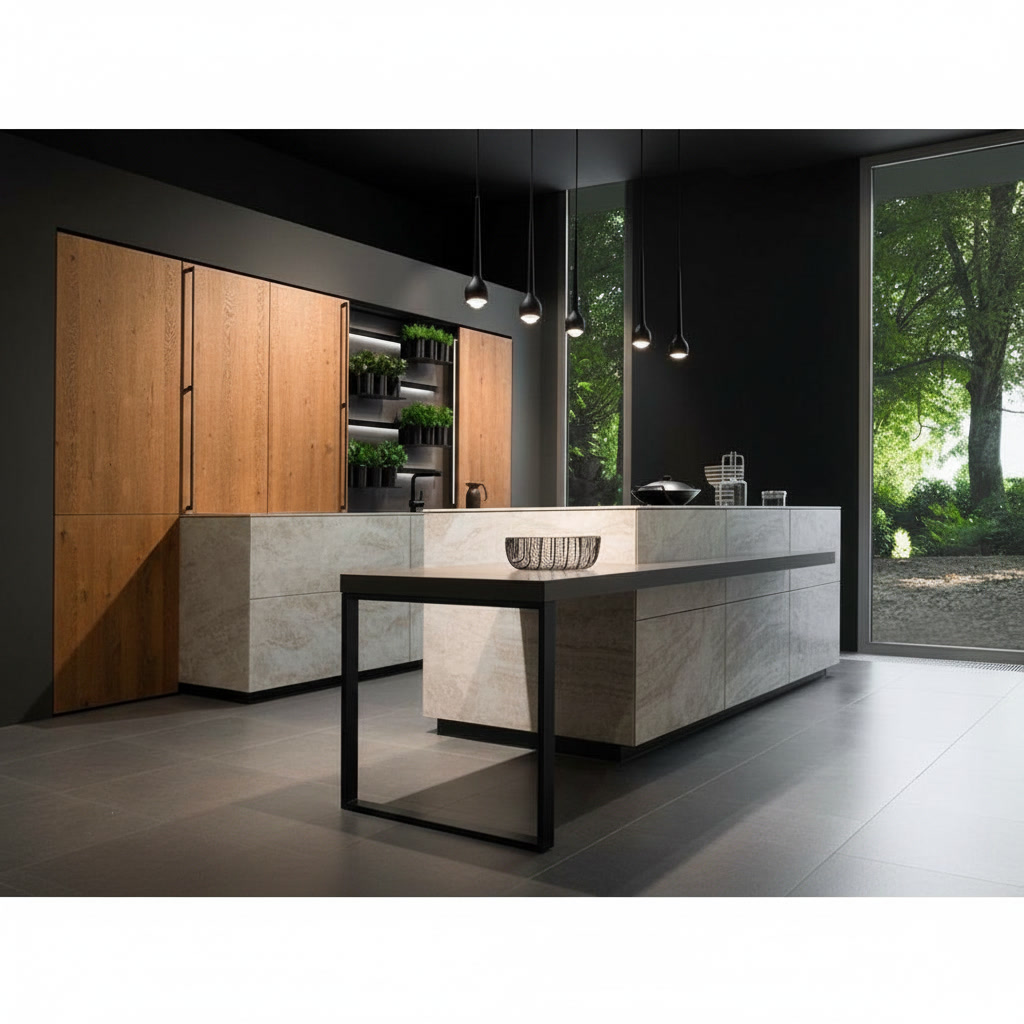
Some of the kitchens we have built
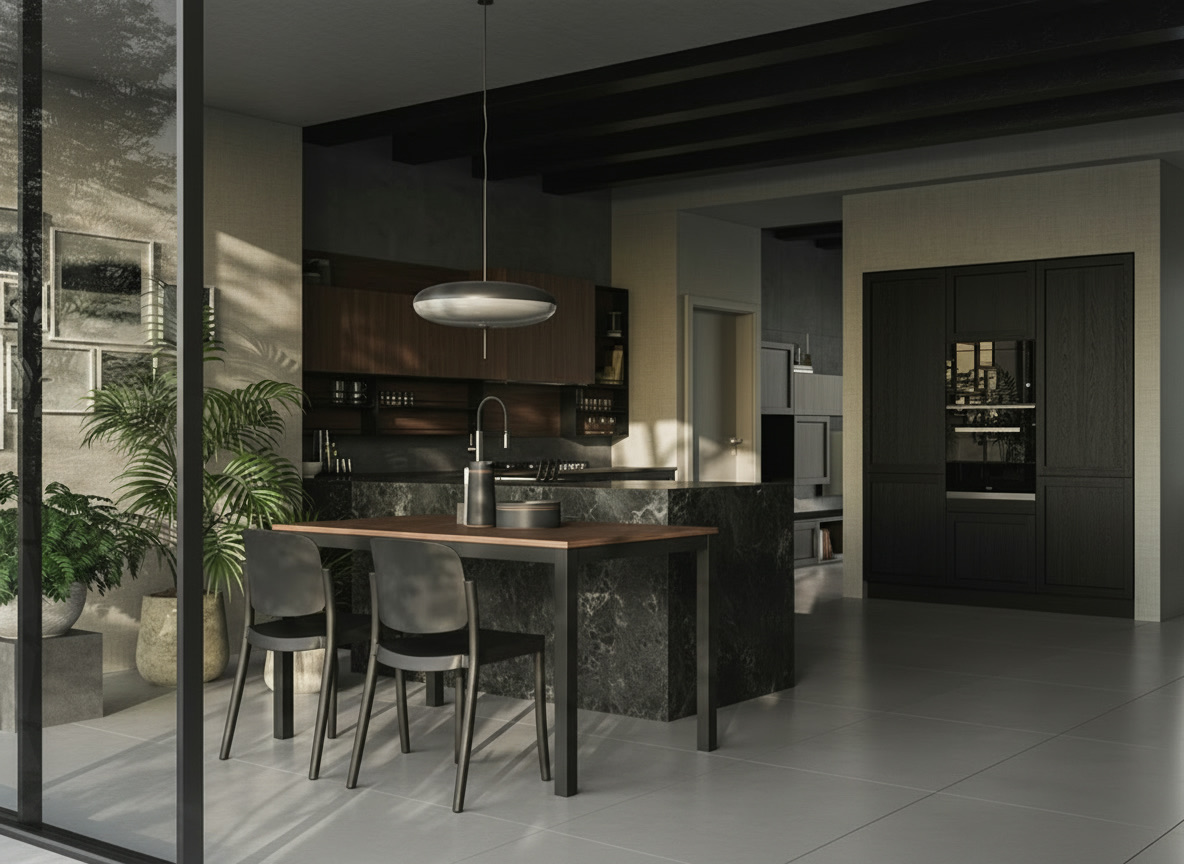
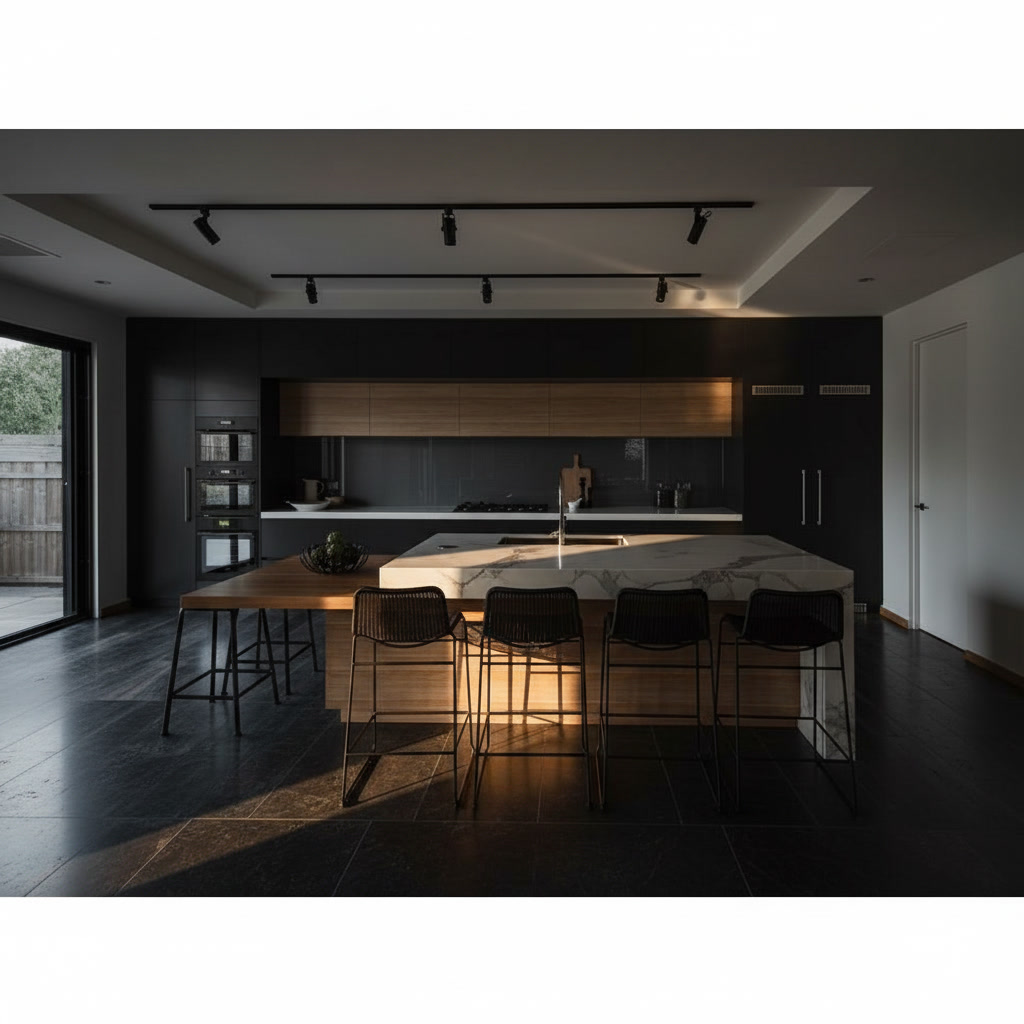
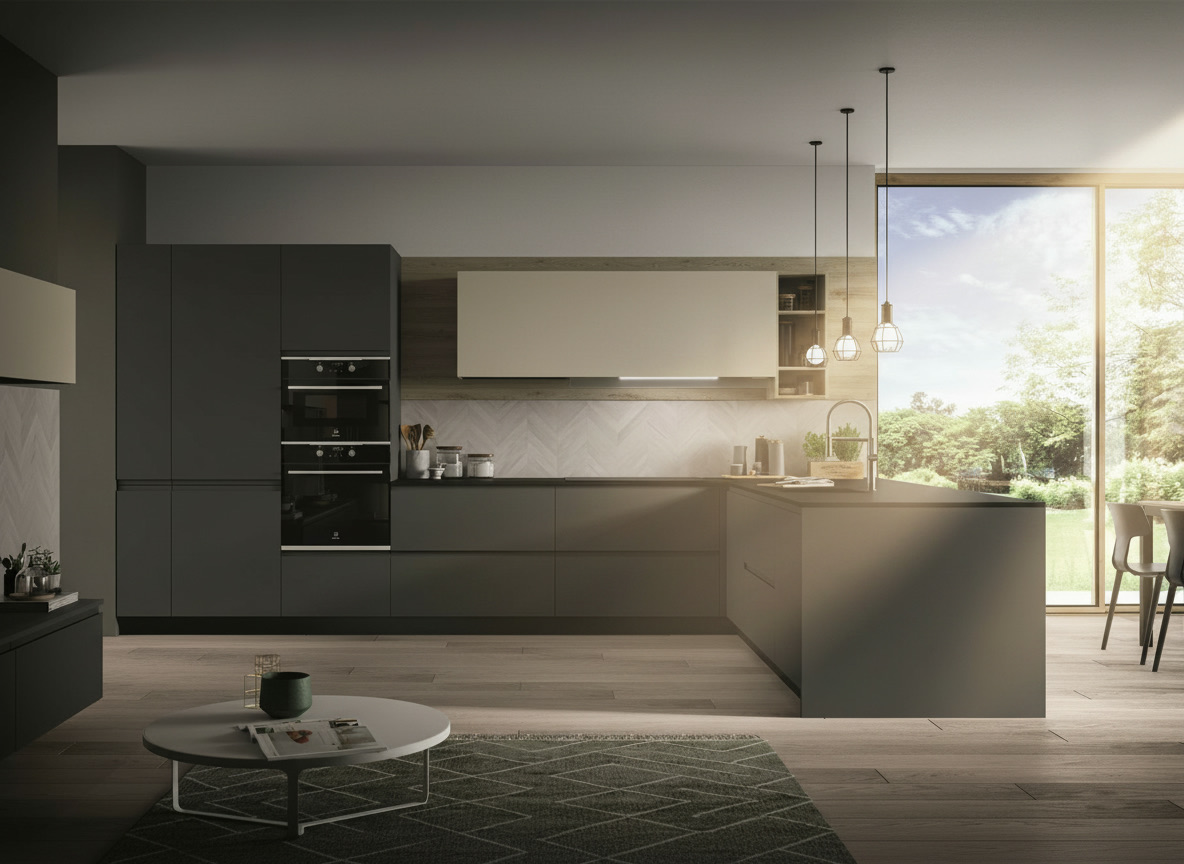
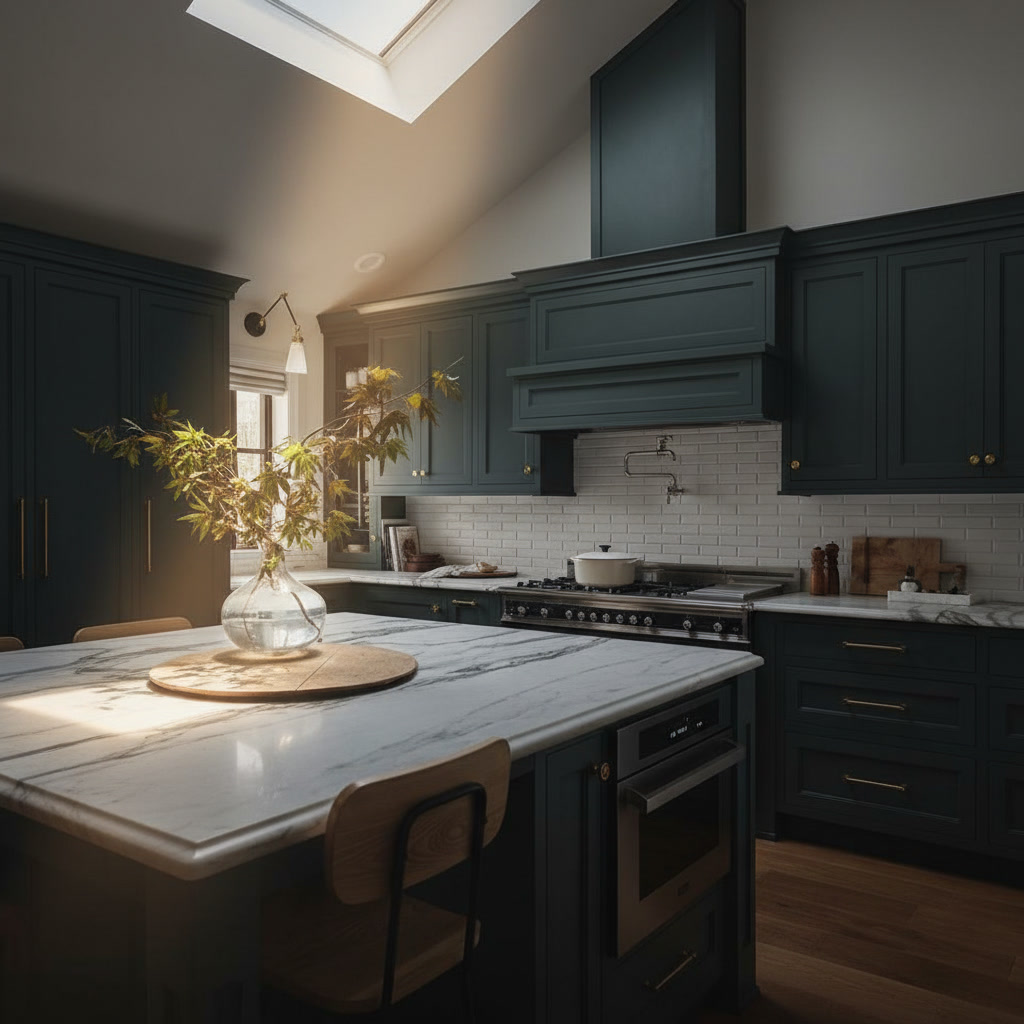
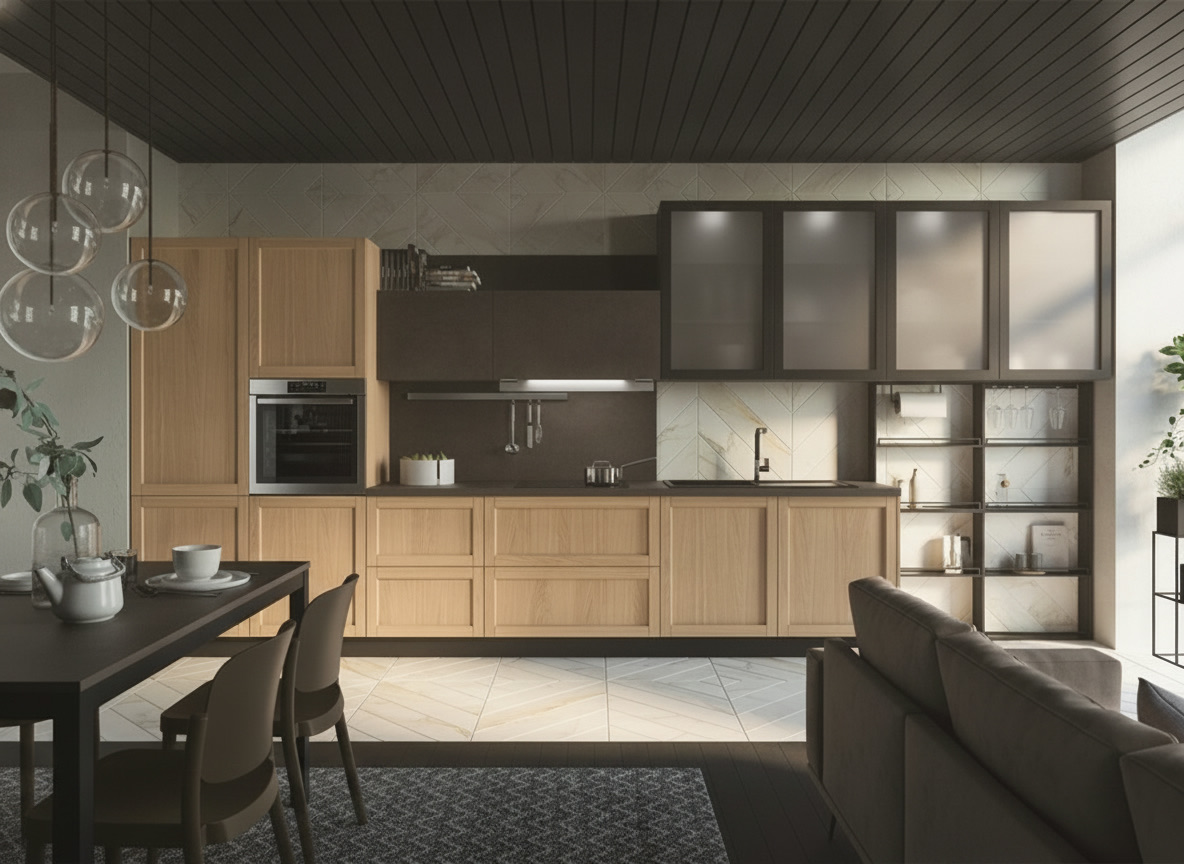
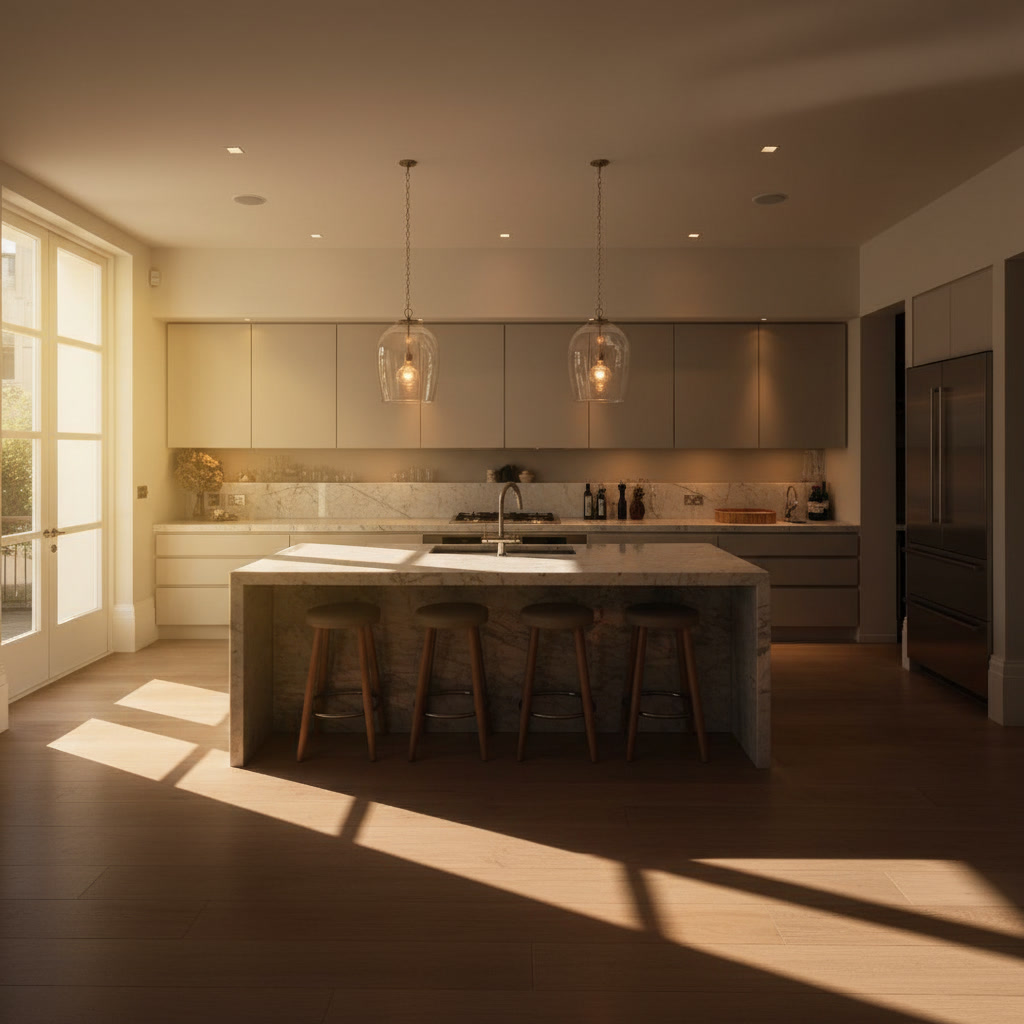
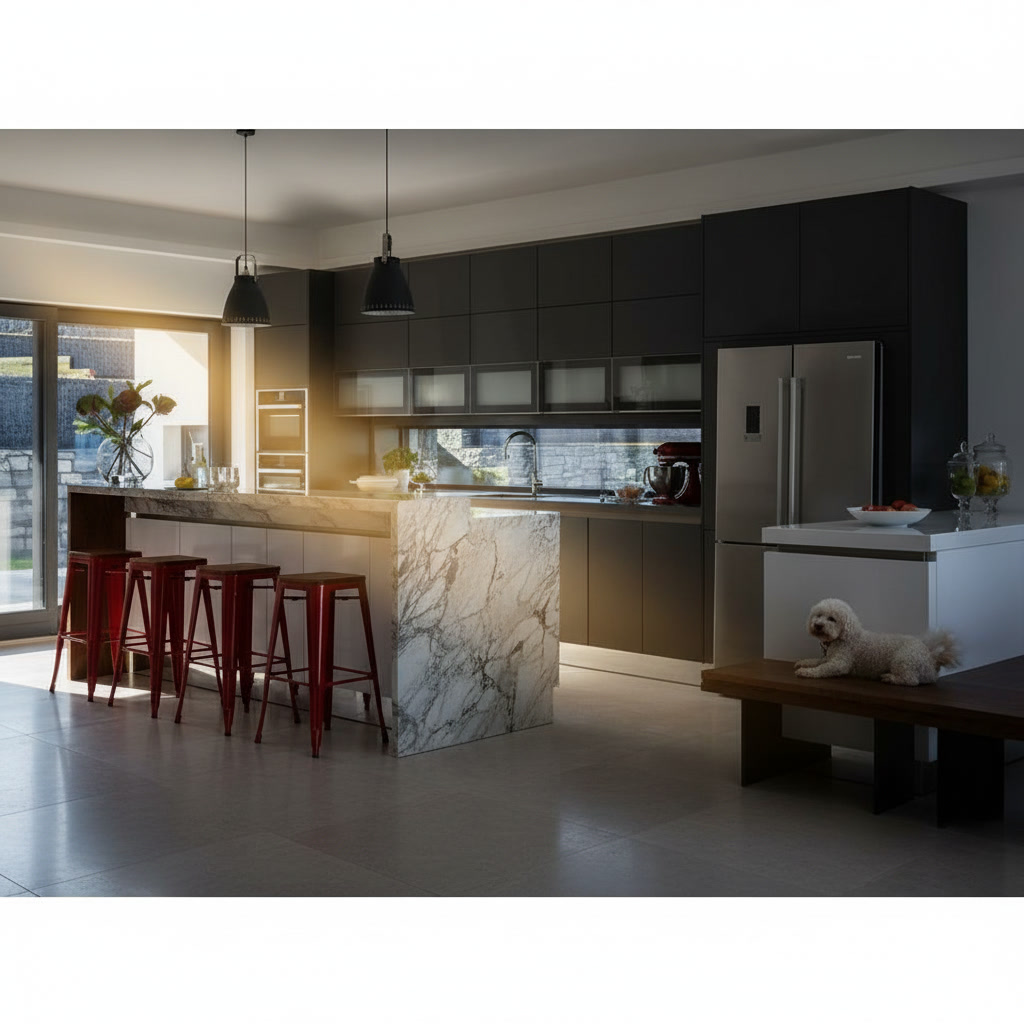
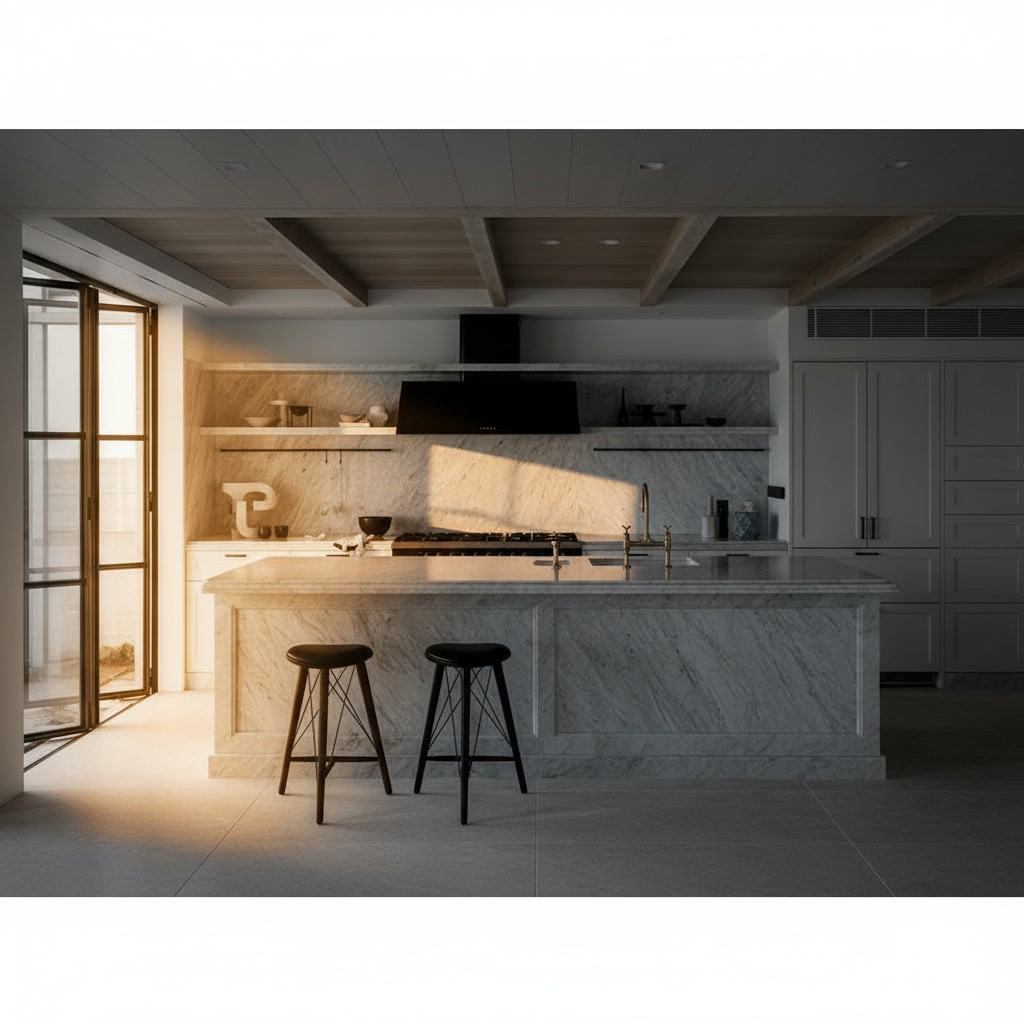
Every kitchen is designed and built to measure, in wood, steel, marble or porcelain stoneware, for every budget. Tap a photo to enlarge it.
See all the kitchens Plans and drawings of the layouts Free quotation
A kitchen like this, made to measure for you.Free, no-obligation quotation · free site survey in Lazio · 3D design · since 1976
The modular kitchen — a Michelessi vision
From flat panels,
piece by piece
01 A dark room under a single spotlight: oak panels still stacked on pallets, doors wrapped in paper, two Calacatta slabs on the trolley. Drill, level and rubber mallet are already on the floor: the kitchen is still all to be built.
02 Two fitters, always seen from behind, join the sides to the bases, adjust the feet, hang the doors one by one and raise the wall cabinets onto the rail. Piece by piece the kitchen takes shape; then the slabs arrive and the marble worktop is laid on the bases, sink and all.
03 Tape and film come off, the matte stone is polished in slow circles and the gold vein comes alive. The brass tap finds its place, the light under the wall cabinets lifts the backsplash. The finished kitchen remains, and the swept floor.
Keep scrolling — the scene follows you
Why Calacatta is the marble for kitchens meant to be looked at
In a kitchen, Calacatta is never a backdrop: it is where the eye lands as you walk into the room. The warm white ground and the broad veins read from across the room, which is why a Calacatta kitchen is designed the other way round from a Carrara one: the question is not how much stone to use, but where to put it. A single island, with the splashback behind the hob cut from the same slab, is enough to set the tone of the whole space; the other worktops can be Dekton, Fenix or quartz, within the same design, and the scene does not change. It is the most sensible way to bring a rare marble into a home: a little of it, in exactly the right place.
- Where it earns its place. The top and end panels of the island or peninsula, the splashback behind the hob, the breakfast bar, the table that runs on from the island.
- Where it is better left alone. Around the sink and hob of someone who cooks with lemon, wine and tomato every day: there, a technical worktop in a matching tone does the work without drawing attention.
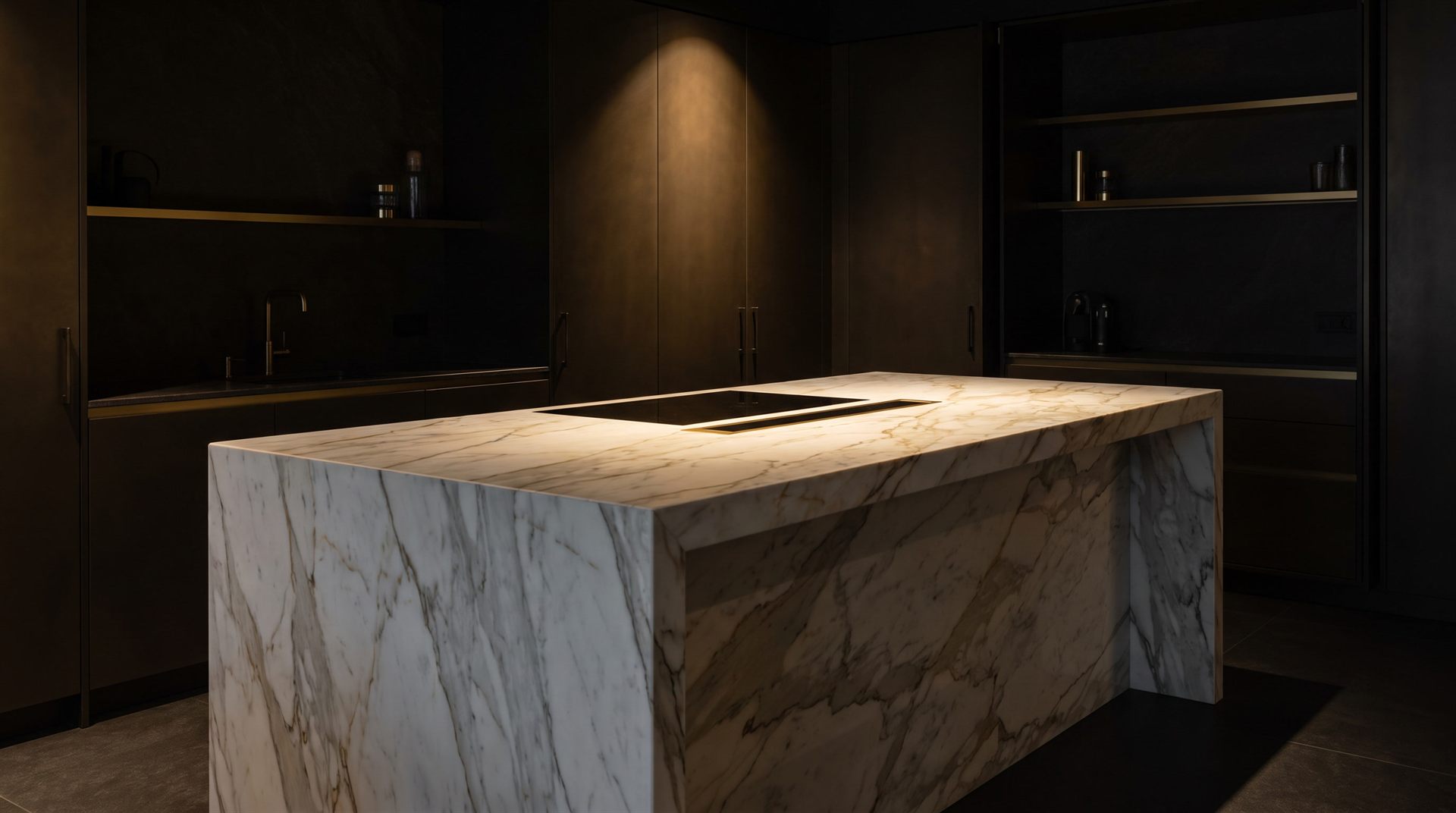
Classic, Oro, Vagli, Borghini, Viola: which Calacatta for your kitchen
The name Calacatta covers slabs that differ a great deal from one another, and in a kitchen the variety decides the colour of everything else: doors, metals, floor.
| Variety | Ground and veining | Sits well with |
|---|---|---|
| Classic Calacatta | Warm white, broad and sparse grey veins | Almost anything: pale timber, black, stainless steel, white |
| Calacatta Oro and Vagli Oro | Milky white, golden and warm-grey veins | Brass, oak, walnut, doors in sand or dove-grey tones |
| Calacatta Borghini | White ground, denser grey veins with gold and brown highlights | Classic kitchens with framed doors, bronze, timber floors |
| Calacatta Macchia Vecchia | Ivory ground, broad clouded grey-gold veins | Dark timber, warm tones, matt-finish doors |
| Calacatta Viola | White ground, violet and burgundy veins | Black or smoke-grey doors, burnished brass; best kept to a single island |
The golden varieties warm the room and call for warm metals; the classic grey-veined stone is the easiest to pair; Viola is a choice with character, and it works when the rest of the kitchen stays quiet. In every case the slab decides, not the name: two Calacatta Oro slabs from the same block can carry one dense vein and one sparse.
Reading the slab: where the vein should run
Once the slab is chosen, in person in Aprilia or by video call as with every kitchen we make, the work that sets a well-made Calacatta kitchen apart begins: deciding where every vein will fall. On the photographed and measured slab we draw the outline of each piece, worktop, end panels, splashback, breakfast bar, and move it until the pattern is right. The rules we follow:
- The main vein runs the length of the island. It stretches the worktop and follows whoever sits at it. Set across the width, it pushes the eye towards the end panels: that only suits short, deep islands.
- Cut-outs never cut through the vein. Hob and sink go in the calmer areas of the slab. If a vein has to cross the sink, we carve the sink from the same slab so the pattern carries on down into the bowl instead of stopping at a steel rim.
- The splashback continues the worktop. The vein climbs from the counter up the wall in the same direction, as if the slab had been folded; that is why the splashback is cut from the part of the slab next to the worktop, not from an offcut.
- The finest part goes where people look. The densest knot of veins belongs on the end panel facing the living room or at the centre of the top, not under the hood or behind the tap.
- Mirrored slabs are reserved together. Book-matching the end panels or the top takes two consecutive slabs from the same block: they are reserved with the design, before cutting, because the block will not wait.
The three-dimensional design shows you the result with the veins in place, and you can still shift the layout by a few centimetres before cutting. The mitred joint, the waterfall edge and the overhang are explained on our page on the marble kitchen island.
The right light for Calacatta
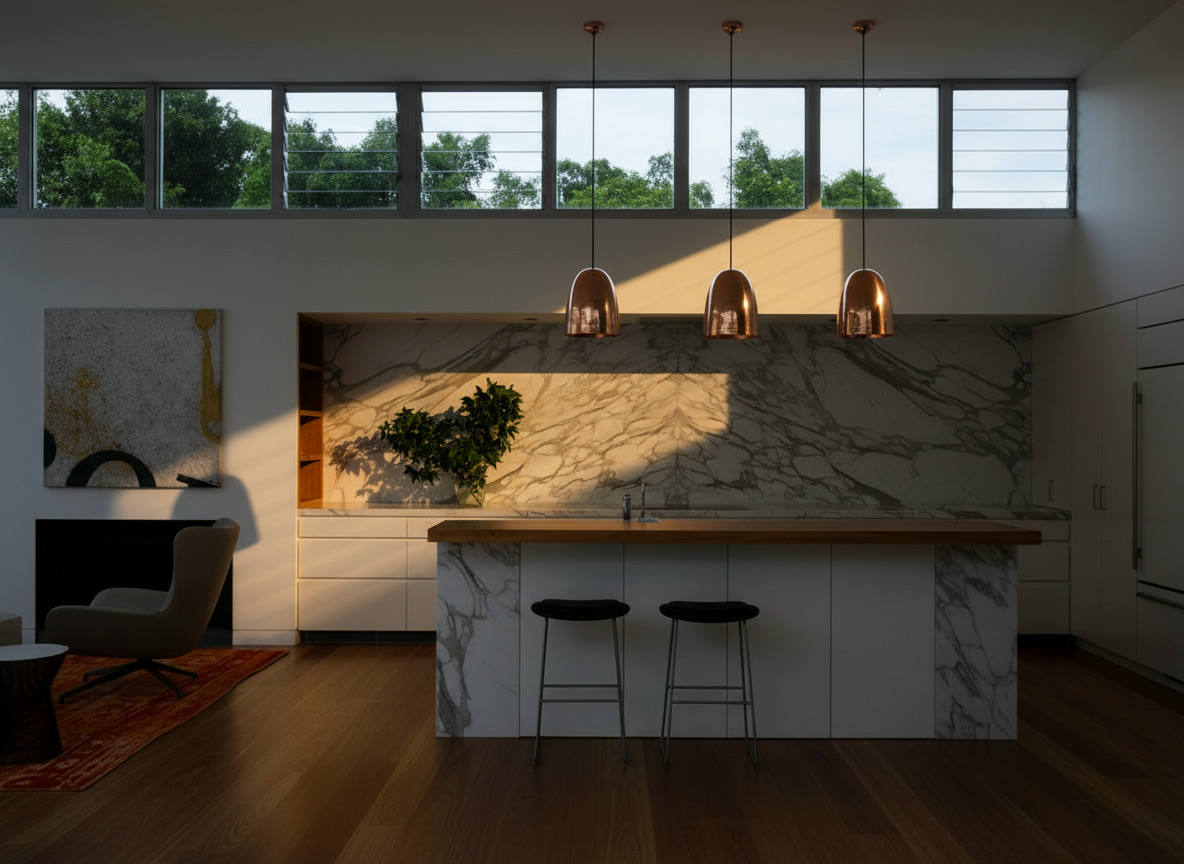
Calacatta's white is a warm one, and light changes it more than you might think. Under very warm light, around 2700 K, the ground turns yellowish and the gold in the veins is lost; under cooler light, from 4000 K upwards, the white goes grey and the stone looks poorer. The light that shows it as it looked on the slab sits around 3000 K, with a high colour rendering index.
- Over the island choose diffused light from above rather than narrow spots: tight downlights on a polished top draw circles and show every mark.
- On the splashback an under-cabinet strip reflects in polished Calacatta; either choose a honed finish or move the light to the front edge of the wall unit.
- By day a north-facing window gives a neutral light that cools the white, a south-facing one warms it: look at the sample in the room itself, at the hours when the kitchen is used most.
Pairings: timber, brass, black
The materials around Calacatta should be chosen with its warm white in mind. Three routes we propose often:
| Pairing | Effect | Where to use it |
|---|---|---|
| Timber: oak, walnut, ash | Softens the marble and brings it into everyday life | Framed doors, island bases, shelving; the Noè doors with a solid oak or ash frame |
| Brass | Picks up the gold in the veins and makes them glow | Edge inlays, handles, taps, the trim of the hood |
| Black: lacquered doors, burnished steel, the hob | Sharpens the white and brings order | Era 02 doors in lead finish, tall units, hood, sink |
With the plain, handleless doors of Volo 01 or Domina the marble stands alone; with the oak of Noè the kitchen grows warmer; brass should be rationed, a thread rather than a frame. The models are described on our modular kitchens page, and the balance between stone and timber on the marble and wood kitchen page.
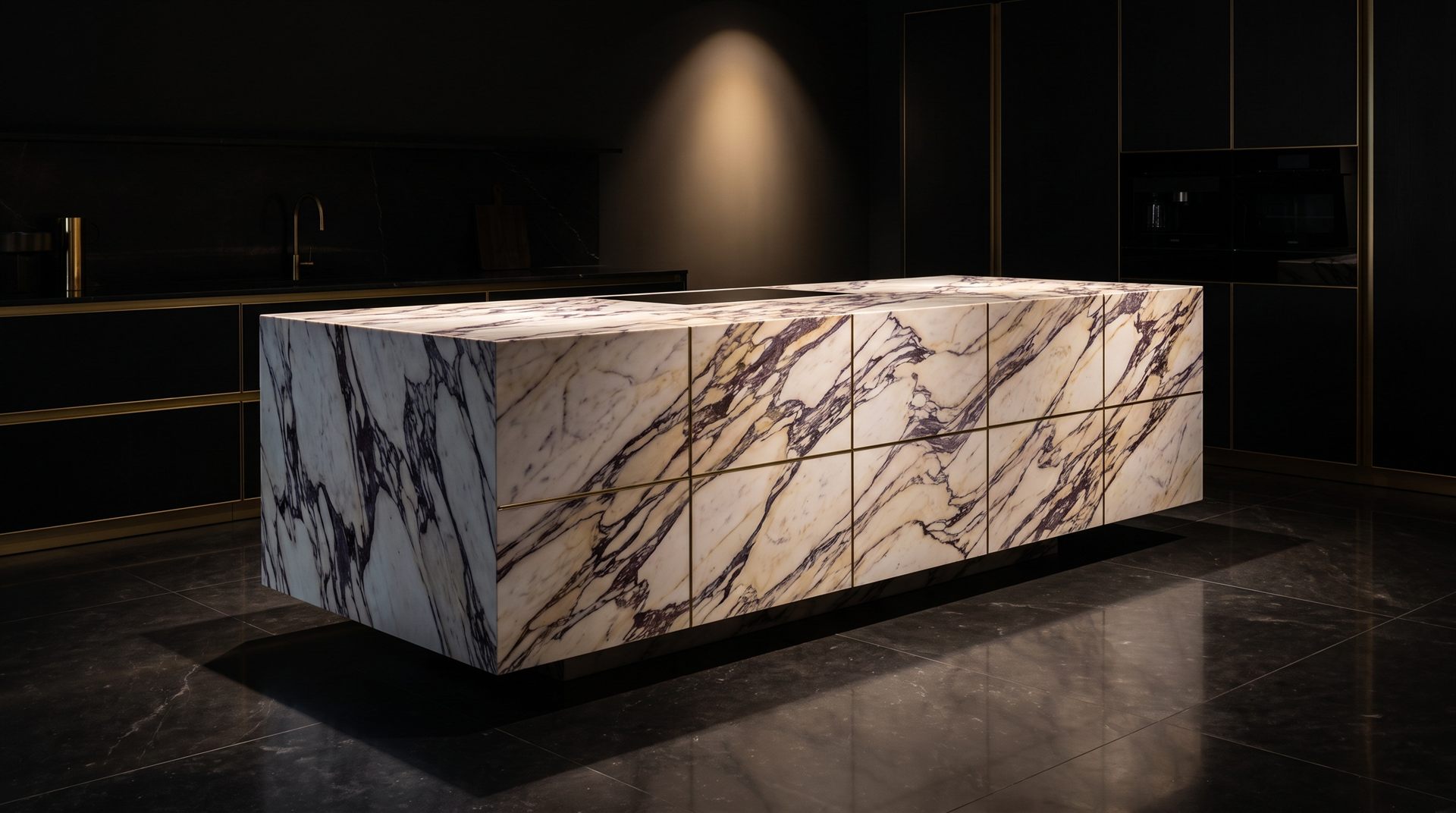
Real Calacatta or a Calacatta look in Dekton and quartz
Technical slabs reproduce the Calacatta pattern, and many people ask us whether the difference shows. It does, in three ways.
- Depth. In marble the vein runs through the thickness: you read it on the edge, inside a carved sink, down a waterfall end panel. In most technical slabs the pattern sits on the surface: on the edge and in the cut-outs the uniform body of the slab appears, and a waterfall does not carry on round the corner by itself.
- Repetition. Every Calacatta slab is unique; in a technical material the same pattern returns slab after slab, and a book-match is a drawn motif, not a vein that truly mirrors itself.
- Repair. An etch mark or a scratch on Calacatta is honed away, on site if need be; a technical slab marked deeply is replaced.
The technical material wins on acids and on peace of mind: it is untroubled by lemon, wine or coffee. That is why many of our designs combine the two, real Calacatta on the island and splashback, Dekton or quartz in a matching tone around the sink and hob. The full comparison is in our guide to marble, Dekton, quartz or Fenix for the kitchen worktop.
How Michelessi works
Calacatta is not a catalogue marble, and our work begins before any cutting: we reserve the chosen slab, or the mirrored pair, and draw the position of every piece with you on a measured photograph of the slab. The quotation is free wherever you are; in Rome, Latina and throughout Lazio the site survey is free of charge too; from further afield the survey is done remotely and the slab is chosen by video call. Every piece is made in our workshop in Aprilia, on the Via Pontina between Rome and Latina, where we have worked marble since 1976: numerically controlled cutting to the approved drawing, joints, edges and sink finished by hand, sealer applied before delivery. Installation is carried out by our own team; we also deliver and install abroad, as in our Dubai project, and lead times are agreed in the quotation.
Where to go next
This page concerns a single marble; the full picture, with Dekton, Fenix and quartz worktops and the modular kitchens, is on our indoor marble kitchens page. The workmanship of the island and the worktop is covered on the marble kitchen island and marble kitchen worktop pages. To get to know the stone, its care and how it differs from the other whites, read the Calacatta page and those on Statuario and Bianco Carrara; to choose with method, our guides on how to choose marble for your kitchen and marble worktop care. To begin, write to us through the contact page with a plan or a photograph of the room.
Free quotation
Ask for a quotation for your kitchen
Tell us about the space and the idea: measurements, even taken by hand, a few photographs, the material you like. We reply from our workshop in Aprilia with a 3D design and a quotation, free and without obligation.
Frequently asked questions
Frequently asked questions
Can I have a book-matched Calacatta island without visible joints?
The joint remains, but in a book-matched layout it becomes the axis of symmetry of the vein and the eye reads it as part of the pattern. It takes two consecutive slabs from the same block, reserved together with the design, and joints closed and polished by hand: the seam is barely noticeable.
Which Calacatta is the easiest to pair in a kitchen?
Classic Calacatta with grey veins: it sits well with pale timber, with black, with stainless steel and with white doors. The golden varieties, Oro and Vagli Oro, warm the room and call for brass and warm timbers; Borghini suits classic kitchens; Viola is a choice with character, best kept to a single island with the rest of the kitchen in quiet tones.
Can I choose the slab if I do not live in Italy?
Yes. We show you the slabs by video call from our workshop in Aprilia, turn them in daylight and send you photographs with the dimensions marked; on those photographs we then draw the position of every piece with you. If you prefer, you are welcome to see them in person on the Via Pontina, between Rome and Latina.
Is Calacatta-look quartz the same as real Calacatta?
No, and the difference shows in three places: in marble the vein runs through the thickness and can be read on the edge and inside a carved sink, whereas in technical slabs the pattern mostly sits on the surface; every Calacatta slab is unique, while a technical pattern repeats; a mark on marble is honed away, a technical slab is replaced. Quartz wins on acids, which is why we often combine them: marble on the island, quartz around the hob.
Calacatta or Statuario for a kitchen?
Calacatta has broad grey or golden veins and is the marble for book-matched islands that become the painting in the room. Statuario has the purest ground and a few crisp veins: quieter and more luminous. For a whole kitchen in marble, with long runs of worktop and splashback, Bianco Carrara gives a calmer surface. We advise you with the slabs in front of us.