
Indoor marble kitchens
Marble Kitchen Worktop: Thickness, Edges, Finishes, Care
A marble kitchen worktop is made from a solid slab 2 or 3 centimetres thick, with a square, bevelled or bullnose edge, a polished, honed or brushed finish, an upstand or full-slab splashback, an undermount or carved sink and a flush-fitted hob. Michelessi has cut them to measure in Aprilia, Italy, since 1976, with free survey and quotation across Lazio.
A kitchen like this, made to measure for you.Free, no-obligation quotation · free site survey in Lazio · 3D design · since 1976
Kitchens we have built
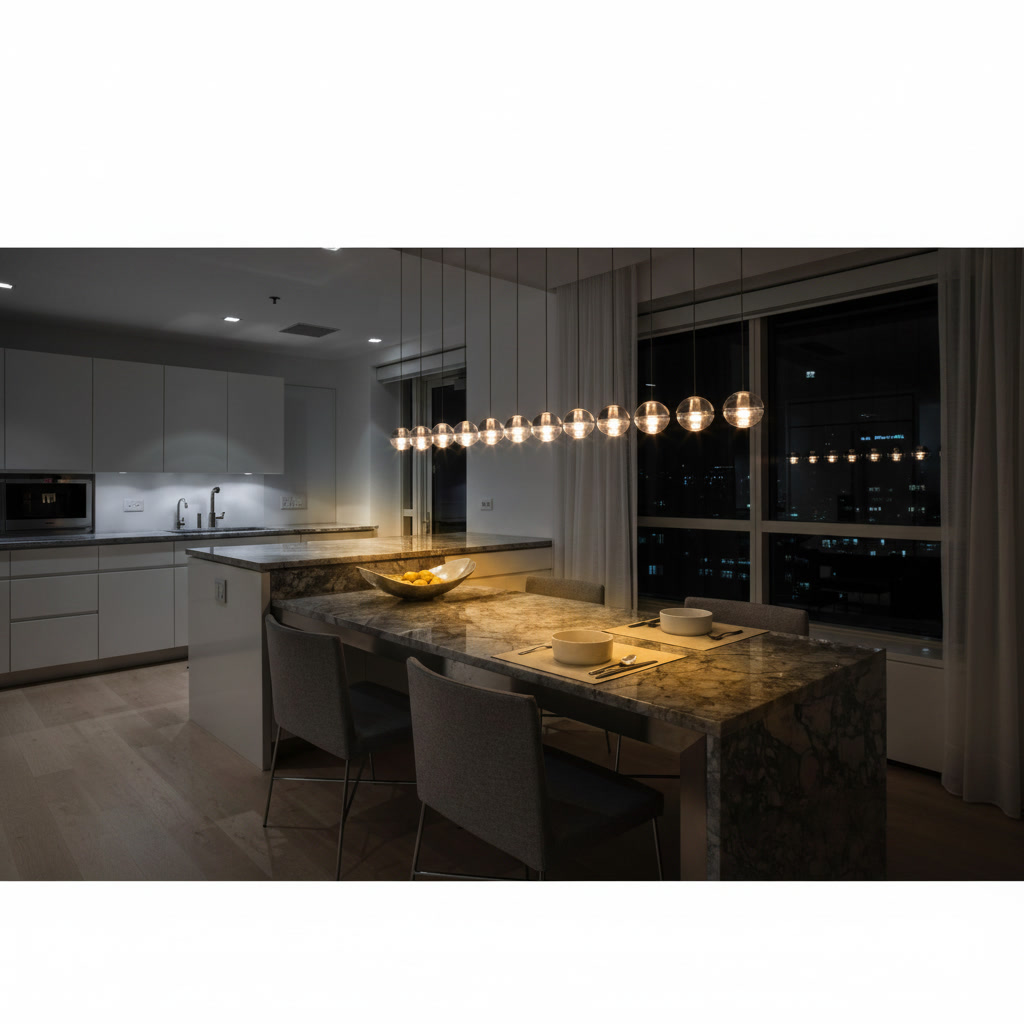
Some of the kitchens we have built
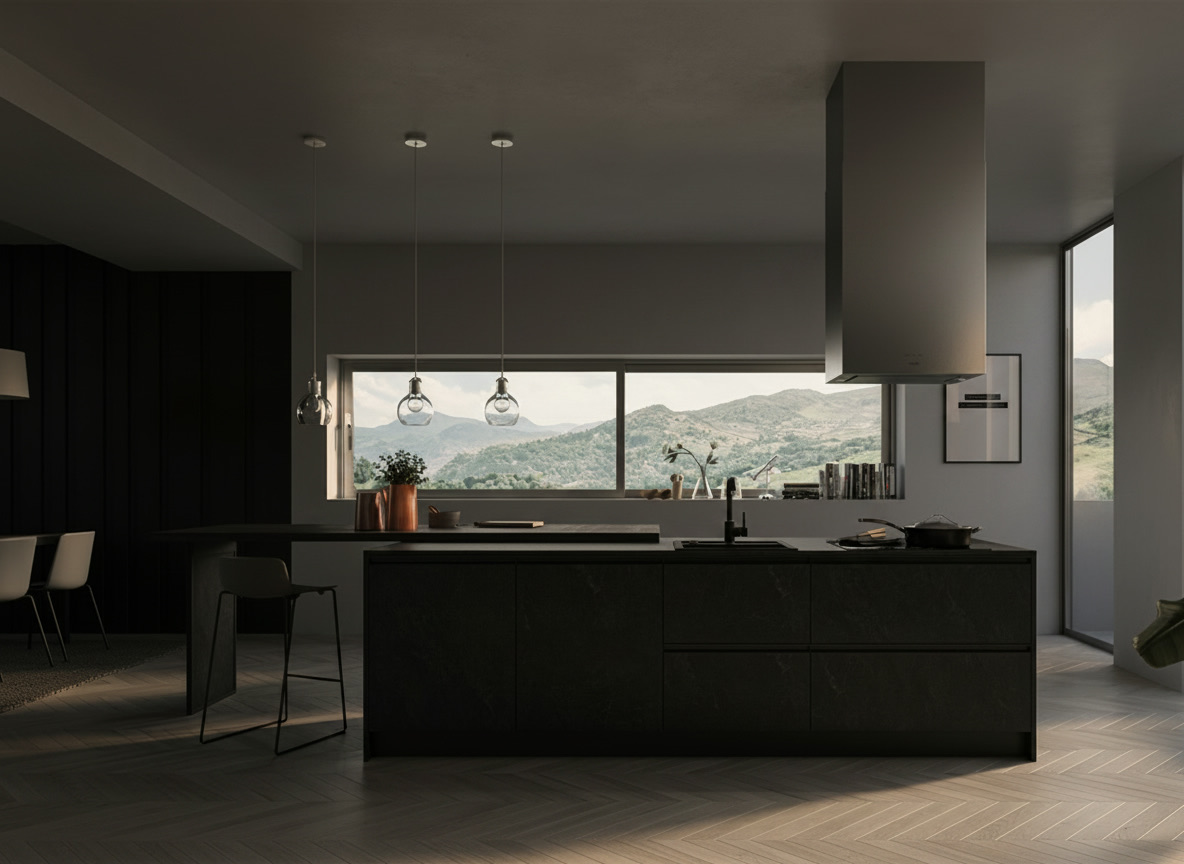
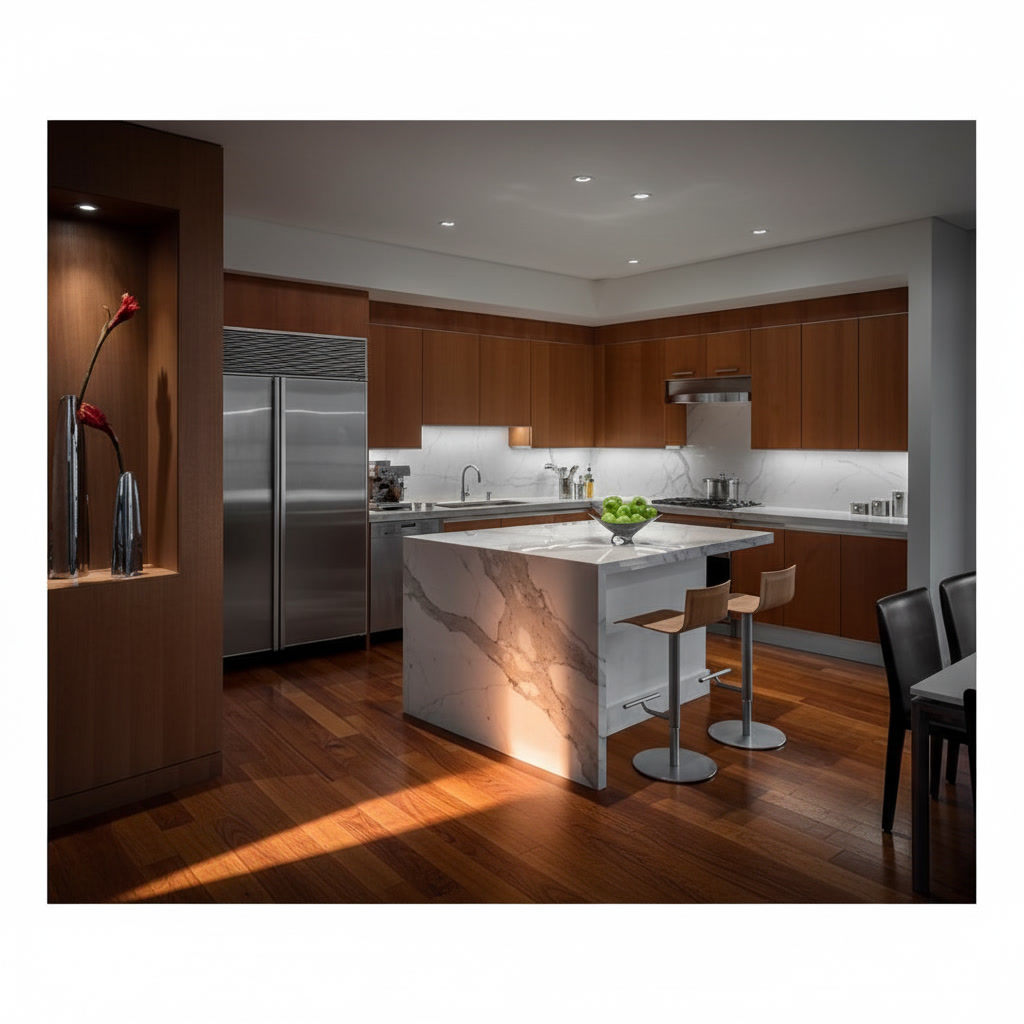
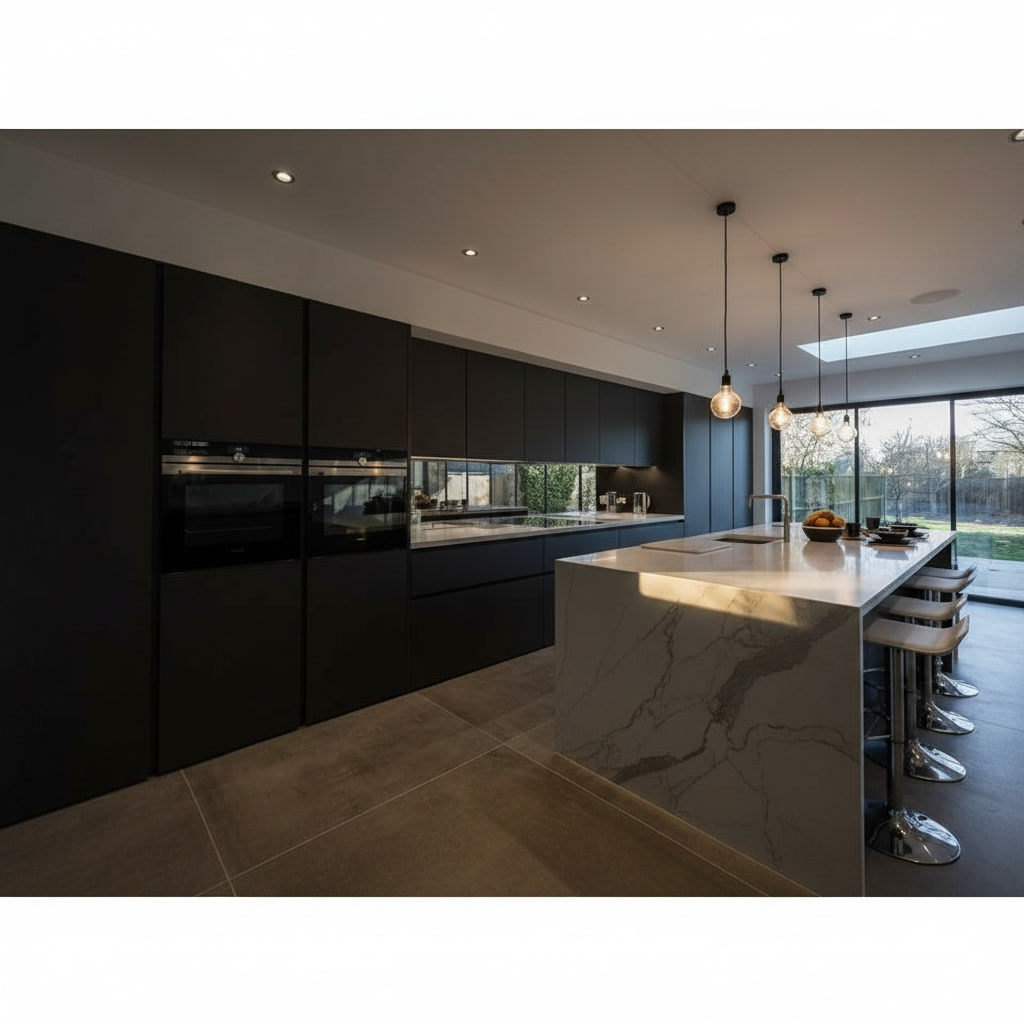
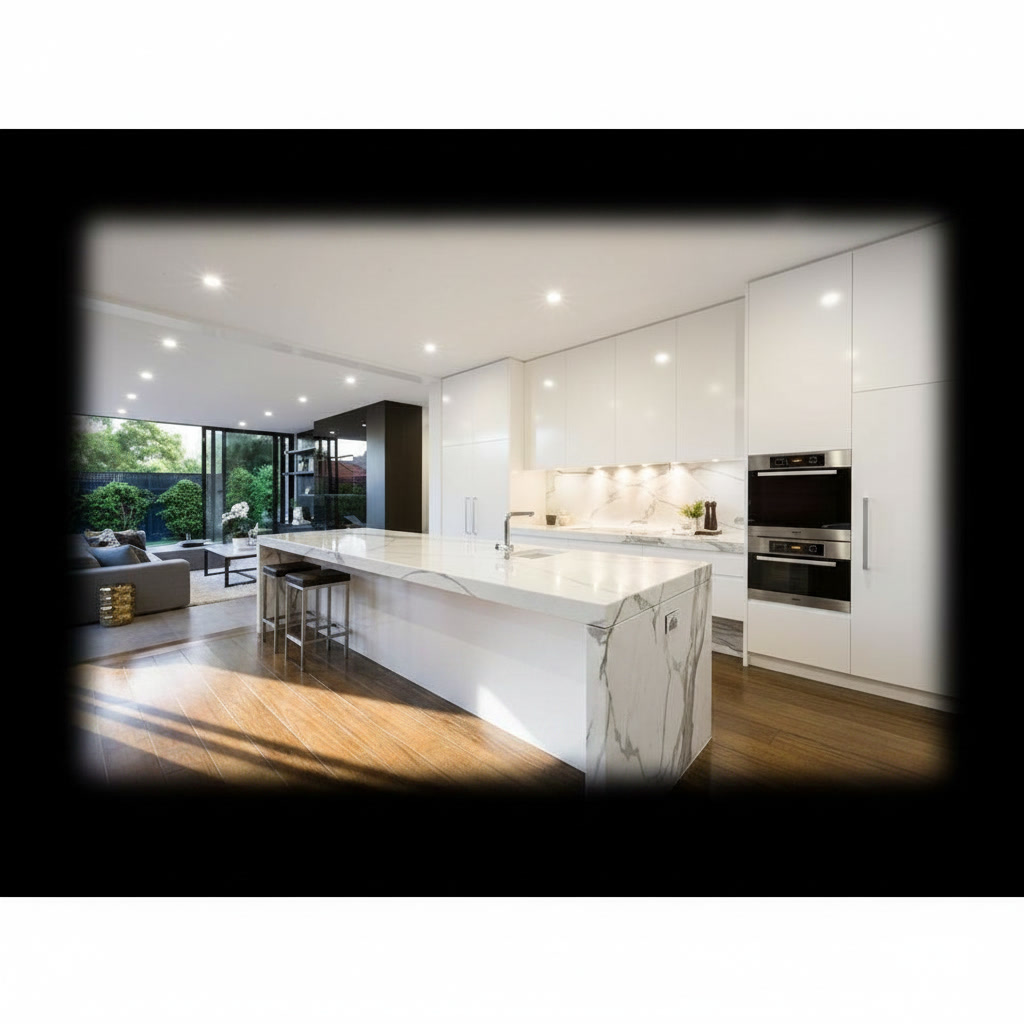
Every kitchen is designed and built to measure, in wood, steel, marble or porcelain stoneware, for every budget. Tap a photo to enlarge it.
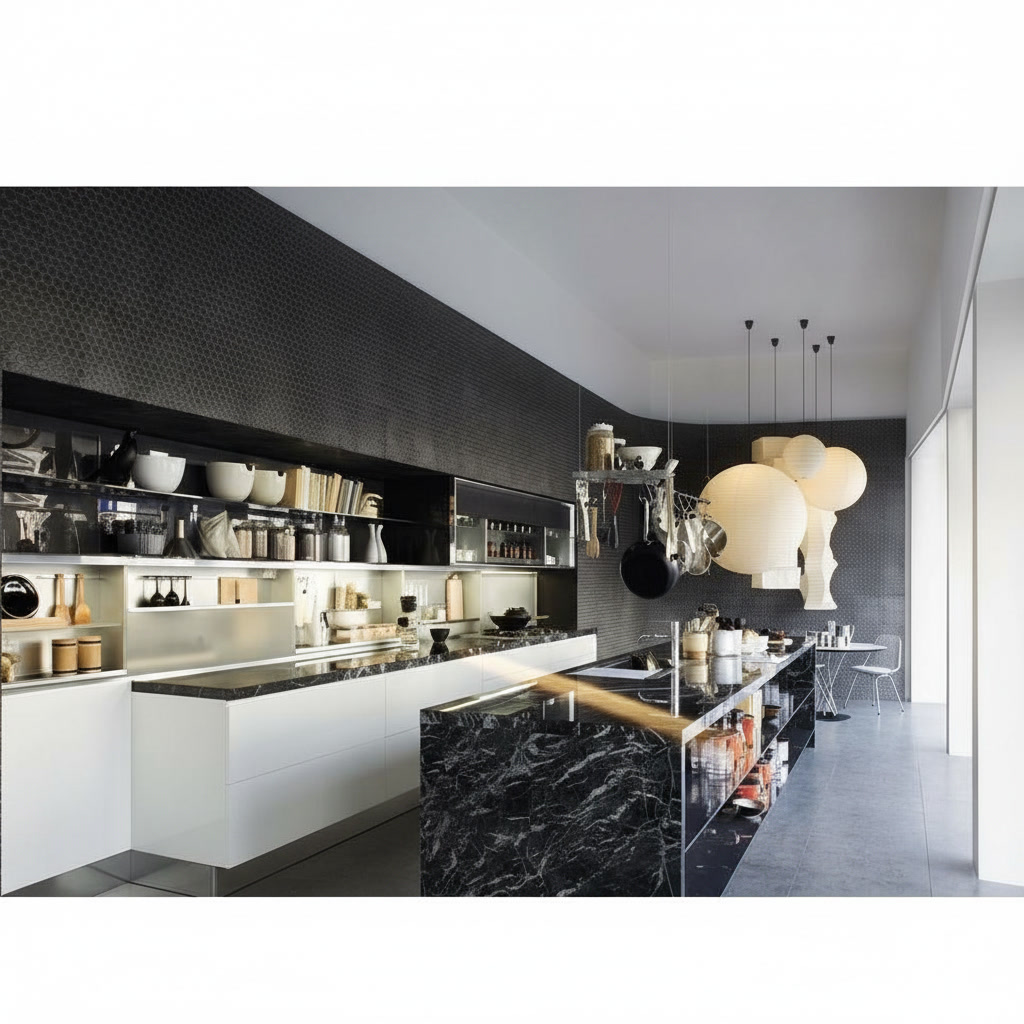
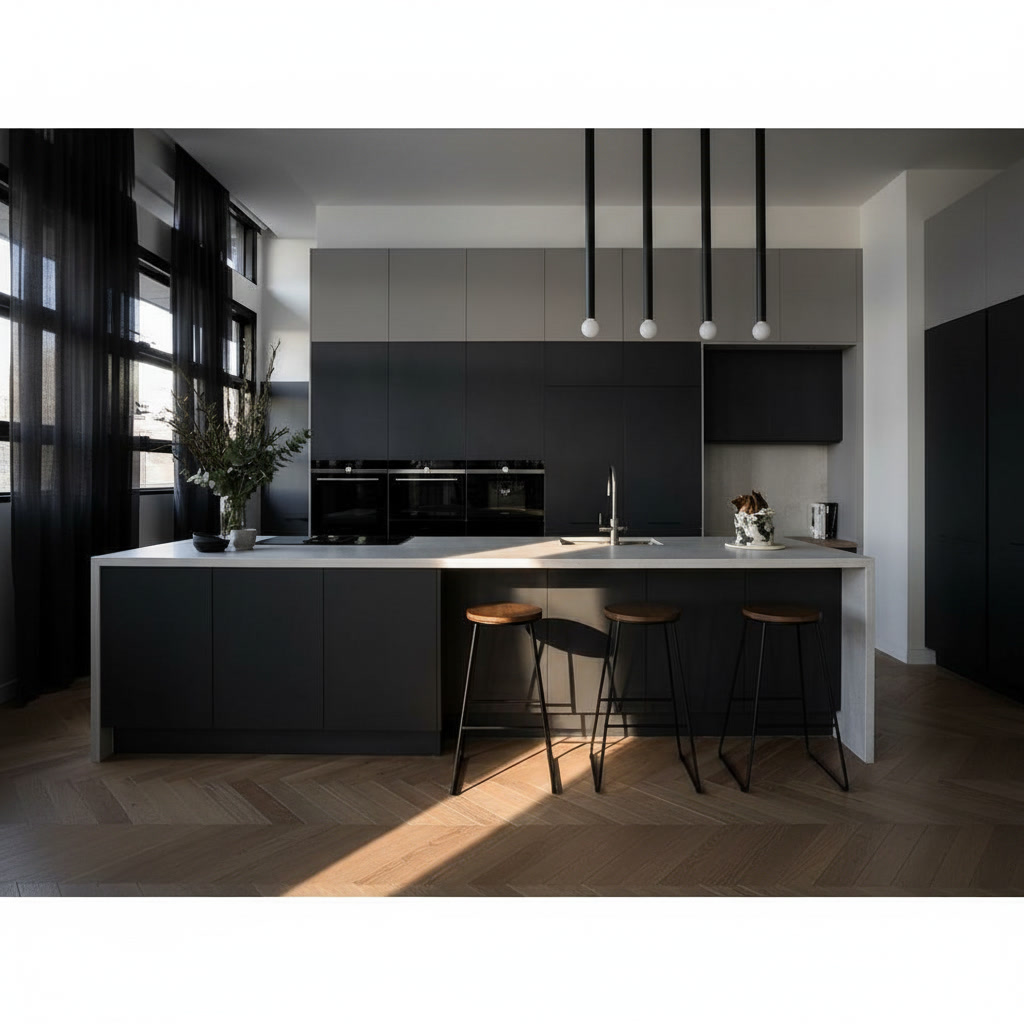
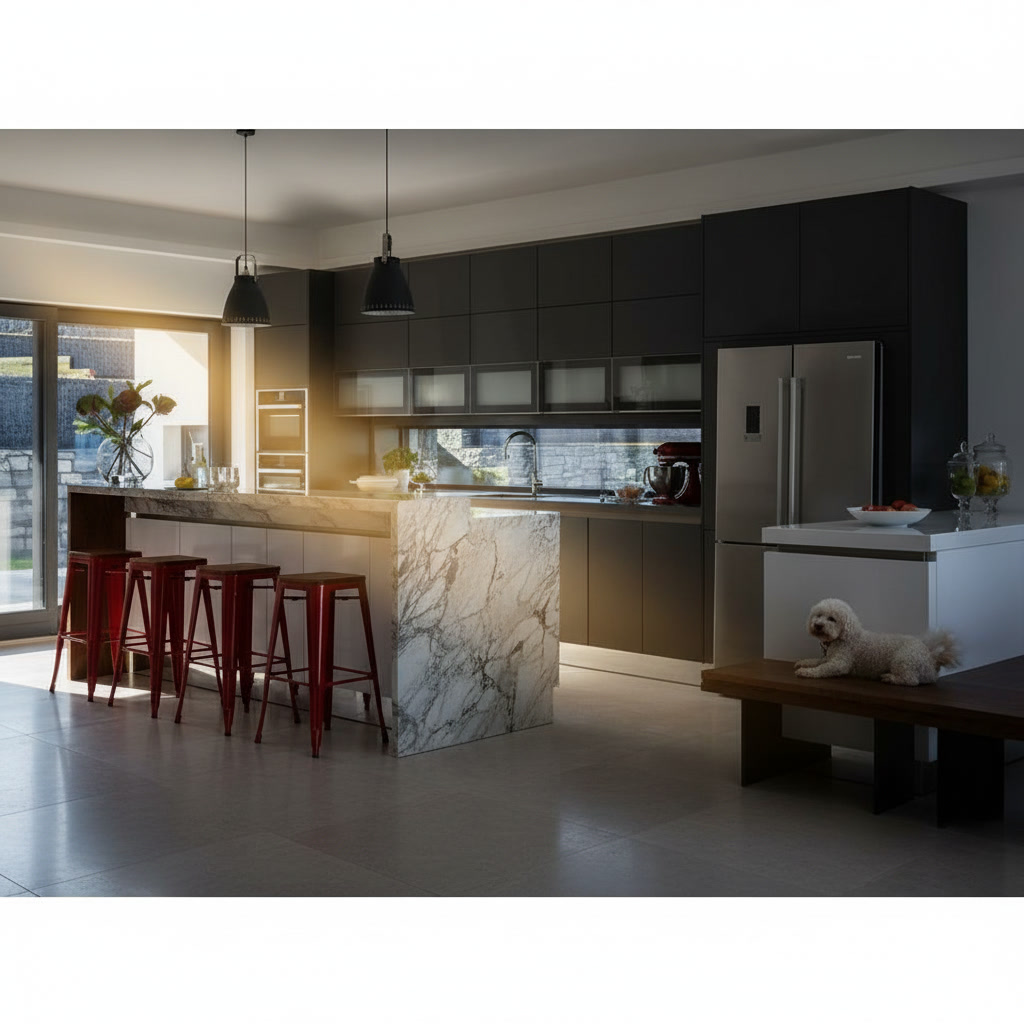
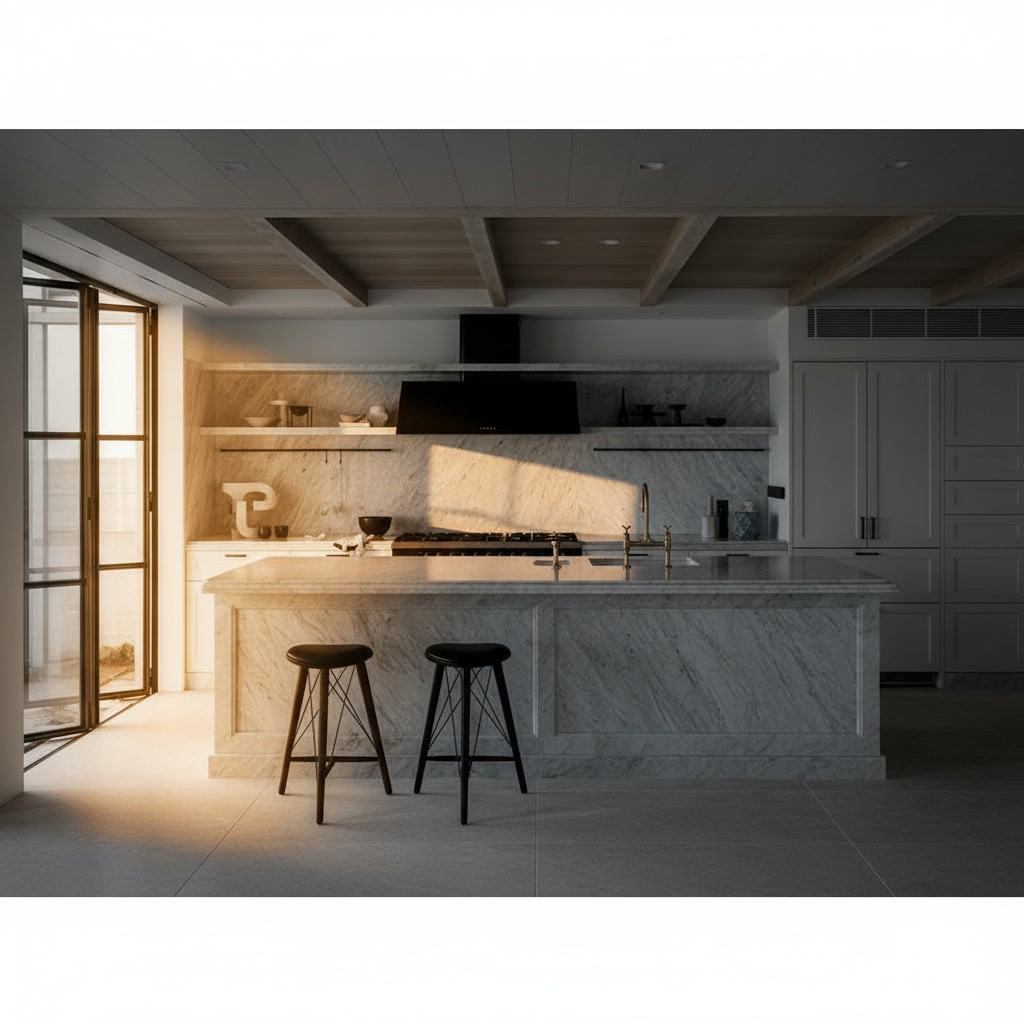
See all the kitchens Plans and drawings of the layouts Free quotation
Worktop thickness: 2 or 3 centimetres, and how the front edge is built
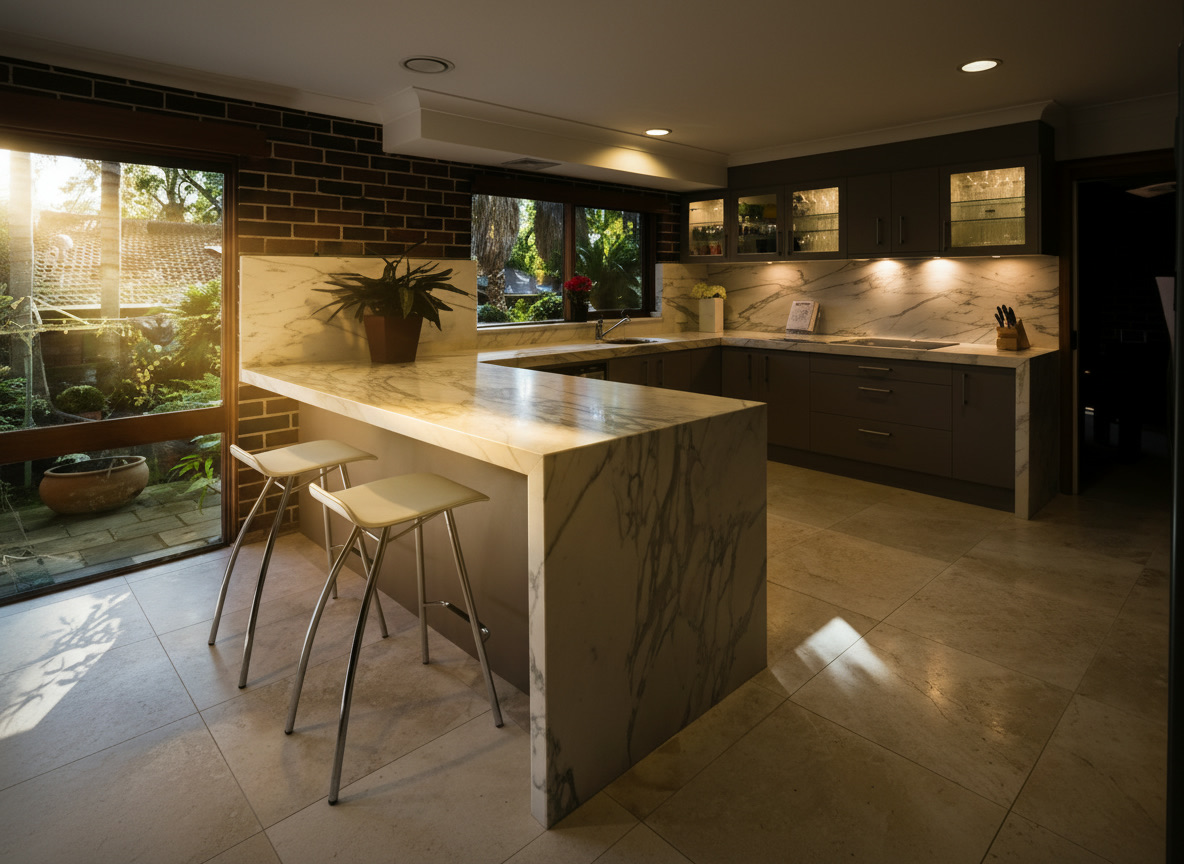
A marble kitchen worktop starts from a slab 2 or 3 centimetres thick. Two centimetres gives a slender profile and is the most common choice for straight runs against a wall; three centimetres adds strength around the sink and hob cut-outs and carries a breakfast-bar overhang more comfortably, though the deepest overhangs still need brackets concealed in the cabinet. If you want a deep front edge — 4, 6, 8 or 12 centimetres, as on a monolithic island — no block is needed: a strip of the same slab is mitred at 45 degrees and bonded beneath the top, so the vein runs from the surface down the edge without the eye finding the joint.
Finishes: polished, honed or brushed
The same slab changes character with its finish, and on a working surface the choice matters more than anywhere else.
- Polished: a mirror surface with the deepest colour and veining, the pores partly closed by the polishing. It does, however, show every etch mark left by acids; we recommend it for the island and the bar.
- Honed: matt and silky, forgiving of everyday marks and free of ceiling reflections; it is the finish we propose around the hob and the sink.
- Brushed: gently textured to the touch and the most forgiving over time.
Edges: square, bevelled, bullnose and the other profiles
| Edge | How it is made | Which kitchen |
|---|---|---|
| Square | Squared arris with a one-millimetre safety pencil round | Modern kitchens, waterfall islands, Dekton tops |
| Bevelled | A 45-degree chamfer a few millimetres wide, polished | Hides small chips on white marbles; contemporary style |
| Bullnose and half bullnose | Rounded profile, full or half | Classic kitchens and masonry-style indoor kitchens such as the Francesca kitchen |
| Ogee | Double curve, concave then convex | Traditional kitchens and thick worktops |
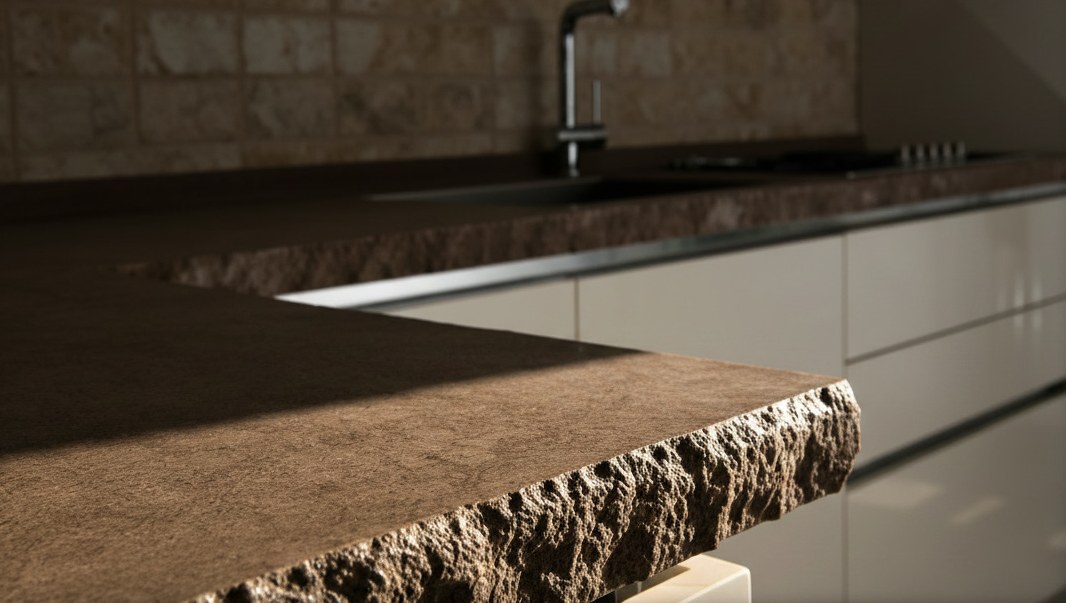
| Split face | Edge left rough as in the quarry | Travertine and textured stones, sculptural islands |
A word from the workshop: on veined, crystalline marbles such as Calacatta and Statuario, a sharp arris chips more readily than a barely-there bevel, which still reads as square to the eye.
Upstand or full-slab splashback
The upstand is a strip of the same slab, usually between 3 and 10 centimetres high, that closes the gap between worktop and wall and shields the plaster from splashes, its vein continuing that of the top. A full-slab splashback is a different project: a whole slab 2 centimetres thick, rising from the worktop to the wall units or the extractor, cut around sockets and shelves. Behind the hob marble tolerates moderate heat, provided the flame does not lick it; behind the sink a honed finish is wiser. When the slab allows, the splashback is cut book-matched, with two mirrored pieces, and the kitchen gains its centrepiece.
Undermount or carved sink, flush-fitted hob
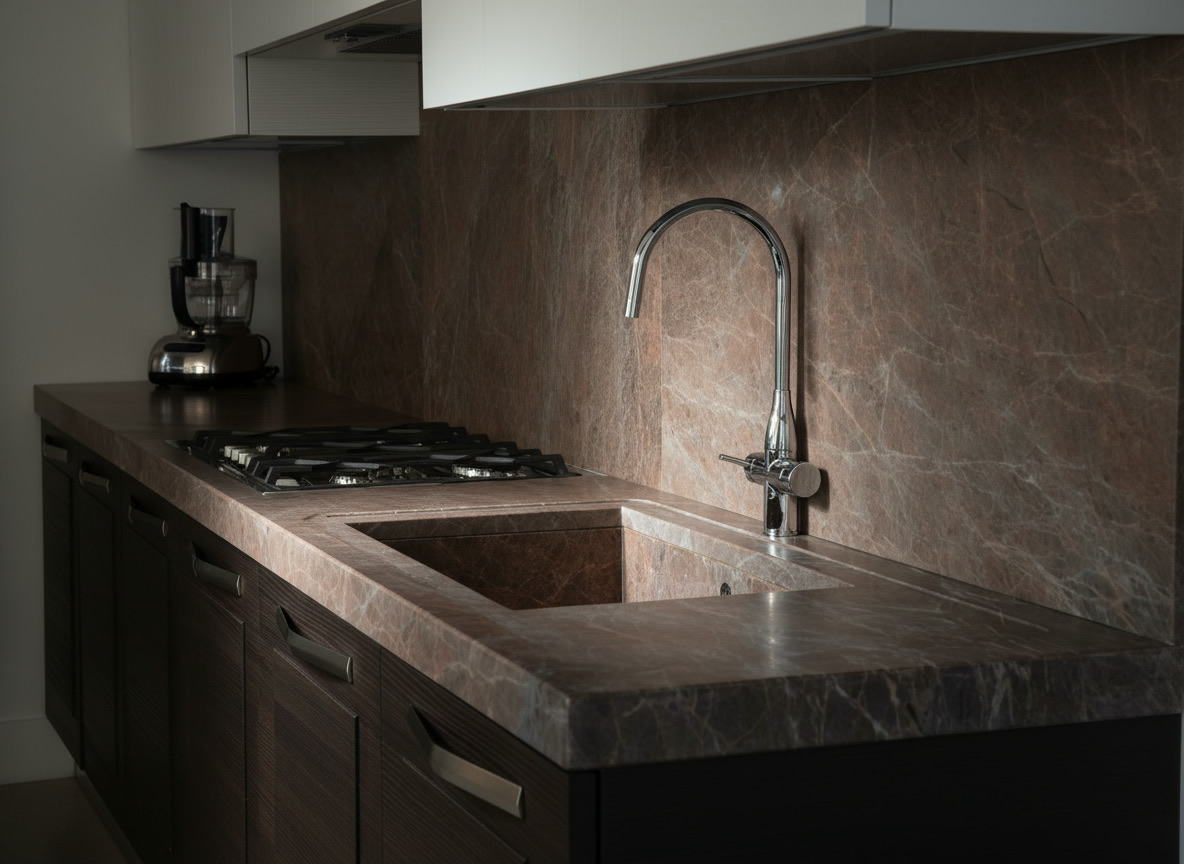
An undermount sink, in steel or composite, is fixed beneath the worktop: the opening is cut on the CNC with radiused corners and its edge polished. A carved marble sink is the piece that tells the craft best: it is hollowed from a block of the same stone or built from slabs mitred at 45 degrees, with the base falling gently towards the waste and the overflow hidden. It needs a cabinet prepared for the weight; in return, bowl and worktop become one object. A flush-fitted hob calls for a rebate a few millimetres deep around the cut-out, machined on the CNC with the precision of an inlay: the induction glass sits level with the marble and the hand glides across without meeting a step. In the design the cut-outs are kept away from edges and joints, which are planned in the 3D drawing before cutting.
Day-to-day care of a marble worktop
Three habits are enough: warm water with a neutral soap and a soft cloth, wiping up lemon, wine, vinegar and tomato straight away, and renewing the sealer once a drop of water no longer beads on the surface. No limescale removers and no scouring pads. A scratch or an etch mark is removed by re-honing and re-polishing in place. Our guide to marble worktop care and maintenance goes into stains and poultices in detail.
Marble, Dekton, quartz or granite: the worktop comparison
For heat, scratch and acid resistance we refer you to our materials guide; here we look at what matters when the worktop is actually made.
| Material | Typical thickness | Edges | Flush hob | Repair | Outdoors |
|---|---|---|---|---|---|
| Marble | 2 or 3 cm, deeper front mitred at 45° | All profiles, including carved | Yes | Re-honed and re-polished in place | Yes, under a pergola or in a sheltered spot, with seasonal care |
| Dekton | 2 cm, bonded mitred front | Square or bevelled | Yes | Chips are filled | Yes |
| Composite quartz | 2 or 3 cm | All polished profiles | Yes, with clearance from gas | Small flaws filled with tinted resin | No, sunlight yellows it |
| Granite | 2 or 3 cm | All | Yes | Re-polished | Yes |
Marble and granite are the two that can be worked from the block and sculpted in the round, while quartz and Dekton exist only as slabs; quartz stays indoors and away from a naked flame.
When it pays to mix materials
The best kitchen is often not all in one material. A Calacatta or Nero Marquina island where people sit and look, a Dekton worktop around the hob and sink where the work is done, and a marble splashback to tie it together: the two materials meet flush, at the same thickness and with the same edge, and the hand never feels the change. It makes sense when you cook a great deal with acids and hot pans, or when the run is so long that a single slab could not keep the vein continuous. On our Domina, Noè, Era 02 and Volo 01 modular kitchens, a stone worktop paired with Fenix or oak doors is one of the pairings we propose most often.
Measuring and fitting the worktop
The worktop is measured once the cabinets are installed and levelled: our technicians template it on site, marking cut-outs, sockets and the walls that are out of square, because no room is perfectly true and the worktop has to follow it. The 3D drawing fixes the position of the joints, the direction of the vein and the shape of the cut-outs before cutting; fitting is by our own team, who seal the joints in the colour of the stone and leave the worktop ready for the sink and hob fitters. The site survey and quotation are free in Rome, Latina and throughout Lazio; for projects elsewhere in Italy and abroad we guide the measuring remotely, dimension by dimension.
Weights and loads: marble worktop weight per square metre
How much does a marble worktop weigh per square metre? There is one sum only: stone density multiplied by slab thickness. Marble has a density of about 2,700 kg/m³, so a 2 cm slab weighs about 55 kg/m² and a 3 cm slab about 80. An example: a straight run 3 metres long and 60 centimetres deep measures 1.8 m²; in 2 cm marble it weighs almost 100 kilograms, in 3 cm about 145. Cut-outs for the sink and hob take a few kilograms off; upstands, waterfall sides and front strips mitred at 45° add some. The figures are indicative: published densities and makers' data sheets, rounded; the true weight depends on the individual slab and its actual thickness.
| Material | Indicative density | Thickness | Indicative weight per square metre |
|---|---|---|---|
| Marble, granite, quartzite | about 2,700 kg/m³ | 2 cm (20 mm) | about 55 kg/m² |
| Marble, granite, quartzite | about 2,700 kg/m³ | 3 cm (30 mm) | about 80 kg/m² |
| Travertine | about 2,500 kg/m³ | 2 cm (20 mm) | about 50 kg/m² |
| Travertine | about 2,500 kg/m³ | 3 cm (30 mm) | about 75 kg/m² |
| Composite quartz (indoor use only) | about 2,400 kg/m³ | 2 cm (20 mm) | about 48 kg/m² |
| Composite quartz (indoor use only) | about 2,400 kg/m³ | 3 cm (30 mm) | about 72 kg/m² |
| Dekton sintered stone | about 2,500 kg/m³ | 1.2 cm (12 mm) | about 30 kg/m² (maximum declared by the maker: 32) |
| Dekton sintered stone | about 2,500 kg/m³ | 2 cm (20 mm) | about 50 kg/m² (maximum declared by the maker: 53) |
| Laminam sintered stone | about 2,500 kg/m³ | 1.2 cm (12 mm) | about 30 kg/m² (average declared by the maker) |
Marble, granite and quartzite weigh much the same: what brings the load down is a thinner slab. At the site survey we look at three things. The load capacity of the floor, on terraces and upper storeys: we read the building's documents and, where they are missing, ask a qualified structural engineer to confirm it, because the structural check is the engineer's job. The kitchen cabinets: level and sturdy, with reinforcement wherever the worktop overhangs or carries a carved sink. The access: stairs, lift and doorways decide the size and weight of each piece, and therefore where the joints will fall.
Where to go next
The worktop is one part of the kitchen: our page on indoor marble kitchens brings together islands, modular models, visions and completed work. To choose the stone, read the profiles of Calacatta, Carrara, Statuario, Nero Marquina and travertine; for the full comparison of surfaces, see the guide marble, Dekton, quartz or Fenix and our page on Dekton; and for the workmanship, our marble glossary. The island has its own page, the marble kitchen island; two stones in practice are the Calacatta marble kitchen and the black marble kitchen in Nero Marquina; on cost, how much a marble kitchen costs. Every family is on our marble and stone kitchens page; to begin, write to us through the contact page.
Free quotation
Ask for a quotation for your kitchen
Tell us about the space and the idea: measurements, even taken by hand, a few photographs, the material you like. We reply from our workshop in Aprilia with a 3D design and a quotation, free and without obligation.
Frequently asked questions
Frequently asked questions
Is a 2 or 3 centimetre marble worktop better?
Two centimetres is enough for a straight run; islands, overhangs and closely spaced cut-outs gain strength from three. A deep front edge is achieved either way with a strip mitred at 45 degrees, without resorting to a block.
Which finish is best on the working surface?
Honed around the hob and sink, because it hides etch marks and everyday signs; polished on the island or bar, where it is admired. The two finishes can live together in the same marble.
Can a hob be fitted flush into a marble worktop?
Yes: a rebate a few millimetres deep is machined around the cut-out on the CNC, and the induction glass sits level with the top. Cut-outs are kept away from edges and joints.
Is a sink carved from marble practical to use?
Yes, provided the base slopes to the waste and the sealer is renewed as on the worktop. Limescale comes off with a natural-stone cleaner, never a descaler; any dullness can be re-polished.