
Since 1976 — Outdoor kitchens
Granite Outdoor Kitchen: Finishes, Colours and Care
STONE · STEEL · MADE TO MEASURE
In short
A granite outdoor kitchen withstands sun, frost, rain and cooking grease because granite is a dense, almost pore-free rock that does not react to acids. Michelessi builds it in Aprilia (Latina), between Rome and Latina, Italy, where it has worked stone since 1976: a 2 or 3 cm granite worktop, flamed or honed, a refractory-stone barbecue, sink and fridge set into it; free quotation, free site survey throughout Lazio, 3D design, installation by our own team, delivery across Italy and abroad. Care is a neutral wash each season.
Kitchens we have built
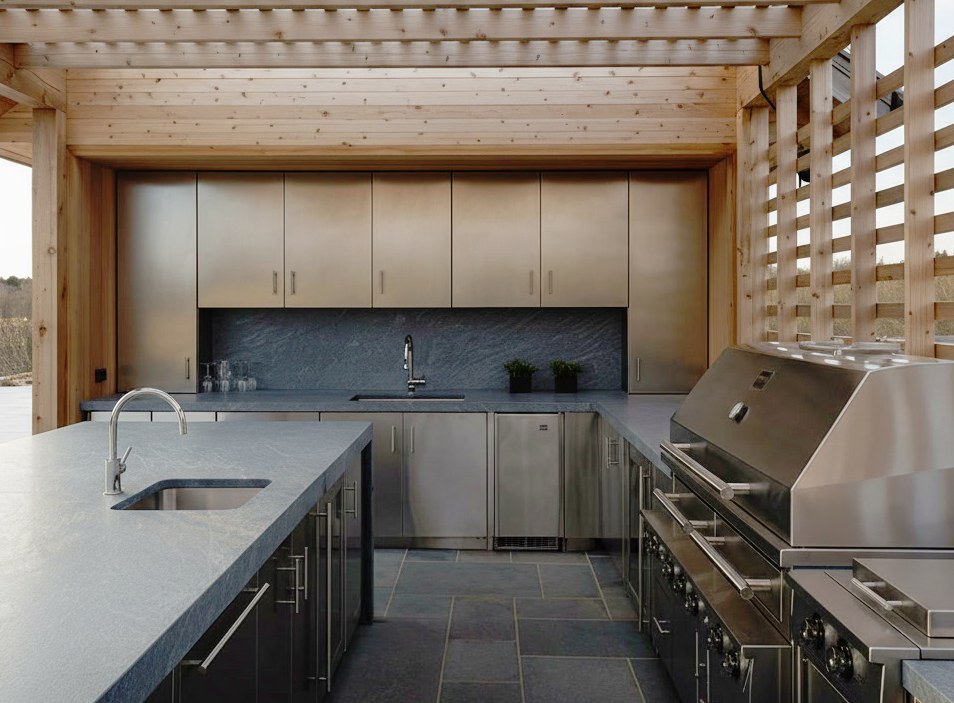
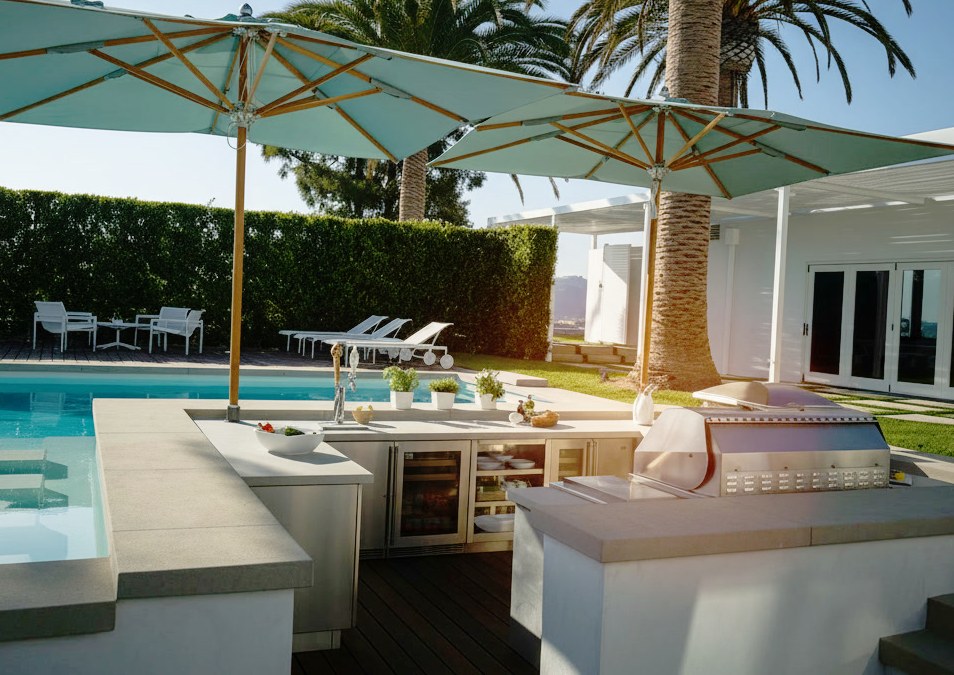
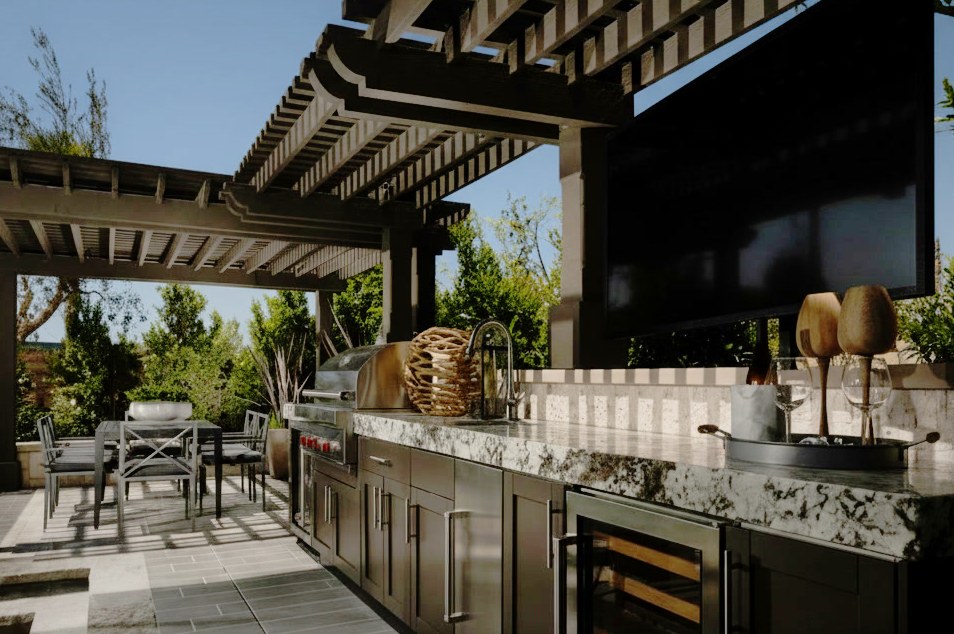
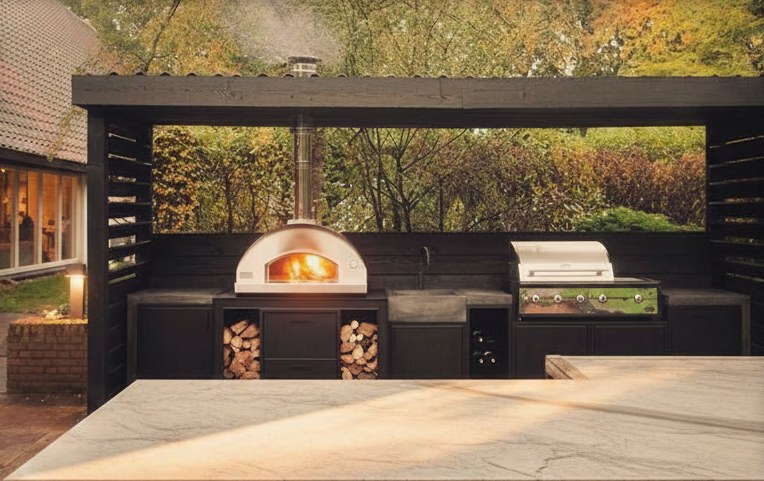
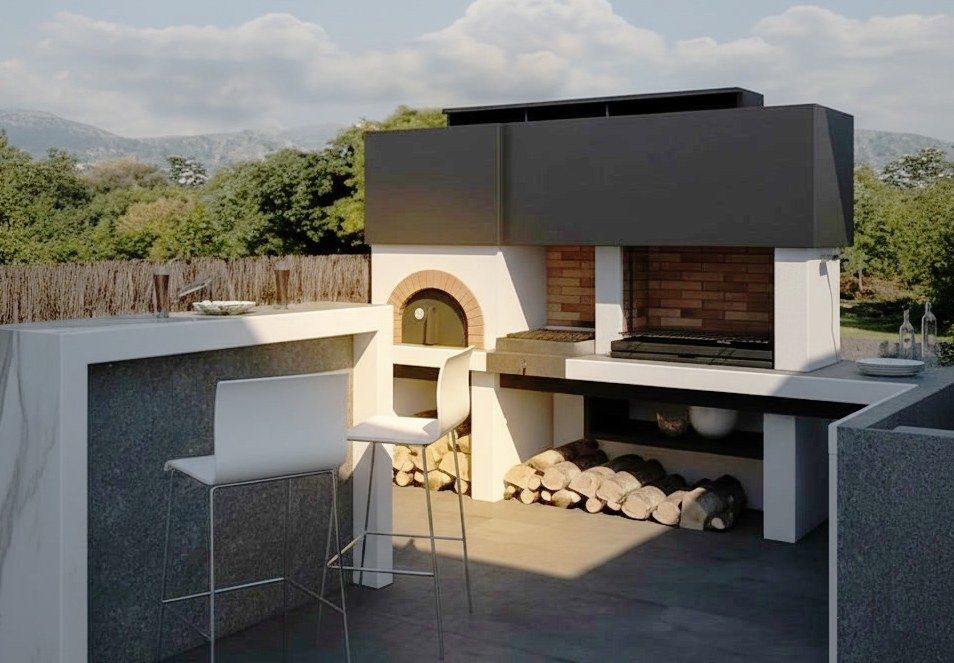
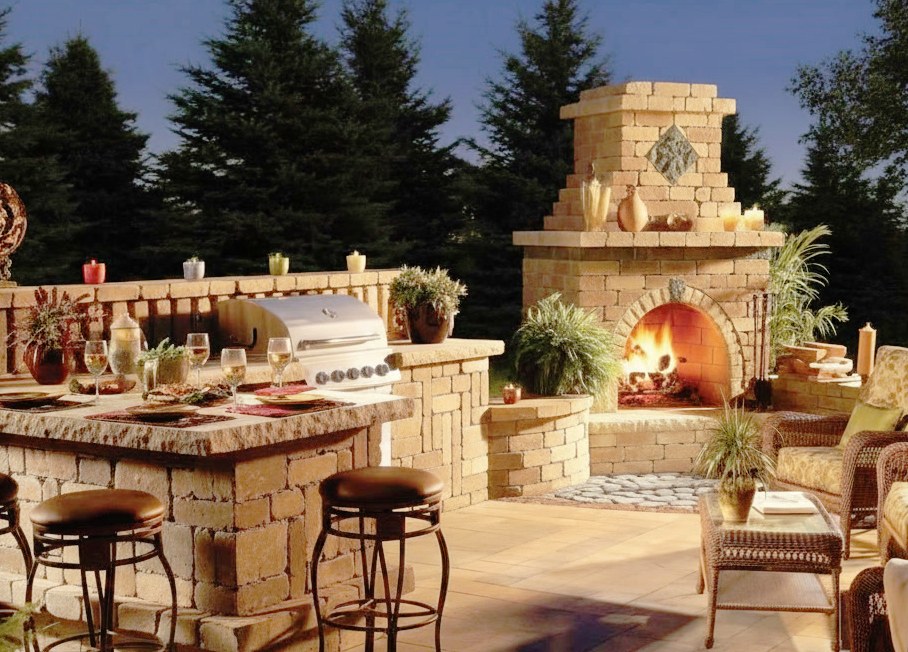
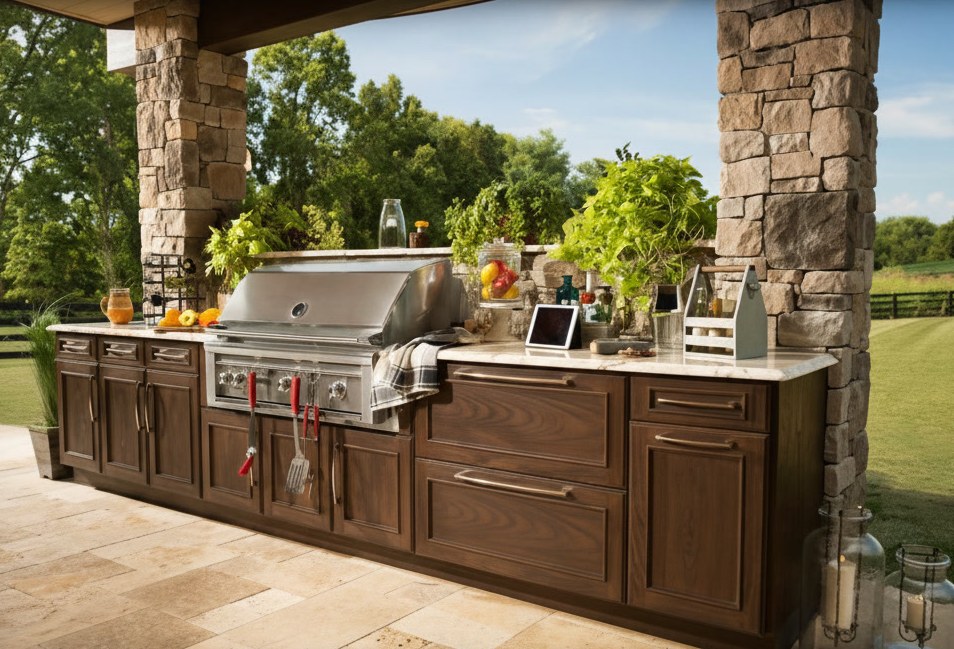
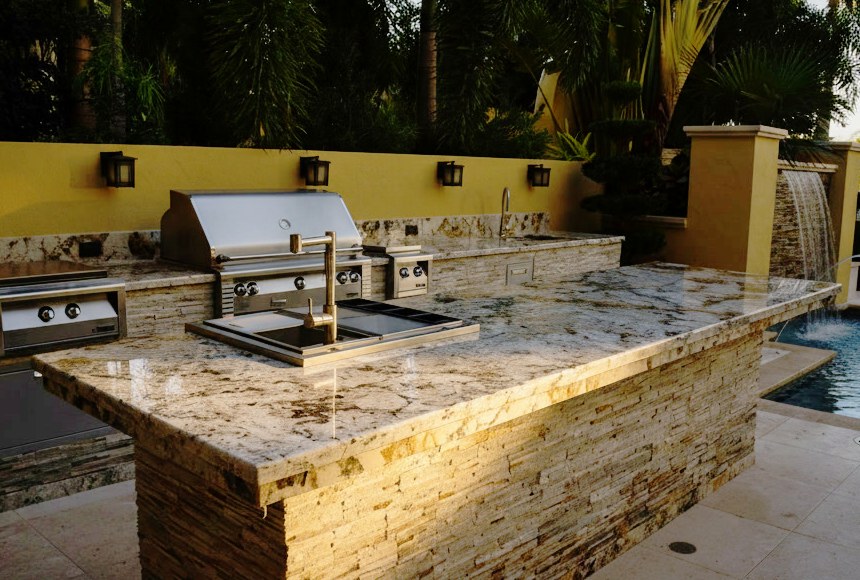
Some of the outdoor kitchens we have built
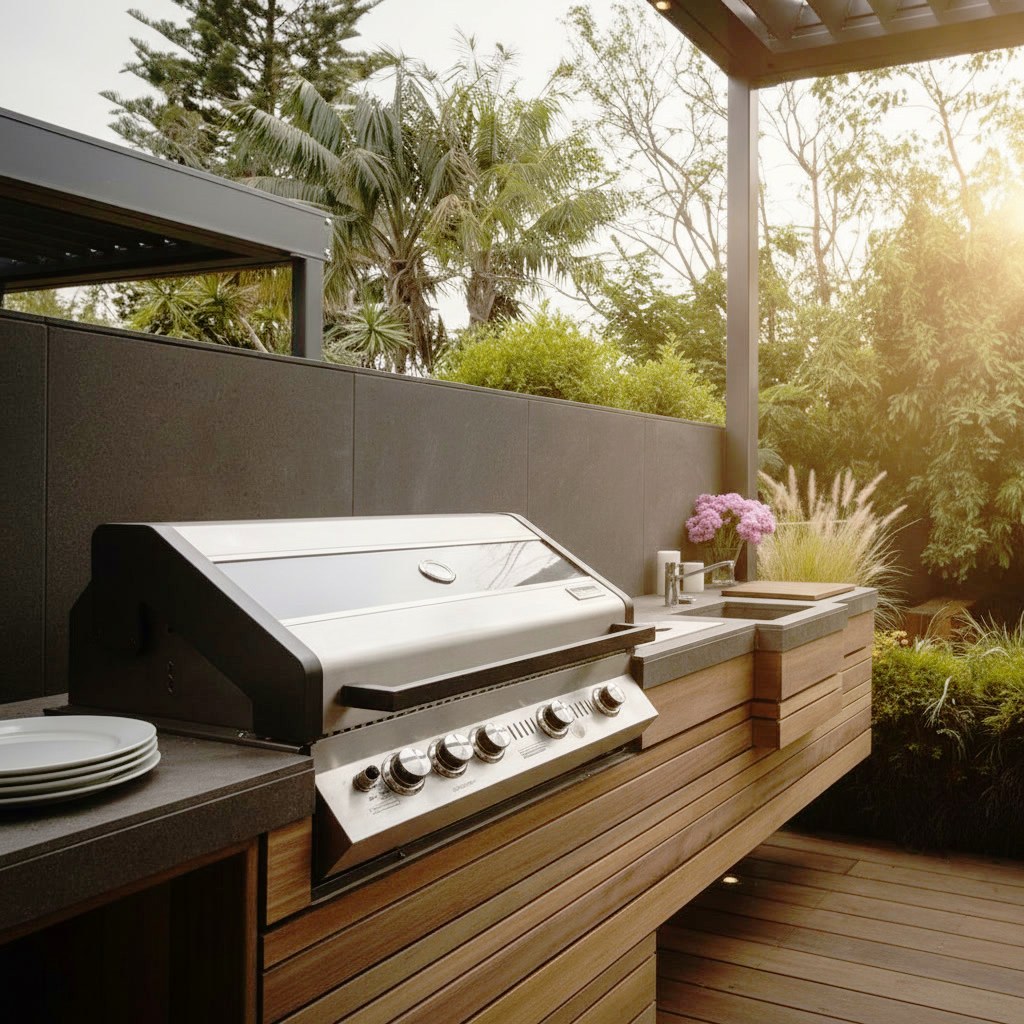
Every outdoor kitchen is designed and built to measure, in stone, steel or treated wood, for every budget. Tap a photo to enlarge it.
See all the kitchens Plans and drawings of the layouts Free quotation
A kitchen like this, made to measure for you.Free, no-obligation quotation · free site survey in Lazio · 3D design · since 1976
The outdoor kitchen — a Michelessi vision
From the block,
the fire
01 A raw block of Calacatta Oro on the terrace above the sea, under the brass lamp, at the hour when the sky turns from orange to blue. Mallet and chisels lie on the floor: the kitchen is still all inside the stone.
02 Two stonemasons, standing beside the block, work it with mallet and chisel. The faces are squared, chips fly, white dust rises in the sea wind; then come the long shape of the island, its sides, the openings of the fronts, the fire channel and the sink, carved slowly. Finally the stone is honed and the gold veins come out.
03 The top is polished, the sink set in, the brass tap mounted, the fire lit in the channel. The stonemasons walk away and the kitchen stays, lit above the sea, with a veil of dust on the floor.
Keep scrolling — the scene follows you
Why granite is the easiest stone to live with outdoors
Granite is an igneous rock: its crystals of quartz, feldspar and mica lock together into a dense mass that absorbs almost no water. Sun does not fade it, because it contains no resins or pigments: the colour is the colour of the minerals. Frost does not split it, because water finds very few pores to enter and expand in. Rain runs off without leaving marks. And unlike marble, which is calcium carbonate, granite does not react to the acids of the table: lemon, wine, vinegar and tomato leave it untouched, and hot oil or grease from the grill wipes off with water and a neutral cleaner. A pan straight from the fire can be set down on the worktop. Its limits are weight and looks rather than durability: granite is heavy, and it has a crystalline grain rather than the cloudy veining of marble.
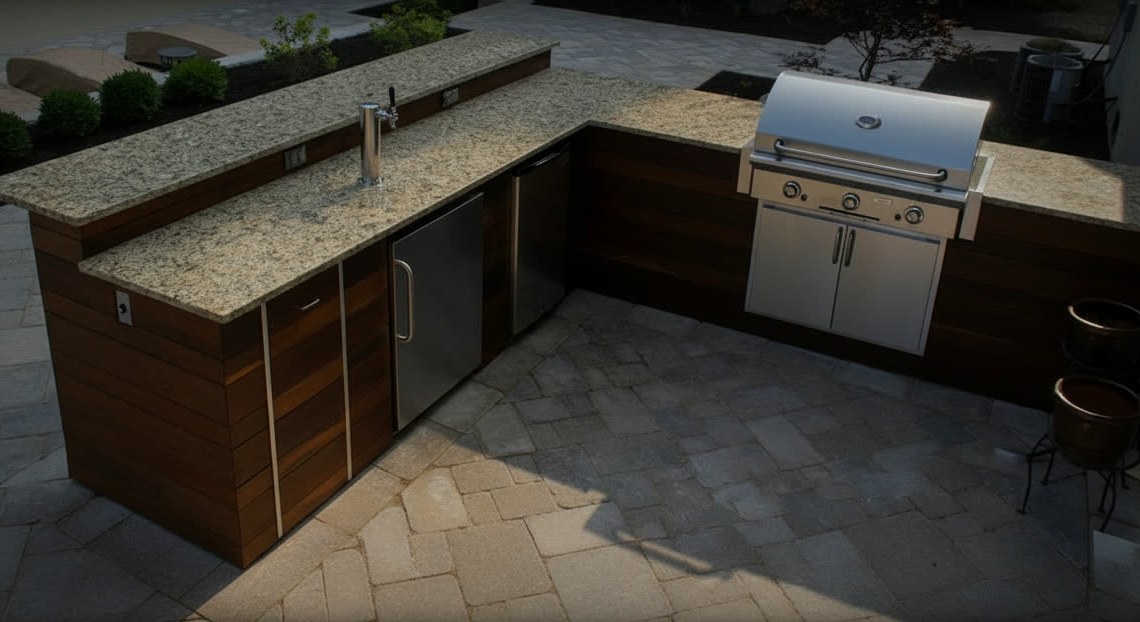
Flamed, bush-hammered, honed: the finish decides touch and safety
On the same slab the finish changes the colour, the grip under your fingers and how easily it cleans.
- Flamed: a flame passes over the surface and bursts the crystals, leaving a rough, matt skin a shade paler than the polished colour. It is slip-resistant even when wet: we recommend it around the sink, on steps and around the pool. On the worktop it is paired with a light brushing, which softens the roughness without losing the grip.
- Bush-hammered: a pointed hammer beats the stone down to a fine or coarse grain, like rock worked by hand. It gives body to sides and plinths; on the worktop it holds on to crumbs.
- Honed: smooth but matt, velvety, with no reflections. The most balanced choice for an outdoor worktop: one pass of a sponge cleans it, it does not dazzle in the sun and it does not show dried water marks.
- Polished: granite holds a polish outdoors far better than marble, and Absolute Black becomes a mirror of the sky. It does, however, reflect the midday light and gets hot in the sun.
The typical worktop thickness is 2 or 3 centimetres; the edge is finished by hand, with a chamfer or a bullnose, and a drip groove is cut beneath the overhang so that water cannot run back onto the sides.
Granite colours
The blacks, such as Absolute Black, are the most requested for islands: deep, even, elegant with steel and treated timber. The greys are the most discreet in sunlight and hide dust and limescale best. The whites and beiges, such as Bianco Sardo with its dark flecks of mica, stay cooler to the touch even in high summer. Then there are the reds and pinks, for a worktop that speaks to terracotta. The darker the colour, the hotter the top becomes: on a south-facing terrace a pale granite, or a pergola, is the wiser choice. Colour is judged in person, on the whole slab.
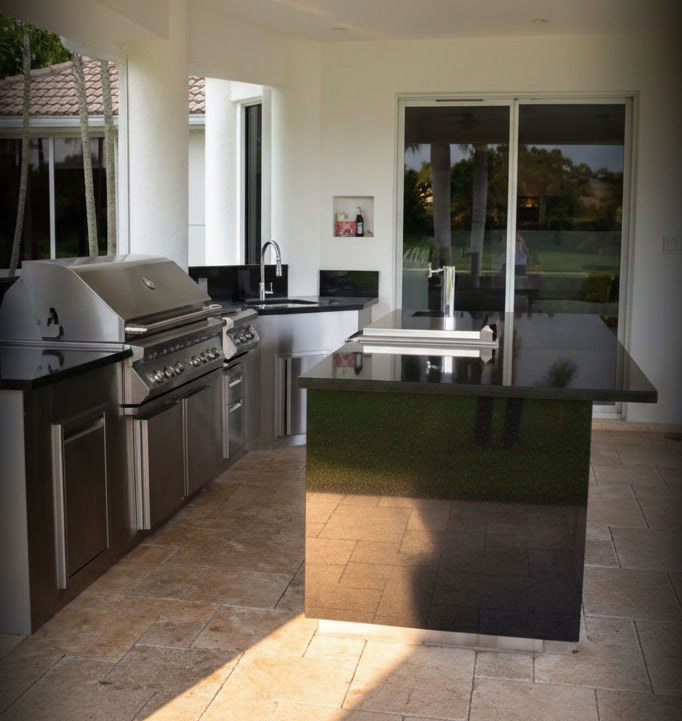
The integrated barbecue: granite on top, refractory stone within
Granite tolerates a hot pan, but it is not made to sit against a live flame. That is why the granite worktop crowns a structure of refractory stone, the same material as a bread oven: the combustion chamber, the housing of the wood-fired barbecue and the vault of the oven are refractory, and the granite stops where the fire begins. A gas or charcoal barbecue (BeefEater, Bull, the Fogher modules, the Cabinex series) is set into the worktop through an opening cut on the numerically controlled saw, with rounded corners to avoid stress points and the air gap the manufacturer specifies around heat sources. A steel hood carries the smoke away; the landing areas on either side of the fire, in flamed or honed granite, take a scorching tray without a mark.
Sink and fridge in granite
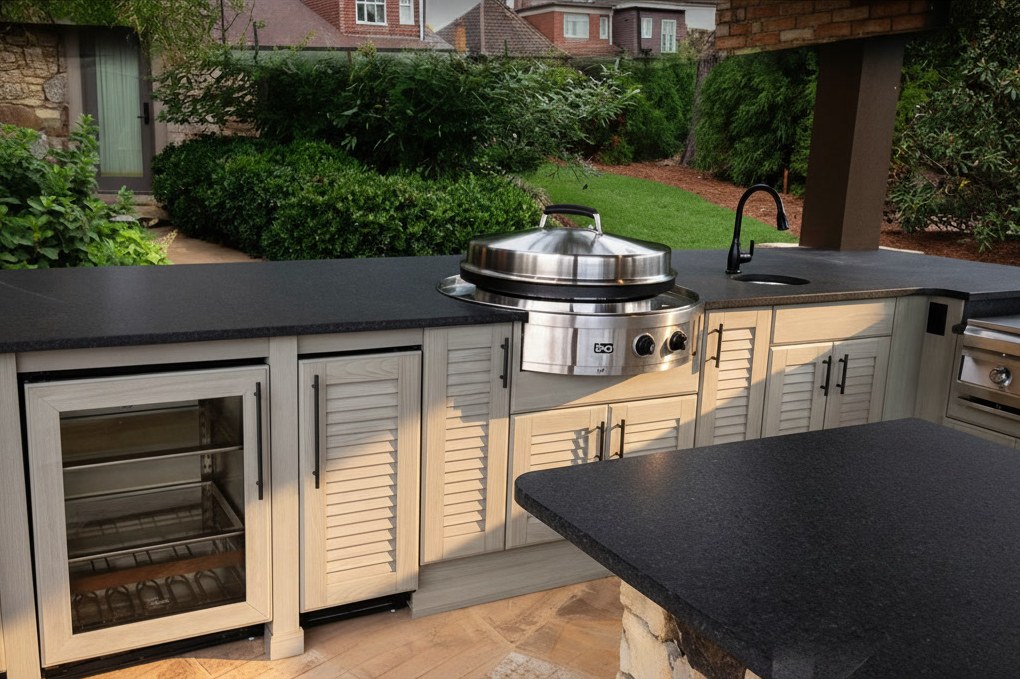
The sink may be a stainless-steel bowl fitted beneath the worktop, with the granite edge polished and left exposed, or a basin carved into the stone itself, as in our solid-stone islands. Near the sea AISI 316 steel is the wise choice, as it withstands salt air. The waste has a trap and a drain-down tap for winter; the worktop is laid with an imperceptible fall away from the house, so that rain does not stand on it. The fridge must be an outdoor model, with its housing ventilated from below and behind: the granite must never block that airflow.
Care, season by season
- Spring: wash with warm water and a neutral cleaner, never acids or aggressive descalers; check the flexible joints between slabs and, if you wish, renew the water- and oil-repellent treatment, which on granite mainly serves to make grease easier to clean off.
- Summer: a wipe with a sponge after each barbecue; grill grease comes away best while still warm, before dust settles on it. Polished black is dried with a cloth to avoid limescale marks.
- Autumn: leaves and soil are swept off flamed finishes with soft bristles; the grill is cleaned cold.
- Winter: drain the water system, cover the fire zone and leave the granite uncovered: frost cannot harm it.
Granite, quartzite or sintered stone?
Quartzite is harder than granite and carries the veining of precious marbles, but it must be checked on a sample: some stones sold under that name are in fact marbles, sensitive to acids. Sintered stone (Dekton, Laminam) has almost no porosity and, in 1.2 centimetre slabs, weighs about 30 kilos per square metre, little more than half the weight of a 2 centimetre granite slab: it is the best suited to terraces with limited load capacity; its edge is the delicate point. Granite sits between the two: real stone, solid blocks possible, considerable weight, and among the simplest to care for.
| Material | Sun and frost | Acids and grease | Veining | Weight and terraces | Recommended outdoor finish |
|---|---|---|---|---|---|
| Granite | Unaffected | Does not react | Crystalline grain | Heavy; solid blocks possible | Honed, or flamed and brushed |
| True quartzite | Unaffected | Resists; check on a sample | Marble-like | Heavy | Honed or brushed |
| Sintered stone | Unaffected | Does not react | Marble effect | Light at 1.2 cm, suited to terraces | Matt |
How Michelessi works with granite
We have worked stone in Aprilia, on the Via Pontina between Rome and Latina, since 1976, and granite calls for three particular points of attention. At the site survey, free of charge in Rome, Latina and throughout Lazio, we look first at the base: granite is heavy, and a solid-stone island needs a footing that will not settle. The slab is chosen in the workshop against a finished sample, because the same granite flamed, honed or polished looks like three different stones, and the 3D design shows it in the finish you have chosen. The openings for barbecue, sink and fridge are cut on numerically controlled machines to the appliance drawings, the edges and the drip groove by hand; the worktop arrives in your garden ready to go down, and our own team installs it throughout Italy, and abroad on a project basis, as in Dubai. Lead times are set out with the quotation.
Further reading
This page is a chapter of our main page on outdoor kitchens in marble and stone, with the layouts, the catalogue models and our design visions. For the structure around the fire, read barbecues and kitchens in refractory stone; for the full comparison of stones, the guide outdoor kitchen: which stone to choose; to see flaming and bush-hammering up close, the finishes page. The granites in our collection are among the natural stones; if your kitchen will stand beside the water, the stone-clad pools page and our poolside outdoor kitchen are worth a look too; for the fire, see the outdoor kitchen with stone barbecue; for a sintered worktop, the Dekton outdoor kitchen. Every family is on our marble and stone kitchens page; to begin, request a quotation.
Free quotation
Ask for a quotation for your kitchen
Tell us about the space and the idea: measurements, even taken by hand, a few photographs, the material you like. We reply from our workshop in Aprilia with a 3D design and a quotation, free and without obligation.
Frequently asked questions
Frequently asked questions
Does granite stain with oil or barbecue grease?
No, provided it is cleaned within a reasonable time: granite absorbs very little and the grease stays on the surface. It comes off with warm water and a neutral cleaner; an optional water- and oil-repellent treatment makes cleaning quicker still.
Does a black granite worktop get hot in the sun?
Yes, like any dark surface under the midday sun. If the kitchen has no pergola, a grey or pale granite is wiser, or a flamed finish, which heats up less than a polished one.
Can I put a hot pan straight from the hob onto granite?
Yes: granite takes the heat of pans and trays without marking. It must not, however, sit against a live flame: the barbecue and oven chambers are in refractory stone, and the granite worktop stops where the fire begins.
Can a granite kitchen be built on a terrace?
It depends on the load the floor slab can bear, which we check at the site survey: a 2 centimetre granite slab weighs around 55 kilos per square metre, and a solid-stone island runs to several hundred kilograms. Where the capacity is limited we propose a thin granite top on a light frame, or sintered stone.