
Indoor marble kitchens
Travertine Kitchen: Colours, Finishes, Care and Real Work
A travertine kitchen is an indoor kitchen with worktops, island, upstands or sink in travertine, a limestone ranging from ivory to walnut brown, filled, honed and protected with an impregnating sealer. It is at its best on islands, serving surfaces, shaped upstands and carved sinks; where lemons and tomatoes are cut every day, pair it with granite, quartzite or sintered stone. Michelessi has worked it in Aprilia since 1976.
What a travertine kitchen is
A travertine kitchen is an indoor kitchen whose worktops, island, upstands or sink are made of travertine, the limestone that thermal springs lay down layer upon layer and that Rome used for the Colosseum and the colonnade of St Peter's. Two marks identify it: the voids, small natural cavities in the surface, and the parallel bands of colour, from ivory to walnut brown. It does not have the vein of marble: it has layers, quieter and warmer.
Travertine enters the kitchen in two ways. The first is the slab worktop, 2 or 3 centimetres thick, laid on a kitchen with doors, lacquered or timber. The second is the built kitchen: a masonry structure clad and crowned in solid travertine, with the doors set into it, like our Francesca. The same premise holds for both: this is a soft, absorbent stone, more so than the compact marbles, and like every limestone it is sensitive to acids. That is why a worktop has to be filled, honed and sealed; the wider picture is on our indoor marble kitchens page.
Roman, walnut, Persian: travertine colours in the kitchen
The colour changes, not the stone. And the cut changes: vein-cut, the bands run parallel along the worktop; cross-cut, the pattern becomes a softer, more even clouding that is easier on the eye across a large island.
| Travertine | How it looks | Where we use it in the kitchen |
|---|---|---|
| Roman (classic) | Ivory ground with slightly warmer bands; the brightest | Worktops, islands, the body of masonry kitchens |
| Walnut (noce) | Brown and amber tones; hides the marks of use better | Worktop edges and shaped upstands |
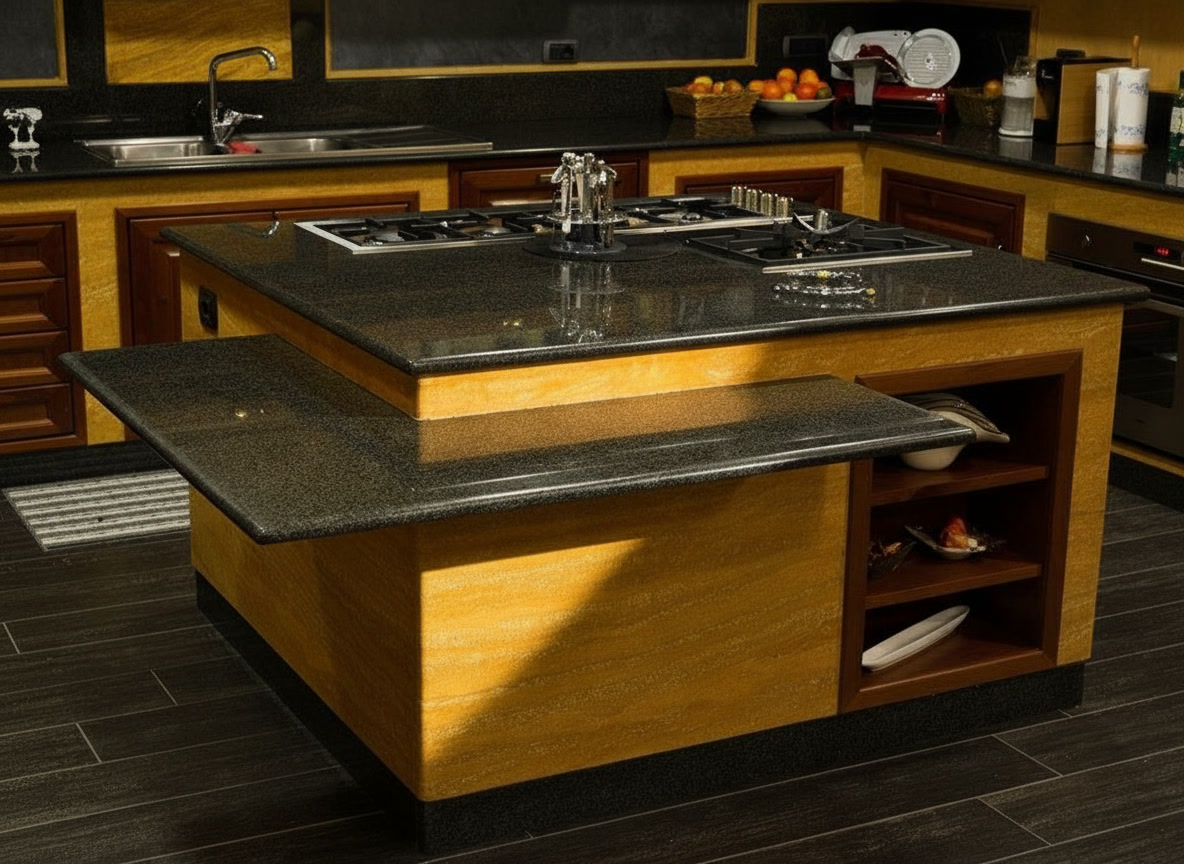
| Persian | Warm, golden tones | The body of the Stefania island and of the Medeleine fireplace kitchen |
| Silver | Grey ground with alternating light and dark bands | Contemporary kitchens, with steel, dark oak and black |
Roman and walnut often work together: pale worktop, dark edge and upstand, so that the outline is drawn and the most handled parts are the ones that show wear least. Our page on travertine tells the whole story of the stone, from quarry to fitting.
Filled or open-pore, honed, brushed or antiqued
The first choice concerns the pores. Filled means the voids are closed in the workshop with a filler matched to the stone, or in contrast: the surface becomes continuous, holds neither crumbs nor grease, and is the only one suited to a working surface. Open-pore leaves the cavities visible: in a kitchen we keep it for vertical surfaces away from water and the hob, where the stone can show itself as it is.
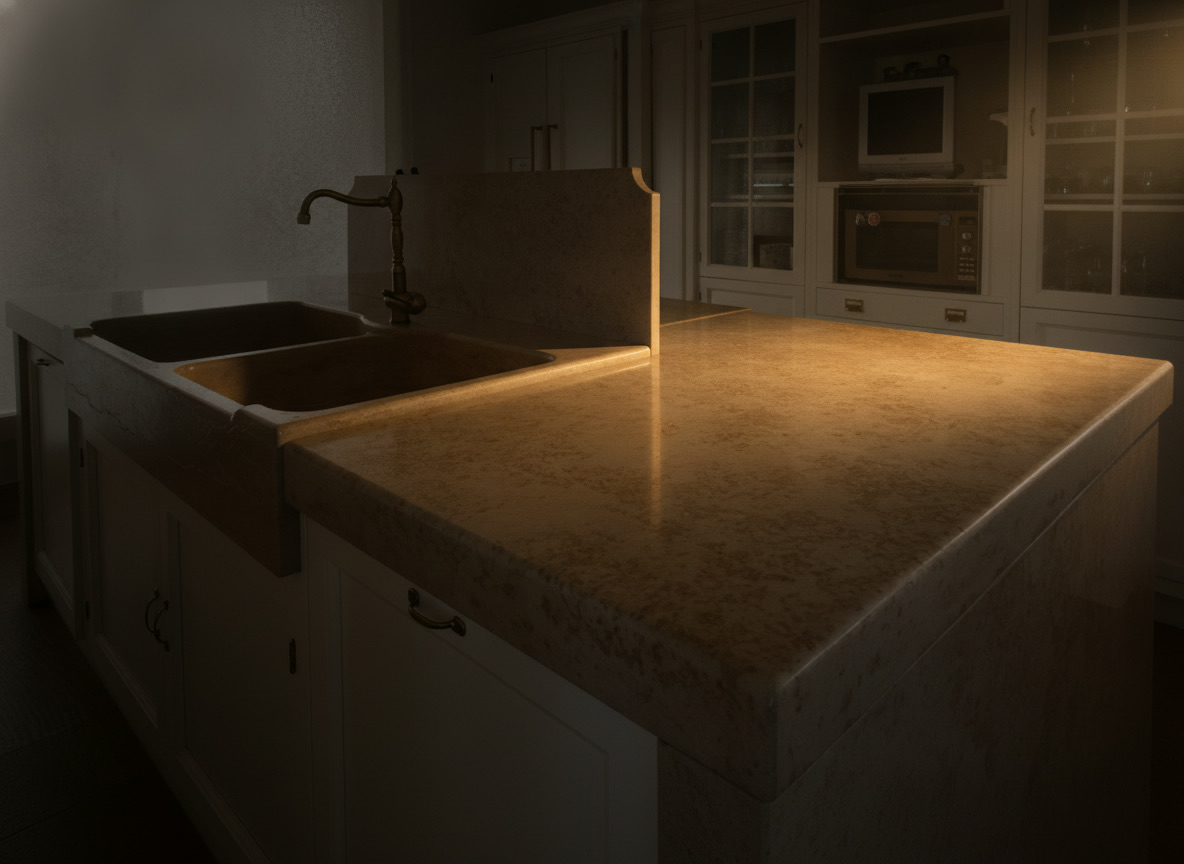
Then comes the skin. Honed, matt and smooth, suits travertine best: the closed pores read as a texture and marks all but disappear. Brushed, which in the workshop we also call antiqued, is gently undulating and velvety, warms the beiges and walnuts and gives the stone the look of a piece already lived with: it is the finish of the sink in our kitchen with a travertine worktop. Polished deepens the colour but is the first to show acid marks. Each is explained on the finishes page; in person, you can handle them in the Aprilia showroom.
Where it works and where it does not
Travertine works where a kitchen is looked at and touched more than it is soiled: the island, including a waterfall side with a 45° mitre that lets the eye read a solid block 6, 8 or 12 centimetres thick; the serving surface and the breakfast bar; the upstand, straight or shaped; the sink carved from the same stone, which has its own page on the carved marble sink. For overhangs and undermounted sinks, choose 3 centimetres.
It works less well in the acid zone: the stretch of worktop where lemons and tomatoes are cut every day, salads are dressed with vinegar and wine is opened. Acid does not stain: it etches the limestone and leaves a dull mark. There, and beside the hob, set a granite, a quartzite or a sintered stone of the same tone next to the travertine. We did exactly that in the Stefania kitchen: island body in Persian travertine, tops on two levels in Nero Africa granite. As for heat, resistance is moderate, as with marble: hot pans go on a trivet. The surfaces are compared in our guide to marble, Dekton, quartz or Fenix.
Travertine, wood and iron: what to pair it with
Travertine is a warm stone and asks for materials with the same honesty. With wood the match is natural: solid walnut, with its moulded frames and deep patina, is the historic companion of Roman travertine; fir stained a light walnut lightens it; rough timber, knots and grain on show, takes it towards the country house; white lacquer makes it bright and urban. Silver travertine sits well with dark oak and steel. How to choose the species and the finish is explained on our marble and wood kitchen page.
Iron is the third material, to be used sparingly: shelf brackets, ring pulls, lamps, a wrought-iron chair. Black or burnished, it draws the outlines that beige alone lacks. The brass of the taps does the same more gently; stainless steel remains the practical choice for the hob, and for the sink when it is not carved from the stone.
The Francesca kitchen and other work in travertine
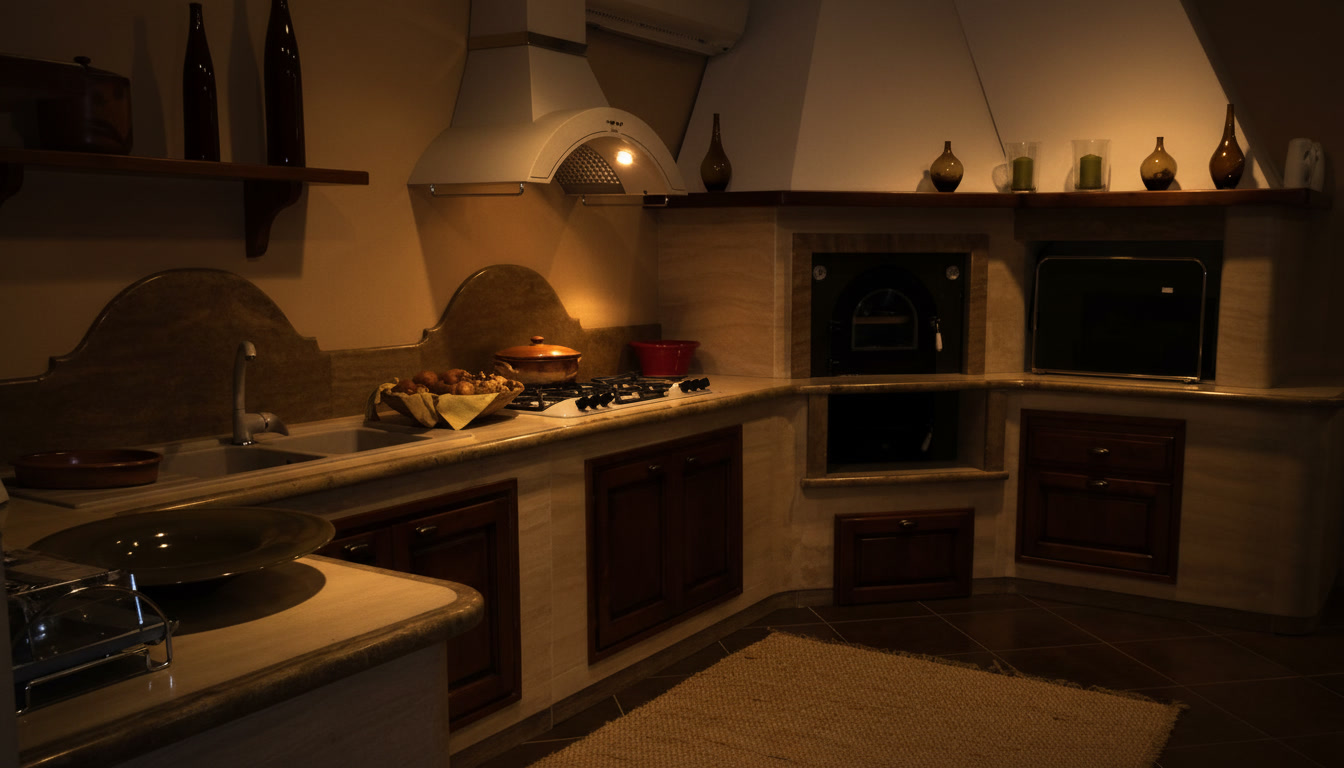
Francesca is our indoor masonry kitchen, and it is built around travertine: solid stone for the worktops, an edge in walnut travertine that draws their outline, an upstand shaped by hand in soft waves along the walls. Doors and wall units are solid walnut, set into the pale masonry; the hood, also in masonry, is finished in wood; a built-in dishwasher, a hob and a stainless-steel sink do the daily work. How it is designed is told on our built-in masonry kitchen page.
From the same family come Letizia, with its curved counter in Roman travertine and its upstand in walnut travertine, and Ivana, in oat-coloured Roman travertine with solid fir doors. Paola has a Roman travertine worktop beneath a great walnut beam. Beyond masonry, the kitchen with a travertine worktop shows a honed island and an antiqued sink projecting from the cabinet, under brass taps; another carries a travertine worktop, with the hob set into it, on a white lacquered island. These are real commissions, gathered in the gallery of indoor kitchens.
Sealing and care
Treatment begins in the workshop: filling, honing and an impregnating sealer that enters the pores and slows absorption without forming a film. It does not make the stone invulnerable: it gives you time to wipe. It is renewed when a drop of water stops beading on the surface, generally once a year.
Day to day, warm water, neutral soap and a soft cloth are enough. Lemon, vinegar, wine and tomato are wiped up at once; limescale removers and acidic cleaners are never used, not even around the tap. A chopping board and a trivet are habits worth acquiring. Over the years travertine takes on a patina and, when needed, it can be honed again on site. Each step is in our guide to marble worktop care.
How Michelessi works travertine
We have worked Roman travertine since 1976 in the Aprilia workshop, on the Via Pontina between Rome and Latina. It begins with a site survey and quotation, free of charge in Rome, Latina and throughout Lazio. The slabs are chosen one by one, because no two slabs of travertine are alike: together we settle the tone, the vein-cut or cross-cut, the colour of the filler. The 3D design shows the finished kitchen before the first cut. Then come CNC cutting and finishing by hand: edges, sinks, the waves of the upstands. Fitting is by our own team; a masonry kitchen is built in the room itself, stone by stone. We deliver across Italy and abroad, as with the Dubai project; timings are agreed with the quotation.
Further reading
If a travertine kitchen is the road for you, send us a floor plan or a photograph of the room from the marble kitchen quote page: we will tell you frankly where travertine is at its best and where another stone should sit beside it. If you picture it in the garden instead, read our page on the travertine outdoor kitchen, where compact varieties and sealing matter most.
Frequently asked questions
Frequently asked questions
Does travertine stain in a kitchen with oil, wine or coffee?
It can if it is left unprotected, because it is an absorbent stone. Filled and treated with an impregnating sealer, oil and coffee stay on the surface long enough to be wiped away. Wine, lemon and vinegar are another matter: they do not stain, they etch, and leave a dull mark. On a honed finish the mark blends into the texture and, if need be, is removed by honing again.
Do the holes in filled travertine reopen over time?
They can, and it is normal: beneath the surface travertine has other small voids, and over the years a filling may come loose or a new pore may appear, mostly where the worktop is used hardest. It is not damage: the hole is closed on site with matching filler and the surface is gone over again. Choosing compact slabs in the workshop reduces it.
What is the difference between a travertine kitchen and a marble kitchen?
Travertine is a layered limestone, with parallel bands and small voids that need filling; marble is compact and veined. In a kitchen travertine is warmer and quieter, absorbs more and needs sealing more regularly; marble has more pattern and more light. Both are sensitive to acids and take only moderate heat: everyday care is the same.
Does travertine suit a modern kitchen?
Yes, if it is chosen and cut the right way. Silver travertine, grey and banded, sits well with steel, dark oak and black; Roman travertine, cross-cut and honed, gives a calm field suited to an island with flat doors, a waterfall side and a 45° mitre. It is the shaped edge and the wave upstand that take it towards tradition, not the stone.