
Outdoor kitchens
Travertine outdoor kitchen: where to use it, how to keep it
A travertine outdoor kitchen works when the stone is compact, filled and sealed with a water-repellent treatment, in a brushed or antiqued finish, never polished. Travertine is at its best on side panels, counter, paving and pool edge; for the cooking zone and wherever acids land, Michelessi pairs it with granite or sintered stone. It is laid to a slight fall and resealed about once a year.
Which travertine holds up outdoors: compact, filled, sealed
A travertine outdoor kitchen succeeds on three conditions, all of them about the stone rather than the drawing. Travertine is a limestone laid down by thermal springs: recognisable by its natural voids and parallel bands of colour, from ivory to walnut. The most celebrated is Roman travertine from Tivoli, the stone of the Colosseum: it was born in the open air. But it is a soft, absorbent stone, more so than the compact marbles, and in a kitchen it meets grease, wine and frost.
So outdoors we use only the most compact varieties, with few voids and tight bands; we want them filled, with the voids stopped in the workshop using a matching filler, on every surface where you lean, eat or walk; and we protect them with an impregnating water-repellent treatment, applied before delivery, which sinks into the pores without forming a film. Open pores remain an option on walls and cladding well away from the fire, where nothing gets spilt. Our travertine page covers the colours and the cuts: classic, walnut and Silver, vein-cut or cross-cut.
Brushed or antiqued: the finishes that keep you on your feet
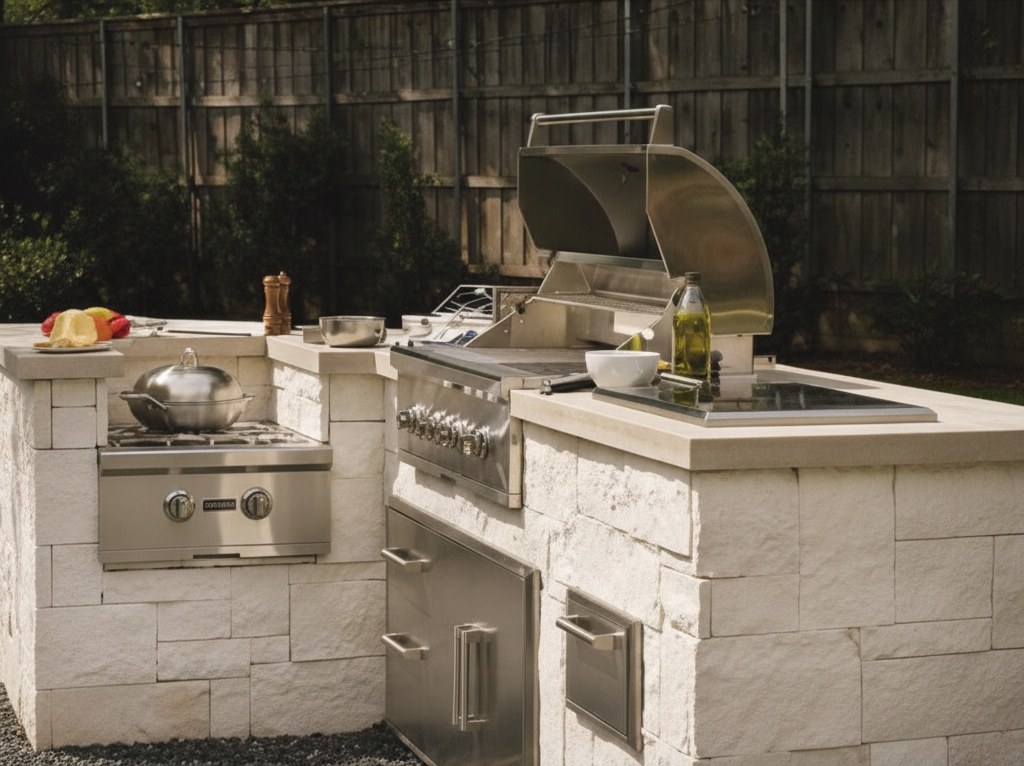
Outdoors a polish is ruled out: under sun and rain it fades within a few years, it shows acid marks and, when wet, turns slippery. The right finishes are matt and textured. Brushed, which in the workshop we also call antiqued, comes from passes of progressively finer brushes: the surface is left gently undulating and velvety, it warms the beiges and the walnuts and it grips the foot even when wet. It is the finish we recommend for the side panels, the counter and the paving around the kitchen. For steps and for the pool edge we go rougher, with a bush-hammered or sandblasted surface. Honed, smooth and matt, is still acceptable on serving surfaces under cover. Each is shown, on the same slab, on our finishes page; edges are rounded to a bullnose or chamfered by hand.
Where to use it: side panels, counter, paving, pool edge
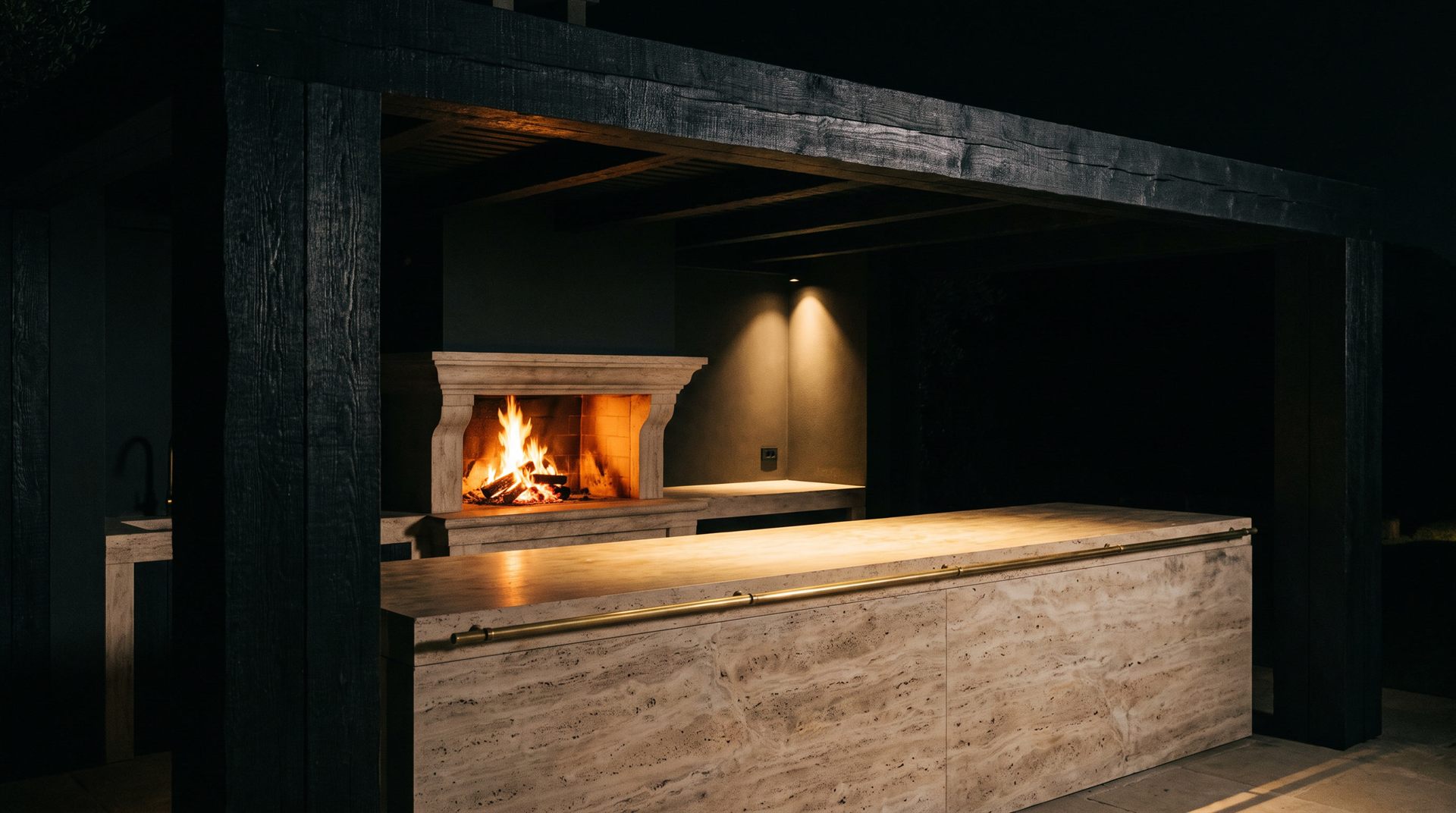
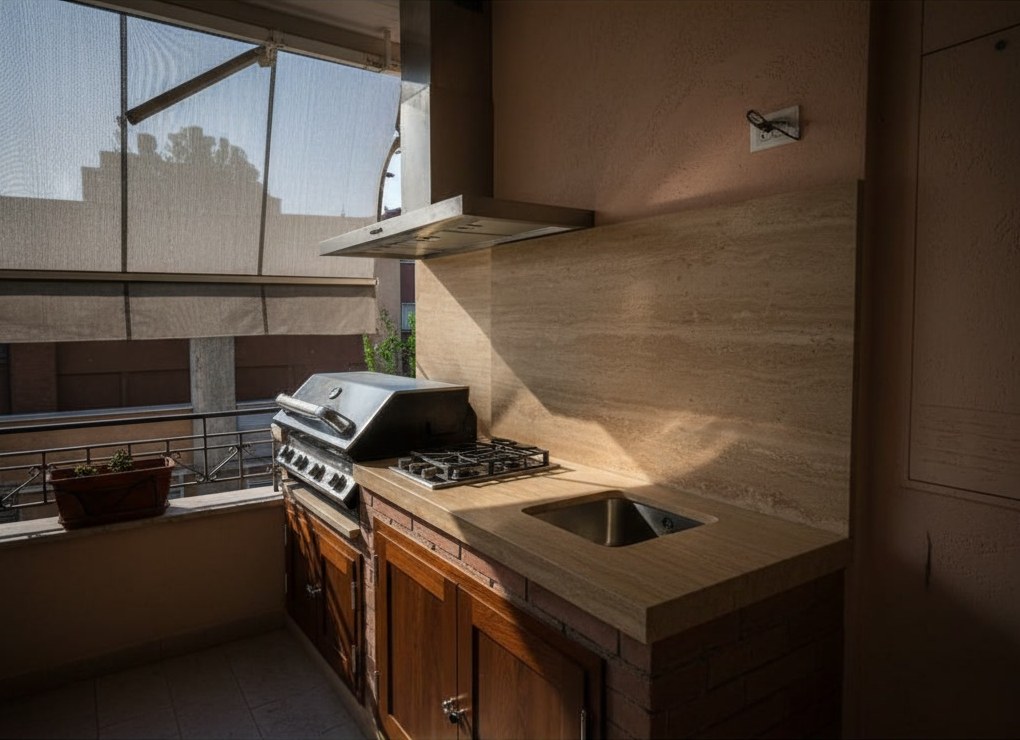
Travertine is at its best where you look, lean and walk, rather than where you chop. On the side panels and plinths of the island the layering runs unbroken, and with a 45° mitred joint two slabs of 2 or 3 centimetres read as a single solid block; with a waterfall side the worktop drops to the ground without interrupting the bands. On the counter where you eat and serve, a brushed surface is warm to the touch and hides the marks of use well, especially in the walnut tone. On the paving around the kitchen and on the pool edge it is the classic stone: pale, never scorching underfoot in the sun and, with a brushed or bush-hammered finish, slip-resistant. The sink can be carved from the solid too, as in our travertine washbasins. Under a pergola or a canopy travertine is at its happiest: it stays dry through the rainy months and asks for less care.
Where granite or sintered stone is the better choice: fire and acids
Two zones of the kitchen call for a different stone. The first is the cooking zone: beside the barbecue and the hob, hot oil and grill fat land on the worktop and scorching trays are set down. Travertine, like marble, has only moderate heat resistance and pores that drink in grease. The second is the acid zone, where lemons are cut, salads are dressed and wine is served: lemon, vinegar, wine and tomato etch calcium carbonate and leave a dull mark that no treatment can prevent. There we fit granite, which does not react to acids, or sintered stone (Dekton, Laminam), which has no pores: see our Dekton outdoor kitchen. The fire chamber, in any case, is in refractory stone. Often the most elegant answer lies in a single project: island and side panels in travertine, the worktop around the burners in sintered stone or granite of the same tone.
| Zone of the kitchen | Recommended stone | Finish | Why |
|---|---|---|---|
| Side panels and plinths | Compact, filled travertine | Brushed | Unbroken bands; reads as a solid block with the 45° joint |
| Counter and serving surfaces | Filled, sealed travertine | Brushed or honed | Warm to the touch; wine and lemon wiped up at once |
| Cooking zone and acid zone | Granite or sintered stone | Honed or matt | Untroubled by grease, acids and hot trays |
| Paving around the kitchen | Compact, filled travertine | Brushed or bush-hammered | Slip-resistant, laid to a slight fall |
| Pool edge and steps | Compact travertine | Bush-hammered or sandblasted | Pale, neither scorching nor slippery |
Frost and stains: the two enemies and how to keep them away
Frost does not break the stone: the water left inside it does. When water gets into the voids it freezes and expands, and over time it opens the pore. There are four defences and they add up: a compact variety, the filling that closes the voids, the water-repellent treatment and, above all, the fall. Every flat surface, worktop or paving, is laid with a slight slope, because standing water is the first cause of staining and frost damage; under the overhang of the worktop we cut a drip groove, which stops water running back onto the side panels.
Stains come in two kinds. Oil, grease and wine soak into the pores and colour the stone from within: the sealer slows absorption and gives you time to wipe up. Acid, on the other hand, does not stain: it etches. It leaves a dull mark that blends into the texture of a brushed finish and that, if need be, is removed by refinishing the surface.
The same stone from the garden to the pool edge
The real advantage of travertine is continuity. The same workshop makes the kitchens and the stone-clad swimming pools: travertine infinity edges curved block by block, Roman steps, submerged sun shelves. From the same slabs we can cut the island's side panels, the counter, the paving of the dining area, the steps and the edge of the pool, repeating colour, direction of the bands, joint and finish: brushed where you sit, bush-hammered where you climb out of the water. The garden reads as a single drawing, without the change of material you see when kitchen and pool come from two suppliers. If the pool already exists, we sample its edge and look for the slab that meets it in tone and grain. Beside the water, the advice on our poolside outdoor kitchen page applies: the fire kept clear of splashes, and a rinse with fresh water against chlorine and salt.
Care, season by season
In spring, wash with warm water, neutral soap and a soft brush, never a strong pressure washer, which gouges the voids; check the filling and try the water-drop test: if the drop no longer beads but darkens the stone, it is time to renew the treatment, usually once a year. In summer a sponge after each meal is enough, wiping up wine, lemon and grease at once; never limescale removers or acidic cleaners, not even the pool ones. In autumn, clear away leaves and soil, which when wet leave dark marks on pale stone. In winter, drain the water supply, cover barbecue and oven with a breathable sheet and, where there is no pergola, protect the travertine too through the rainy months. With these habits the stone gains a patina and does not wear out.
How Michelessi works travertine for the outdoors
We have worked Roman travertine in our Aprilia workshop, on the Via Pontina between Rome and Latina, since 1976. At the site survey, free of charge in Rome, Latina and throughout Lazio, we look at the exposure, the falls that carry water away, the load the base can bear and any pool edge. Slabs are chosen one by one, in person or by video call, because no two slabs of travertine are alike. The 3D design shows the kitchen in your own space and marks where the travertine ends and the granite or sintered stone begins. Cutting is numerically controlled, filling is done in the workshop, edges and finish are completed by hand, and the treatment is applied before departure. Our own team installs throughout Italy; abroad we number every slab and follow shipping and fitting, as we did for our project in Dubai. Lead times are set out with the quotation.
Further reading
This page is one chapter of our outdoor kitchens in marble and stone, with the layouts, the models and the refractory-stone structure. To compare travertine with the other stones for the open air, read the guide outdoor kitchen: which stone to choose; if you like travertine indoors as well, see the page on the travertine kitchen. To begin, request a free quotation with a few measurements and a photograph of your garden.
Frequently asked questions
Frequently asked questions
Can the worktop next to the barbecue be travertine too?
It can, but we advise against it: hot oil and fat land beside the barbecue and scorching trays are set down there, while travertine has pores that absorb grease and only moderate heat resistance. In that strip we fit granite or sintered stone in the same tone, and leave the side panels, the counter and the serving surfaces to travertine. The fire chamber is always in refractory stone.
Does outdoor travertine stain with wine or barbecue grease?
Yes, if it is not filled and sealed, because it is an absorbent stone. With the voids closed and a water- and oil-repellent sealer, liquids stay on the surface long enough to be wiped away. Lemon and vinegar, however, etch the surface and leave a dull mark: on a brushed finish it shows little and is removed by refinishing.
Does travertine get too hot to walk on in summer?
No, not in the pale tones: classic ivory travertine heats up in the sun far less than dark stones, which is why it is the traditional stone for pool edges. Walnut and Silver, being darker, warm up a little more. With a brushed or bush-hammered finish it also stays rough under a wet foot.
Can I clean an outdoor travertine kitchen with a pressure washer?
Better not: strong pressure washers gouge the voids and wear the surface. Outdoor travertine is washed with warm water, neutral soap and a soft-bristled brush; the green bloom that appears in shady spots comes off the same way. Never limescale removers or acidic products, and at the end of the season check the treatment with the water-drop test.