
Indoor marble kitchens
Carved Marble Kitchen Sink: Solid Block, Slabs and Care
A carved marble kitchen sink is made in one of two ways: hollowed from a solid block or built from slabs mitred at 45°, and it can be carved into the worktop slab, undermounted or left projecting. The base falls towards the waste and the stone is sealed; it is cleaned with neutral soap, never limescale remover. Michelessi has made them to measure in Aprilia since 1976.
Hollowed from solid or built from slabs mitred at 45°
A carved marble kitchen sink is made in one of two ways. The first is the sink hollowed from solid: a block of the chosen stone is emptied, first by CNC and then by hand, until walls and base remain in one piece. There are no joints, the inside corners are rounded and the vein runs through the thickness, visible on the rim and inside the bowl. It is the longest job and the heaviest piece, often left with its front on show on the cabinet.
The second is the sink built from slabs: base and walls are cut from the same slab as the worktop, 2 or 3 centimetres thick, and joined with 45° mitres closed with resin tinted to the stone. It weighs less, allows large, square-sided bowls and carries on the pattern of the worktop. It asks for precision rather than material: those joints sit under water every day and must be full, with no voids.
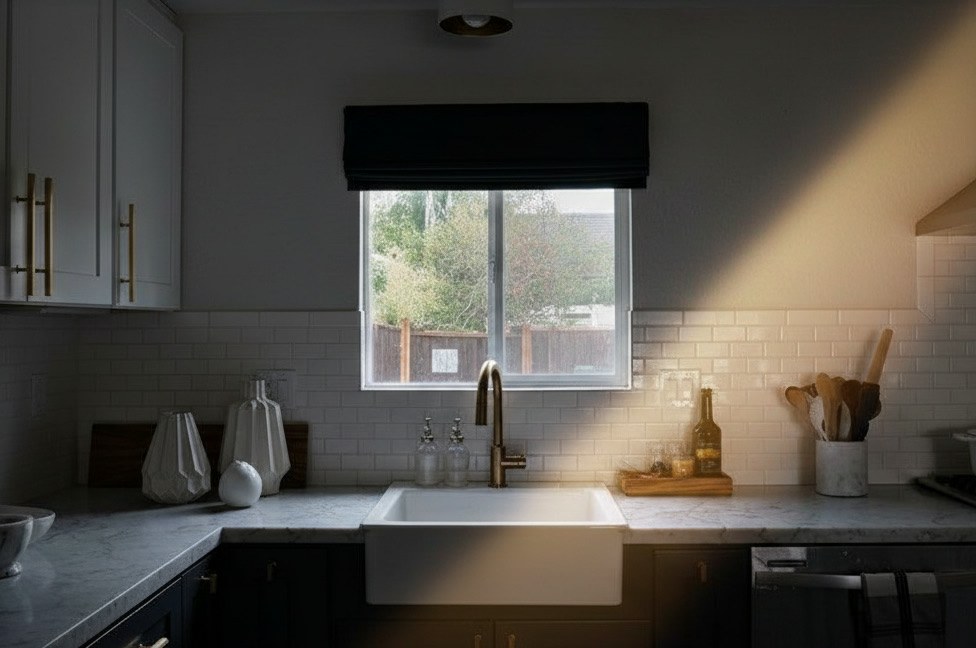
Undermounted, flush, carved into the worktop or exposed-front
The next decision is how the bowl meets the worktop: four routes, which change the look, the daily cleaning and the work in the workshop.
| Fitting | How it is made | When to choose it |
|---|---|---|
| Carved into the worktop slab | Stone bowl joined to the worktop with no applied rim: the surface runs from top to base | For those who want worktop and bowl as one object; normally on a 3 cm slab |
| Undermounted | Stone, steel or composite bowl fixed beneath the worktop; the edge of the cut-out stays on show, polished | The most practical: water and crumbs are swept straight in by hand |
| Flush | The rim of the sink sits in a rebate a few millimetres deep, level with the worktop | Steel sinks in modern kitchens and on technical surfaces |
| Exposed-front | A block of stone projecting from the cabinet, like a Belfast sink, its front on show | Classic kitchens and indoor masonry kitchens; needs a base unit built around it |
With a carved sink, the slabs for worktop and bowl are chosen together, so the vein passes from top to base. With an undermounted sink what matters is the edge of the cut-out, CNC-shaped with radiused corners and then polished: thicknesses and edges are explained on our marble kitchen worktop page. A single large bowl takes oven trays and wide pans; two suit those who wash up a lot by hand, but need a wider base unit.
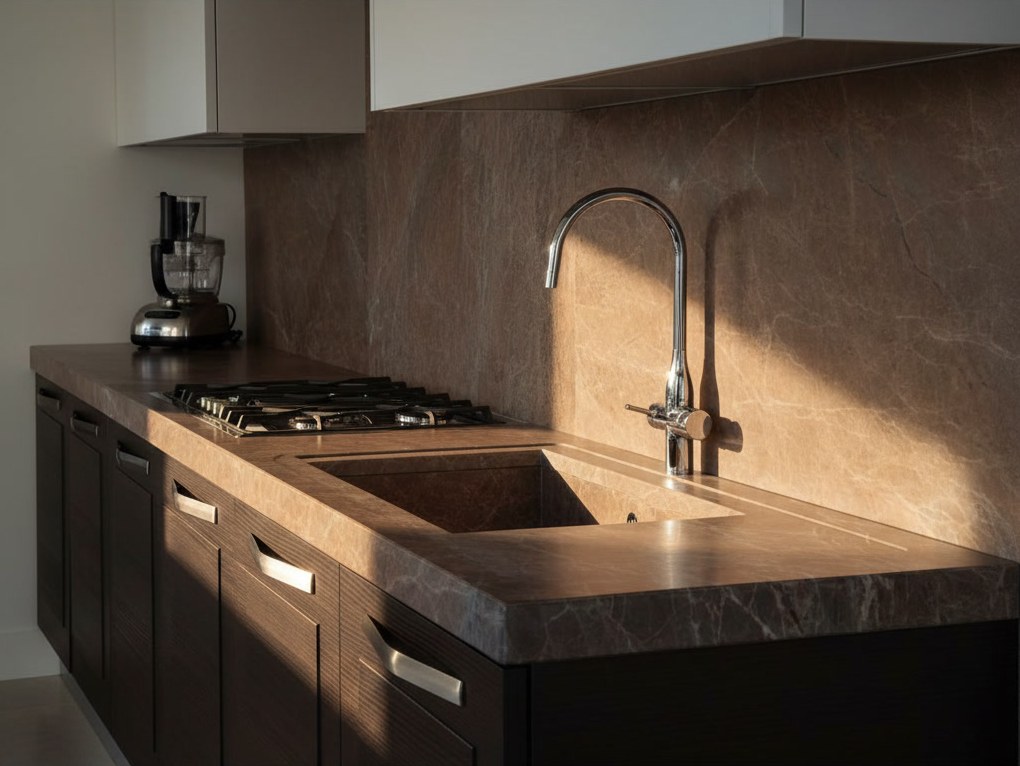
The sloping base, the waste and the draining grooves
A stone bowl with a dead-flat base holds water, and standing water leaves limescale. That is why the base is worked to a fall towards the waste: a few millimetres are enough to empty it completely. The corners between base and walls are eased with a radius, so the sponge reaches everywhere.
The waste is a hole sized to the chosen fitting, with a recessed seat so the metal rim does not act as a dam. An overflow, if you want one, is concealed in a wall; the holes for tap and soap dispenser are drilled in the worktop. Beside the bowl we can cut draining grooves: flutes falling gently towards the sink, which return the water from the dishes and keep the doors below dry.
Which stones suit a sink and which do not
Suitable. Compact, fine-grained marbles such as Bianco Carrara and Botticino hollow out well and are easily re-honed. Travertine, provided it is compact, filled and sealed, gives warm bowls, antiqued if you wish: see the travertine kitchen page. Granite and quartzite are harder and slower to hollow out, but they resist acids: they are the stone bowl with fewer worries, provided the quartzite is checked on a sample.
To be weighed up. Calacatta and Statuario, heavily veined and crystalline, can be carved, but the slab must be chosen with an eye to where the bowl will fall: an open vein should not cross the base. On Nero Marquina a film of limescale shows at once: it wants a honed finish and drying after use.
Not suitable. Onyx is delicate and is used backlit on non-working surfaces, not under the tap. Composite quartz and Dekton, a sintered stone, cannot be hollowed from a block: with these worktops a steel sink is normally fitted, undermounted or flush. In marble, the inside of the bowl is best honed, which hides rings and marks better than a polish.
Weight, and the cabinet to plan for
Marble weighs about 2.7 kilograms per cubic decimetre. A bowl built from 2 or 3 cm slabs already weighs some tens of kilograms; one hollowed from solid, with thicker walls and base, appreciably more, and both gain the weight of the water. It is not a weight to hang from the worktop: it rests on the cabinet.
So the base unit is designed together with the bowl: sides and rails sized for the load, a frame for the stone to bear on, and room for the trap and pipework, which sit lower than usual under a deep bowl. On a marble kitchen island the weight goes onto a structure hidden in the cabinet. If the kitchen already exists, we check the base units at the survey and reinforce them where needed; we also check the access, because a solid block has to pass through doors and up stairs.
Sealing and cleaning, without limescale remover
Before delivery the bowl receives, like the worktop, an impregnating sealer, which enters the pores without forming a film. It does not make marble indifferent to acids — no treatment does — but it slows absorption and gives you time to rinse. In a sink it wears sooner than elsewhere: if a drop of water on the dry rim no longer beads and darkens the stone, it is time to renew it.
Cleaning is as for the worktop: warm water, neutral soap, a soft sponge and, at the end of the day, a dry cloth, which is the real remedy for limescale. The white film around the waste comes off with a cleaner made for natural stone, never with limescale remover: it is an acid and etches marble within seconds. No bleach or strong degreasers, which strip the protection; no scorching pans set down on the stone. If the bowl turns dull, it is re-honed and comes back as it was. More in our guide to marble worktop care and maintenance.
When an undermounted steel sink is the better choice
A workshop that carves sinks should also say when not to. An undermounted steel sink is the right choice if you cook a great deal with lemon, vinegar and tomato and would rather not rinse at once; if you often wash cast iron and heavy pans, or fine glasses, which break more readily on stone; if the worktop is 2 cm thick on a modular kitchen; or if the budget should go into the worktop rather than the bowl. Steel fears neither acids nor knocks, and beneath marble it all but disappears: what you see is the polished stone edge.
In the Francesca collection, our indoor masonry kitchen, worktops and upstand are in travertine and the sink is in steel: stone where beauty is wanted, steel where service is.
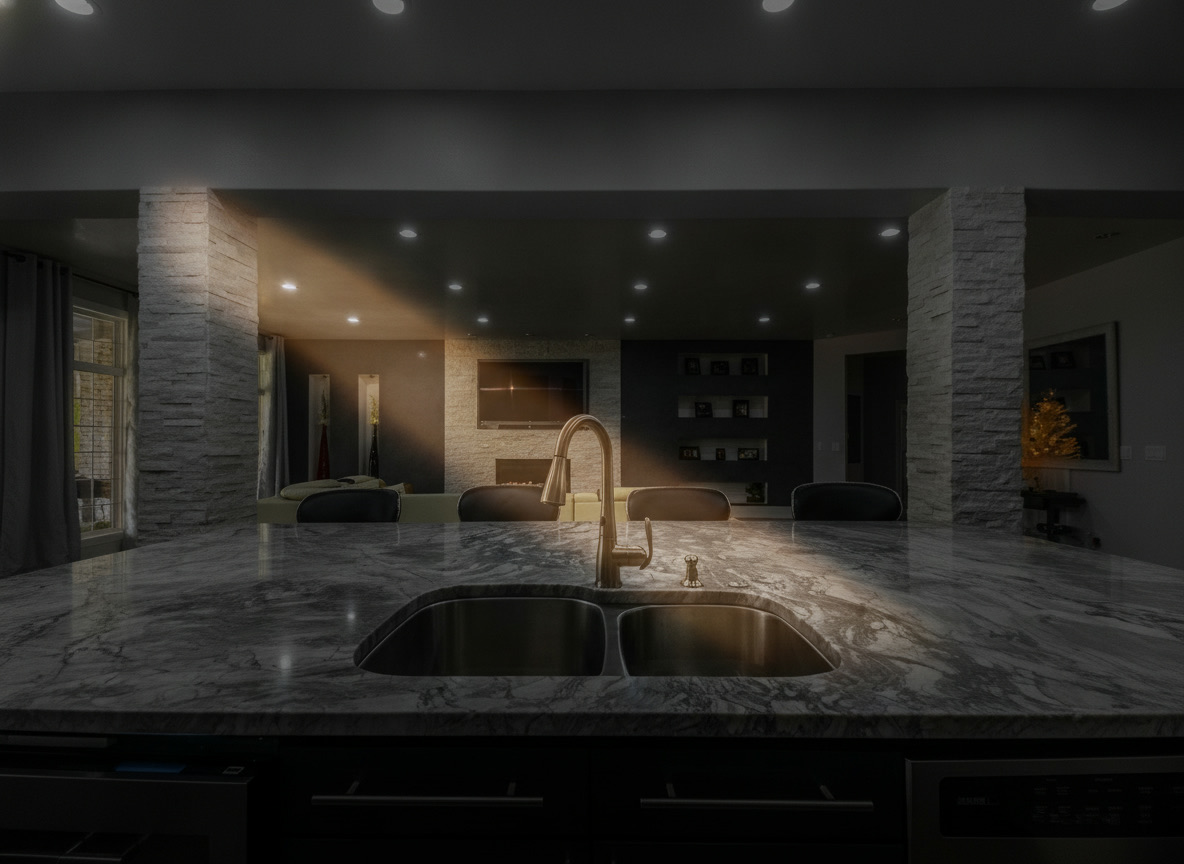
How Michelessi makes them: three real sinks and the method
Three pieces from our gallery show these routes. In the rose-grey worktop the sink is formed in the same pink marble as the worktop and upstand, with gently sloping walls. In the kitchen with a travertine worktop there are two bowls, in antiqued travertine, projecting from the cabinet. In the blue and white kitchen an exposed-front sink in white marble steps forward from the blue base units, under a Carrara marble worktop.
Michelessi has worked marble in Aprilia, on the Via Pontina, since 1976. It begins with a site survey and quotation, free of charge in Rome, Latina and throughout Lazio; the 3D design fixes the bowl's size and the position of waste, tap and draining grooves before the first cut. The slabs are chosen one by one, deciding where the bowl falls on the vein. Cutting and hollowing are done by CNC; radii, falls and the honing of the interior are finished by hand. Fitting is by our own team, who level worktop and bowl, seal the joints and coordinate the waste and tap connections. We deliver and install throughout Italy and abroad, as for the Dubai project; lead times are set with the quotation.
Further reading
The sink is one chapter of the kitchen: the full picture, with islands, modular ranges and completed work, is on the indoor marble kitchens page. For the wall behind the tap, see the marble kitchen splashback; to compare stone with technical surfaces, the guide marble, Dekton, quartz or Fenix. With a floor plan or a photograph of the room, ask for a free quotation.
Frequently asked questions
Frequently asked questions
Does limescale damage a marble sink?
No, limescale does not damage marble: it leaves a white film that comes off with a cleaner made for natural stone and a soft sponge. What damages it is limescale remover, which is an acid and etches the surface within seconds. The real remedy is to dry the bowl at the end of the day; if the film has hardened, we remove it by re-honing the stone.
How heavy is a marble sink carved from a solid block?
It depends on the size and the thickness of the walls, but expect several tens of kilograms: marble weighs about 2.7 kilograms per cubic decimetre, and the water adds to the stone. A bowl built from 2 or 3 cm slabs weighs less. Either way the weight rests on a base unit designed for it, not on the worktop.
Can a stone sink be fitted to a kitchen I already have?
Yes, if the base unit under the sink can be adapted. We survey the cabinet, the waste pipes and the existing worktop: an undermounted or exposed-front bowl means reinforcing or rebuilding the base, whereas a sink carved into the slab comes with a new worktop, because bowl and top are cut from the same stone. In Lazio the site survey is free.
Does a marble sink cost more than a steel one?
Yes: a stone sink is special workmanship, made of CNC machine time and craftsman's time, whereas a steel sink is a standard product fitted beneath the worktop. The cost depends on the stone, the dimensions and the type, hollowed from solid or built from slabs; we state it in the quotation, which is free.