
Outdoor kitchens
Luxury outdoor kitchen made in Italy, shipped worldwide
A luxury outdoor kitchen made in Italy is a bespoke kitchen built in Italy around stone chosen slab by slab: a monolithic island, fire held in refractory stone, edges finished by hand. Michelessi has designed and built them in Aprilia, between Rome and Latina, since 1976, packs them in made-to-measure crates with numbered pieces and installs them in Italy and abroad, as in Dubai.
What makes an outdoor kitchen a luxury one
A luxury outdoor kitchen made in Italy is not defined by how many appliances it holds, but by four things you can see and touch. The first is the stone: not a material picked from a catalogue, but a slab chosen for that garden, with its own veining. The second is the island, conceived as a single block rather than a row of modules pushed together. The third is the fire, held in refractory stone, the material bread ovens are made of, born to stand beside the flame. The fourth is the detail no photograph conveys: the edge finished by hand, the joint as fine as a pencil line, the drip groove cut beneath the overhang. Everything else, from the fridge to the wine cooler, can be bought; these four things have to be built. This page explains how we build them in Aprilia and how they reach your home, however far from Italy.
Stone chosen slab by slab
Two slabs from the same block resemble each other but are never identical, which is why the choice is the first act of the project. In the Aprilia workshop the slab is viewed upright, with the drawing of the kitchen in hand. The veining is followed: the worktop, sides and upstand of the island are cut from the same slab, so that the pattern carries on from one element to the next; in book-matched projects the slabs are set side by side like the pages of a book. The flaw is avoided: a trained eye reads the weaker lines and keeps them clear of the cut-outs for sink and barbecue. Outdoors there is one more test: the stone must be seen dry and wet, because rain changes its tone. If you cannot come to Aprilia, we show you the slabs over a video call, send samples to your door and photograph in full the slab destined for your kitchen; nothing is cut until you have approved it.
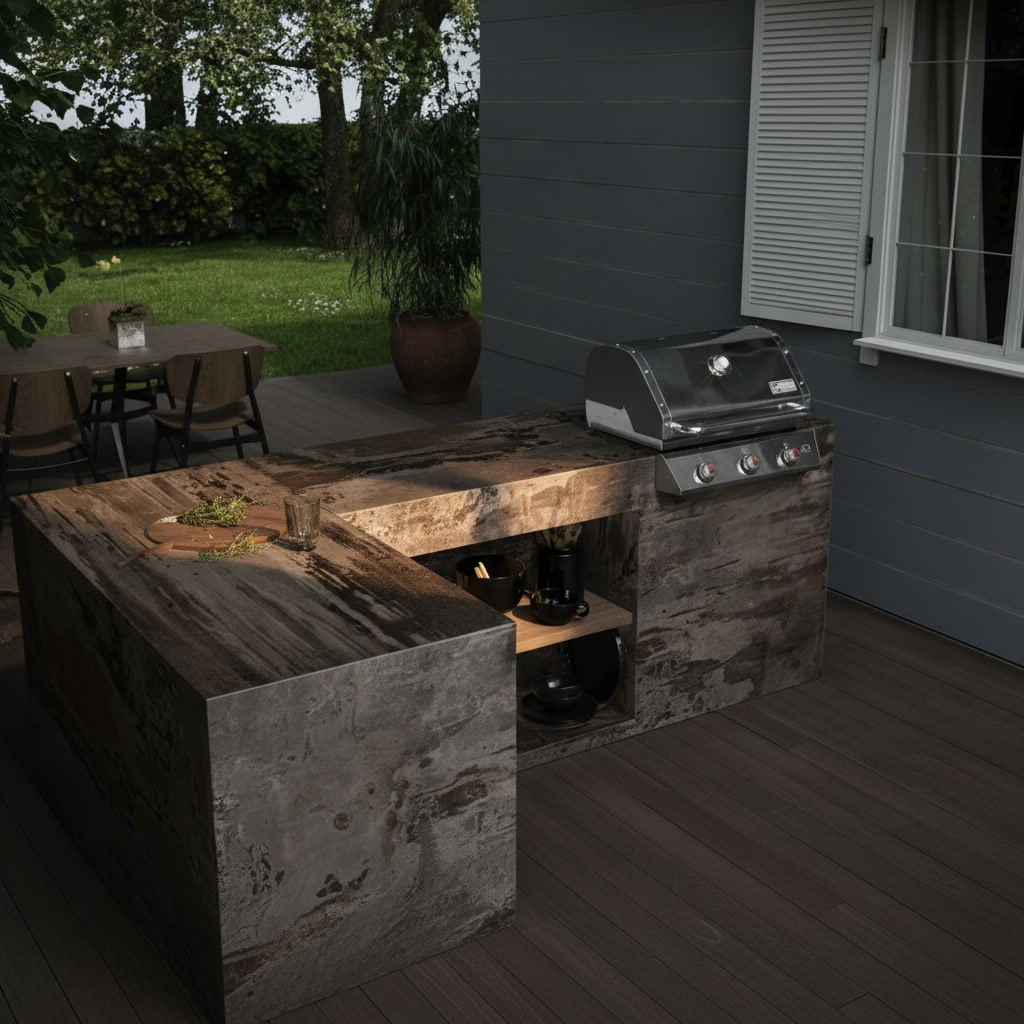
The monolithic island and fire in refractory stone
A monolithic island is made in two ways. In the first, slabs 2 or 3 centimetres thick are mitred at 45 degrees and joined along the edge: the vein runs from the worktop down the side without a break and the island reads as a single carved block, light enough for a terrace too, once the load has been checked. In the second the stone is solid, for the most sculptural islands, with the sink carved out of its thickness: a choice for the garden, on a base designed to carry the load. In both cases the edges are finished by hand, and a drip groove cut beneath the overhang keeps rainwater off the sides.
Fire is another matter. Granite and quartzite will take a hot pan, marble asks for a trivet, and no worktop stone is meant to sit against a live flame. So the chamber of the wood-burning barbecue and the dome of the oven are built in refractory stone, and the fine stone stops where the fire begins. Gas and charcoal barbecues, BeefEater and Bull among them, are set into the worktop through an opening cut by numerical control to the appliance drawing. The structure is explained on our page about refractory stone barbecues and outdoor kitchens.
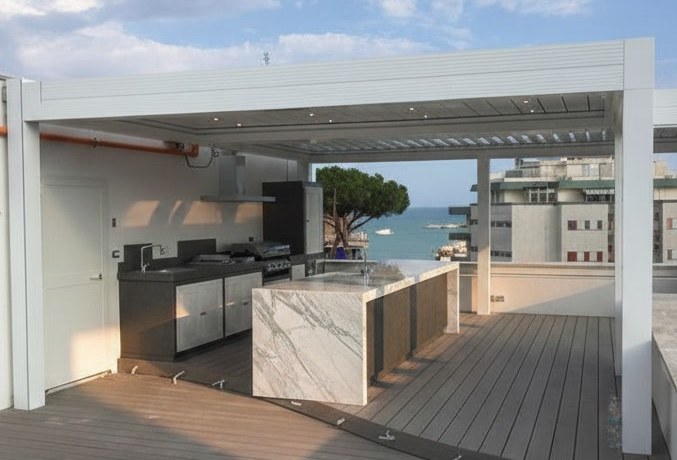
What ‘built in Aprilia’ actually means
‘Made in Italy’ is a label one reads often; here it has a single address: Via Pontina Km 45,350, Aprilia, between Rome and Latina, where Michelessi has worked marble since 1976. Design, cutting, finishing and final checks never leave that workshop. The technical office draws the kitchen in three dimensions within your own space; numerically controlled cutting centres transfer the drawing to the slab under a veil of water, and cut openings and joints to a precision the hand alone could not guarantee. Then the machine stops and hand finishing begins: edges, corners, joints that must disappear, the water-repellent treatment applied in the workshop. Before packing, the pieces are dry-assembled: every element is checked against its neighbour as in the drawing, because cut stone cannot be adjusted on site, least of all thousands of kilometres away. That is what fifty years of practice are for; the full story is in the guide Made in Italy since 1976: the Aprilia workshop.
Heat, sea air, frost: the right stone for each climate
A kitchen that leaves Aprilia for another climate is designed for that climate. The stone that suits a sheltered Roman garden is not necessarily right for a desert terrace, a seafront or a mountain valley.
| Climate | What it asks of the stone | Materials we recommend | Finish and precautions |
|---|---|---|---|
| Hot, full sun | Strong sun, surfaces that heat up, wind-borne sand | Granite, quartzite, sintered stone (Dekton, Laminam); marble only in pale colours | Honed, never polished; pale colours; a pergola over the worktop |
| Coastal and poolside | Salt air, chlorinated water, constant splashing | Granite, quartzite, sintered stone; marine-grade stainless steel | Marble and compact travertine sealed and kept clear of splashes; non-slip paving around, never polished |
| Cold, with frost | Water freezing in the pores, sharp swings in temperature | Granite, quartzite, sintered stone, lava stone | Marble and compact travertine with a water-repellent sealer; covered in winter, taps drained |
Two exclusions hold everywhere: quartz composite stays indoors, because its resin yellows in the sun, and Nero Marquina does not care for direct sunlight. Marble remains the most beautiful stone and lives well outdoors beneath a pergola, honed or brushed, with its sealer renewed each season. For a pale, veined worktop in full sun, the answer is the quartzite outdoor kitchen.
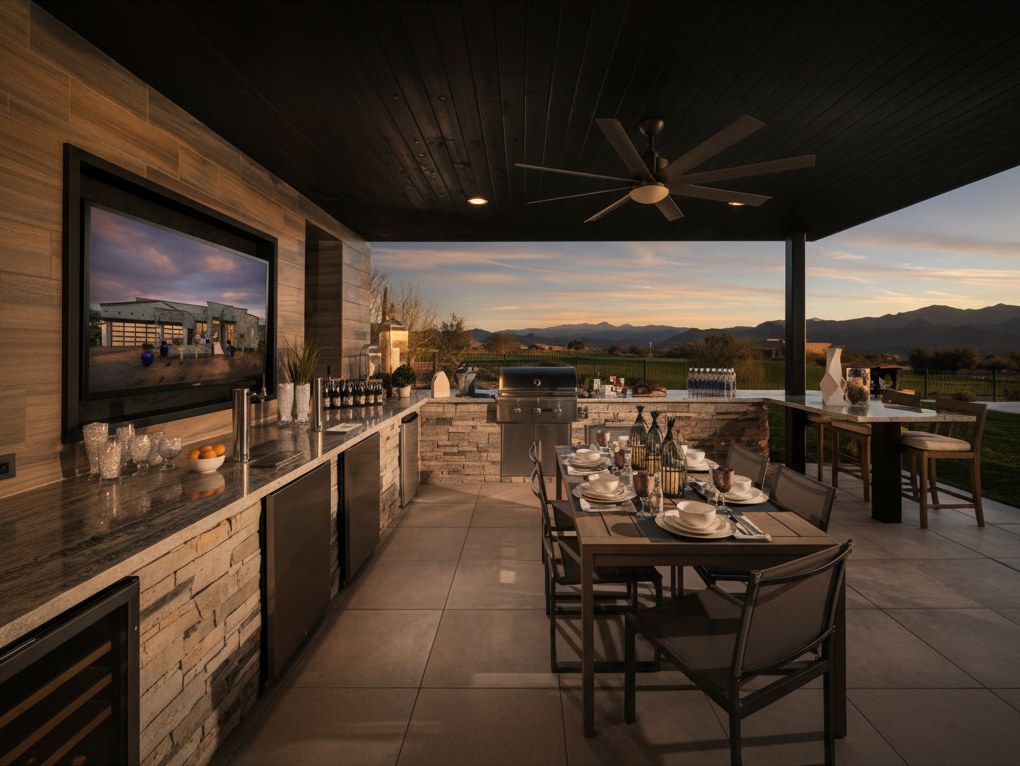
Packing, shipping and installation abroad
A slab is heavy and fragile at once: it travels well only if it is packed well. Each finished piece is protected individually, the corners above all, and stood upright between spacers in wooden crates built to the size of the load. The pieces are numbered as in the installation drawing, which travels with the shipment: whoever opens the crate knows where each element belongs. Transport and customs documents are prepared with the freight forwarder and state the Italian origin of the goods. Shipping is by road within Europe, by sea or air to more distant destinations; the means and the schedule are set out in the quotation.
In Italy the kitchen is fitted by our own team. Abroad, installation is coordinated with the project: our technicians follow the assembly on site, or guide the local contractor with the numbered drawing and instructions on adhesives, sealants and joints; services and appliances are specified to the standards of the destination country. The method is described in the guide to how a bespoke kitchen travels from Italy worldwide.
Dubai, our project abroad
Our work abroad has one name: the Dubai project. Bespoke interiors and exteriors designed and built in Aprilia, then installed at the residence by our own artisans: complete outdoor kitchens with fireplace and barbecue in natural stone, wood and steel; marble interiors, from floors to formal bathrooms; and the climate-controlled pergola that produces and stores its own energy, engineered for the desert. We say this plainly, because anyone choosing from a distance is entitled to know: the kitchens our website sets in London, Miami, Monte Carlo, Saint-Moritz, New York and on Lake Como are project visions, exercises from our drawing board, not delivered commissions. They show how the same stone changes character with light and climate, and how we would like to work for you.
How to begin from a distance
A photograph of the garden, terrace or poolside, a few measurements taken by hand and an idea are enough. Write to us in English or Italian from the outdoor kitchen quotation page or on WhatsApp: we reply with a first assessment of material and layout. If an architect or contractor is working on site, we speak with them directly and receive their drawings; otherwise we guide you through the survey, and in the more complex cases a template is made, a full-size outline of the worktop. From the measurements comes the 3D design, which you review with us over a video call; samples reach your home, to be judged in real daylight. Only once the drawing is approved do we move on to the slabs. The quotation is free and sets out production, transport and installation for your destination; in Rome, Latina and across Lazio the site survey is free as well.
Further reading
This page is a chapter of our main page on outdoor kitchens in marble and stone, with the layouts, the catalogue models and our design visions. For the comparison of stones, read the guide outdoor kitchen: which stone to choose; if fire is the heart of your project, see the outdoor kitchen with wood-fired oven; and for what drives the price, the guide how much does an outdoor kitchen cost.
Frequently asked questions
Frequently asked questions
What is the difference between a luxury outdoor kitchen and a standard one?
Four things that are built rather than bought: stone chosen slab by slab, an island conceived as a single block with the vein running from the worktop down the sides, fire held in refractory stone, and details finished by hand. The appliances may well be the same; what changes is the bespoke design, the cutting and the hand that finishes the work.
How can I tell whether an outdoor kitchen is really made in Italy?
Ask where the design, cutting, finishing and final checks are done, and by whom. For Michelessi the answer is a single address: the workshop in Aprilia, on the Via Pontina between Rome and Latina, where stone has been worked since 1976. You can visit it, less than an hour from Rome, or follow the work over a video call, from the chosen slab to the dry assembly.
Does a luxury outdoor kitchen have to be made of marble?
No: the luxury lies in the choice of the slab and in the workmanship, not in the name of the stone. In full sun, by the sea or where it freezes, granite, quartzite and sintered stone last longer and ask for less care; marble, sensitive to acids, is at its best beneath a pergola, honed and sealed. The two can be combined: quartzite for the working surface, marble where no cooking is done.
Can I see my kitchen assembled before it is shipped abroad?
Yes, where the project allows: before packing, the pieces are dry-assembled in the Aprilia workshop and we show them to you over a video call, or in person if you visit. Before that, you approve the 3D design and the photograph of the full slab. What you have seen is what comes out of the crate, with the pieces numbered as in the installation drawing.