
Outdoor kitchens
Outdoor kitchen with wood-fired pizza oven: dome, flue, care
An outdoor kitchen with a wood-fired pizza oven brings a domed oven, a barbecue, a sink and a worktop together in a single block of refractory stone. The oven has a refractory cooking floor, an arched mouth with a door, a flue of its own and a dry log store beneath; beside it runs a worktop in granite or sintered stone. The first firings are gradual.
What an outdoor kitchen with a wood-fired pizza oven includes
An outdoor kitchen with a wood-fired pizza oven is a single block in which the domed oven works beside the barbecue, the sink and the worktops: the dough is stretched a step from the mouth, a scorching tray finds somewhere to land at once and the logs are within reach. In our outdoor kitchens in marble and stone the structure is built from blocks of refractory stone, the material of ovens themselves; on top goes a worktop in granite, quartzite or sintered stone, cut in our workshop in Aprilia. Compared with a barbecue, an oven asks for four more things: a dome that stores heat, a mouth that closes, a flue of its own and a supply of dry wood.
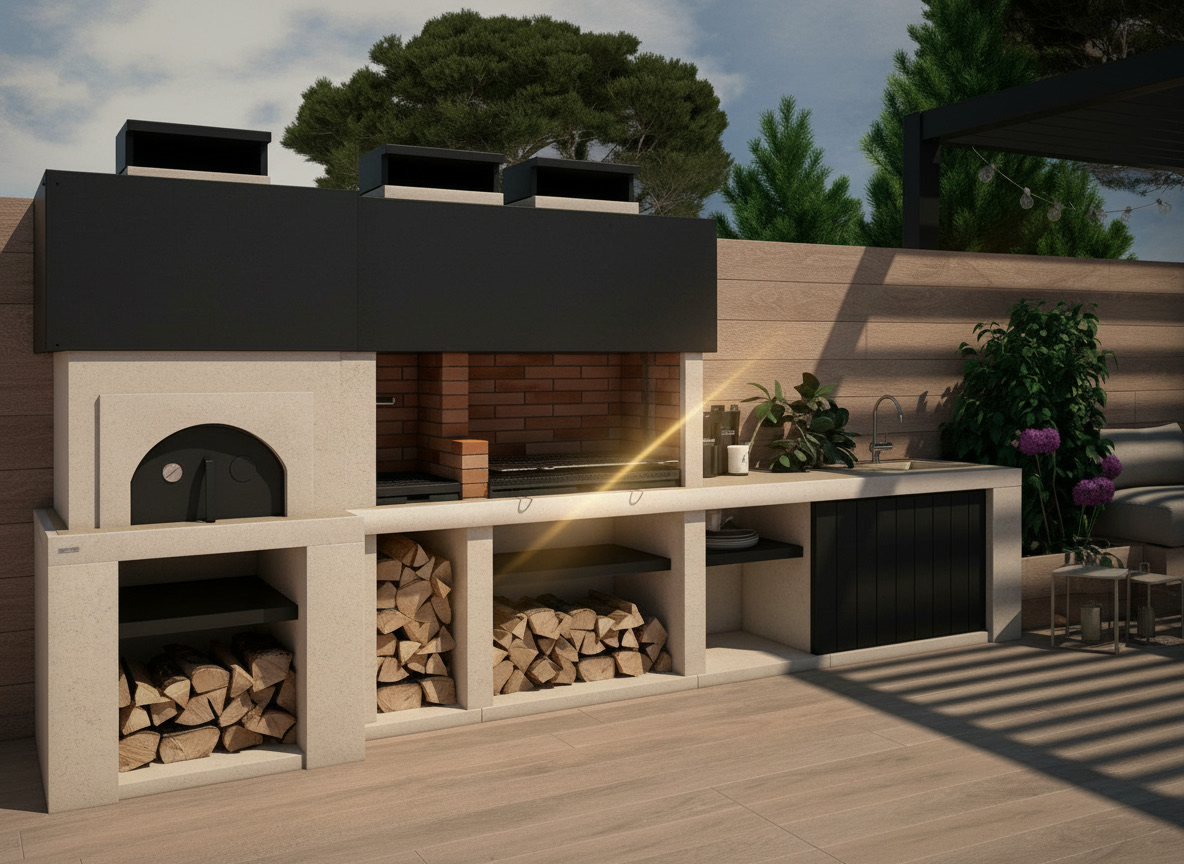
Refractory-stone dome and cooking floor: how the oven cooks
A wood-fired oven cooks with three kinds of heat at once. The cooking floor gives heat by contact to the base of the pizza or the loaf; the dome radiates it from above; hot air travels along the vault and wraps around the food. Everything depends on the mass of the refractory stone, which takes up the heat of the flame and gives it back slowly. The fire is lit in the middle of the floor, then pushed aside: when the vault, blackened by soot, turns pale again, the oven is up to temperature. As a guide, pizza wants a floor at around 400 °C with a live flame; bread and roasts follow, with the fire out, at 200 to 250 °C.
A well-built oven has an insulating layer over the dome and beneath the cooking floor, which keeps the heat in for hours and protects the neighbouring worktops. The cooking floor sits higher than the worktop, at roughly elbow height: you look into the mouth without stooping.
Arched mouth, door and a flue of its own
The arched mouth is no affectation: an arch carries the load down its sides and moves with the stone as it expands; the opening is wide enough for peel and tray, yet tight enough to keep the heat in. It is often ringed with a brick arch, as in the ‘Cucina con forno’ in our collection. The door, in steel or cast iron, sets the kind of cooking: open for pizza, when the flame needs air; shut for bread and roasts, when the oven works on stored heat.
Smoke leaves at the top of the mouth and rises through a flue of its own, separate from the barbecue hood: two fires with different draughts, joined in one duct, interfere and send smoke back towards the cook. So in models with both oven and barbecue each fire has its own outlet. In the 3D design we fix the position of the flue: its outlet above head height, clear of windows and beams, with a cap that keeps rain out of the dome.
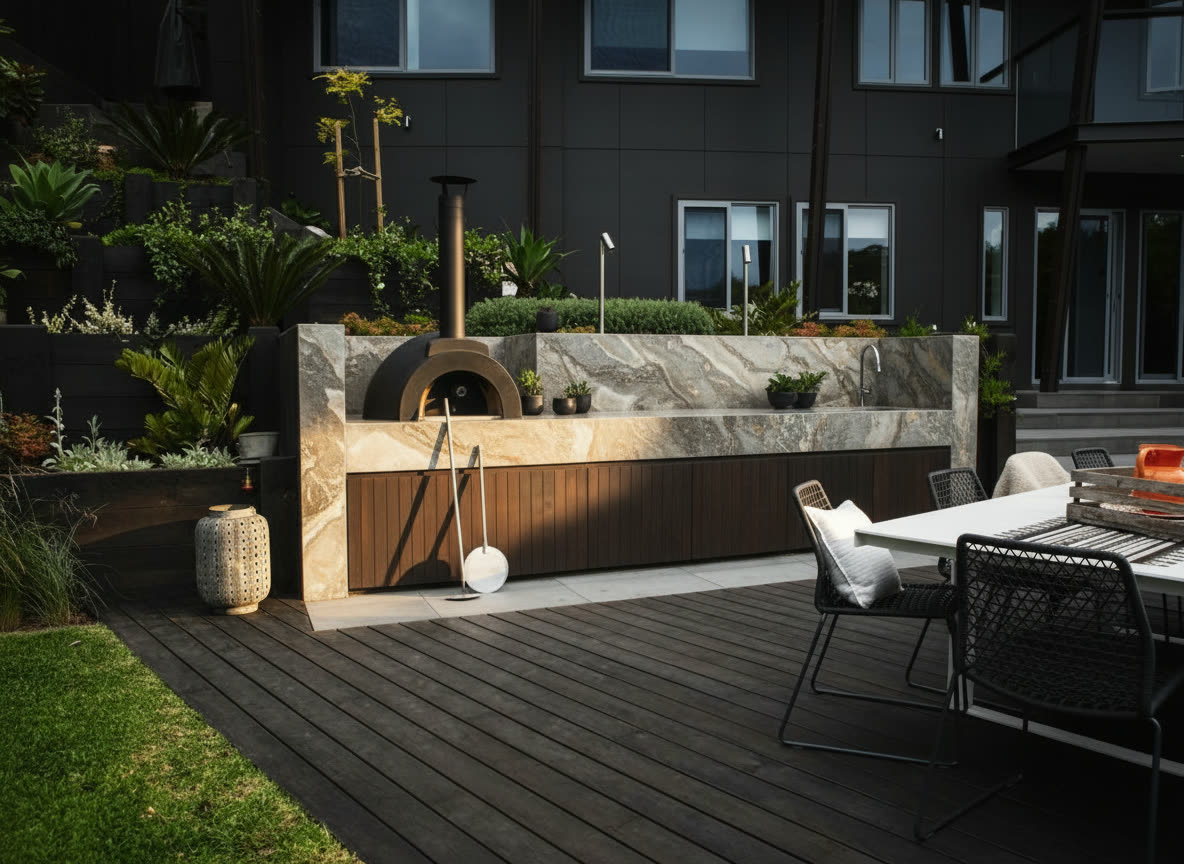
A dry log store, with oven and barbecue in one block
Damp wood smokes, dirties the vault and never brings the oven up to temperature. So the log store sits beneath the oven, raised off the ground, open at the front so that air can pass and sheltered from the rain. Use well-seasoned hardwood such as beech, oak, olive or fruit wood, with a moisture content of under about 20 per cent; never painted, treated or resinous timber.
When oven and barbecue share a block, the order matters. The oven goes at one end, because it is the fire that burns longest; then come the barbecue, the worktop and finally the sink, so that heat stays on one side and water on the other. This is the arrangement of model 109 in the Economy range in refractory stone: a wood-fired oven with an arched mouth, a barbecue with a brick back, a sink and log shelves. If you prefer gas for grilling, a built-in BeefEater or Bull barbecue can sit in the worktop beside the oven, as explained on our page about the outdoor kitchen with a stone barbecue.
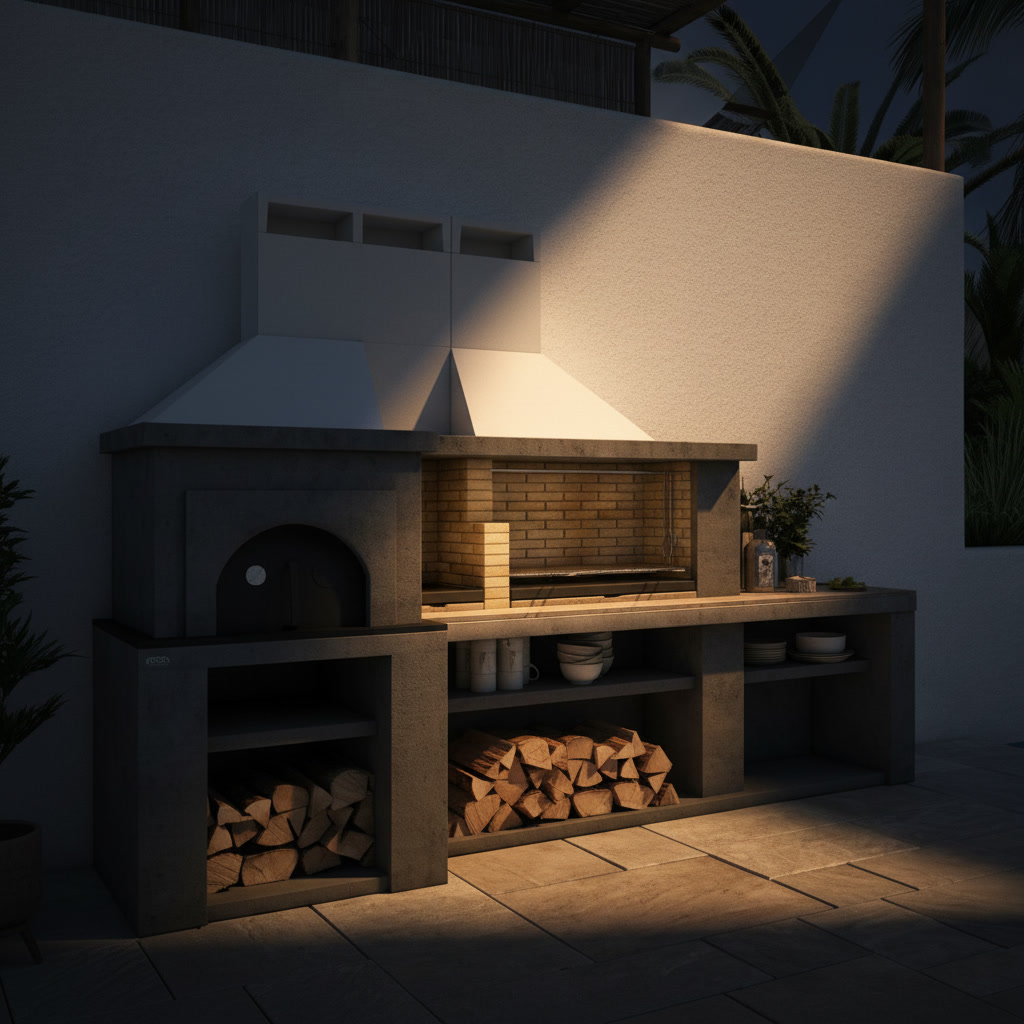
The worktop beside the oven: granite or sintered stone
Beside the mouth you need a clear run of worktop at least two trays wide: that is where the dough is stretched and whatever comes out scorching is set down. Only refractory stone works in contact with the fire; the stone worktop stops short of it, separated from the oven by a flexible joint that lets the two materials expand independently. The typical thickness is 2 or 3 centimetres.
| Material | Beside the oven | What to watch |
|---|---|---|
| Granite | Takes a scorching tray, tomato and lemon | Dark colours heat up in the sun: best honed, or flamed and brushed |
| Quartzite | Hard and low in absorption, with the veining of marble | Check it on a sample: some stones sold under this name are marbles |
| Sintered stone (Dekton, Laminam) | Non-absorbent, unaffected by sun or frost, light | The edge dislikes sharp knocks: it is drawn with a chamfer |
| Marble | Cool under the hands, the traditional surface for dough | Moderate heat resistance, sensitive to acids: honed, sealed, under a pergola and away from the mouth |
Engineered quartz is not used outdoors: it yellows in the sun and marks with heat. Near the fire, granite for the outdoor kitchen remains the least demanding choice.
Where to put it: clearances, roofs and permissions
There is no single distance that suits every garden: the figures come from the flue manufacturer, from your local authority and, in a shared building, from its own rules. The principles do not change. The mouth is turned away from the prevailing wind, which would otherwise blow into the oven and drive the smoke back; the smoke must drift away from the table and from windows, yours and the neighbours'. Nothing that burns belongs near the mouth or the flue: timber doors, hedges, awnings, beams. The floor in front of the oven is stone or porcelain tile.
The oven can stand under a pergola or a porch, but the flue must pass above the roof through an insulated section kept clear of the timber, and no fabric or reed screening may hang over the fire. As for permissions, a fixed refractory-stone structure with an oven and flue may need to be notified to the local authority, depending on local rules: we check this at the survey. Lastly, weight: dome, base and logs need a footing that will not settle. On a terrace, the floor's load capacity is checked before anything is drawn, as we explain for the rooftop terrace outdoor kitchen; where smoke is a problem, a gas oven is worth considering.
Gradual first firings and care through the seasons
New refractory stone holds moisture, and takes more up again after a winter of rain. Heated too fast, that water turns to steam and puts the stone under strain. So the first firings are gradual: for several days, small, short fires in the middle of the floor, a little longer each time, and only then the first full blaze for pizza. The same care applies to the first firing of spring.
Ash is removed once the oven is cold, with shovel and brush, into a metal bucket. The cooking floor is brushed, never washed: the heat of the next firing deals with any residue. Never cool the oven with water: let it die down by itself, with the door shut. Outside, water and a neutral cleaner are enough, never acids or harsh descalers. Once a year, check the flue and its cap; in winter a breathable cover goes over the oven and the fire zones.
How Michelessi builds it
We have worked stone in Aprilia, on the Via Pontina between Rome and Latina, since 1976. For a kitchen with an oven the site survey, free of charge in Rome, Latina and throughout Lazio, looks at four things: the footing that will carry the weight, the wind that carries the smoke, the distance from plants, walls and neighbours, and the spot where the wood will stay dry. Our technical office then draws the kitchen in 3D and sets the worktop heights and the position of the flue. The worktop slabs are chosen one by one in the workshop; cutting is numerically controlled, the edges are finished by hand and the pieces are dry-fitted before they leave. In Italy our own team installs, fitting oven, barbecue and sink and testing every element with you; abroad our technicians follow the installation, as for the Dubai project. Lead times are set out with the free quotation.
Further reading
To choose the stone for the worktop, read the guide outdoor kitchen: which stone to choose and our page on the quartzite outdoor kitchen; if the oven is to stand under a country pergola, the travertine outdoor kitchen; and to see what drives the cost, how much an outdoor kitchen costs.
Frequently asked questions
Frequently asked questions
How long does an outdoor wood-fired oven take to heat up?
As a rule about an hour of live fire, longer if the dome has a great deal of mass or the oven is cold and damp after winter. The sign is the vault: blackened by soot at first, it turns pale again once the oven is up to temperature. At that point the embers are pushed to one side and cooking begins.
What wood should I burn in a wood-fired pizza oven?
Dry, well-seasoned hardwood: beech, oak, olive or fruit wood, in small pieces for lighting and larger ones to keep the flame going. Avoid painted or treated timber, pallets and resinous species, which smoke and dirty the vault. Enough for a few firings lives in the log store beneath the oven, sheltered from the rain.
Can a wood-fired oven and a barbecue share the same flue?
No, each fire is better with its own outlet. Oven and barbecue draw differently and, joined in one duct, they interfere: the smoke from one comes back down through the mouth of the other. In the 3D design we fix the position of the oven flue and of the barbecue hood, with both outlets above the height of the cook.
Can a wood-fired oven go under a pergola or a canopy?
Yes, on three conditions: the flue passes above the roof through an insulated section, the beams stay clear of the mouth and the pipe as the manufacturer specifies, and no fabric or reed screening hangs over the fire. These are points we study in the 3D design and check at the site survey, together with your local authority's rules.