
Outdoor kitchens
Quartzite outdoor kitchen: durability, colours and care
A quartzite outdoor kitchen has worktops cut from a natural rock harder than granite, which withstands sun, frost, rain and the acids of lemon and wine without fading. It is not engineered quartz, which yellows outdoors. Choose a pale slab beside the barbecue, honed or brushed, 2 or 3 centimetres thick; care is water, a neutral cleaner and one protective treatment a year.
What quartzite is, and why it is not quartz
A quartzite outdoor kitchen has its worktops cut from a natural rock, not from a manufactured material. Quartzite begins as quartz-rich sandstone that heat and pressure have recrystallised into a dense mass: a metamorphic rock, harder than granite, low in porosity, with marble-like veining and colours that run from white to grey and from green to blue. Engineered quartz is a different material: ground quartz, pigments and a small share of resin, pressed into slabs. Indoors it makes a practical worktop; outdoors we do not fit it, because sunlight yellows the resin and the heat of a barbecue marks it. The two names are easily confused: your quotation should carry the word ‘quartzite’ beside the name of the stone, and you should see the whole slab before it is cut.
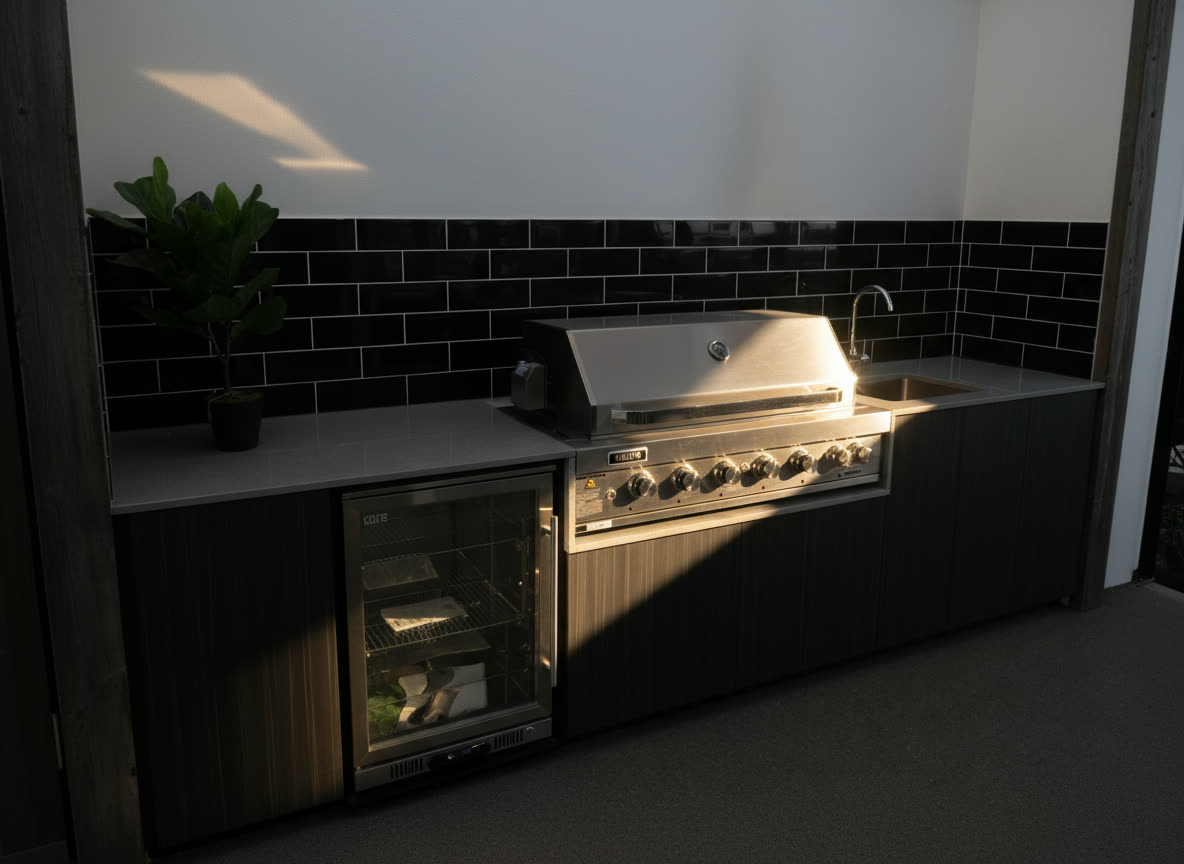
Why it withstands sun, frost and acids
Quartzite is made almost entirely of quartz, and its character follows from that. Sun does not fade it, because it contains no resins or pigments: the colour is that of the minerals. Frost does not split it, because water finds very few pores to enter and expand in. Rain and salt air run off it. The acids of the table, lemon, wine, vinegar and tomato, do not dull it as they dull marble, which is calcium carbonate. On the Mohs scale quartz stands at 7 and the calcite of marble at 3: a knife blade does not scratch quartzite. It copes well with kitchen heat, but a trivet under a pan straight off the flame is still the rule.
The first limit: no worktop stone is meant for a live flame. The chamber of a wood-fired barbecue and the vault of an oven are built in refractory stone, and the quartzite stops where the fire begins, as we explain on our page on the outdoor kitchen with a stone barbecue. The second concerns the name: some stones sold as ‘quartzite’ are in fact dolomitic marbles, sensitive to acids. The check is made on a sample, with a drop of lemon juice left for a few minutes: if it leaves a dull mark, the stone is not quartzite.
Pale colours beside the barbecue
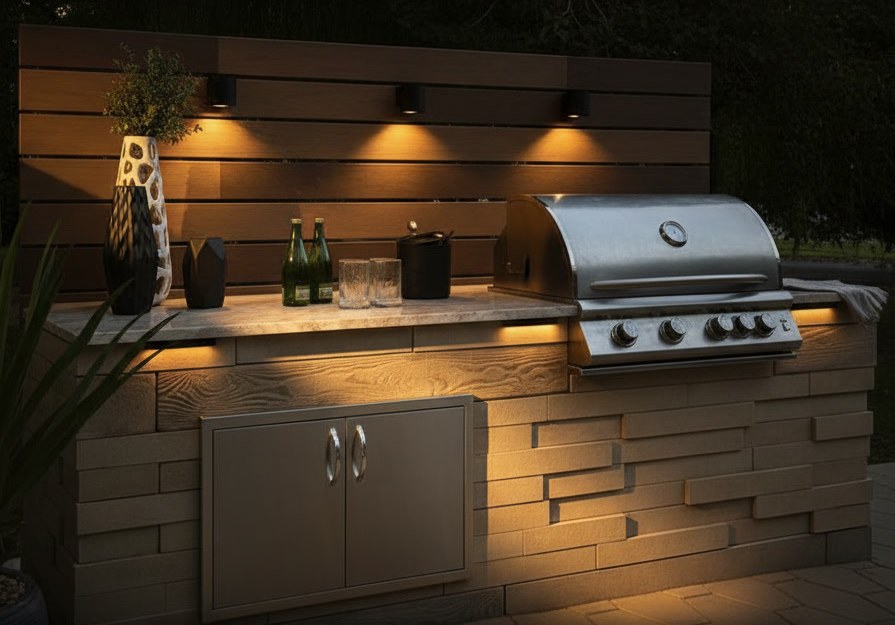
Beside the grill is where hands, plates and trays come to rest: this is where the colour of the worktop matters most. Pale stones heat up far less in the sun than dark ones, which is why we recommend quartzite above all in full sun and for the pale worktops on either side of the barbecue. A white quartzite with grey veins resembles a Calacatta, yet it fears neither a forgotten slice of lemon nor a spilt glass of wine. Pale stone has one weak point: it shows grease. That is why pale slabs leave the workshop already treated with an impregnating sealer, and why grill grease is wiped away at the end of cooking. There are dark quartzites too, grey and almost black: they heat up more in the sun and are happiest where the worktop stays in shade through the hottest hours, under a pergola or a canopy. Colour is judged in person, on the whole slab, dry and wet; the stones in our collection are on the page of natural stones chosen at the quarry.
Finishes and worktop thickness
Outdoors we recommend two finishes. Honed is smooth and matt: it does not dazzle, cleans with one pass of a sponge and lets the vein be read. Brushed is satin and faintly undulating to the touch: it hides dried water marks and small scuffs better than any other, keeps its grip when wet and needs the sealer. Flamed is rough: we use it for the paving and steps around the kitchen rather than for the worktop, where it would hold crumbs. Polished lasts better outdoors on quartzite than on marble, but it reflects the midday light and shows every drop: we advise against it for a working surface. You can see the finishes side by side on our stone finishes page.
The typical thickness is 2 or 3 centimetres. The edge is finished by hand with a small chamfer, which protects the arris from knocks; a drip groove is cut beneath the overhang so that water cannot run back onto the sides, and the worktop is laid with a barely perceptible fall towards the outer edge. Joints between slabs are sealed with flexible products. A 2 centimetre slab weighs around 55 kilos per square metre: on a terrace the floor's load capacity is checked before anything is drawn.
Quartzite, granite or marble: the comparison
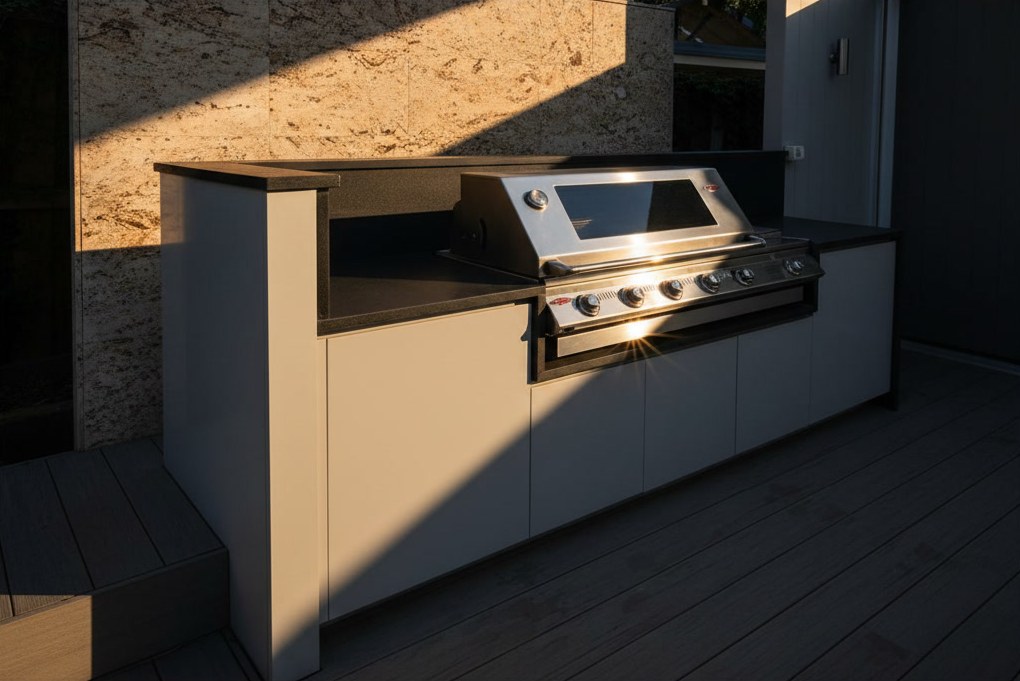
Granite is as untroubled as quartzite by sun, frost and acids, but has a crystalline grain where quartzite has a vein: it is the choice for those who want an even worktop, described on our granite outdoor kitchen page. Marble is the most beautiful and the most delicate: it reacts to acids and wants a honed or brushed finish, a treatment renewed every season and, where possible, a pergola. Quartzite sits between the two: the vein of marble with the resistance of granite, at the cost of slower workmanship, because its hardness slows both cutting and polishing.
| Stone | Lemon, wine, vinegar | Sun and frost | Look and care |
|---|---|---|---|
| True quartzite | Resists; check on a sample | Unaffected | Marble-like veining; minimal care |
| Granite | Resists | Unaffected | Crystalline grain; minimal care |
| Marble | Sensitive: wipe at once | With a water-repellent treatment, best under a pergola | Unique veining; treatment every season |
| Engineered quartz | Resists | Not for outdoor use: sunlight yellows it | Even colour; indoors only |
Where we use it: worktop, island, bar counter
The straight worktop is the most frequent use: a slab of quartzite running along a wall or a balustrade and taking the gas or charcoal barbecue (we work with BeefEater and Bull, with the Cabinex series and with Fògher modules), the sink and, below, an outdoor fridge. Each opening is cut in the workshop to the appliance drawings, with rounded corners and with the air gap the manufacturer specifies around heat sources.
The island is seen from every side, and here quartzite shows its vein: the slab is chosen so that the pattern runs unbroken across the top and, if you wish, down the sides with a 45° mitred joint. The bar counter is the raised top where guests sit on stools: the overhanging part must be supported by the structure, and a stone that fears neither wine nor lemon suits a counter where drinks are served, as we show on the outdoor stone bar counter page. Beneath the slab the structure may be refractory stone, treated timber or steel, as in the stainless steel and stone outdoor kitchen. Beside a pool, pale quartzite in a brushed finish, never polished, is among the most suitable stones: it stays cool in the sun and is untroubled by chlorinated water.
Care: little, but regular
Quartzite asks less than any other veined stone. After each barbecue, warm water and a neutral cleaner are enough; grease comes away while it is still warm. Aggressive descalers are unnecessary and spoil the protective treatment: limescale from water drops is prevented by drying the worktop with a cloth, on dark quartzites especially. Once a year, at the start of the season, the sealer is renewed and the flexible joints are checked. In winter the taps are drained, the barbecue and the fire parts are covered and the worktop is left uncovered: quartzite does not fear frost.
How Michelessi works with quartzite
We have worked stone in Aprilia, on the Via Pontina between Rome and Latina, since 1976. The work begins with a site survey, free of charge in Rome, Latina and throughout Lazio: we look at the measurements, the connections, the sun during the hours when you cook and the wind that carries the smoke. Slabs are chosen one by one, in person at the workshop or by video call, and samples are sent to your home to be tried in real light, dry and wet, and with the drop of lemon. Our technical office draws the kitchen in 3D within your space; with the drawing you receive the quotation, and the lead times are set with the quotation. Quartzite is cut on numerically controlled machines with diamond tools suited to its hardness; edges, chamfers and drip groove are finished by hand, and the water-repellent treatment is applied in the workshop. Installation is by our own team throughout Italy; abroad we ship in protective packaging and follow the fitting with our technicians, as in Dubai. A few measurements and a photograph are enough to begin: request a free quotation for your outdoor kitchen.
Further reading
This page expands on our main page about outdoor kitchens in marble and stone, with the layouts, the catalogue models and photographs of completed work. For the full comparison of materials, read the guide outdoor kitchen: which stone to choose; for a pale stone with a warmer character, see the travertine outdoor kitchen.
Frequently asked questions
Frequently asked questions
What is the difference between quartzite and quartz for an outdoor kitchen?
Quartzite is a natural rock; engineered quartz is a manufactured product bound with resin. Outdoors that difference decides everything: quartzite contains no resin, so it does not yellow in the sun and it takes a hot tray, whereas engineered quartz changes colour under direct sunlight and marks beside the barbecue. That is why, outside the house, we fit quartzite, granite or sintered stone.
Does white quartzite turn yellow or stain in the garden?
It does not turn yellow, because its colour comes from minerals, not from resins or pigments. It can take a grease stain if fat from the grill is left on the worktop for a long time: that is why pale slabs are sealed in the workshop and cleaned after use with water and a neutral cleaner. The treatment is renewed once a year, at the start of the season.
How can I tell true quartzite from a marble sold as quartzite?
With two tests on a sample. A drop of lemon juice left for a few minutes must leave no dull mark: if it does, the stone contains carbonates and is a dolomitic marble. The edge of a true quartzite will also scratch glass, which marble cannot do. You can try both at our workshop in Aprilia, or on the sample we send to your home.
Is quartzite more expensive than granite?
Often yes, for the same dimensions. Quartzite is harder than granite, and that hardness makes cutting and polishing slower; slabs with the rarest veining are also the most sought after. We publish no price lists, because thickness, the length of the worktop, the cut-outs and the structure all count: the quotation is free and starts from a few measurements and a photograph of your space.