
Outdoor kitchens
Stainless steel outdoor kitchen with stone worktop: a guide
A stainless steel outdoor kitchen with stone worktop is made of steel modules, light and movable, topped with a made-to-measure worktop in granite, quartzite or sintered stone. Near the sea it calls for AISI 316 steel; the gas barbecue, sink and fridge are built into the modules. It weighs less than a refractory-stone block, suits terraces and is cared for with water and a neutral cleaner.
How a stainless steel outdoor kitchen with a stone worktop is built
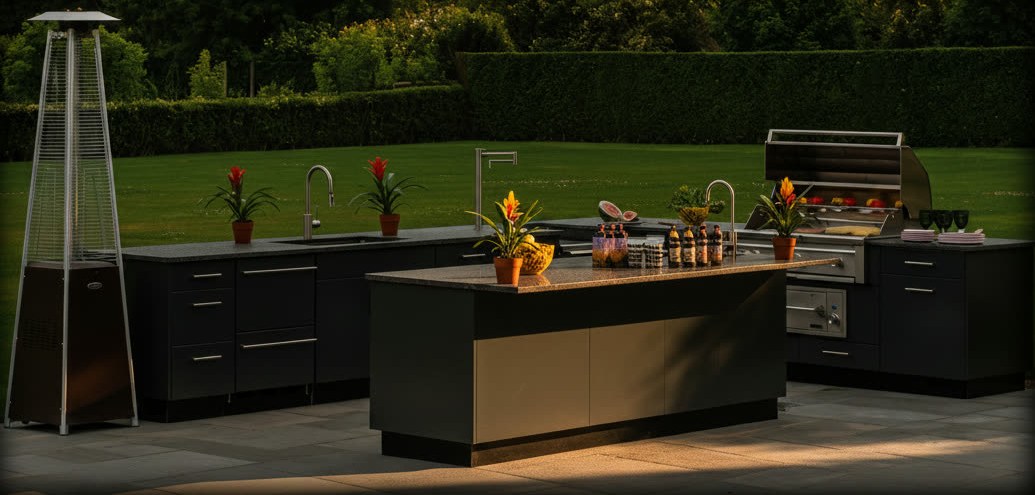
A stainless steel outdoor kitchen with stone worktop pairs two materials that do different jobs. Steel makes the structure: frames, sides, doors and drawers, in modules set side by side that house the gas barbecue, the sink, the fridge and the gas cylinder. Stone makes the worktop: a slab of granite, quartzite or sintered stone cut to measure. The advantage lies in weight and freedom: the modules are hollow, and therefore light, and stand on the paving with no fixed works. From them come the monobloc, a single linear volume with everything inside, the island and the corner layout. On our page about outdoor kitchens in marble and stone, steel is one of three possible structures, with refractory stone and treated timber.
Which steel outdoors, and which by the sea
‘Stainless’ is not one single material. Stainless steel does not rust because its chromium forms an invisible film on the surface, one that renews itself; but chlorides, meaning sea salt and pool chlorine, can attack that film in tiny spots. That is why the alloy is chosen for the place. AISI 304, the chromium-nickel steel of professional kitchens, is right for gardens and towns away from the coast. AISI 316 adds molybdenum, which protects it against chlorides: it is the steel suited to a marine climate, and we recommend it on the coast, on terraces open to the sea wind and beside a pool.
The finish matters as much as the alloy: a fine satin surface holds less salt and dust than a coarse brushed one, and folds without crevices leave water nowhere to sit. There is also coated steel, in dark tones or with a wood effect, which shows fewer fingerprints.
Granite, quartzite or sintered stone: the worktop above the steel
On a steel frame the worktop rests on the modules and is fixed with a flexible adhesive, which leaves stone and metal free to expand each in its own way under the sun. Granite is the most untroubled choice: dense, indifferent to lemon, wine and cooking grease, honed or flamed and brushed. Quartzite brings the veining of marble outdoors with a hardness greater than that of granite; check it on a sample, because some stones sold under that name are in fact marbles. Sintered stone (Dekton, Laminam) absorbs nothing, does not fade and, in its thinner formats, is the lightest. Marble can be used under a porch or a pergola, honed and with a water-repellent treatment; quartz composite cannot: it yellows in the sun and marks near the fire. The full comparison is in our guide outdoor kitchen: which stone to choose.
| Worktop | Typical thickness | Indicative weight | When we recommend it |
|---|---|---|---|
| Granite | 2 or 3 cm | around 55 kg/m² at 2 cm | full sun, barbecue zone, heavy use |
| Quartzite | 2 or 3 cm | around 55 kg/m² at 2 cm | pale, veined worktops beside the fire |
| Sintered stone (Dekton, Laminam) | 1.2 or 2 cm | around 50 kg/m² at 2 cm, less at 1.2 cm | terraces, poolside, light frames |
Movable modules or a fixed block in refractory stone
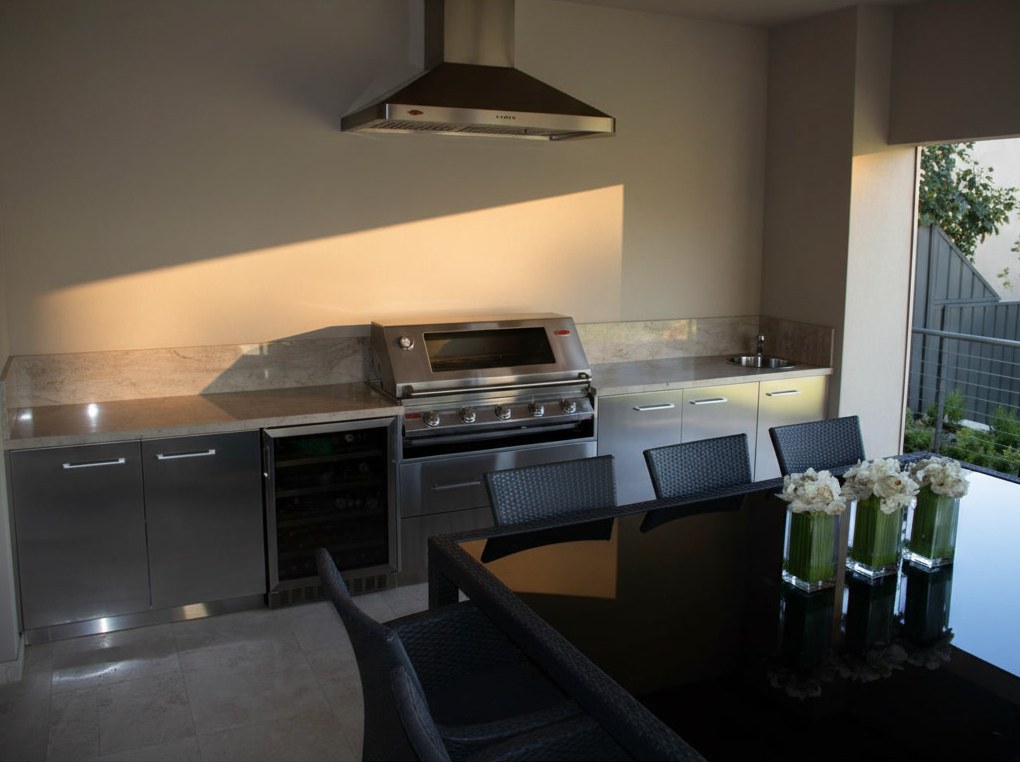
A refractory-stone kitchen is built on site and is made to stay where it is built: it is the route for those who want a domed wood-fired oven, a wood-burning barbecue and the presence of solid stone in the garden. A modular steel kitchen, by contrast, simply stands in place: the modules can be dismantled, moved and reassembled, and the stone worktop follows them, provided the new layout keeps the same dimensions.
In general terms a freestanding kitchen is treated as garden furniture, whereas a fixed structure with an oven and a flue may require a notification to the municipality, depending on local rules: we check this at the site survey. Steel therefore suits those who rent and those who cook with gas and want to be able to change; refractory stone suits those who have already decided where the fire belongs. If your project starts from the live flame, read about the outdoor kitchen with wood-fired oven and the outdoor kitchen with a refractory-stone barbecue.
Built-in gas barbecue, sink and fridge
The built-in gas barbecue is the heart of a steel kitchen. We work with BeefEater, the long-established Australian brand, and with Bull, an American one; the Cabinex series, Classica and Premium, come from the collaboration with BeefEater and carry barbecues with 4, 5 or 6 burners; the Fògher modules, in the Agher and Larès models, are composed with a sink, a built-in barbecue and gas burners. When the worktop is stone, the opening for the barbecue is cut on numerically controlled machines to the appliance drawing, with the air gap the manufacturer specifies around heat sources. The gas cylinder sits in a ventilated compartment closed by a door; connection to the mains is the work of a qualified installer.
The sink is a steel bowl fitted beneath the worktop, with the stone edge polished and left on view; the waste has a trap and, where it freezes, a drain-down tap for winter. The fridge and the wine cooler must be outdoor models, with the housing ventilated from below and behind and a protected electrical line: neither steel nor stone should close off that airflow. Water, waste, gas and power are settled on the drawing before cutting, because the worktop arrives already drilled for every fitting.
On the terrace: modest weights, pieces that climb the stairs
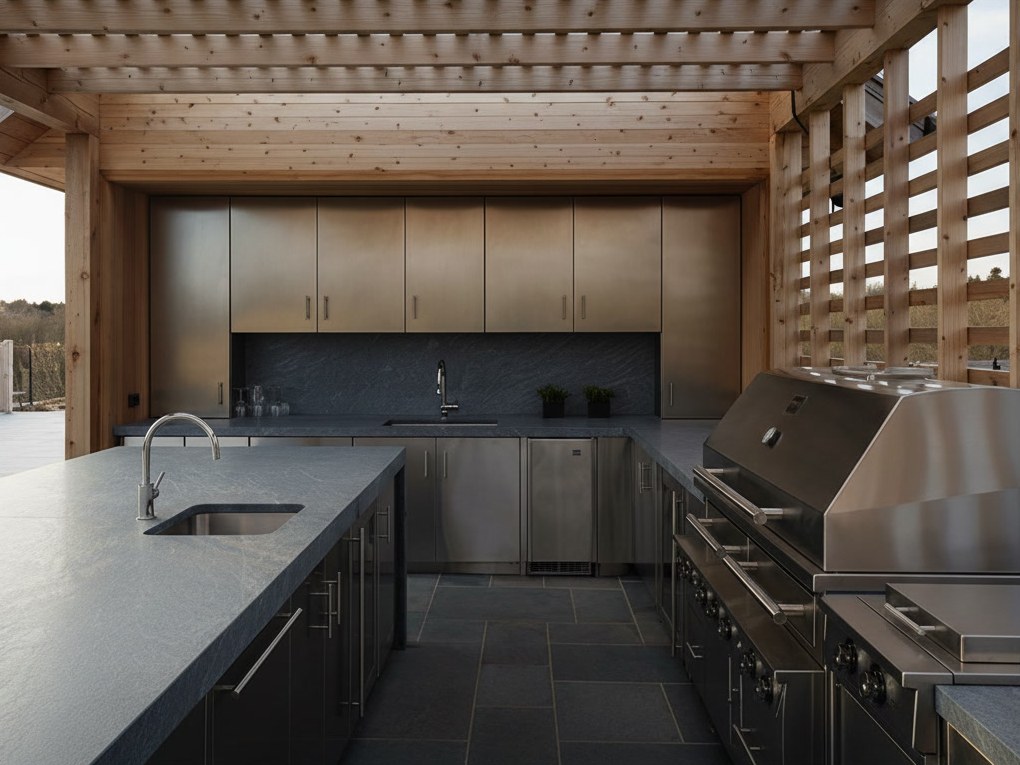
On a terrace the first question is how much the kitchen weighs. A solid stone structure weighs several hundred kilograms; a steel kitchen puts on the floor slab only the weight of the hollow modules, the appliances and one slab of stone. A 2 cm granite worktop weighs around 55 kilograms per square metre, a sintered one of the same thickness around 50. Then there is the way up: the modules pass through doors, stairs and lift one at a time, and the worktop is designed in pieces that can make the same journey. The load capacity of the floor is checked at the site survey in any case. Wind, smoke, neighbours and services at height are covered on our rooftop terrace outdoor kitchen page.
Caring for the steel, and for the stone
Steel asks for little, but asks for it often: a wipe after each use. Warm water, a neutral cleaner and a soft cloth, moved in the direction of the satin grain; then rinse and dry, because it is the drops left to dry that draw limescale marks. Three things are to be avoided: wire wool and abrasive pads, which scratch and leave particles that will rust; bleach and chlorine-based products; hydrochloric acid and aggressive descalers, which attack the steel and, if they run onto the worktop, the stone as well. Near the sea an occasional rinse with fresh water is wise: it removes the salt deposit before it leaves the small brown specks typical of the coast. If they appear, they are superficial and come away with a cleaner made for stainless steel.
The stone follows its own calendar: granite, quartzite and sintered stone are washed with the same neutral cleaner and stay uncovered in winter; marble wants its water-repellent treatment renewed each season.
How Michelessi works on a steel and stone kitchen
We have worked stone in Aprilia, on the Via Pontina between Rome and Latina, since 1976. At the site survey, free of charge in Rome, Latina and throughout Lazio, we measure the space and look at the service connections, the distance from the sea and, on a terrace, the load capacity of the floor: on these depend the right steel and the thickness of the worktop. The modules are chosen from the catalogue or designed to measure; the 3D design shows the kitchen in your space. You select the slab with us, one by one, in the workshop; cutting is numerically controlled to the appliance drawings, while the edges and the drip groove beneath the overhang are finished by hand. Installation is by our own team: they level the modules, fix the worktop, fit barbecue, sink and fridge and test every element with you. We deliver and install throughout Italy and follow projects abroad, as in Dubai. Lead times are set out with the quotation.
Further reading
For the worktop, each stone has its own page: the granite outdoor kitchen, the quartzite outdoor kitchen and the Dekton outdoor kitchen. On what drives the cost, see our guide how much does an outdoor kitchen cost. When you have a few measurements and a photograph of the space, request a free quotation for your outdoor kitchen.
Frequently asked questions
Frequently asked questions
Does stainless steel rust outdoors?
No, it does not rust the way iron does, but it can stain if salt or chlorine is left on it. The chromium in the alloy forms a protective film that renews itself; chlorides can attack it in small, superficial brown spots. They are prevented with AISI 316 steel near the sea, a rinse with fresh water and no chlorine-based products.
Is AISI 304 or AISI 316 steel better for an outdoor kitchen?
It depends on where the house is: away from the sea AISI 304 is enough, on the coast and beside a pool AISI 316 is needed. Grade 316 contains molybdenum, which protects it against salt and chlorine. At the site survey we look at the distance from the sea and the exposure to wind.
Can a stone worktop be fitted to a steel outdoor kitchen I already own?
Usually yes, provided the frame can carry the weight of the slab: that has to be checked against the measurements and the model's data sheet. The worktop is drawn on the modules, with openings for barbecue and sink, and cut in granite, quartzite or sintered stone; lighter frames suit sintered stone in its thinner formats. For the Bull and Fògher models we offer, we design with you the made-to-measure stone worktop that completes them.
Does a steel outdoor kitchen get hot in the sun?
Yes, in full summer sun steel becomes hot enough to be unpleasant to touch, though it comes to no harm. The remedy is shade: a pergola or a parasol over the working area. A pale stone worktop also helps, as it heats up less than a dark one; fronts coated in dark tones, on the other hand, get hotter.