
Outdoor kitchens
Outdoor stone bar counter: levels, overhang, stones
An outdoor stone bar counter is a bar built on two levels, one for working and a raised one for glasses, with an overhang for stools and a sink and fridge set into it. Michelessi builds it in granite, quartzite or sintered stone, which stand up to chlorine and sun, with no polished finishes beside a pool, in the Aprilia workshop where it has worked stone since 1976.
What an outdoor stone bar counter is
An outdoor stone bar counter is where, in the garden or beside the pool, drinks are made and then enjoyed: on one side the person serving, with sink, ice and fridge to hand; on the other the guests, on their stools, elbows on the stone. It has its own measurements: two levels, an overhang worked out for knees, and a stone chosen to sit in the sun with wet glasses, cut citrus and, near the water, chlorine on it. We build it to measure in the Aprilia workshop, where we have worked stone since 1976.
Two levels: the working top and the raised ledge
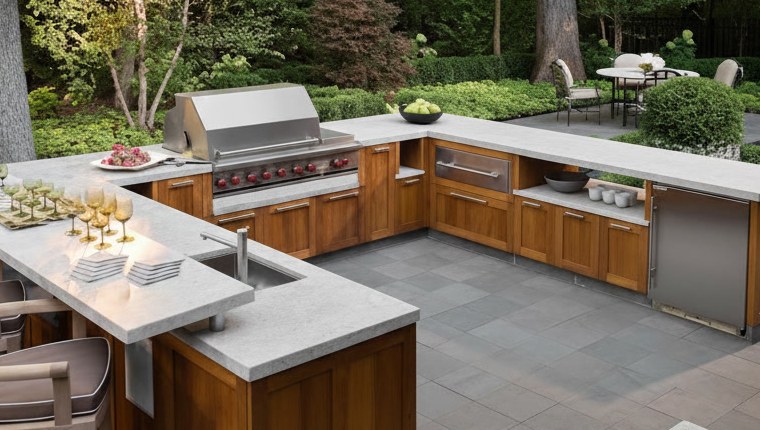
A well-made counter has two heights. The working top, on the server's side, sits at kitchen height, around 90 centimetres, and is deep enough for a sink, a chopping board and the ice well. The raised ledge, on the guests' side, stands 15 to 20 centimetres higher, at roughly 105 to 110 centimetres from the ground: a shelf of stone, 30 to 40 centimetres deep, for glasses and plates. The step is not there for show: it hides the sink and the clutter of preparation, and it stops splashes before they reach the guests. In our two-level peninsulas, such as the granite Barbecue con Penisola, the fridge and the beer tap sit on the service side and the upper ledge stays clear. Where space is tight a single level at 90 centimetres will do, with lower stools: you lose the screen and gain a table.
The overhang for the stools: measurements and support
Knees have to fit under the stone, which is why the raised ledge projects about 30 centimetres beyond the front; with a single level at 90 centimetres the overhang grows to about 38 to 40, because knees come further forward from a lower seat. Allow about 60 centimetres of width per person; with the top at 105 to 110 centimetres the stools have a seat height of 75 to 80, and with a 90 centimetre top the seat drops to around 65. A 3 centimetre slab of granite or quartzite will carry a modest overhang on its own; as the projection grows, or where the slab is 2 centimetres thick or in thin sintered stone, steel brackets or a plate run beneath it, out of sight of anyone seated: our technical office calculates them on the drawing, not on site. The edge is rounded to a half-bullnose or chamfered, because nothing beside a pool should be left sharp, and a drip groove is cut under the overhang so that rain cannot run back towards the front.
Stones that stand up to chlorine and sun
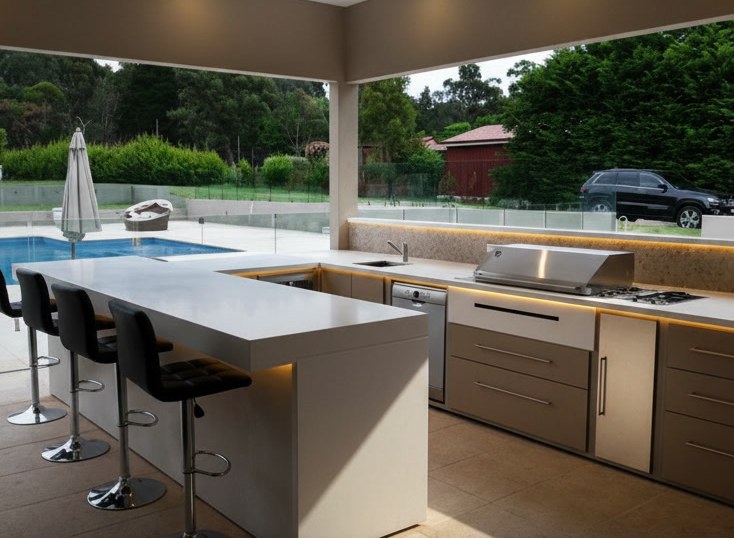
A bar counter takes lemon, wine, sugary drinks, melting ice and, near the pool, water carrying chlorine or salt. Granite and quartzite are the easiest choices: dense, barely absorbent, indifferent to acids and to sun; dark granite does get hot in the sun, though. Sintered stone (Dekton, Laminam) neither absorbs nor fades, and allows thin tops on light structures. Compact travertine, filled and sealed, is cool to the touch and ties the counter to the pool surround. Marble is sensitive to the acids in citrus and wine: we keep it for counters under cover, honed or brushed, with the water-repellent treatment renewed each season. Quartz composite is not used outdoors: it yellows in the sun. For each stone, read the granite outdoor kitchen, the quartzite outdoor kitchen and the Dekton outdoor kitchen.
| Stone | Chlorine, salt and sun | Finish on the counter | Where we use it |
|---|---|---|---|
| Granite | Unaffected; hot if dark | Honed, or flamed and brushed | Working top and raised ledge |
| Quartzite | Unaffected; cool if pale | Honed or brushed | Tops in full sun |
| Sintered stone | Unaffected | Matt | Thin tops, terraces |
| Compact travertine | Good, if filled and sealed | Brushed | Front, sides and tops under a pergola |
| Marble | Needs sealing and distance from splashes | Honed or brushed | Under cover only |
| Onyx | Cannot take sun, frost or acids | Polished | Never outdoors: indoor counters only |
Sink, fridge and ice set into the counter
A bar counter works when the person serving never has to go back indoors. A small sink is set into the working top, undermounted with the stone edge polished and left on show, in AISI 316 stainless steel where the pool or the sea is close, so that chlorine and salt air do not attack it. Beside it there can be an ice well with its own drain: in our Blocco Cucina Esterno Pro it is the large sink that fills with ice and bottles. Below, the fridge and the wine cooler are outdoor models, housed in the structure with the ventilation the manufacturer specifies: the stone must never close off the air grilles. Those who wish can add a beer tap. Every opening is cut on numerically controlled machines to the appliance drawing, with rounded corners; water, waste and power are brought under the counter before installation, with the sockets protected from splashes.
The glowing counter: why we do not use onyx outdoors
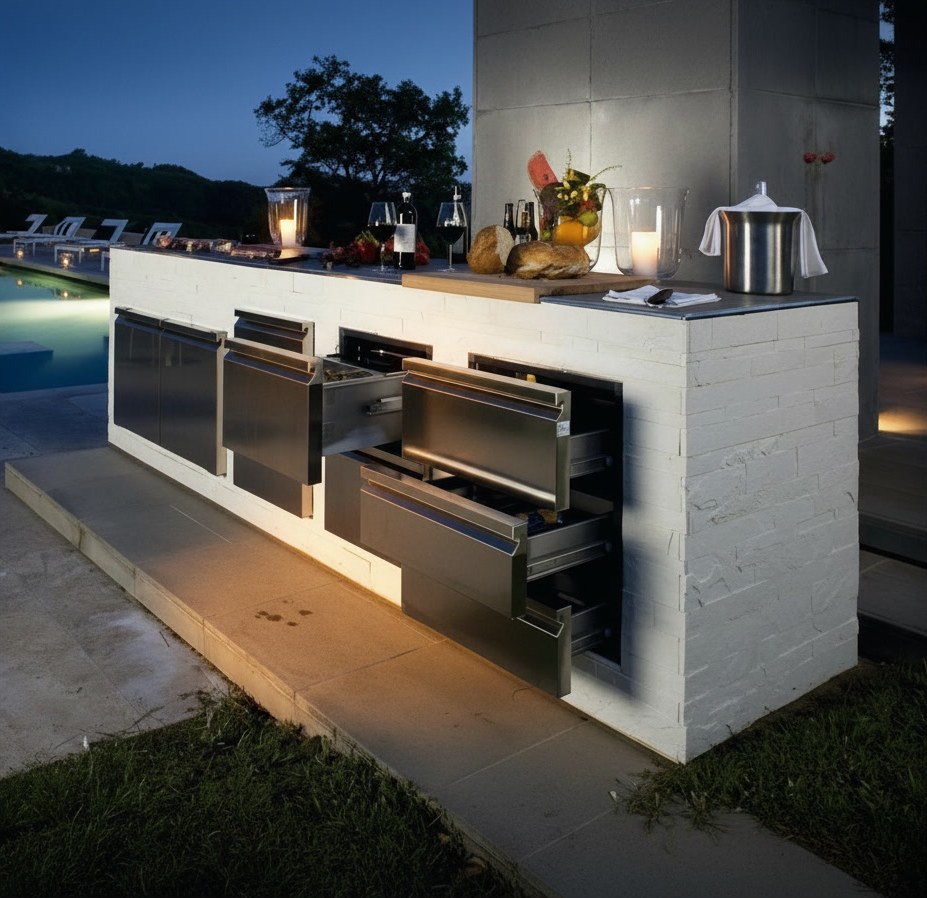
The counter that glows from within is the picture many have in mind, and the stone behind it is onyx: a banded, translucent calcareous stone that lets light through. But it is soft and fragile, more sensitive to acids than marble, and sun, frost and acid rain degrade it within a few seasons: so we do not use it outdoors, neither as a top nor as a front. Its place is the bar counter indoors, where it is at its best as a backlit front beneath a top in a tougher stone. Outdoors the same evening effect is achieved another way: a front in quartzite or compact travertine, washed by warm grazing LED light hidden at its base or beneath the overhang of a granite or quartzite top, well away from splashes from the pool. The stone is chosen under that light, because grazing light brings out grain and veining; the fittings sit in a housing closed to the rain but open to inspection. The evening effect is there, the fragility is not.
Light beneath the overhang and the paving around it
The most useful light on a bar counter is not the one that decorates it but the one that runs beneath the overhang: a warm LED strip housed in a channel routed into the underside of the slab and set back from the edge, so that the source cannot be seen from the stools. It lights knees, footrest and paving without dazzling anyone looking at the water: this is the solution in our Cucina da Esterno Circolare, where warm lights run under the top and trace the curve of the counter. Near a pool the circuit is extra-low voltage, with the drivers kept away from the water, and it is installed by an electrician to the regulations for these zones. Around the counter people walk barefoot and wet: the paving needs a slip-resistant finish, flamed on granite, bush-hammered, sandblasted or brushed on other stones, never polished, and a slight fall that carries water away from the feet of the stools. The top itself stays honed or brushed too, never mirror-polished.
From the bar to the outdoor kitchen: how Michelessi builds it
A bar counter rarely stands alone: it is the peninsula of a kitchen, or the side of the island that faces the pool. In a poolside outdoor kitchen the fire zone stays away from the water and the counter acts as a screen between grill and pool. Counter and kitchen come from the same slabs, with the same finish, on a structure of refractory stone, steel or treated timber. At the site survey, free of charge in Rome, Latina and throughout Lazio, we measure the space and look at the service connections, the falls and the distance from the pool edge. The 3D design shows you the counter with its stools, its two levels and the light switched on, in your own garden. The slabs are chosen one by one in the Aprilia workshop; cutting is numerically controlled, edges and drip groove are finished by hand, and the pieces are dry-assembled before they leave. Installation is by our own team throughout Italy; abroad we ship in protective packing and follow the fitting, as we did for the Dubai project. Lead times are set out with the quotation.
Further reading
This page looks closely at one element of our outdoor kitchens in marble and stone, where you will find layouts, models and design visions. If your counter is to be in the Roman stone, read the travertine outdoor kitchen; to understand what the cost depends on, the guide how much does an outdoor kitchen cost. To begin, request a free quotation with a photograph of the garden or pool and a few measurements.
Frequently asked questions
Frequently asked questions
How high should an outdoor bar counter be?
The raised ledge for guests sits at roughly 105 to 110 centimetres from the ground, with stools whose seat is at 75 to 80 centimetres; the working top on the server's side stays at around 90. If you prefer a single level at 90 centimetres, the stool seat drops to about 65. The knee overhang is about 30 centimetres at the raised ledge and about 38 to 40 with a 90 centimetre top.
How do you light an outdoor bar counter by the pool at night?
With a warm LED strip hidden beneath the overhang of the top and, if you wish, grazing light across a front in quartzite or compact travertine. Near the pool the circuit is extra-low voltage, with the drivers kept away from the water, and it is installed by an electrician. We do not use backlit onyx outdoors: sun, frost and acid rain degrade it within a few seasons.
How many stools fit at a garden bar counter?
Allow about 60 centimetres of counter for each person seated: four stools therefore need a front of roughly 2.40 metres. A corner or curved counter helps conversation, because guests can see one another. In the 3D design we place the stools at true size, with a clear passage behind them.
Does an outdoor bar counter need water and electricity?
Only if the counter has a sink, a fridge or lighting. A stone top with stools needs no connections at all; a sink needs water and a waste, while a fridge, a wine cooler and the light beneath the overhang need a protected electrical line installed by an electrician. We mark every connection on the 3D design before installation, so the stone arrives with its openings already cut.