
Indoor marble kitchens
Carrara Marble Kitchen: Where to Use It, Finishes and Care
A Carrara marble kitchen uses Bianco Carrara, a cool white marble with a fine, diffuse grey vein, for the worktop, splashback, island or wall: it is the marble best suited to whole kitchens, because the slab stays calm over long runs. We recommend it honed, 2 or 3 centimetres thick and sealed: like every marble it is sensitive to acids. Michelessi has made these kitchens in Aprilia, Italy, since 1976.
Bianco Carrara in the kitchen: a cool white with a fine grey vein
A Carrara marble kitchen is one in which the worktop, the splashback and often the island are cut from Bianco Carrara, the marble of the Apuan Alps quarried above the town of Carrara in Tuscany, where the quarries have been worked since Roman times. The ground is a slightly cool white with a pearl-grey cast; the veins are thin, diffuse and soft grey, and they fade into the ground rather than cutting across it. The grain is fine and even and takes a polish well.
A Carrara slab is calm and reads as a single surface even along a long run of worktop, which makes it the marble for whole kitchens, where stone covers many metres without stealing the scene. Among the Apuan whites it is also the most widely available, the most consistent in pattern and the most reasonable in cost.
C, CD and Venato: the trade grades and choosing the slab
Quite different slabs are sold under the name Bianco Carrara. The trade grades ‘C’, ‘CD’ and ‘Venato’ denote progressively more veined grounds. A grade points the way, but it is not enough: the same name can hide whiter or greyer grounds, and two slabs of the same grade may carry a clouded vein or a thread-like one.
That is why Carrara is chosen on the slab, never from a sample. In our Aprilia workshop the slabs are looked at one by one, in person or by video call, checking the tone of the ground, the direction of the vein in relation to the worktop and where the cut-outs for sink and hob will fall. Our gallery also includes a ‘boldly veined’ Carrara, picked to bring movement to a white kitchen.
Where to use it: island, worktop, splashback, wall
Carrara copes well with all four positions, and the work photographed in our gallery of marble kitchens we have built shows them one at a time.
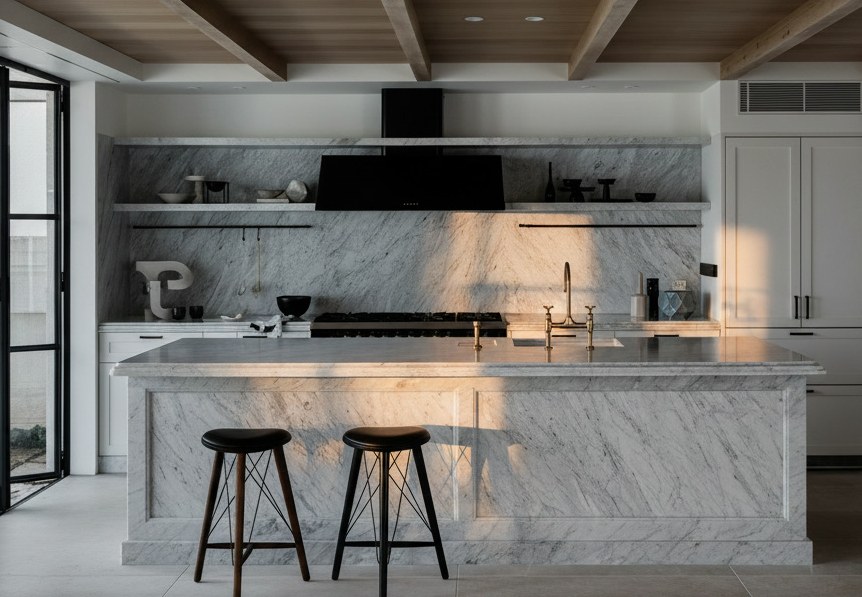
Island. It can be a worktop on cabinets or a volume clad on every face. In the kitchen we call ‘Full Marble Island’ the top, sides and door fronts are all in the same stone, with veins that carry on from one front to the next; in the ‘Suspended Island’ the top cantilevers from a single foot, held by a steel structure hidden in the stone. The 45° mitre and the waterfall side are explained on our marble kitchen island page.
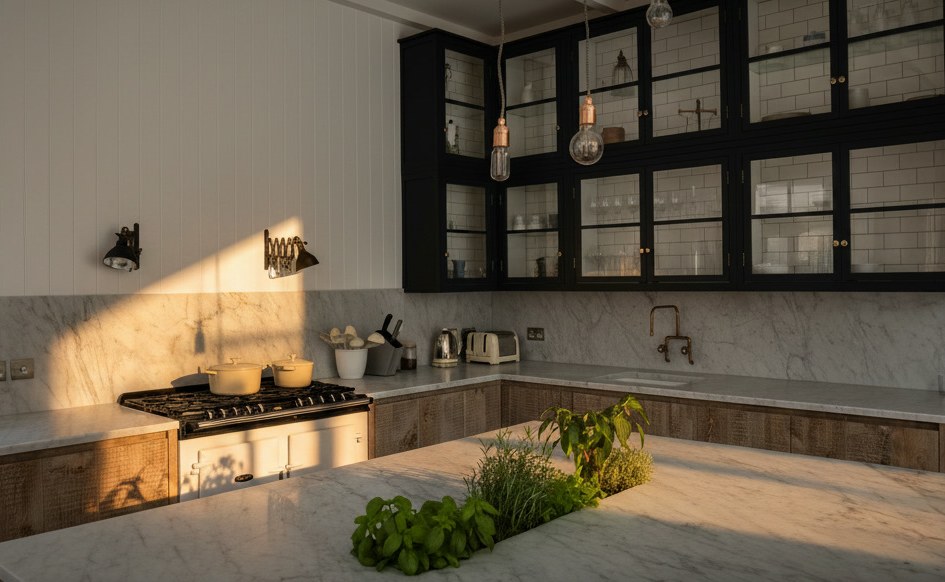
Worktop and splashback. This is the most natural use: worktop, upstand and splashback from the same slab, the vein climbing from the work surface up the wall. In a U-shaped kitchen in the gallery, Carrara covers worktops, end panels and splashbacks in one continuous pattern, closed by crisp square edges, and the peninsula drops to the floor as a waterfall. It works in a small kitchen too: a worktop, a splashback and one waterfall side are enough. The subject has a page of its own: the marble kitchen splashback.
Wall. Clad from the worktop right up to the ceiling, the wall becomes the backdrop of the room: slabs are cut and recomposed so that the pattern runs on without a break. Book-matching gives a more subdued symmetry on Carrara than on Calacatta: delicate rather than theatrical.
Recommended finishes and thicknesses
The same slab speaks differently depending on the finish. Honed, matt or satin, is what we recommend for a worktop used every day: smooth but without reflection, it leaves the colour a little lighter and makes etch marks and light scratches all but disappear. Polished deepens the white, sharpens the vein and partly closes the pores, but shows an acid mark at once: it suits splashbacks, walls and the sides of the island, where no one works. Brushed has a gently textured skin, soft under the hand, and is the most forgiving over time.
Worktops are made 2 or 3 centimetres thick. At 2 cm the slab is lighter and pairs well with modular kitchens; at 3 cm it carries breakfast-bar overhangs, undermounted sinks and moulded edges carved from the solid. For a deep front of six, eight or twelve centimetres, a strip is bonded on with a 45° mitre: the vein turns the corner and the eye reads a single piece of stone.
Acids, stains and heat: caring for Carrara
Carrara is almost pure calcite, that is calcium carbonate, and like every marble it reacts to acids. Lemon, vinegar, wine, tomato and fizzy drinks dissolve the thinnest film of the surface and leave a dull mark. Wipe them up at once: it is a matter of minutes, not hours. A stain is something else: oil and coffee enter the pores and colour the stone from within. This is where the impregnating sealer does its work, and the worktop leaves our workshop already treated with it: it does not make marble indifferent to acids, but it slows absorption and gives you time to act. It is renewed as a rule once a year, when a drop of water no longer beads on the surface.
Cleaning is simple: warm water, neutral soap, a soft cloth; never limescale removers, descalers or scouring pads. Its resistance to heat is moderate: hot pans go on a trivet. A scratch or an etch mark is removed with fresh honing, in the workshop or on site. Keen cooks can keep Carrara where it is looked at and put an engineered surface where the work is done: in one kitchen in the gallery, white quartz forms the working top of the island, while Carrara clads its body and the splashback behind the hob. Every rule is in our guide to marble worktop care and maintenance.
Pairings: black, navy and brass, timber, steel
Carrara's cool white is a neutral ground, and it accepts pairings that a more heavily patterned marble would make hard work. Four routes, all taken from kitchens we have built.
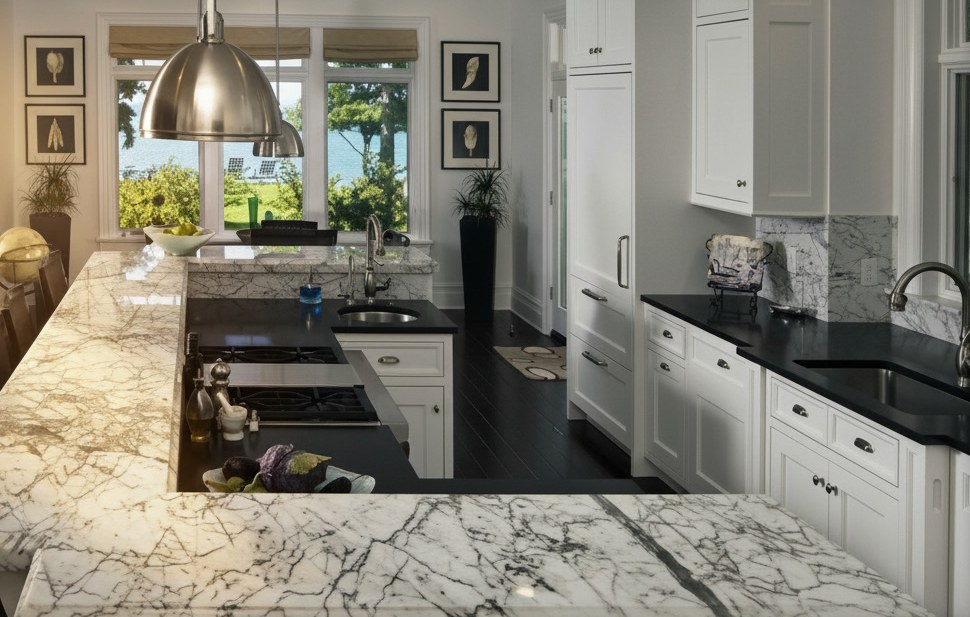
Black. A black hood, dark stools, black-framed glazing: in the ‘Black and White Kitchen’ the island clad entirely in Carrara and the large splashback hold the scene without harshness. It works on the worktop too: Carrara and black quartz alternating, the first on the breakfast bar, the second round the hob and sink. Navy and brass. Navy base units, gold-coloured handles, white tiles: the grey of the vein softens the step between the two colours, and the projecting marble sink adds an old-fashioned note. Timber. Wengé and dark timber play against the pale monolith; natural timber warms it, even beside a floor in antique green marble. Steel and copper. Steel hoods and refrigerators, copper lamps, classic taps: cool and warm metals both sit well on a white with no warm cast.
Carrara, Calacatta and Statuario compared
The three great Apuan whites come from the same mountain and differ in ground, vein and rarity.
| Marble | Ground and vein | Availability | Best in the kitchen |
|---|---|---|---|
| Bianco Carrara | Cool white, pearl grey; fine, diffuse, soft grey vein | Wide; the most balanced in cost | Whole kitchens: long worktops, splashbacks, fully clad islands |
| Calacatta | Warm, milky white; broad, bold vein, grey or gold | Limited, few quarries; among the most prized | Book-matched islands, splashbacks that act as the painting |
| Statuario | Pure, luminous white; a few crisp grey veins | Rare; highly prized | Luminous islands and worktops, carved sinks |
The rule of thumb: if the stone is to be the protagonist, look at the Calacatta marble kitchen or the Statuario marble kitchen; if you want marble across the whole kitchen, with a serene light and a more reasonable outlay, Carrara is the answer. As the worktop of an outdoor kitchen exposed to sun, rain and frost, none of the three is the right choice: there we recommend granite, quartzite or sintered stone.
How Michelessi works
In our workshop in Aprilia, on the Via Pontina between Rome and Latina, we have worked Carrara since 1976. In Rome, Latina and throughout Lazio the site survey and quotation are free; from further afield we guide you through a remote survey. The slabs are chosen one by one, together with you; the 3D design shows the finished kitchen, with the vein of every slab in its place, before any cutting. Cutting is computer-controlled; edges, 45° mitres and sinks are closed and finished by hand. Installation is by our own team, who level the tops and seal the joints. We deliver and install across Italy and abroad, as on our Dubai project; lead times are agreed with the quotation.
Further reading
The full picture, with Dekton, Fenix and quartz worktops and the Domina, Noè, Era 02 and Volo 01 modular kitchens, is on our indoor marble kitchens page. Composition, hardness and uses in bathrooms, on staircases and on floors are on the Carrara marble page. When you have a floor plan or a photograph of the room, ask for a free marble kitchen quote.
Frequently asked questions
Frequently asked questions
Does Carrara marble stain in a kitchen?
It can stain if left unprotected, but the real thing to watch is acid. Oil and coffee enter the pores: the sealer applied before the worktop leaves our workshop slows absorption and is renewed as a rule once a year. Lemon, vinegar and wine etch the surface and leave a dull mark, so wipe them up at once. An etch mark is removed with fresh honing, in the workshop or on site.
What do the grades C, CD and Venato mean for Bianco Carrara?
They are trade grades that denote progressively more veined grounds: from C to CD to Venato, the grey of the veins becomes more present. They help you find your bearings, but the same name can hide whiter or greyer grounds. That is why in Aprilia the slabs are chosen one by one, in person or by video call, looking at the tone of the ground and the direction of the vein.
Is Carrara marble cheaper than Calacatta?
As a rule, yes: among the Apuan whites Bianco Carrara is the most widely available and the most reasonable in cost, while Calacatta comes from a handful of quarries and is among the most prized marbles. The cost of a kitchen also depends on thickness, linear metres and workmanship such as a 45° waterfall or a carved sink. The quotation is free and starts from a floor plan or a photograph.
Which cabinet colours go with Carrara marble?
Almost all of them, because its cool white with a grey vein is a neutral ground. In the kitchens we have built it sits beside white lacquered doors, navy base units with brass handles, dark timber and wengé, natural timber, and the black of hoods and stools. The sample should still be seen in your own room, in its own light: on request we send one to your home.