Indoor marble kitchens
Statuario Marble Kitchen: Island, Book-Matching, Finishes
A Statuario marble kitchen is recognised by its pure white ground and a few bold grey veins: the rarest of the Apuan whites, it works best on the island and a book-matched splashback. Like every marble it is sensitive to acids; honed, it copes with daily use, and around hob and sink a matching sintered stone can stand in. Michelessi has worked marble in Aprilia, Italy, since 1976.
What sets a Statuario marble kitchen apart
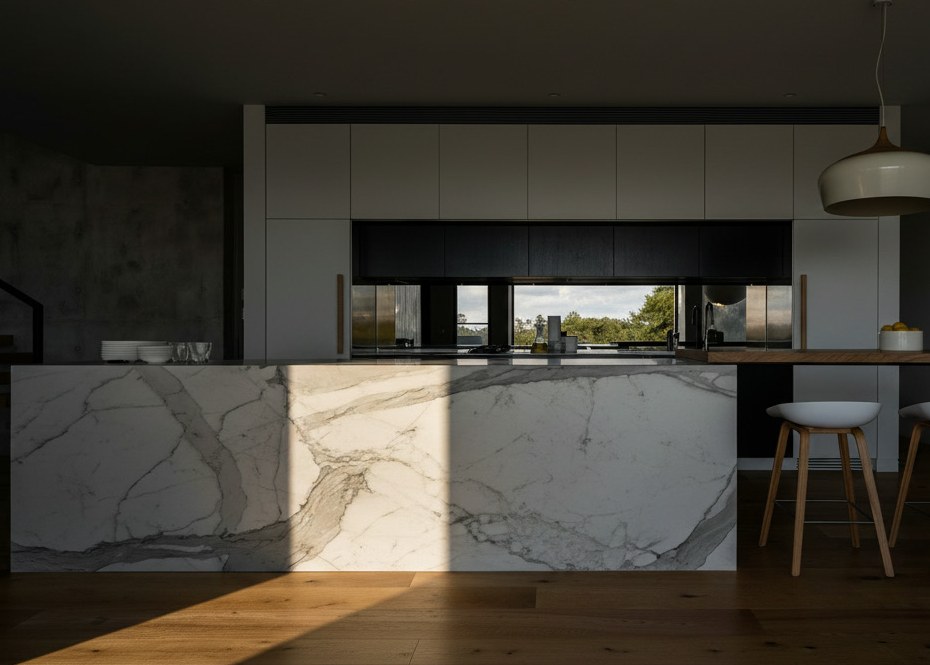
A Statuario marble kitchen is recognised by two things: a pure white ground, full and luminous, and a few crisp grey veins that cross the slab as if drawn with a brush. Statuario is a marble from the Apuan Alps, quarried in a handful of sites above Carrara; it is almost pure calcite with a fine, even grain, which made it, from Michelangelo onwards, the sculptors' marble. In a kitchen it gives a surface that returns more light than any other white: it neither drifts towards grey like Bianco Carrara nor has the milky tone of Calacatta.
With Statuario there is no need to fill the kitchen with stone: a single vein, well placed, is enough to draw a whole island, and the white around it holds its own against dark timber, brass and black. The full profile of the stone is on our Statuario marble page.
Why Statuario is rare, and what that means for the design
Statuario comes from very few quarries and in limited quantities: among the Apuan whites it is the rarest and the most variable. The same trade name covers purer or less pure grounds and denser or sparser veins, depending on the quarry bench and the year of extraction. In Statuario Venato the veins are denser and more pronounced; in Statuario Extra the ground is at its purest. That is why you buy a slab, not a name, once you have seen it.
Rarity has three practical consequences. The slab should be chosen and reserved together with the design, because the one you see today may be gone by the time the house is ready. Book-matching takes consecutive, numbered slabs from the same block, bought together. And it pays to decide where the stone really counts: a little Statuario in the right place is worth more than a great deal of it hidden behind appliances.
Where it works best: the island and the book-matched splashback
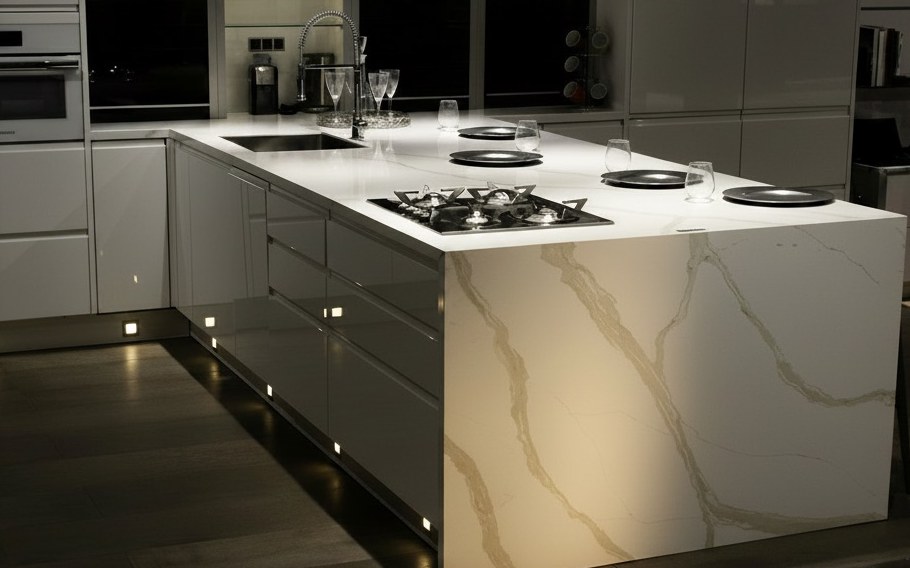
Statuario belongs on the island. On the top the grey vein runs lengthways and follows whoever sits at it; with a waterfall side it flows down the flank to the floor, and the 45° mitre puts the seam on the corner, so the volume reads as a single block. This workmanship is explained on our marble kitchen island page.
Its second place is the book-matched splashback: two consecutive slabs from the same block opened like the pages of a book, the vein mirrored across the joint in a symmetrical, butterfly figure. On Statuario the effect is especially crisp, because the veins are few and the ground does not blur them: the wall behind the hob becomes the kitchen's picture. Dimensions, joints and sockets are covered on the marble kitchen splashback page.
A sink carved from the same slab and an upstand that carries the worktop's vein up the wall complete the picture.
Finishes and thickness: polished, honed, 2 or 3 centimetres
The same slab changes voice with its finish. Polished, the pores close, the vein gains contrast and the white gains depth: it is the choice for the splashback, the sides of the island and tops admired more than used, because on a polished worktop the mark of a drop of lemon shows at once. Honed, the surface is matt, soft as silk and a shade paler: it softens etch marks and light scratches, and it is the finish we recommend most often for Statuario in daily use. One solution we often adopt combines the two: a honed top with polished island sides.
There are two thicknesses. 2 centimetres is lighter and suits a built-up edge; 3 centimetres is substantial by nature and copes better with a peninsula overhang and the cut-out for a carved sink.
Caring for a Statuario worktop
Statuario is a fine-grained white: it shows stains more readily than other marbles and asks for a few steady habits. Like every marble it has moderate heat resistance, so hot pans go on a trivet, and it is sensitive to acids: lemon, vinegar, wine, tomato and fizzy drinks do not stain it, they etch it, leaving a dull mark that only fresh honing or re-polishing removes. Wipe them up straight away.
Otherwise a soft cloth, lukewarm water and a few drops of neutral soap are all it needs. No limescale remover, no bleach, no abrasive pads; always a chopping board. The worktop leaves the workshop already treated with an impregnating sealer, which slows the absorption of oil, wine and coffee and is generally renewed once a year, when a drop of water no longer beads. An absorbed oil stain is treated with a poultice of bicarbonate of soda and water, covered for twenty-four hours. And real marble keeps its advantage: an etch mark or a scratch is honed away, in the workshop or on site, with nothing replaced.
Statuario, Calacatta and Carrara compared
The three great Apuan whites look alike from a distance and differ up close: in a kitchen the difference decides how much stone to use and where.
| Marble | Ground | Veining | In the kitchen |
|---|---|---|---|
| Statuario | Pure, luminous white, almost free of blemishes | A few crisp grey veins | Luminous islands, book-matched splashback, carved sink; the rarest of the three |
| Calacatta | Warm, milky white | Broad veins, grey or golden | Showpiece islands and splashbacks; rare, with more pattern and more colour |
| Bianco Carrara | Cool white, pearl grey | Fine, diffuse, pale grey | Whole kitchens and long worktops; the most available and the most balanced in cost |
In short: pure light, Statuario; pattern, Calacatta; balance and availability, Bianco Carrara. If you love golden veins and a warm room, your stone is on the Calacatta marble kitchen page; if you want long runs of worktop and splashback in a calm stone, on the Carrara marble kitchen page. Statuario is for those who want the cleanest white and a single stroke, and are happy to choose it slab by slab.
Statuario-look sintered stone for the working areas
Cooking every day with lemon, wine and tomato does not mean giving up Statuario: put it where it is looked at and hand the working areas to a sintered stone. It is a popular solution: island and splashback in marble, and the run along the wall, around the hob and the sink, in a technical slab of the same tone. Dekton is an ultra-compact surface of quartz, porcelain and glass, pressed and fired into slabs with no pores and no resin: it is untroubled by heat, scratches, stains or acids, and is worked in 2 cm slabs. Among the Dekton surfaces we cut in Aprilia are veined whites that echo the great marbles: Natura 18B2, which carries the Statuario pattern on a ground just warmed with ivory; Kairos, a luminous white with very fine grey veins; Olimpo, with soft grey veining.
The difference from real marble remains. In Statuario the vein runs through the thickness: you read it on the edge, inside a carved sink, down a waterfall side. In technical slabs the pattern sits mostly on the surface and repeats from one slab to the next, and a slab that is deeply marked is filled or replaced. That is why the two materials share the work: marble on the island, the technical slab on the worktop, set flush and at the same height. The tone is matched by holding the sample next to your chosen Statuario slab.
How Michelessi works
Michelessi has worked marble in Aprilia, on the Via Pontina between Rome and Latina, since 1976. The site survey and the quotation are free of charge in Rome, Latina and throughout Lazio; from further afield we guide you through a remote survey. The slabs are chosen one by one, in person or by video call, looking at the purity of the ground, the direction of the vein against the design and the absence of fissures that cutting might open. The 3D design shows where every vein will fall before the saw touches the stone.
Cutting is numerically controlled; edges, 45° mitres and carved sinks are finished by hand. Fitting is carried out by our own team, who level the tops and seal the joints. We deliver and install throughout Italy and abroad, as in the Dubai project; lead times are agreed with the quotation. A floor plan or a photograph of the room is enough to begin: request a quotation for your marble kitchen.
Further reading
This page deals with a single marble; the full picture, with technical worktops and the Domina, Noè, Era 02 and Volo 01 modular kitchens, is on our indoor marble kitchens page. To choose methodically among the whites, read our guide on how to choose marble for your kitchen; for stains, sealer and re-polishing, the guide to marble worktop care and maintenance.
Frequently asked questions
Frequently asked questions
Why does Statuario cost more than Bianco Carrara?
Because it is rarer: Statuario comes from very few quarries above Carrara and in limited quantities, whereas Bianco Carrara is the most available of the Apuan whites and the most balanced in cost. The price of a kitchen also depends on the number of slabs, the thickness and the workmanship, such as waterfall sides and book-matching. The exact figure comes with the quotation, which is free.
What is the difference between Statuario Venato and Statuario Extra?
The ground and the amount of veining: in Statuario Venato the grey veins are denser and more pronounced, in Statuario Extra the ground is at its purest. These are trade names, and the stone varies from one quarry bench to the next: for a kitchen what counts is the slab in front of you, chosen in person in Aprilia or by video call, not the label.
How many Statuario slabs does an island with a book-matched splashback need?
Book-matching takes at least two consecutive, numbered slabs from the same block, bought together, so that the vein mirrors itself across the joint. The total number depends on the dimensions of the top, sides and splashback and on the length of the slabs available: it is settled by the 3D design, which shows where every vein will fall before cutting.
Can real Statuario be combined with a marble-look Dekton worktop in the same kitchen?
Yes, and it is a much-requested solution: Statuario on the island and splashback, Dekton in the same tone on the worktop around the hob and sink. The two materials are not mixed on the same top: they are set flush, at the same height, each on its own volume. The tone is matched by comparing the sample with the chosen marble slab, in the light of the room.