Skip to content
Made in Italy

Since 1976 — Wooden kitchens

How Much Does a Wooden Kitchen Cost? What Sets the Price

WOOD · STEEL · MARBLE · STONEWARE

In short

Stoneware-clad kitchen with island, integrated sink, induction hob, hood and oven
Stoneware-clad kitchen with island, integrated sink, induction hob, hood and oven — photograph of a Michelessi project.

The block — a Michelessi vision

From the block,
blow after blow

01 A raw block of Calacatta Viola waits under the spotlight, in the dark kitchen with brass profiles. Mallet and chisel are already on the floor: the island is still all inside the stone.

02 Blow after blow the faces are squared, chips fly, white dust rises into the light. The chisel scores the drawers, opens the recess for the hob, carves the sink: the shape of the island comes out of the block slowly, without haste.

03 Then the stone is honed and polished: the purple vein catches the light, brass edges close the drawers, the black hob sinks into its recess, the gold tap finds its place. The island remains, and a veil of dust on the floor.

Keep scrolling — the scene follows you

How much does a bespoke wooden kitchen cost?

A bespoke wooden kitchen has no fixed price: it is built up from ten choices, from how the wood is constructed (solid, blockboard or veneered) to the installation, and it changes from one wall to the next. Who builds it: Michelessi SRL, marble and stone masons in Aprilia, between Rome and Latina, since 1976, with our own team installing kitchens throughout Italy.

In general a wooden kitchen costs more than one in laminate or melamine, and solid wood is among the most expensive options. Apart from that there is no reliable figure that applies to everyone: there is no trustworthy price per linear metre for bespoke solid wood, and the per-unit prices of off-the-shelf kitchens cannot be compared with a kitchen designed for your wall. That is why we do not publish a price list: a figure given without seeing the room is a guess, not information.

This page explains what sets the price and how a real quote comes about. It is part of the bespoke wooden kitchens section, where you will find species, finishes and styles.

FactorWhat is decidedWhy the price changes
ConstructionSolid wood, blockboard, veneerMore solid wood and more work cost more
Species and selectionOak, walnut, chestnut, ash, cherry, fir; with knots or withoutEach species has its own selection and working
FinishOil, wax, varnish, brushed, heat-treatedDifferent cycles and different upkeep over the years
Type of doorFlat, framed, mouldedWorking and number of pieces
Worktop and splashbackMarble, granite, quartzite, sintered stone, travertine, woodStone, thickness, edge, cut-outs, integrated sink
Size and shapeLinear metres, units, tall units, islandMore units and more worktops to work
Hardware and interiorsHinges, runners, drawers, pull-outsMechanisms and internal organisation
AppliancesBuilt-in, compartments made to measureA separate item
Out-of-measure workOut-of-square walls, recesses, beamsPieces designed one by one
Design, delivery and installation3D design, transport, assemblyOur own installation team throughout Italy
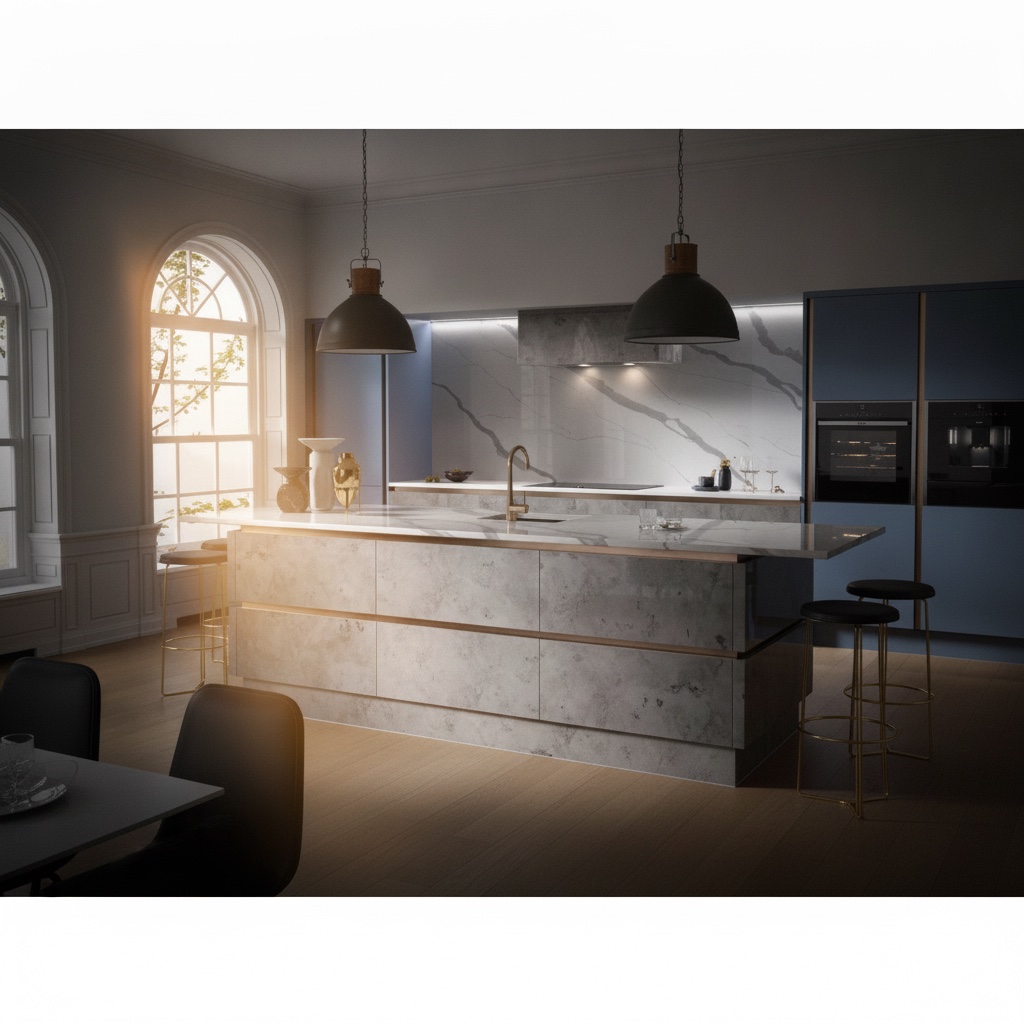
Stoneware-clad kitchen with island, integrated sink, induction hob, hood and oven

Stoneware-clad kitchen with island, integrated sink, induction hob, hood and oven

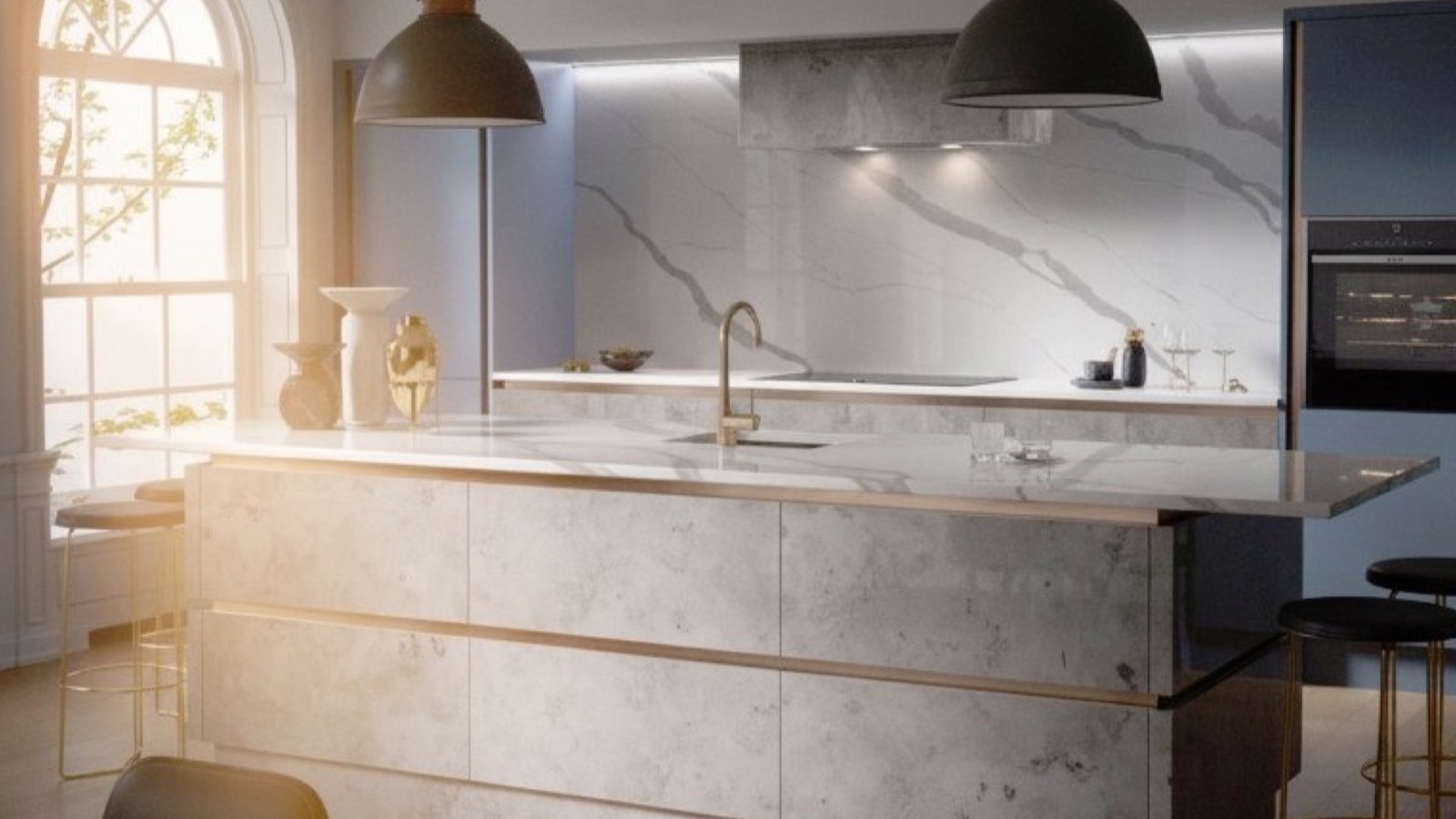
The island presents itself in its pale stone-effect stoneware dress, crossed by slender inserts that mark out its drawers; above, the top integrates sink and induction hob in a single working surface, served by burnished taps. Behind, a marble-effect stoneware wall rises beyond the cooking zone, while powder-blue columns — with black ovens recessed — add the colour that gentles the whole scene. Dark bell lamps, stools at the counter, tall windows of a stately apartment: the ensemble has an urban, serene elegance. A wooden structure clad in stoneware is a sound formula: the constructive warmth of wood, the resistance of ceramic at the surface. With hood and oven completing the equipment, it is an indoor kitchen ready for real life: Michelessi builds it to measure, attending to joints, recesses and tonal pairings with an artisan's care. The powder blue, then, is the touch that lingers in the eye.
Central quartzite island with spectacular veining, wooden counter and black stools

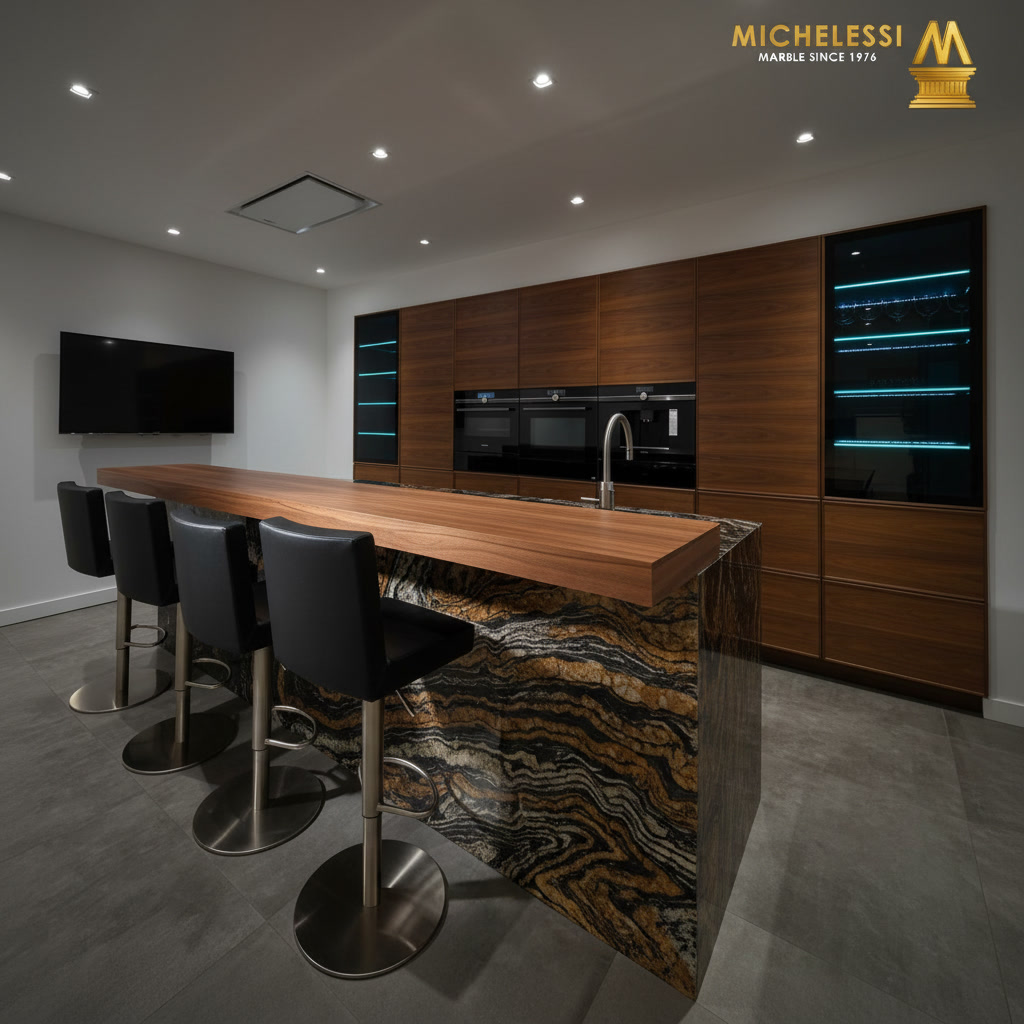
Central quartzite island with spectacular veining, wooden counter and black stools

The island is a fire made stone: quartzite with amber and black veining blazes along the flanks in its impetuous figuring, polished until it mirrors the room; above, a solid wood counter lays down its warm board and gathers black swivel stools. The sink sits flush in the top; behind, walnut boiserie conceals and reveals — black ovens, backlit vitrines of bottles, a recessed television. A pale floor leaves the whole stage to the material. This is the project for those who want a collector's stone at the heart of the home: quartzite, with its unrepeatable figure, is not chosen from a catalogue — it is encountered, slab by slab. Bespoke stonework orchestrates its veining across top and flanks, with cuts and joints that honour the natural movement. This is the art of Michelessi: craftsmanship that knows when a stone deserves the stage, and builds one around it.

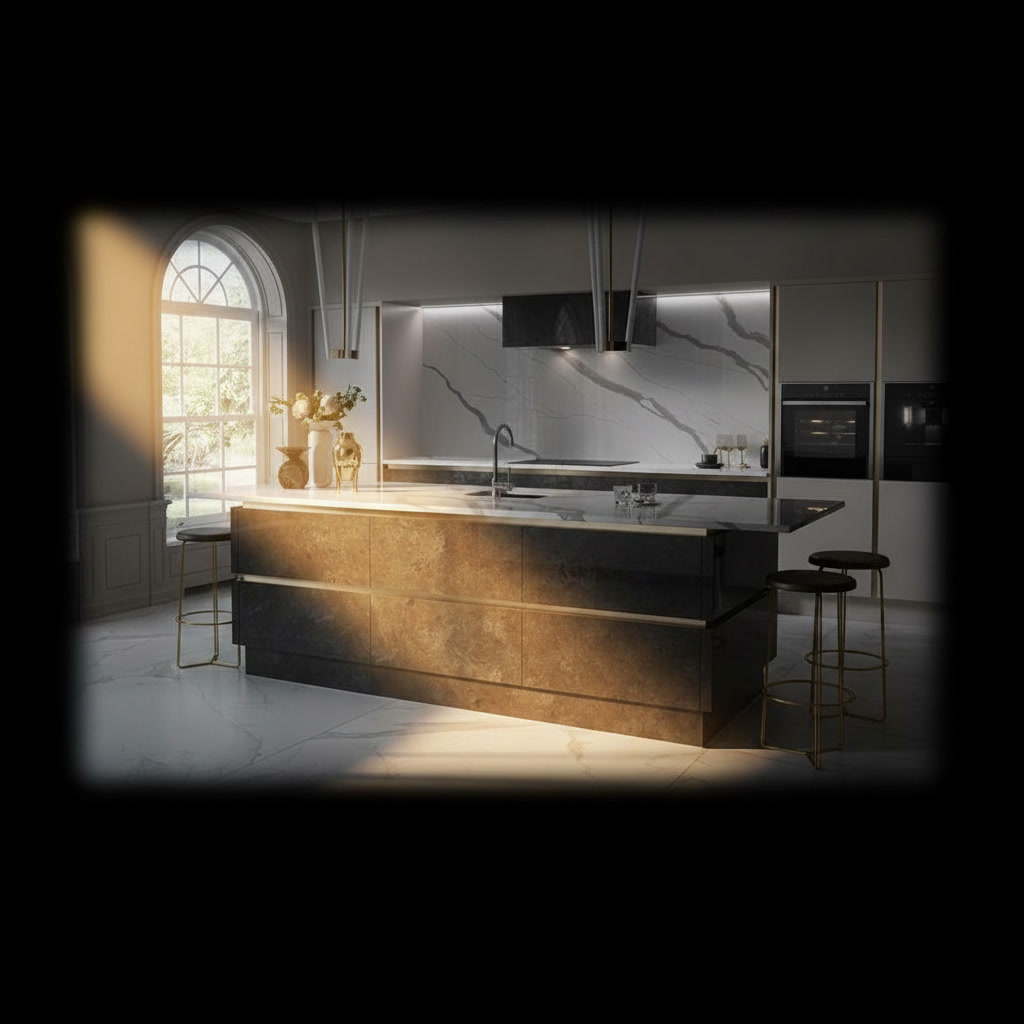
Kitchen with island clad in grey porcelain stoneware with golden profiles and marble wall

Kitchen with island clad in grey porcelain stoneware with golden profiles and marble wall

Arched windows and a wall of veined marble effect give the room the breath of a palazzo; at the centre, the island clad in stone-grey porcelain dresses itself in golden profiles — fine lines running along the volumes like threads of light — and carries the integrated sink with its gold tapware. Stools with gilded details complete the register, together with dark columns housing the built-in ovens. Fully equipped, this is a kitchen that plays the luxury card openly: technical materials treated like jewels, measured reflections, a curated scenography. The porcelain stoneware bears the practical side with its tireless surface; the gold does its own work, which is to shine. Made-to-measure holds it all in balance: proportions, alignments, cut-outs. This is the glamorous face of Michelessi indoor kitchens: artisan craftsmanship that knows how to be sober when needed — and magnificent when the project asks. The gold here is not ostentation: it is a line of light drawn with a ruler.

Classic grey kitchen with veined travertine top, oven, sink and yellow stools

Classic grey kitchen with veined travertine top, oven, sink and yellow stools

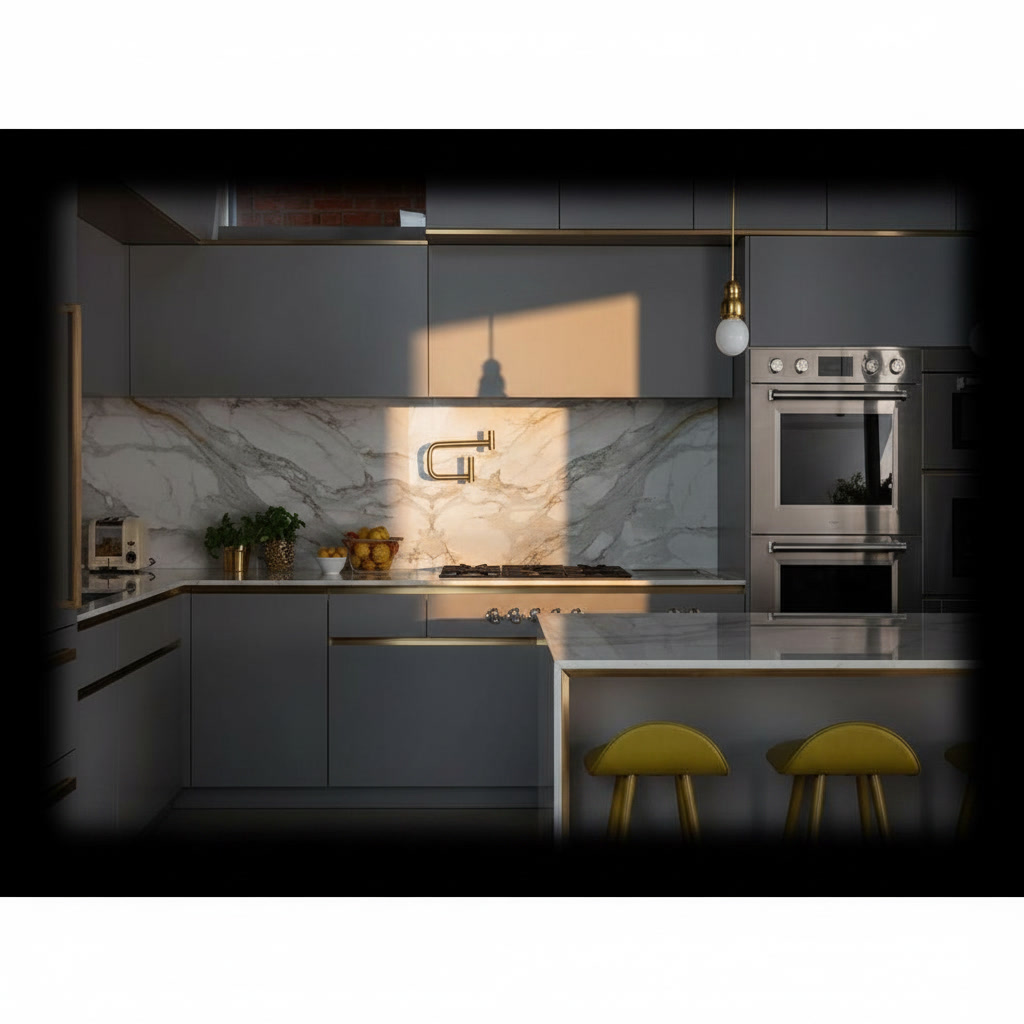
The lines are elegant and the colour knows it: uniform grey doors, crossed by golden profiles that draw the handles and frames, meet a veined travertine counter — pale stone with a moving figure that also clads the wall behind the burners, as one single mineral gesture. Twin ovens sit in their column, the sink works beneath a suspended brass bulb, and yellow stools light the counter with their note of sun. Complete with oven, sink and range, this is a classic kitchen of contemporary proportions: few elements, all of them right. Veined travertine is the silent protagonist: Roman stone, warm and luminous, worked to measure in counters and cladding with the care its history deserves. This is the Michelessi métier: craftsmanship that sets gold against stone without ever sliding into excess — because true elegance is known by its restraint. The yellow stools confirm it: elegance, now and then, also knows how to smile.

Dark lacquered wooden kitchen with veined travertine island with bar table and induction

Dark lacquered wooden kitchen with veined travertine island with bar table and induction

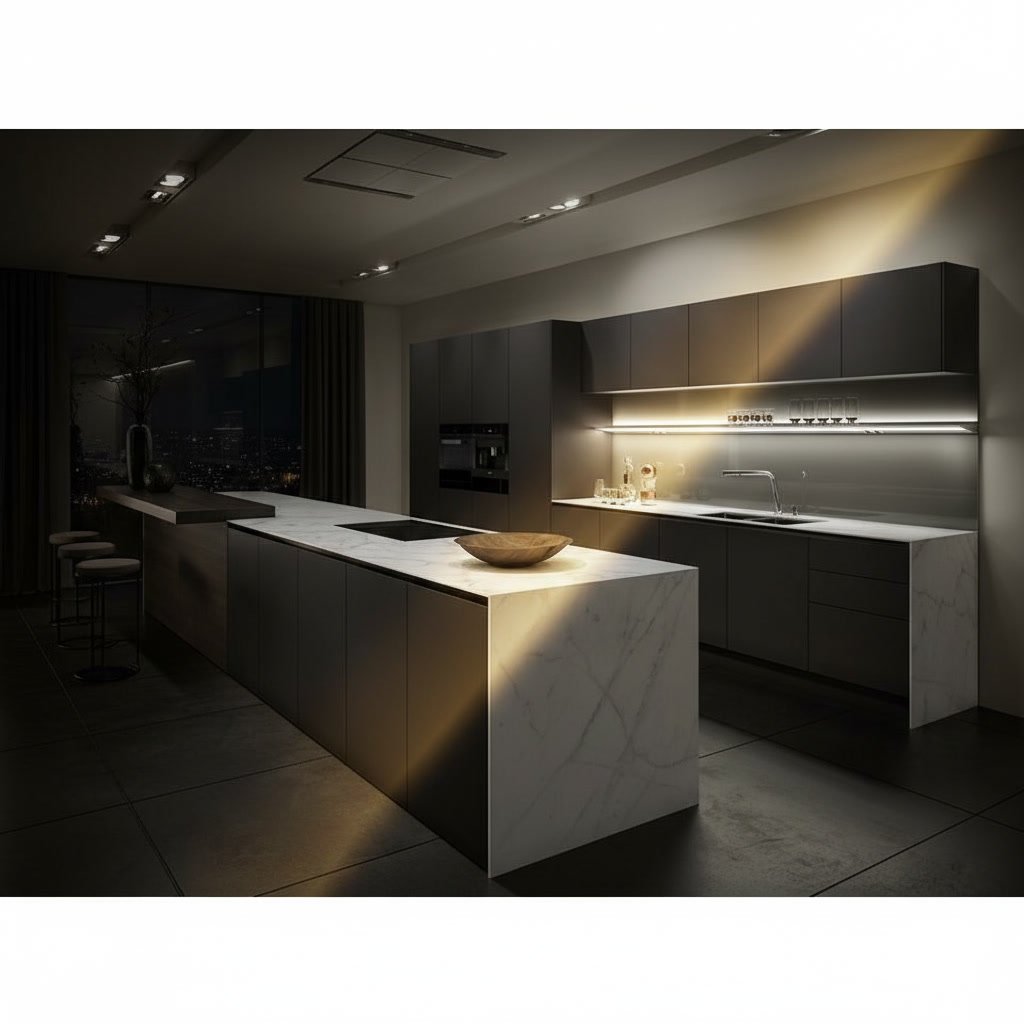
It is the hour when the city lights up, and the kitchen answers with its veined travertine island: pale stone, crossed by grey veining, falls in a waterfall along the flanks and carries the integrated induction hob, extending into a bar table where dark stools wait. Around it, surfaces of dark lacquered wood absorb the spotlight; a fitted wall with its LED strip lights the worktop, and doors keep everything in its place. Complete with sink and oven, this is a kitchen of metropolitan charm: sharp contrasts, noble materials, a penthouse atmosphere. The veined travertine is the luminous heart of the dark: working it in a waterfall demands exact joints and orchestrated veining — the bespoke stonework Michelessi practises with the artisan craftsmanship of always. The result is an island that seems lit from within: stone that gives light, while everything around it chooses shadow. Elegant darkness plays the backdrop: the pale stone takes, deservedly, the stage.

Veined travertine island with leather stools, grey kitchen with sink, induction and oven

Veined travertine island with leather stools, grey kitchen with sink, induction and oven

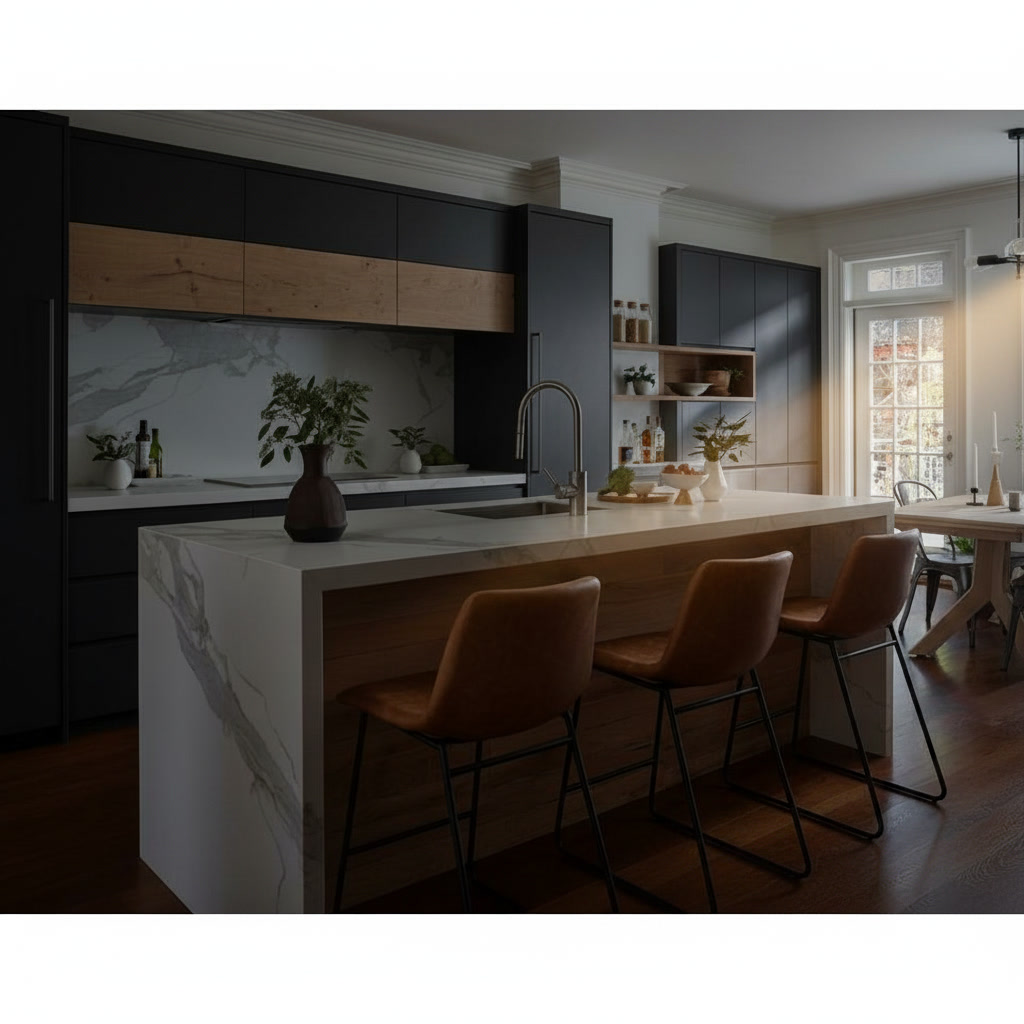
The island falls in a waterfall of pale veined stone: the travertine top continues down the flanks without breaking its figure, and three cognac leather stools draw up with their club-room elegance. Behind, the dark grey kitchen works with the sink beneath a suspended wooden shelf, the induction hob, the oven and well-ordered doors; a pale veined wall amplifies the light, and flowers on the counter complete the grace of the whole. A brown timber floor anchors the composition. This is warm contemporary style played on the right materials: stone that ennobles, leather that ages well, grey as the backdrop. The travertine waterfall — mitred joints at forty-five degrees, veining aligned — is the detail that marks serious work: Michelessi work, Italian craftsmanship in stone for made-to-measure indoor kitchens. The cognac of the stools does the rest: it invites you to stay.

Solid wood, veneer and laminate: the cost scale

A solid wood kitchen is a kitchen whose doors are made of the declared species of wood throughout the thickness of the piece, even when the piece is made up of several parts of the same species glued together. It is the fullest way to build in wood and, for that reason, among the most expensive. The alternatives cost less, but they change what you are buying.

ConstructionWhat it isPlace on the cost scaleCan it be sanded and refinished?
Solid woodThe declared species of wood throughout the thicknessAmong the most expensive optionsYes, it can be sanded and refinished
BlockboardA core of solid wood strips faced with sheets of woodIntermediateOnly within the limits of the facing layer
VeneerA thin sheet of real wood glued to a baseIntermediateOnly within the limits of the facing layer
Laminate or melamine, wood effectA printed grain on resinThe least expensiveNo, and it is not wood

Solid wood is not necessarily more stable: with strong swings in humidity it moves more, and the design controls that movement (a frame and panel helps). In return it can be sanded and refinished, whereas veneer is harder to repair.

Beware of the word: in the trade, ‘solid wood’ is stretched, and in a quote what counts is the botanical species and the construction of the door, written out in full; in ours they are stated item by item. To tell real wood from wood effect, see the page on real wood or wood effect; for doors in solid timber, the page on the solid wood kitchen.

Oak, walnut or chestnut kitchen: how much the species matters

The species is the choice you see most and understand least. Oak is the species kitchen makers are asked for most; it is a quality wood without excessive cost. Walnut, chestnut, ash, cherry and fir each have their own colour, hardness and working, and their cost does not follow a ranking that holds for everyone: it also depends on the selection and on how the timber is worked.

  • Oak: a streaked grain and a warm tone, natural, bleached or dark; it tends to darken over time. More on the oak kitchen page.
  • Walnut: ‘a walnut kitchen’ is not enough. European walnut (Juglans regia) and canaletto walnut, that is American black walnut (Juglans nigra), are two different species, with different colour and ageing: canaletto lightens with time. The quote must say which of the two is intended. More on the walnut kitchen page.
  • Chestnut, ash, cherry, fir: ash is the hardest of the group, cherry darkens in the light, fir is soft and marks more easily. They are on the page chestnut, ash, cherry or fir.

With knots or without: the selection

Timber with knots is more rustic, timber without knots is cleaner: it is an aesthetic choice, and the price changes with it too. A permitted, filled knot is a feature of the wood, not a defect. For the style with beams and stone there is the page on the country and rustic wooden kitchen.

Oil, wax or varnish finish: the cost today and over the years

Brushing and planing work the surface; oil, wax and varnish protect it, and they combine: an oak can be brushed and then varnished, or smooth and oiled. The finish weighs twice: in the quote, for the finishing cycle, and over the years, for the care it asks.

FinishWhat changesWhat weighs over the years
OilSinks into the pores without forming a film: the grain stays readableIt has to be refreshed periodically; a mark is sanded out and the oil reapplied
Wax or oil-waxA silky sheen, a water-repellent effectIt is renewed like oil
Matt or gloss varnishA continuous film: it repels water better and is cleaned with a damp clothA deep scratch is hard to touch up: often all the surfaces are sanded and revarnished
BrushedThe grain stands in relief and small marks show lessIf too pronounced, dirt stays in the hollows
Heat-treatedHeat and steam, no chemicals: a more stable wood, an even colour through the thicknessThe tone shifts towards a caramel brown
Bleached or pigmentedFrom near-white to natural shadesA deep scratch shows the colour underneath

Lacquer is a solid colour: with an open pore the grain and knots can still be read, with a closed pore they cannot. How often an oil needs refreshing depends on use and on the product, and manufacturers give different intervals: that is why we do not write a number. Colours and pairings are on the page on light or dark wood; doors and finishes are in doors, hinges and finishes.

Flat, framed or moulded doors: the type of door

The flat door has a single surface; the framed door has a frame with a panel in the middle; the moulded door has a worked profile. The working and the number of pieces change, so the cost changes. A frame and panel help to control the movement of the wood; a large flat door can be made of joined boards or of faced blockboard, and the quote says which.

A marble or stone worktop on a wooden kitchen

The worktop and splashback are the item where our workshop comes in. In Aprilia the slabs are chosen one by one, cut on numerically controlled machines and finished by hand; doors and worktop come from the same design and the same quote. Marble withstands moderate heat and dislikes acids, such as lemon and vinegar: those who cook a lot often choose granite, quartzite or a sintered stone.

MaterialHow it behavesWhat weighs in the quote
Marble (Calacatta, Carrara, Statuario, Nero Marquina, Botticino)Unique veining; withstands moderate heat and dislikes acidsStone chosen, thickness, length without joints, edge, cut-outs, upstand
Granite and quartziteStand up better to heavy useStone, thickness, edge, cut-outs, integrated sink
Sintered stone (Dekton, Laminam)A technical surface, suited to those who cook a lotFormat, thickness, working
TravertineWarm beige; outdoors only compact and treatedSelection of the slab and finish
Solid wood (including glued-strip)Warm to the touch; it must be protected and dislikes standing waterThickness and protection of the surface

For pairings there are the pages on wood and marble, stone or steel and on the marble and wood kitchen; the stones are under marbles, Calacatta, travertine, Dekton and Laminam.

Wooden kitchen with an island: linear metres, units and tall units

Metres count, but they are not enough. A linear kitchen with few units is one thing; the same length as an L, with tall units or with an island, is another, because units, worktops and joints increase, and the island brings a sink or hob and the services to the middle of the room. That is why the price of one unit is not the price of the kitchen. Starting ideas are in the layouts to start from and on the page about the marble kitchen island.

Handmade wooden kitchen: hardware, interiors, appliances and out-of-measure work

Hardware and interiors

Soft-close hinges and runners, drawers, pull-outs: this is the part you use every day and cannot see from outside, and two kitchens with the same doors can have very different interiors. In the quote they are separate items.

Built-in appliances

Appliances are chosen first: the recesses are cut to their dimensions and to the manufacturer's ventilation clearances. In the quote they are a separate item, and it should state whether they are included or excluded.

Out-of-measure work

Out-of-square walls, recesses, exposed beams: in farmhouses they are common. Each out-of-measure unit is a piece designed for that wall, on its surveyed dimensions. Water, drainage, gas and electricity are services that must be in place before installation, and the quote states which works are left to others.

Outdoor wooden kitchen: why the quote is different

Outdoors the wood has to last, and this changes the quote. Naturally durable woods are chosen, such as teak and iroko, or modified woods, such as heat-treated timber, and they are treated: wood moves with humidity, the treatment has to be renewed, and untreated teak takes on a silver-grey patina, which is a change of look and not damage.

Michelessi outdoor kitchens have a structure in dry-laid refractory stone, in steel or in treated wood; the worktops are in granite, quartzite, sintered stone, compact travertine or marble, with the warnings that apply; barbecues and ovens have a cooking chamber in refractory stone. Each choice weighs separately in the quote. The woods that stand up outdoors are on the page about the outdoor wooden kitchen; the rest is under outdoor kitchens.

How the free quote comes about

The quote is free wherever you are and carries no obligation, and so is the 3D design; in Rome, Latina and throughout Lazio the site survey is free too, while outside Lazio we start from your measurements and photographs, with a guided remote survey (the slabs can also be viewed by video call). Construction, species, finish, door and worktop are decided together, you see the kitchen drawn in 3D on your own wall and the quote comes item by item, so you can see where a different choice could be made. The full path, from site survey to installation, is on the page bespoke wooden kitchens.

How to compare two wooden kitchen quotes

Two quotes can be compared only if they say the same things. Before the total, check that both state:

  • the botanical species of the wood (European or canaletto walnut? European or American oak?);
  • the construction of the door, with its construction section: solid, blockboard or veneered, and what lies behind and inside the drawers;
  • the selection, with knots or without, and the finish;
  • the worktop: stone, thickness, edge and cut-outs;
  • hardware, appliances (included or excluded) and installation, with the work left to others.

A grain that looks continuous does not prove the material is solid wood: a well-matched veneer looks like a single board. Answers to other questions are on the page wooden kitchens: questions and answers.

The quote is free: request it here.

Frequently asked questions

Frequently asked questions

How much does a bespoke wooden kitchen cost?

There is no price that applies to every kitchen, because a bespoke wooden kitchen is designed for one particular wall. The cost is built up from the construction of the wood, species, finish, type of door, worktop, size, hardware, appliances and installation. Michelessi does not publish a price list: after the 3D design it prepares a free quote, item by item.

Does a wooden kitchen cost more than a laminate one?

In general yes: solid wood and veneered kitchens cost more than laminate or melamine ones. Wood-effect laminate, however, is a print on resin: it is easy to clean, but it cannot be sanded or refinished. With solid wood you spend more today and can sand and refinish it tomorrow.

Which choices change the quote for a wooden kitchen the most?

It depends on the project. The main items are the construction (solid, blockboard or veneer: solid wood is among the most expensive options), the species and selection, the marble or stone worktop, the size with island and tall units, and the interiors with drawers and hardware. Built-in appliances are a separate item.

European walnut or canaletto walnut: does the quote change?

They are two different woods: European walnut is Juglans regia, canaletto is Juglans nigra, American black walnut, which lightens with time. Colour, grain and ageing are not the same, and the quote must state which of the two is intended. The botanical species written out in full is the first step in comparing two offers.

Is the Michelessi quote really free?

Yes. The quote is free wherever you are and carries no obligation; in Rome, Latina and throughout Lazio the site survey is free too. The 3D design is also free wherever you are. Outside Lazio we start from your measurements and photographs, with a guided remote survey; the slabs can also be viewed by video call.

What should a good wooden kitchen quote state?

The botanical species of the wood, the construction of the door (solid, blockboard or veneer), the selection with or without knots, the finish, the worktop with stone and thickness, the hardware, the appliances included or excluded, the installation and the work left to others. With these details two quotes can really be compared, item by item.

How much does it cost to maintain a wooden kitchen over the years?

There is no figure, but there is a rule. Oil and wax are refreshed periodically and a mark is sanded out and reoiled; varnish is more convenient, but a deep scratch means sanding and revarnishing. The interval depends on use and on the product. Everyday cleaning needs a soft, barely damp cloth.

Is the marble or stone worktop part of the wooden kitchen quote?

Yes, as a separate item: the stone chosen, thickness, edge, cut-outs for sink and hob, upstand and integrated sink all count. Doors and worktop come from the same design, and the slabs are chosen one by one in the Aprilia workshop. Marble withstands moderate heat and dislikes acids.

Do you install outside Lazio?

Yes. Michelessi installs with its own team throughout Italy and follows projects abroad too. The quote is free wherever you are; the site survey is free in Rome, Latina and Lazio. Elsewhere we start from your measurements and photographs with a guided remote survey (the slabs can also be viewed by video call), with the 3D design free of charge.

Does an outdoor wooden kitchen cost in a different way?

Yes, because outdoors the wood has to be chosen to last and has to be treated: durable or modified woods are used and the treatment is renewed over time. Michelessi outdoor kitchens have a structure in dry-laid refractory stone, steel or treated wood, with worktops in granite, quartzite, sintered stone or compact travertine. Each choice weighs separately.

Call us WhatsApp