Skip to content
Made in Italy

Since 1976 — Wooden kitchens

Outdoor Wooden Kitchen: Which Woods Stand Up Outdoors

STONE · STEEL · MADE TO MEASURE

In short

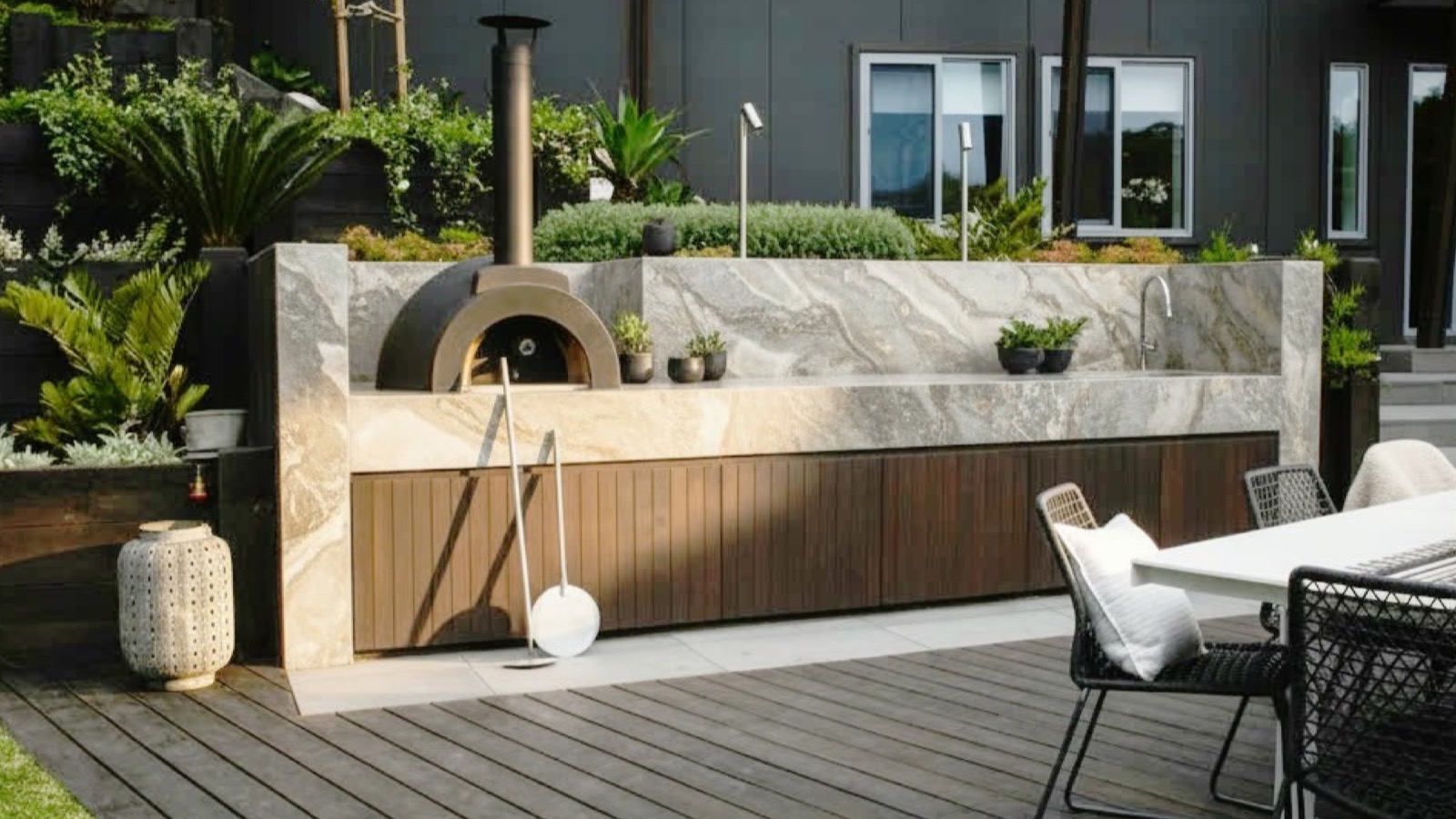
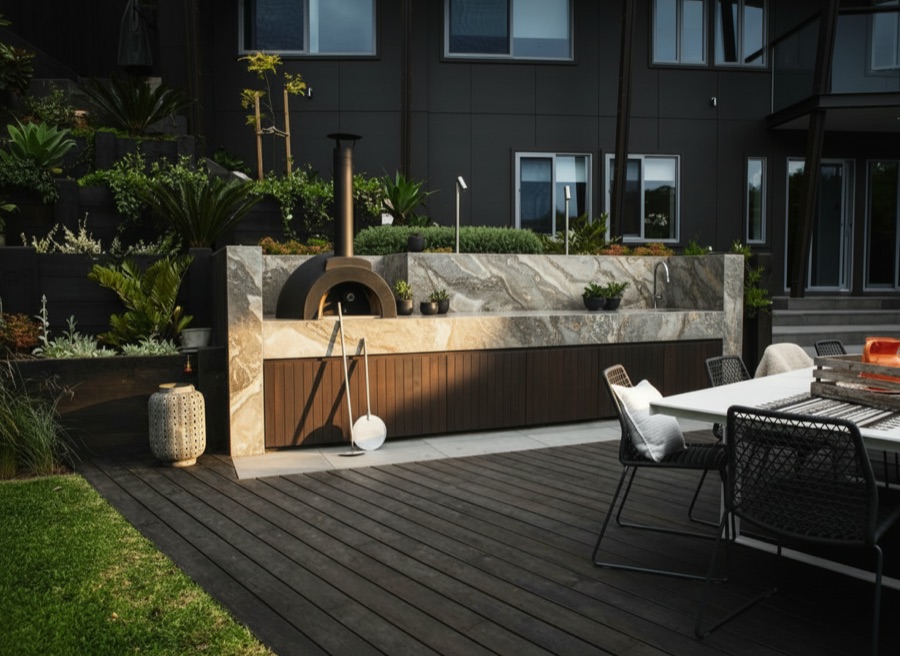
Terrace with stone and dark wood outdoor kitchen, pizza oven and dining table with seating
A Signature Terrace, Where the Kitchen Lives in Wood — photograph of a Michelessi project.

The outdoor kitchen — a Michelessi vision

From the block,
the fire

01 A raw block of Calacatta Oro on the terrace above the sea, under the brass lamp, at the hour when the sky turns from orange to blue. Mallet and chisels lie on the floor: the kitchen is still all inside the stone.

02 Two stonemasons, standing beside the block, work it with mallet and chisel. The faces are squared, chips fly, white dust rises in the sea wind; then come the long shape of the island, its sides, the openings of the fronts, the fire channel and the sink, carved slowly. Finally the stone is honed and the gold veins come out.

03 The top is polished, the sink set in, the brass tap mounted, the fire lit in the channel. The stonemasons walk away and the kitchen stays, lit above the sea, with a veil of dust on the floor.

Keep scrolling — the scene follows you

Outdoor wooden kitchen: can it be done, and in which woods?

An outdoor wooden kitchen is a kitchen for the garden, the terrace or the poolside with doors, drawers and fronts in a wood that stands up to rain, sun and swings in humidity, mounted on a stone, steel or treated-timber structure. It can be done, on one condition: choosing the right wood. Under the European standard EN 350, teak (class 1), iroko (class 1-2) and chestnut (class 2) are very durable or durable; oak is class 2 according to some sources and up to 4 according to others; the woods modified in the factory, thermally modified and acetylated, declare class 2 and class 1. Untreated fir, ash and cherry do not belong outdoors.

Who builds it: Michelessi SRL, stone masons in Aprilia since 1976, with installation throughout Italy. We design and build outdoor kitchens to measure: a structure of refractory stone blocks fitted together dry, a stone worktop, and wooden doors made for outdoor use. We are in Aprilia, on the Pontina road between Rome and Latina; we install them with our own team throughout Italy and follow projects abroad too.

This page belongs to the wooden kitchens department and looks at wood outdoors; the other outdoor kitchens (stone, marble, steel) are on the outdoor kitchens page.

Terrace with stone and dark wood outdoor kitchen, pizza oven and dining table with seating

A Signature Terrace, Where the Kitchen Lives in Wood

A floor of dark decking stretches out like a stage, and the camera crosses it slowly: on one side the table laid with its light seating, on the other the outdoor kitchen running along the flowering wall, with dark wood doors and a pale worktop. Above, the dome of the oven stands against the facade of the building, a promise of long, fragrant evenings.
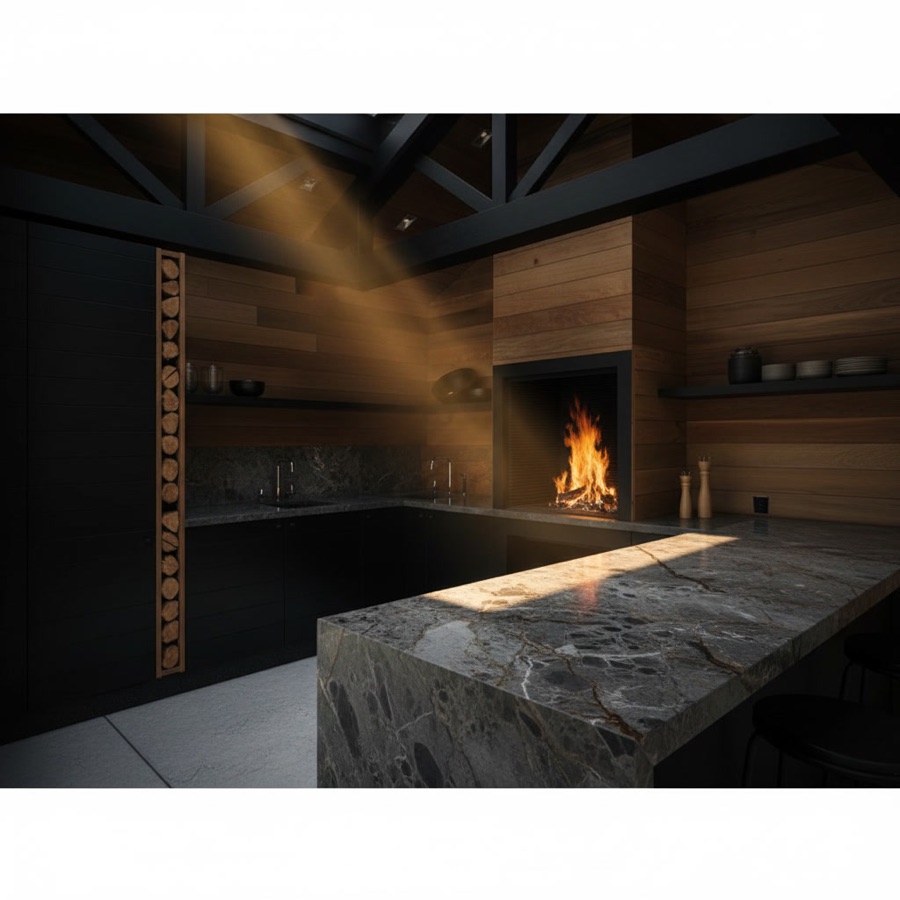
Outdoor kitchen with lit wood-fired barbecue, sink, black bases and lacquered wood worktop

The Black Fire, the Wood That Dresses It

The flame burns in its black frame and lights the wall clad in lacquered wood, which answers with amber reflections: a dialogue between darkness and warmth, orchestrated with an elegance almost worthy of an interior. Black bases run beneath the counter carrying the sink and the working spaces, shelves order tableware and objects on the wooden wall, and the dark beams of the covering close the scene above. The wood-fired barbecue, protagonist, promises fragrant cooking and long evenings.

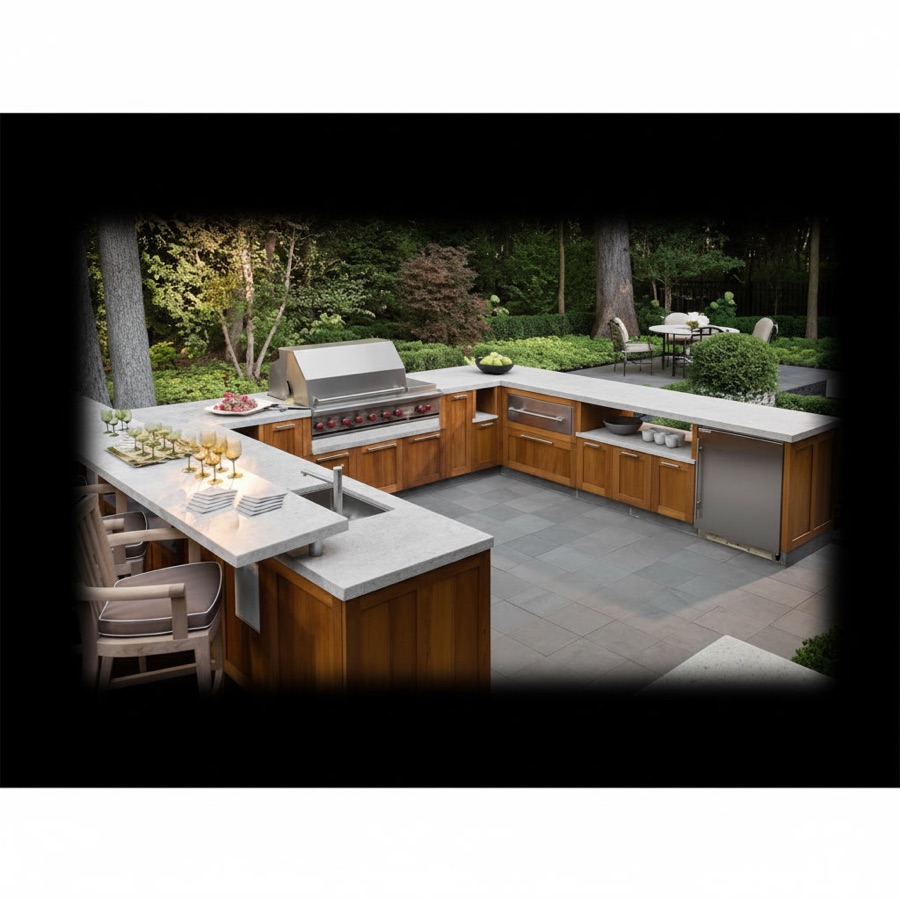
Outdoor kitchen with built-in appliances, light granite worktop and treated wood structure, U-shaped

The Great U of Teak and Granite in the Woods

The U spreads generously over blue stone paving and the woods embrace it on every side: the treated wood structure, with its warm, orderly doors, bears the light granite worktop running along three sides, carrying the barbecue with its steel hood, the sink, built-in appliances and the counter where high seats await company. Little plants on the tops add their domestic green to the great green of the trees.

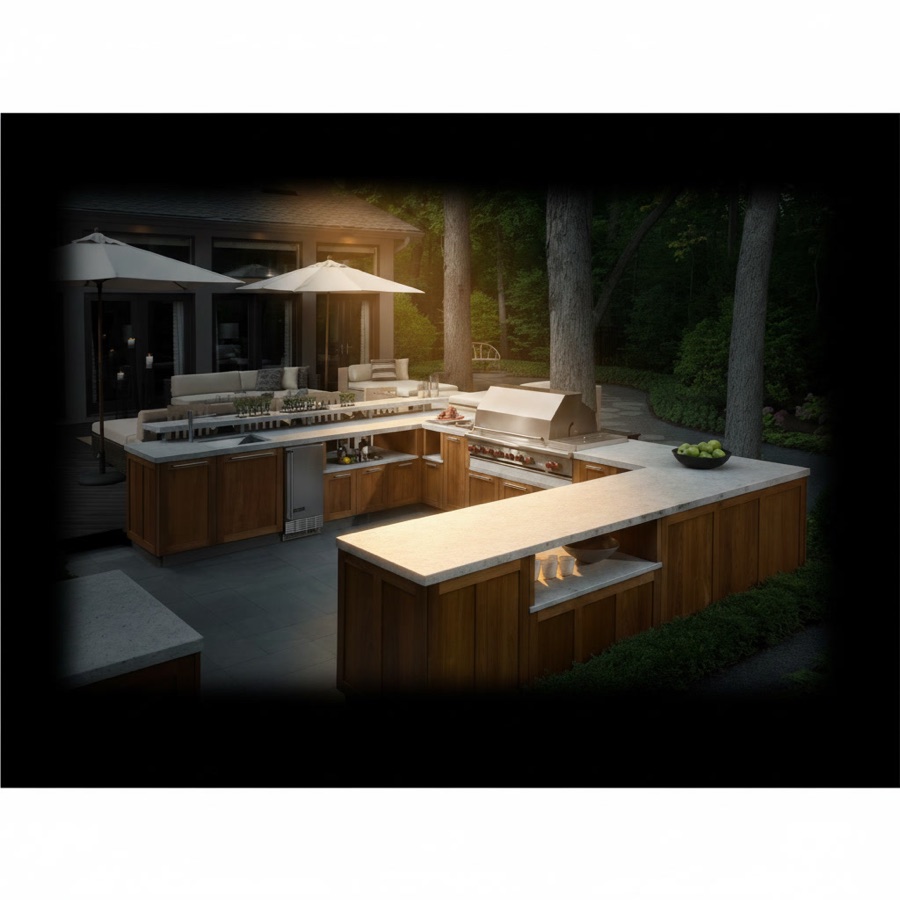
Modern U-shaped outdoor kitchen with light marble tops, wooden bases, fridge and built-in barbecue

The Great U with Marble Worktops

The U opens generously into the woods and lays out a true piazza of taste: great slabs of light marble run along three sides, luminous against the deep green of the trees, while wooden bases with classic doors pace the perimeter with ordered warmth. The built-in barbecue works beneath its steel hood, the fridge stands guard in the base, and white parasols open their corollas over the scene, ready to shade long lunches. The house with its great windows watches from behind.

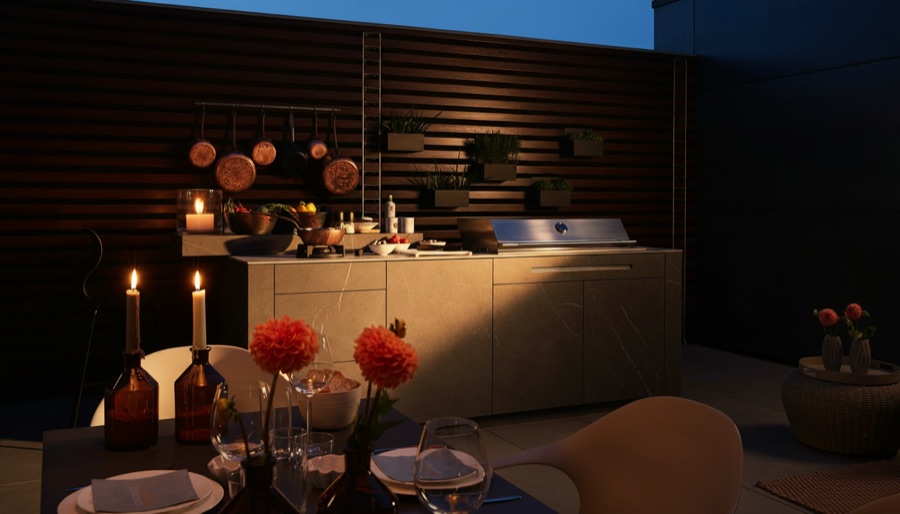
Stone-effect outdoor kitchen with copper pots hung on a wood-slat wall, table with candles and flowers

Copper, Candlelight and Refractory stone: Dinner Is Served

Candles burning in the foreground, orange flowers in the vase, glasses at the ready: the table is laid, and the camera lifts its gaze towards the protagonist. Against the wall of dark wood slats, the stone-effect kitchen extends its pale volumes; above it, copper pots hung in a row catch the light of the flames like small suns. Aromatic herbs in wall-mounted pots, the steel barbecue set into the worktop, the diffuse warmth of evening: every detail builds an atmosphere somewhere between alpine refuge and metropolitan terrace.

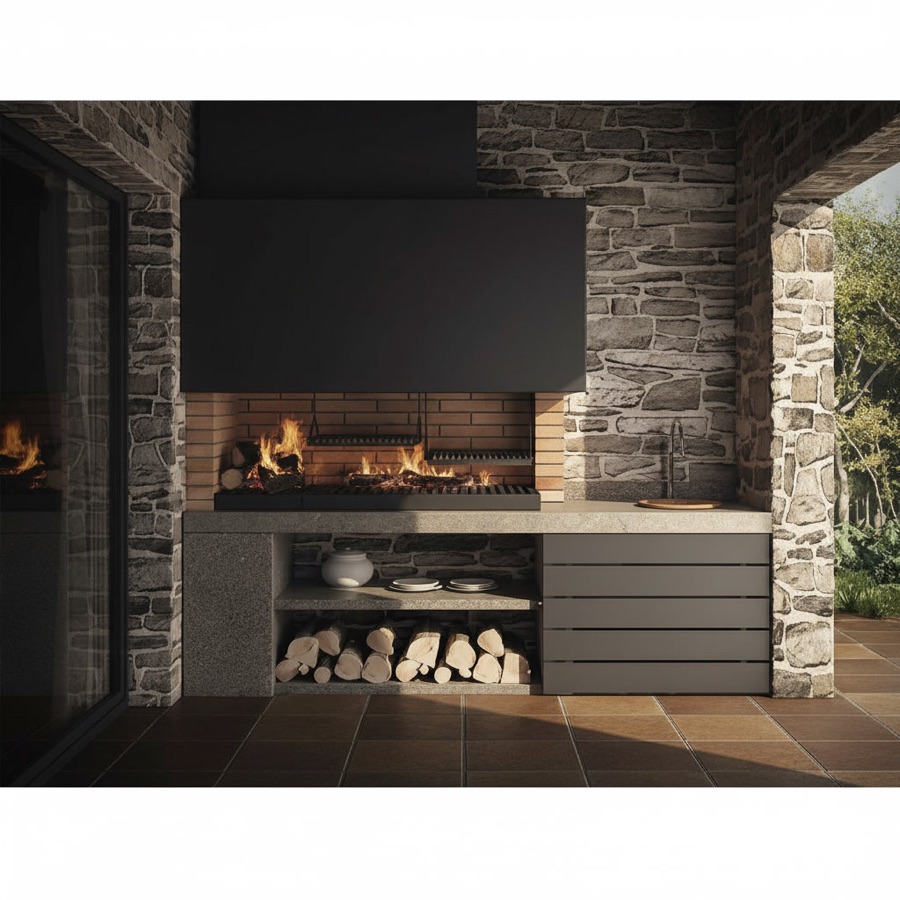
Large modern wood-fired barbecue with double grill, black metal hood, stone walls and log store

Wood-Fired, Beneath the Great Black Hood

The fire already lives within the mouth of the barbecue: embers glow beneath the double grill, ready to receive the meat, while the great black metal hood descends from the ceiling like a technical curtain, gathering the perfumes of the wood. At the sides, stone walls in irregular courses frame the scene with their ancient roughness; below, open bays keep logs stacked in order, beside drawers of contemporary line and the adjoining sink.

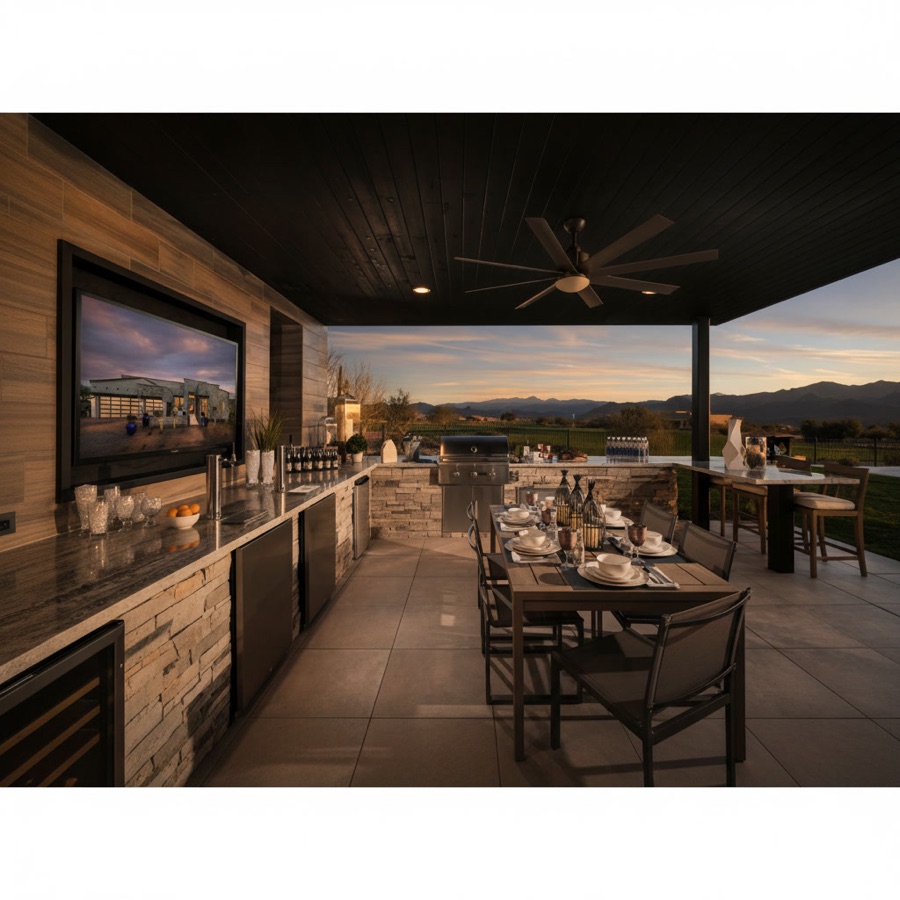
Outdoor kitchen in marble and brick-format marble with sink, barbecue, refrigerator and wooden canopy

Beneath the Canopy, Marble Facing the Hills

The dark wooden canopy frames the landscape like a panoramic screen: beyond the counter, the hills fade into the sunset light and the evening begins. Beneath this built sky, the kitchen works with elegance: marble counters, brick-format marble cladding giving rhythm to the vertical surfaces, the sink, the barbecue and the refrigerator each recessed in its place. The great screen at the side accompanies the evenings, the fan stirs the air, and the table laid at the centre awaits its guests with glasses ready.

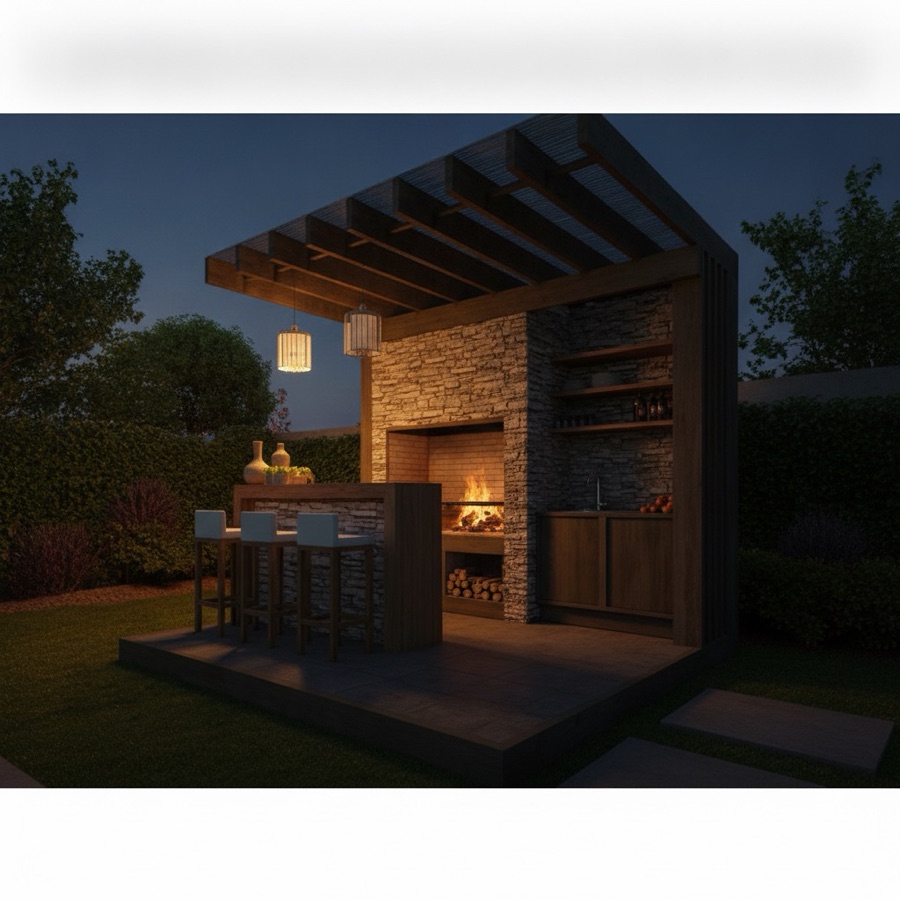
Complete outdoor kitchen with sink, wood-fired stone barbecue, bar table with stools and wooden pergola

The Pavilion of Fire, Stone and Pergola

It is a small pavilion devoted to fire: the wooden pergola with its bold beams covers the space, the wall of stone in irregular courses receives the wood-fired barbecue with its mouth at the ready, and before it the bar table with tall stools invites you to sit exactly where everything happens. Hanging lanterns, shelves set into the stone and the service sink complete the equipment, while the lawn breathes around in the sunset light.

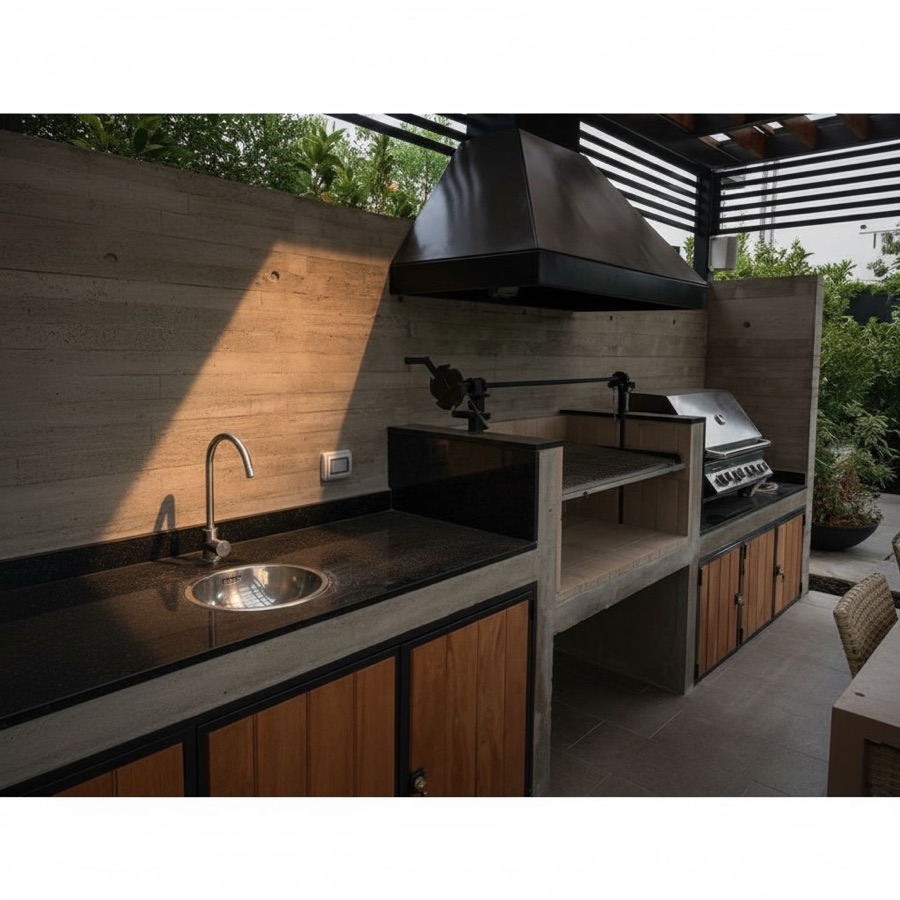
Complete outdoor kitchen with gas barbecue, rotisserie, burner, sink and lacquered wood doors

Rotisserie and Refractory stone Beneath the Green

The great black hood descends over the barbecue and its rotisserie, ready to gather the aromas of slow cooking; beside them, the burner and the gas barbecue add their quick fires, while the round sink carved into the black counter awaits the service. The refractory stone structure with its living surfaces carries everything with solidity, and lacquered wood doors warm the bases with their golden grain. Above, the pergola filters the light; around, the green presses in generously.

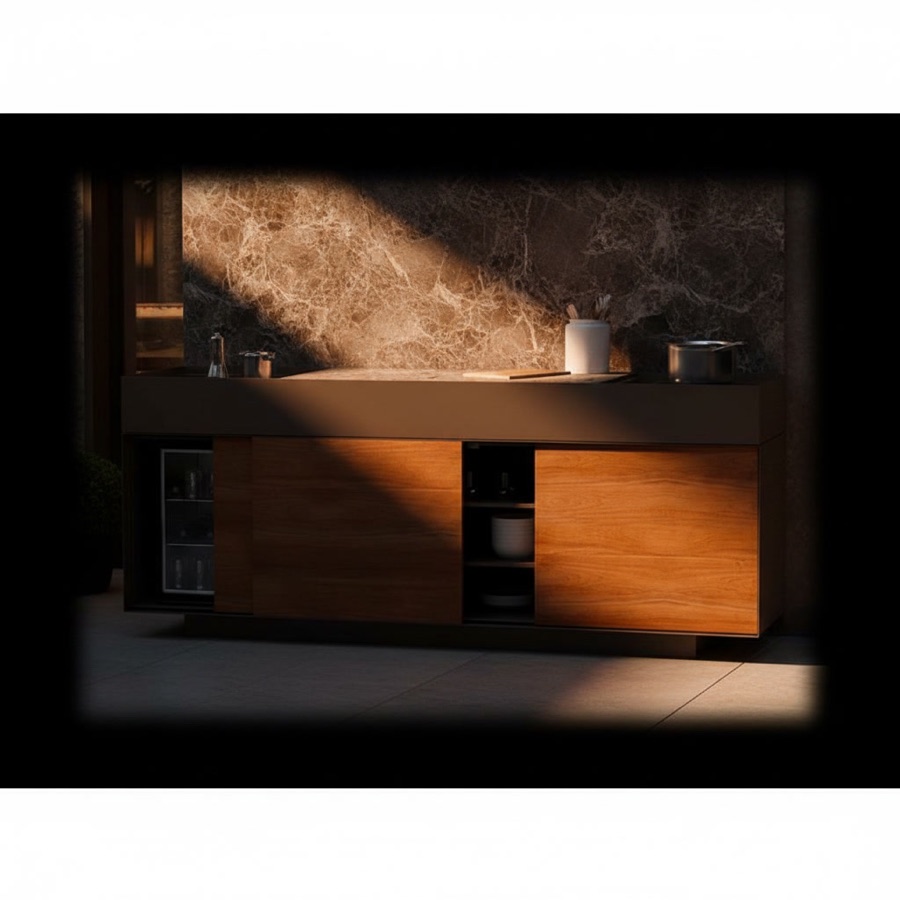
Outdoor kitchen complete with burner, wine cooler, shelves and worktop, with sliding wooden doors

The Dresser of Fire, Wood and Anthracite

It looks like a designer dresser, and it is a complete kitchen: the anthracite body with its rigorous profile receives great sliding doors of warm wood, opening onto inner shelves and onto the wine rack where bottles rest horizontally, visible as in a small wine shop. On the counter work the burner and the preparation spaces, the pot already on stage and the tray at the ready. Everything glides, everything closes, everything stays in order.

Which woods stand up outdoors: teak, iroko, chestnut, thermally modified wood, Accoya

Outdoors, the woods with high natural durability (teak, iroko) stand up best, together with chestnut, oak with some care, and the modified woods. The table lists them by the natural durability class of EN 350, which runs from 1 (very durable) to 5 (not durable).

WoodEN 350 classHow it behaves outdoors
Teak1 (heartwood only)Golden brown that weathers to a silver-grey patina: a change of colour, not damage. The natural oil in the wood can come to the surface and stain cushions.
Iroko1-2Resists rot and insects and is used in place of teak. From yellow to golden brown, it darkens over time.
Chestnut2Durable, but rich in tannin: on damp wood, iron leaves stains and corrodes fixings, so use stainless steel screws.
Oak2 according to some sources; 2 to 4 for oaks according to the CNRThe same tannin problem with iron. Better under cover.
Larch3-4Resinous and not very durable untreated; the 'thermo-structured' version sold commercially stays in class 3-4.
Thermally modified wood (ThermoWood Thermo-D, pine or ash)2 (manufacturer's figure)More stable: less shrinking and swelling. It turns grey within 3-6 months if not protected from UV and does not resist termites; stainless steel screws.
Accoya (acetylated radiata pine)1 (manufacturer's figure)Declared stable by the manufacturer, which backs it with a guarantee of its own.
Fir, ash, cherry untreatedfir 4 · ash perishable · cherry moderately to not durableNot suitable outdoors without modification: they remain indoor woods. Thermally modified ash rises to class 2.

Two points help in reading the table. The class applies only to the heartwood, the darker inner part of the trunk: sapwood, the pale outer band, counts as non-durable, which is why the quote should state that the wood is heartwood. And the years of service quoted in guides, class by class, are comparison values between woods, not guarantees: some technicians relate them to wood in contact with the ground, a harsher condition than a door lifted off the floor.

Larch, a mountain wood, stays in class 3-4 in the data sheets we have read, even in the thermo-structured version: we recommend it for covered areas, not for a door exposed to rain. For a rustic character chestnut is the safer choice. The other woods are described on the pages chestnut, ash, cherry and fir, oak and country and rustic kitchens.

Use class and durability: how the hold of wood outdoors is measured

Two European standards describe wood outdoors: EN 335 says where it sits (use class), EN 350 says how long it lasts on its own (natural durability). An uncovered kitchen sits in use class 3.2, that is outdoors and exposed to rain. Under a pergola or a roof that keeps the water off, the class drops to 3.1, which is less severe. Contact with the ground is class 4, harsher still: a kitchen must never reach it, and it is one of the reasons why the wooden door rests on a stone structure that lifts it off the ground.

A rule follows: the more sheltered the kitchen, the wider the choice. Under cover, oak can be used too and, in the most sheltered parts, larch; an uncovered kitchen calls for teak, iroko, chestnut or a modified wood. Made-to-measure covers are on the pergolas page, and the outdoor kitchen under a pergola shows how the space is organised.

Treated wood: thermal modification, acetylation, oils and protective finishes

Treatment decides how much the wood changes over time, not whether it changes. Three routes, all described by the manufacturers:

  • Thermally modified: the wood is heated in the presence of steam, with no chemicals. It becomes more stable and the colour is the same throughout its thickness. Outdoors, without protection from UV, it turns grey in 3-6 months.
  • Acetylated (the best known is Accoya): a modified radiata pine that the manufacturer declares to be class 1 and dimensionally stable.
  • Oil, wax, varnish: oil enters the pores and leaves the wood with its natural feel, but it has to be renewed; varnish forms a film that sheds water better, but a deep scratch is hard to touch up. Outdoors the renewal cycle depends on the product, the exposure and the species, and is given on the data sheet of the product chosen.

With teak it is worth deciding at once what colour you want in a few years: left natural it takes on a silver-grey patina and is not harmed; to keep it golden, one maker of teak furniture advises one clean a year and a UV protector each season. Oil-soaked rags are flammable: keep them away from the barbecue and the oven.

Outdoor stone and wood kitchen: how we build it

Our outdoor stone and wood kitchen has three parts with three jobs: the refractory stone structure that carries the weight, the fire and the frost; the stone worktop that resists stains; the wooden doors for outdoor use that bring the warmth of the material where there are no flames.

  • Structure: refractory stone blocks fitted together dry, with no binders. Each block is replaced on its own. When the design calls for it, it can be steel or treated timber; next to the fire, refractory stone remains.
  • Worktop and sink: slabs chosen and cut in the Aprilia workshop; stone or steel sink.
  • Doors, drawers, pantry: wood for outdoor use, made to measure, on the sink, pantry and outdoor fridge units. Hinges and finishes are on the page doors, hinges and finishes.
  • Barbecue and wood-fired oven: cooking chamber in refractory stone, inside the structure. These are the refractory stone barbecues and ovens.

Those who want a fixed stone kitchen, built on site, will find our answer on the page refractory stone outdoor kitchen, built in dry-laid blocks. The versions with a barbecue or with steel are in outdoor kitchen with stone barbecue and stainless steel and stone outdoor kitchen. For wood with marble and with steel in general, see wood and marble, stone and steel.

Which worktop with wood: granite, quartzite, sintered stone, travertine or marble

Outdoors, the worktop that sits best with wood is granite, quartzite or sintered stone; travertine and marble are chosen knowing what they ask of you. Composite quartz, on the other hand, does not belong outdoors.

  • Granite and quartzite: compact, barely absorbent, the most reliable under sun, frost and cooking grease. Pages: granite and quartzite.
  • Sintered stone: Dekton and Laminam (Laminam in 12 mm thickness, also 20 mm), ultra-compact, non-absorbent and scratch-resistant.
  • Travertine: outdoors only compact and treated, with a water repellent to be renewed. See travertine.
  • Marble: fears acids such as lemon and vinegar; outdoors it calls for a honed or brushed finish, a water-repellent treatment and, if possible, a cover.
If you chooseWorktop that goes with it, and why
Teak or dark irokoBlack granite or dark sintered stone: designers pair black with teak, with black marble, and outdoors the idea is carried over to granite or sintered stone.
A pale or golden woodPale sintered stone or compact, treated travertine: they lighten the kitchen, and outdoors pale sintered stone is easier than white marble.
Rustic chestnutRustic outdoor kitchen: chestnut with granite, quartzite or travertine, warm material and colour, all compact.

Wood and fire: barbecue, wood-fired oven and distances

Wood does not go next to the flame: the cooking chamber of the barbecue and the oven is in refractory stone inside the structure, and the wooden doors sit on the units away from the fire. Safety distances depend on the appliance manufacturer's instructions and we set them in the design, appliance by appliance. One maker of wooden kitchens advises against exposing wood to high temperatures.

That is why the fire sits at the centre, in stone, and the wood at the sides: sink, pantry, log store, outdoor fridge. The oven with its refractory stone dome is on the page outdoor kitchen with wood-fired oven.

The limits to know before choosing

The limits of wood outdoors are six: it changes colour, it moves, it heats in the sun, it suffers from iron, it needs a finish to be renewed and, if modified, it has weak points of its own. They should be known before you sign:

  • The colour changes: teak turns grey, iroko darkens, thermally modified wood turns grey if unprotected.
  • Wood moves with humidity: suitable clearances and fixings are needed.
  • The sun heats: in full sun the surface can get very hot.
  • Iron stains damp chestnut and oak: stainless steel screws.
  • The finish is renewed according to the product and the exposure.
  • Modified wood has weak points of its own: thermally modified wood does not resist termites and has to be protected from UV.

What to ask for in the quote for an outdoor wooden kitchen

The quote for an outdoor wooden kitchen should put six things in writing, which separate a true outdoor wood from a generic promise:

  1. the botanical species, not only the trade name;
  2. that the wood is heartwood, and the EN 350 class of the species;
  3. the intended use class, uncovered kitchen (3.2) or sheltered (3.1);
  4. the surface treatment and how often to renew it;
  5. the screws and hinges, in stainless steel;
  6. the distance from the fire, according to the appliance instructions.

To tell real wood from wood-effect, and for other questions, see the pages real wood or wood effect and questions and answers on wooden kitchens.

How much does an outdoor wooden kitchen cost?

We do not publish prices, because they depend on factors that change with every project. The main ones are the wood chosen, the finishing of the doors, the structure, the worktop stone, the barbecue and the oven, the outdoor appliances, the measurements and the installation. Wood costs more than laminate and melamine, and outdoors it needs a finish to be renewed over time. The factors are explained on the page how much does a wooden kitchen cost.

From the site survey to installation

It begins with a site survey, free in Rome, Latina and throughout Lazio, and a 3D design, free wherever you are; then the kitchen is built and installed throughout Italy. Outside Lazio we start from your measurements and photographs, with a guided remote survey; the slabs can also be viewed by video call. The slabs are chosen one by one and cut on numerically controlled machines, and the kitchen is built to measure and installed by our own team. The department is introduced on the page wooden kitchens.

The quotation is free wherever you are: request it here.

Frequently asked questions

Frequently asked questions

Can an outdoor kitchen be made in wood?

Yes, by choosing woods that stand up outdoors: teak, iroko, chestnut or modified woods such as thermally modified and acetylated wood. Mounted on a structure of refractory stone, steel or treated timber that lifts them off the ground and, if possible, under a cover, they are less exposed to damp. Untreated fir, cherry and ash remain indoor woods. Michelessi, in Aprilia, builds it to measure and installs it throughout Italy.

Which wood should I choose for an outdoor kitchen?

For an uncovered kitchen, in full sun and rain, the most reliable woods are teak (durability class 1) and iroko (class 1-2), followed by chestnut (class 2). Under a cover, oak can be used too. The modified woods, thermally modified wood and Accoya, are a stable alternative: the choice is made in the design, according to the exposure.

Does teak turn grey outdoors?

Yes: untreated, teak takes on a silver-grey patina. It is a change of appearance, not damage, and the wood stays sound. To keep it golden, one maker of teak furniture advises one clean a year and a UV protector each season. It is worth deciding early whether to leave it grey or keep it golden, and remembering that teak oil can stain cushions.

Is thermally modified wood suitable for an outdoor kitchen?

Yes, with some precautions. Thermally modified wood, made with heat and steam and no chemicals, is more stable than natural wood and the manufacturer declares it to be class 2. Without protection from UV it turns grey in 3-6 months, it does not resist termites and it needs stainless steel screws. It is a good choice under cover or with a protector.

Is larch suitable for an outdoor kitchen?

Only in covered areas. Larch is resinous and, untreated, sits in durability class 3-4, which means not very durable; even the 'thermo-structured' version sold commercially stays in the same class. For a door exposed to rain, teak, iroko or chestnut are safer.

What is Accoya wood and does it stand up outdoors?

Accoya is acetylated radiata pine, that is, pine modified to make it more durable and stable. The manufacturer declares it to be durability class 1 and backs it with a guarantee of its own, to be read on the data sheet. The manufacturer declares it dimensionally stable, that is, with little movement: it is a choice worth weighing for the doors of an outdoor kitchen.

Can wood be next to the barbecue and the wood-fired oven?

Not next to the flame. In our kitchens the cooking chamber is in refractory stone, inside the structure, and the wood sits on the sink, pantry and fridge units. Safety distances follow the appliance manufacturer's instructions and we set them in the design, appliance by appliance.

Which worktop goes with an outdoor wooden kitchen?

Granite, quartzite and sintered stone (Dekton, Laminam) suit the outdoors best. Travertine should be compact and treated; marble fears acids and calls for a honed or brushed finish, a water repellent and, if possible, a cover. Composite quartz does not belong outdoors. Black with teak, pale with pale woods.

How much maintenance does an outdoor wooden kitchen need?

It depends on the wood and the exposure. Teak left natural turns grey without damage; keeping it golden calls for cleaning and a UV protector. Iroko darkens over time. Oils and varnishes are renewed as the product data sheet says. Thermally modified wood has to be protected from UV. The refractory stone structure does not have this cycle; for the worktop it depends on the stone, and travertine and marble need a water repellent to be renewed.

Does an outdoor wooden kitchen withstand rain and frost?

Yes, if the wood is chosen for outdoor use and fitted well. An uncovered kitchen sits in use class 3.2 (exposed to rain) and needs teak, iroko, chestnut or a modified wood; under a pergola that keeps the rain off it drops to class 3.1, which is less severe. Wood never touches the ground: the structure in refractory stone, steel or treated timber lifts it, and dry-laid stone has none of the parts frost damages most.

How much does an outdoor wooden kitchen cost?

We do not publish prices, because they depend on the wood chosen, the finishing of the doors, the structure, the worktop, the barbecue and oven, the measurements and the installation. Wood costs more than laminate and melamine. The quotation is free wherever you are, as is the 3D design, and in Rome, Latina and Lazio the site survey is free too.

Does Michelessi build outdoor wooden kitchens outside Lazio?

Yes. We design and build them to measure, install them with our own team throughout Italy and follow projects abroad too. The quotation and the 3D design are free wherever you are; the free site survey applies in Rome, Latina and Lazio, while elsewhere we start from your measurements and photographs, with a guided remote survey; the slabs can also be viewed by video call.

Call us WhatsApp