Skip to content
Made in Italy

Since 1976 — Wooden kitchens

Wood and Steel, Marble or Stone Kitchen: How to Pair Them

WOOD · STEEL · MARBLE · STONEWARE

In short

Carrara marble kitchen with large island, fast-lunch section and dark wood columns
White Carrara Kitchen — photograph of a Michelessi project.

The block — a Michelessi vision

From the block,
blow after blow

01 A raw block of Calacatta Viola waits under the spotlight, in the dark kitchen with brass profiles. Mallet and chisel are already on the floor: the island is still all inside the stone.

02 Blow after blow the faces are squared, chips fly, white dust rises into the light. The chisel scores the drawers, opens the recess for the hob, carves the sink: the shape of the island comes out of the block slowly, without haste.

03 Then the stone is honed and polished: the purple vein catches the light, brass edges close the drawers, the black hob sinks into its recess, the gold tap finds its place. The island remains, and a veil of dust on the floor.

Keep scrolling — the scene follows you

Wood and Steel, Marble or Stone Kitchen: How the Materials Pair

A wood and steel, wood and marble or wood and stone kitchen is one in which the wood dresses the doors, tall units and shelves, the parts you touch, and a second material works where strength and easy cleaning matter: the worktop, the island, the splashback, the cooking zone. The starting rule is simple: wood where the kitchen opens, stone or steel where it works. The rest is a matter of colour, finish and proportion.

Who builds it: Michelessi SRL, in Aprilia (LT), on the Via Pontina between Rome and Latina, with installation throughout Italy. We have worked stone since 1976 and made modular kitchens since 2022. We design and build wooden kitchens to measure, with solid wood doors and worktops in marble, stone or steel chosen within the same project. This page belongs to the made-to-measure wooden kitchens section; the pairing of marble and wood alone, with the models, is on the page marble and wood kitchen.

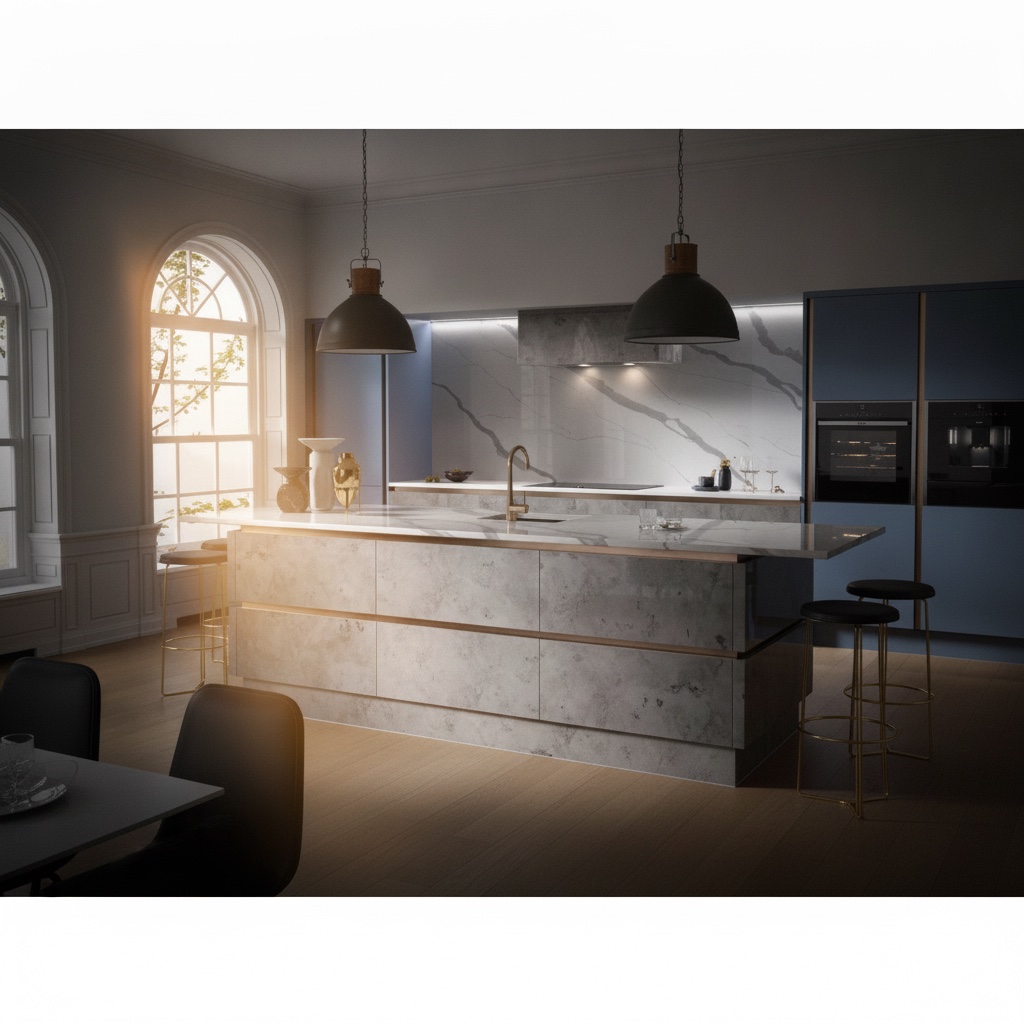
Stoneware-clad kitchen with island, integrated sink, induction hob, hood and oven

Stoneware-clad kitchen with island, integrated sink, induction hob, hood and oven

The island presents itself in its pale stone-effect stoneware dress, crossed by slender inserts that mark out its drawers; above, the top integrates sink and induction hob in a single working surface, served by burnished taps. Behind, a marble-effect stoneware wall rises beyond the cooking zone, while powder-blue columns — with black ovens recessed — add the colour that gentles the whole scene. Dark bell lamps, stools at the counter, tall windows of a stately apartment: the ensemble has an urban, serene elegance. A wooden structure clad in stoneware is a sound formula: the constructive warmth of wood, the resistance of ceramic at the surface. With hood and oven completing the equipment, it is an indoor kitchen ready for real life: Michelessi builds it to measure, attending to joints, recesses and tonal pairings with an artisan's care. The powder blue, then, is the touch that lingers in the eye.
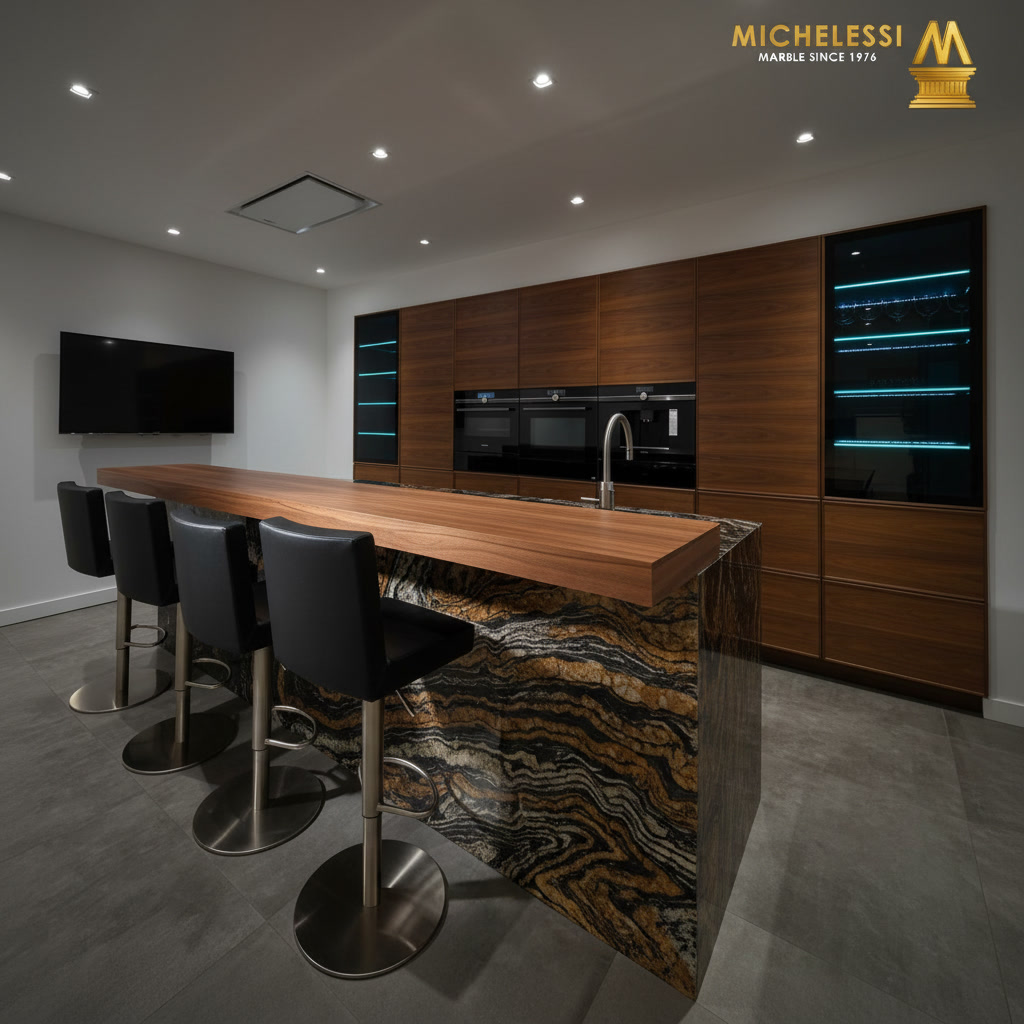
Central quartzite island with spectacular veining, wooden counter and black stools

Central quartzite island with spectacular veining, wooden counter and black stools

The island is a fire made stone: quartzite with amber and black veining blazes along the flanks in its impetuous figuring, polished until it mirrors the room; above, a solid wood counter lays down its warm board and gathers black swivel stools. The sink sits flush in the top; behind, walnut boiserie conceals and reveals — black ovens, backlit vitrines of bottles, a recessed television. A pale floor leaves the whole stage to the material. This is the project for those who want a collector's stone at the heart of the home: quartzite, with its unrepeatable figure, is not chosen from a catalogue — it is encountered, slab by slab. Bespoke stonework orchestrates its veining across top and flanks, with cuts and joints that honour the natural movement. This is the art of Michelessi: craftsmanship that knows when a stone deserves the stage, and builds one around it.

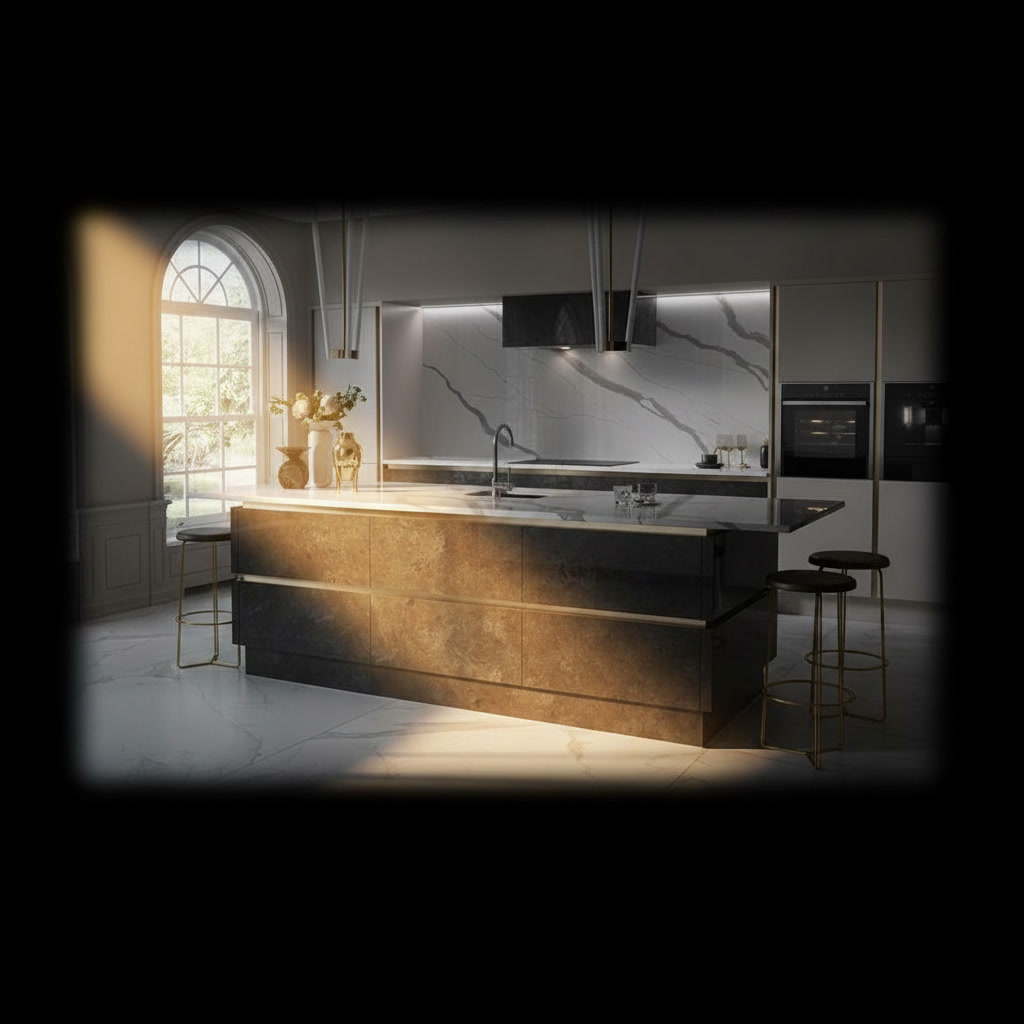
Kitchen with island clad in grey porcelain stoneware with golden profiles and marble wall

Kitchen with island clad in grey porcelain stoneware with golden profiles and marble wall

Arched windows and a wall of veined marble effect give the room the breath of a palazzo; at the centre, the island clad in stone-grey porcelain dresses itself in golden profiles — fine lines running along the volumes like threads of light — and carries the integrated sink with its gold tapware. Stools with gilded details complete the register, together with dark columns housing the built-in ovens. Fully equipped, this is a kitchen that plays the luxury card openly: technical materials treated like jewels, measured reflections, a curated scenography. The porcelain stoneware bears the practical side with its tireless surface; the gold does its own work, which is to shine. Made-to-measure holds it all in balance: proportions, alignments, cut-outs. This is the glamorous face of Michelessi indoor kitchens: artisan craftsmanship that knows how to be sober when needed — and magnificent when the project asks. The gold here is not ostentation: it is a line of light drawn with a ruler.

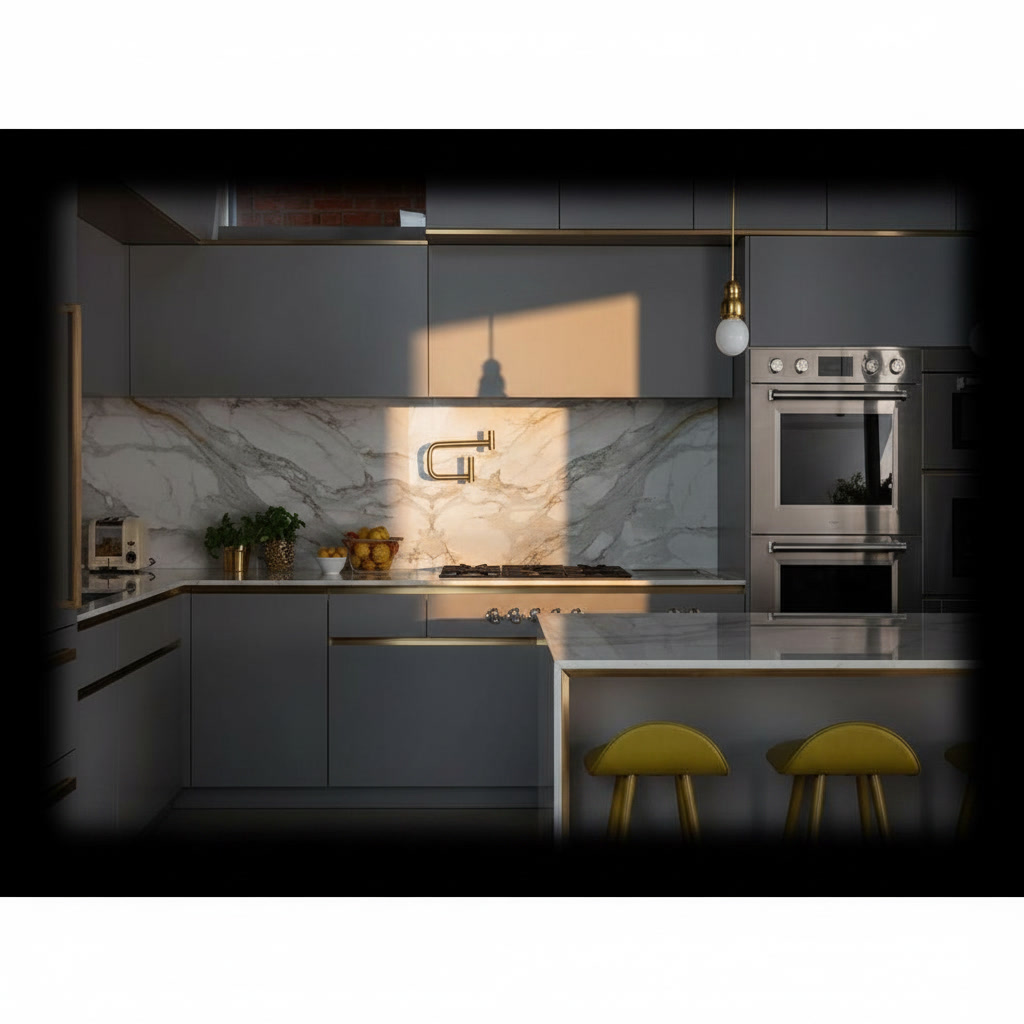
Classic grey kitchen with veined travertine top, oven, sink and yellow stools

Classic grey kitchen with veined travertine top, oven, sink and yellow stools

The lines are elegant and the colour knows it: uniform grey doors, crossed by golden profiles that draw the handles and frames, meet a veined travertine counter — pale stone with a moving figure that also clads the wall behind the burners, as one single mineral gesture. Twin ovens sit in their column, the sink works beneath a suspended brass bulb, and yellow stools light the counter with their note of sun. Complete with oven, sink and range, this is a classic kitchen of contemporary proportions: few elements, all of them right. Veined travertine is the silent protagonist: Roman stone, warm and luminous, worked to measure in counters and cladding with the care its history deserves. This is the Michelessi métier: craftsmanship that sets gold against stone without ever sliding into excess — because true elegance is known by its restraint. The yellow stools confirm it: elegance, now and then, also knows how to smile.

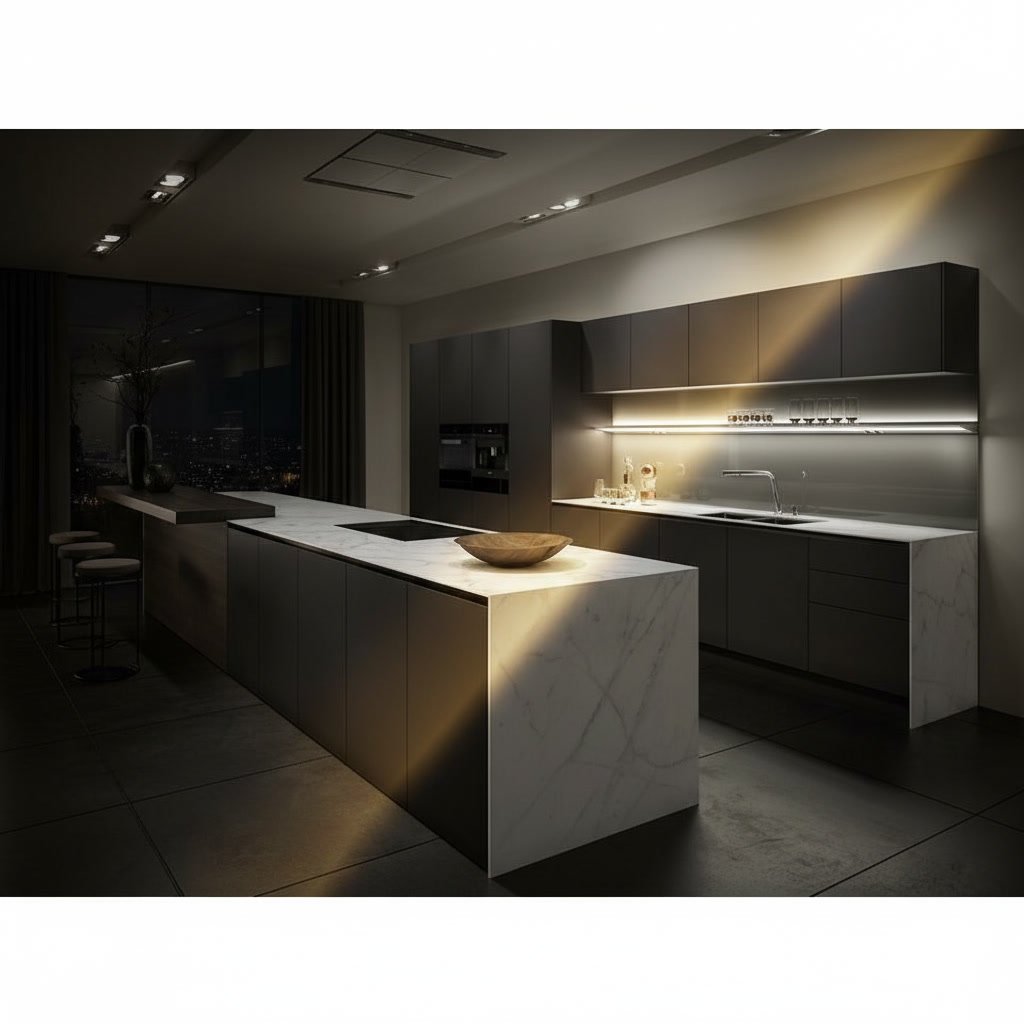
Dark lacquered wooden kitchen with veined travertine island with bar table and induction

Dark lacquered wooden kitchen with veined travertine island with bar table and induction

It is the hour when the city lights up, and the kitchen answers with its veined travertine island: pale stone, crossed by grey veining, falls in a waterfall along the flanks and carries the integrated induction hob, extending into a bar table where dark stools wait. Around it, surfaces of dark lacquered wood absorb the spotlight; a fitted wall with its LED strip lights the worktop, and doors keep everything in its place. Complete with sink and oven, this is a kitchen of metropolitan charm: sharp contrasts, noble materials, a penthouse atmosphere. The veined travertine is the luminous heart of the dark: working it in a waterfall demands exact joints and orchestrated veining — the bespoke stonework Michelessi practises with the artisan craftsmanship of always. The result is an island that seems lit from within: stone that gives light, while everything around it chooses shadow. Elegant darkness plays the backdrop: the pale stone takes, deservedly, the stage.

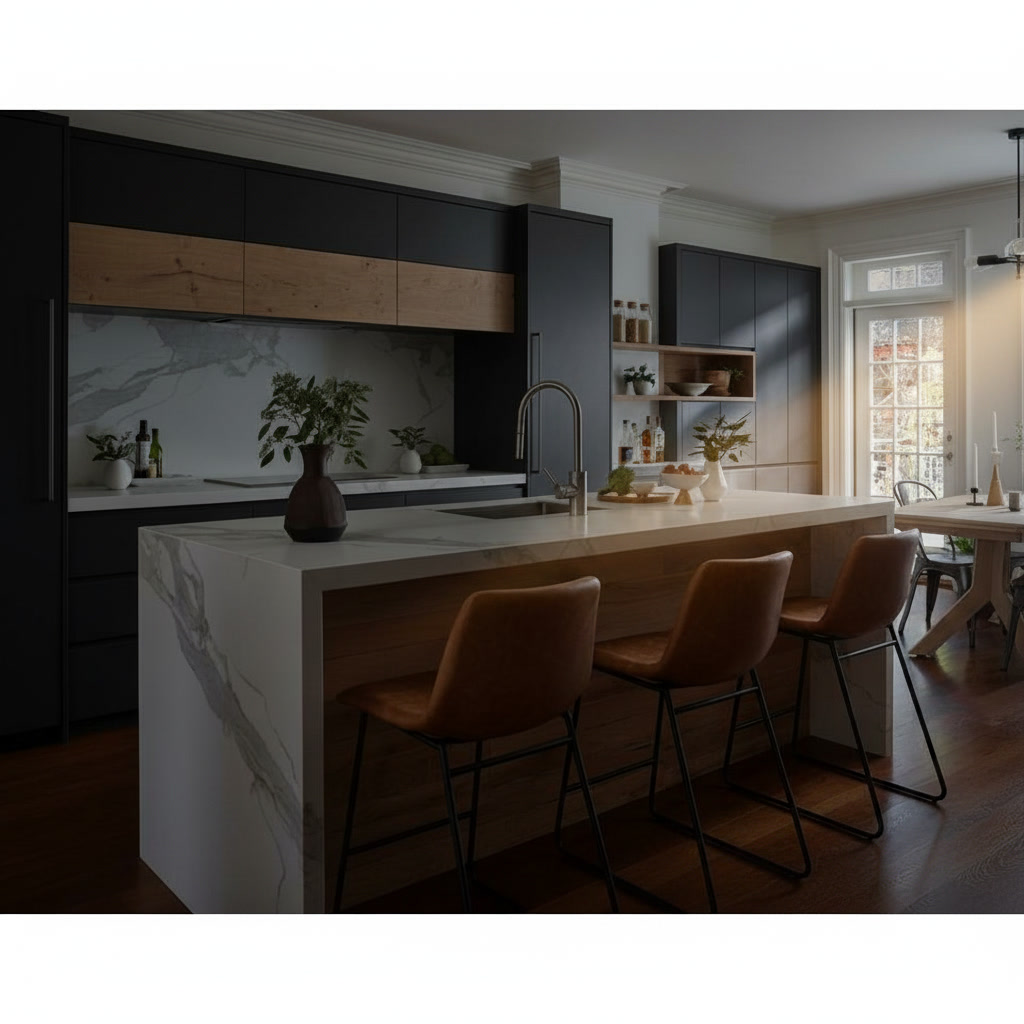
Veined travertine island with leather stools, grey kitchen with sink, induction and oven

Veined travertine island with leather stools, grey kitchen with sink, induction and oven

The island falls in a waterfall of pale veined stone: the travertine top continues down the flanks without breaking its figure, and three cognac leather stools draw up with their club-room elegance. Behind, the dark grey kitchen works with the sink beneath a suspended wooden shelf, the induction hob, the oven and well-ordered doors; a pale veined wall amplifies the light, and flowers on the counter complete the grace of the whole. A brown timber floor anchors the composition. This is warm contemporary style played on the right materials: stone that ennobles, leather that ages well, grey as the backdrop. The travertine waterfall — mitred joints at forty-five degrees, veining aligned — is the detail that marks serious work: Michelessi work, Italian craftsmanship in stone for made-to-measure indoor kitchens. The cognac of the stools does the rest: it invites you to stay.

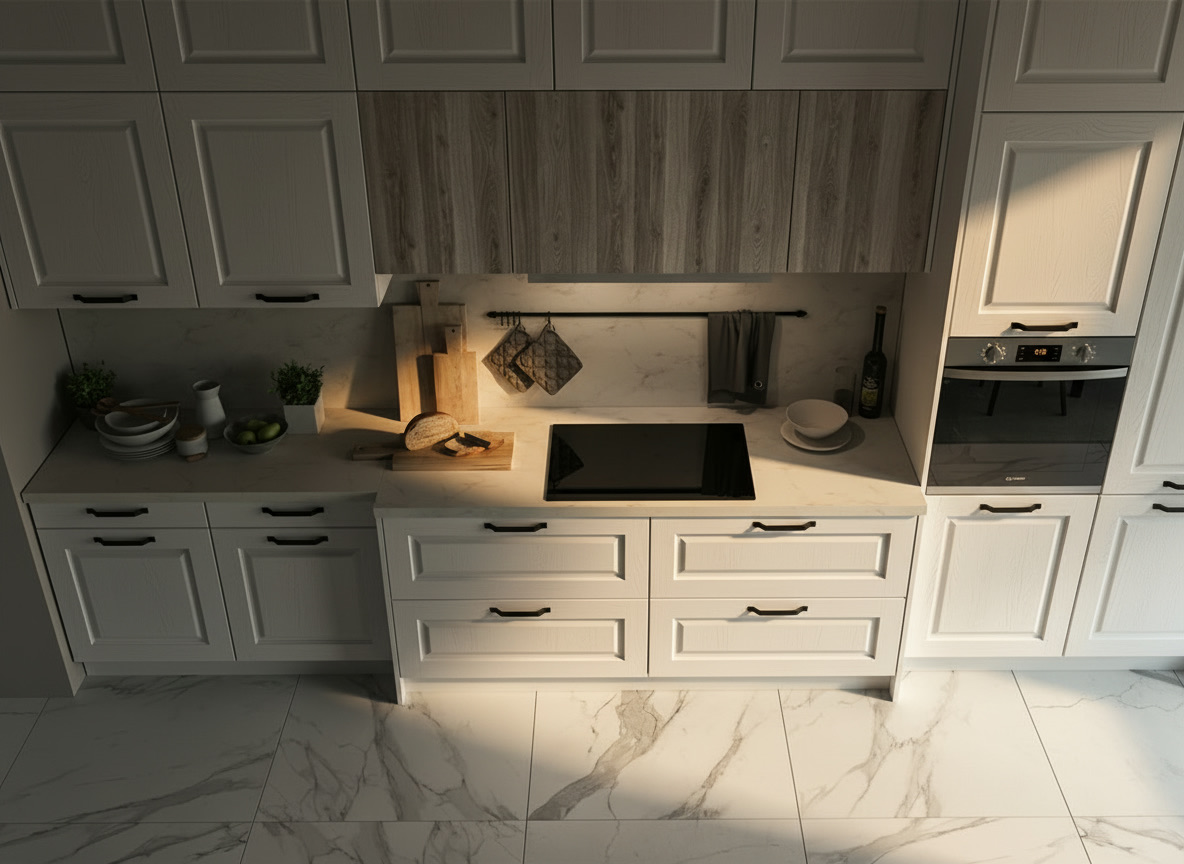
Classic white kitchen with framed doors and white marble floor with grey veining

Classic Candour on Veined Marble Floors

Seen slightly from above, the kitchen unfolds like a well-written page: white framed doors, orderly deep drawers, the pale worktop with its black induction hob, wood-effect panelling warming the wall. But it is the floor that steals the scene: great slabs with the look of white marble, crossed by grey veins running free from one side of the room to the other, like rivers seen from the sky. Such is the power of marble — true protagonist of the Italian tradition — to ennoble everything that rests upon it. Michelessi indoor kitchens are born inside this culture: the company has always worked marble to measure and knows how to set it beside modular finishes with balance, from worktop to floor. White, here, is not the absence of colour: it is a light that welcomes — the same light the marble workshops have pursued for generations, slab after slab. A floor like this is not crossed absent-mindedly: it is inhabited, with the gratitude owed to beautiful things.

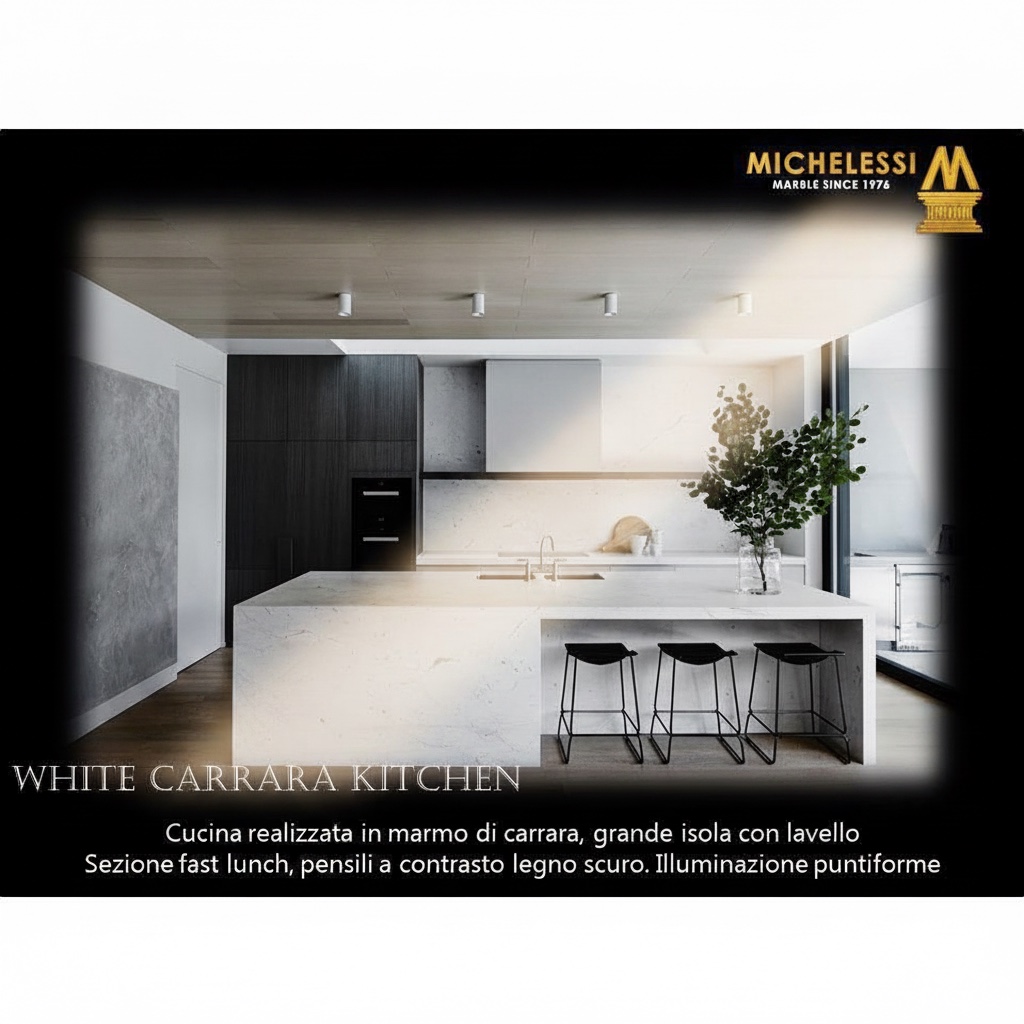
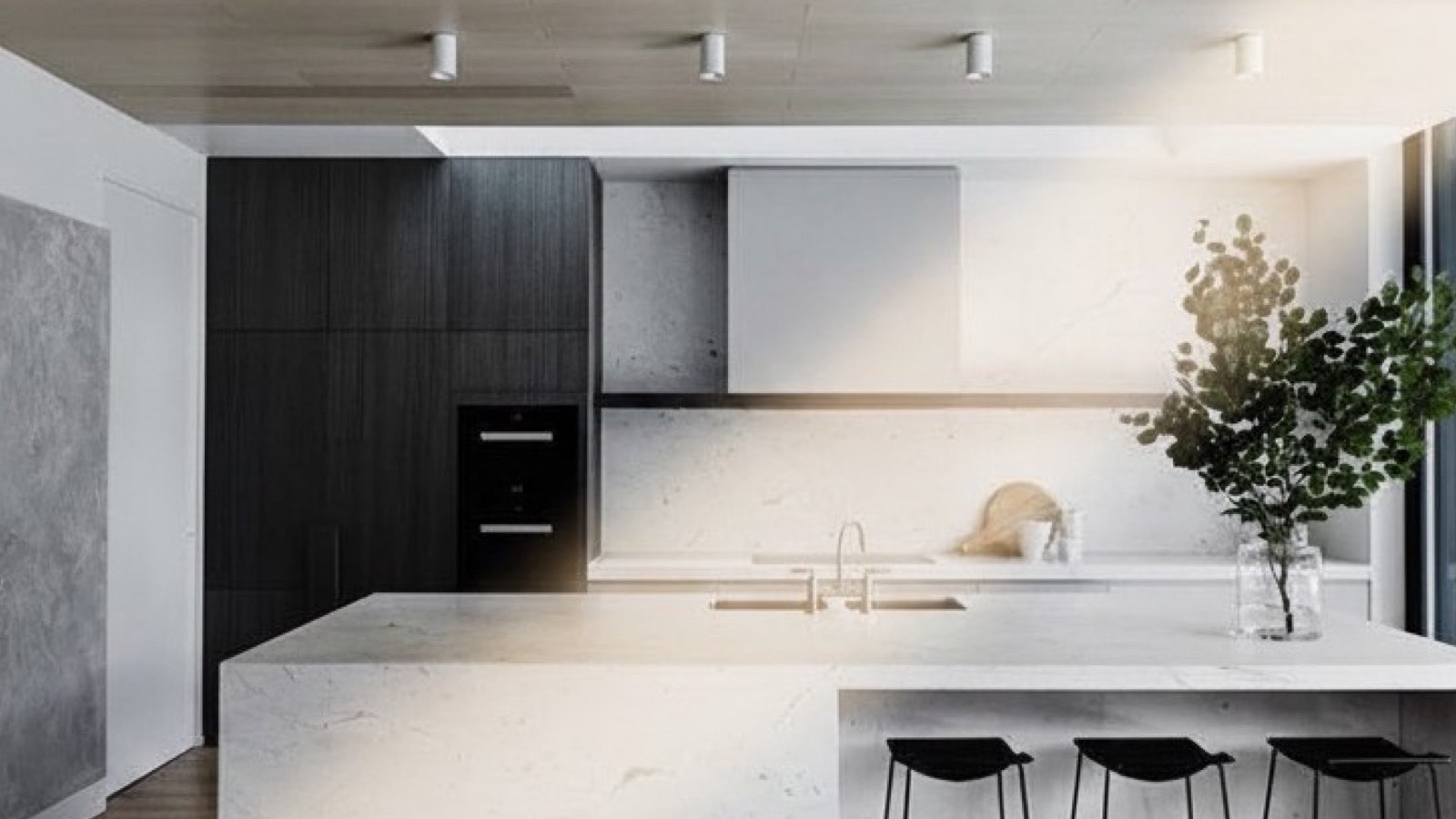
Carrara marble kitchen with large island, fast-lunch section and dark wood columns

White Carrara Kitchen

A stone-effect wall forms the neutral backdrop, and track spotlights rain pointed light onto the protagonist: the great Carrara marble island, with its integrated sink and the fast-lunch section where three black stools line up in good order. The stone descends along the sides and draws a compact, luminous volume, crossed by discreet veins; behind, dark wood columns create the contrast that gives the whole scene its depth, while a potted tree brings a note of living green. It is the formula of the well-tempered contemporary: white and dark, stone and wood, technical light and ancient matter. Carrara marble, cut to measure, holds the centre of the composition with the ease of a champion. Michelessi attends to every step — slab selection, cuts, recesses, finish — with the rigour of Italian craftsmanship: because an island like this is the heart of the home, and the heart admits no approximation.

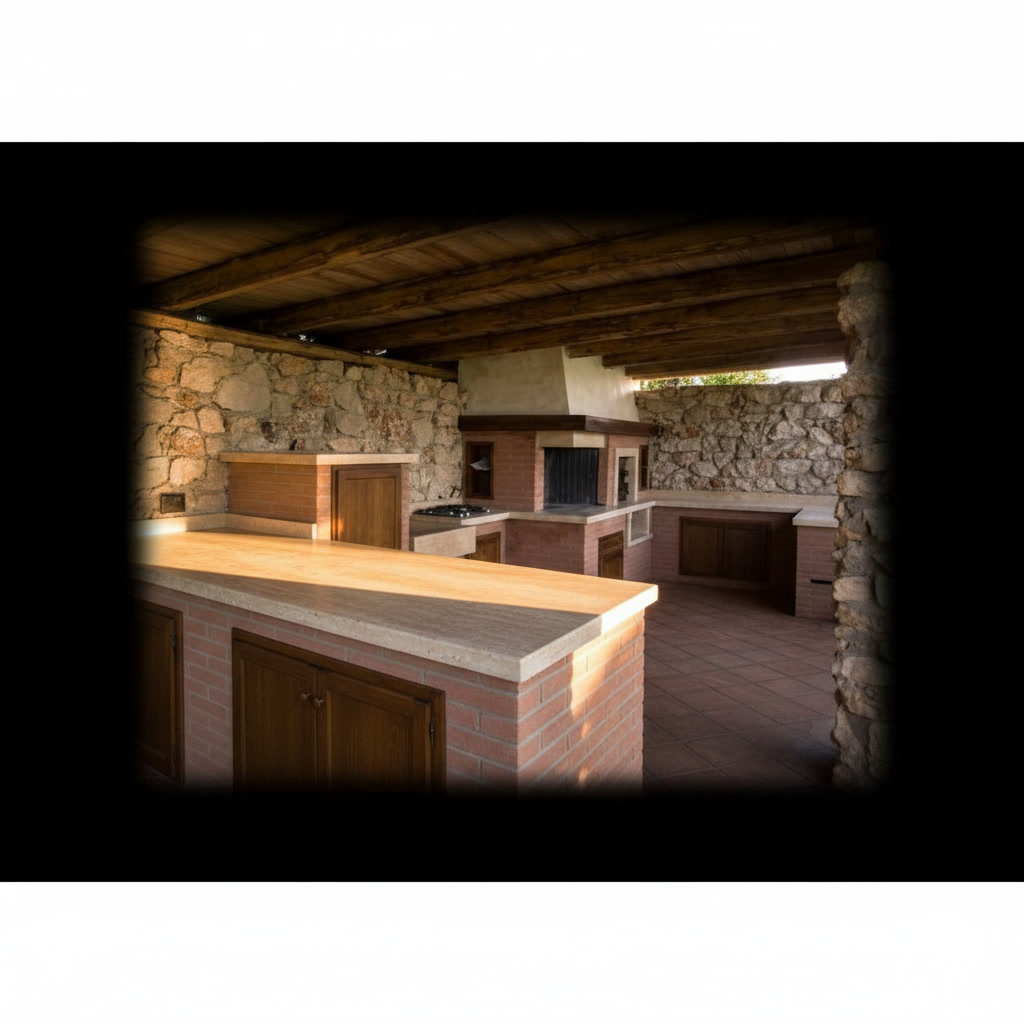
Rustic kitchen in sandblasted brick with travertine top, barbecue and chestnut doors

The Michelle Kitchen

Michelle lives in the open air: beneath a roof of wooden beams, between dry-stone walls, the rustic kitchen in sandblasted brick spreads its warm volumes, crowned by a travertine top that binds barbecue, burners and work zone into a single surface of stone. The barbecue fireplace is the heart of the project — the promise of grilled feasts and warm bread — flanked by the oven; chestnut doors close the compartments with the most honest wood of the Italian forests. Terracotta underfoot completes the palette of true materials. This is the kitchen of long summers, of lunches that end at sundown: built in masonry, made to withstand seasons and years. Bespoke travertine work — counters, edges, recesses — gives Michelle her elegant solidity: Italian craftsmanship applied to conviviality, which has always been its oldest vocation. Because cooking outdoors, after all, is the most festive way of being together.

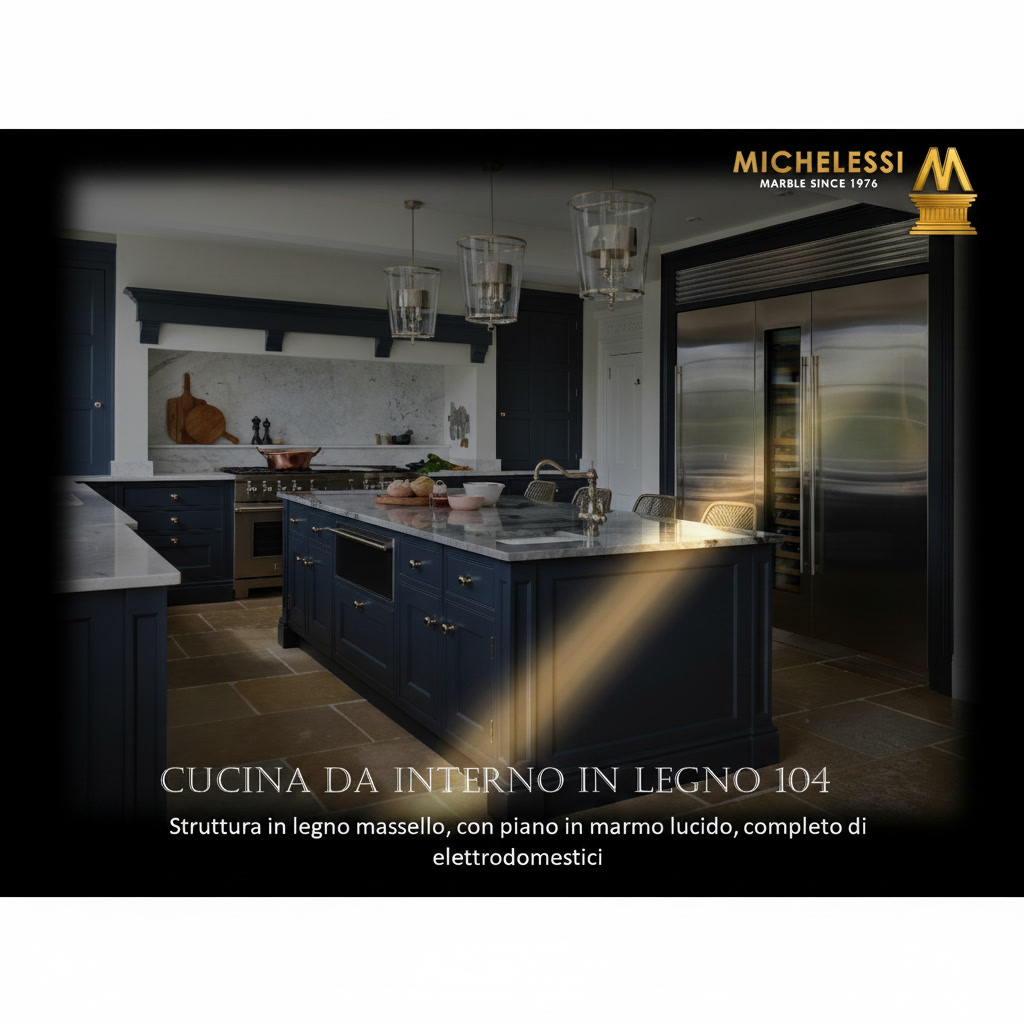
Solid wood kitchen in blue with island, polished marble top and large steel refrigerator

Solid wood kitchen in blue with island, polished marble top and large steel refrigerator

The deep blue of the solid wood dresses the whole kitchen — base units, columns, the central island — and suspended glass lanterns add a light worthy of an English residence; the polished marble top, pale and veined, crowns the island and the perimeter counters with a surface that reflects the day. The great professional steel refrigerator occupies the back wall like a luminous monolith; the hood set into the blue boiserie and the pale stone floor complete the scheme. This is a kitchen complete with appliances, conceived for lovers of the classic contemporary: decisive colours, true materials, tended details. Polished marble gives the blue its natural counterpoint: pale stone breathing above a deep colour. The bespoke working of the counters — thicknesses, edges, recesses — carries the hand of Michelessi and of Italian craftsmanship: because a blue this important deserves a marble equal to it. A blue that receives guests properly: with substance, not with effects.

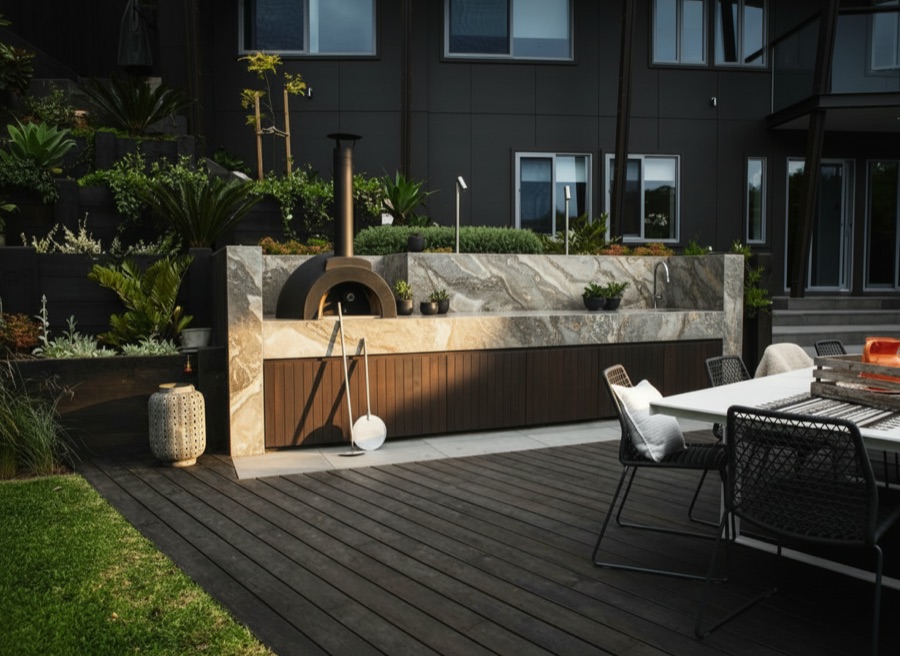
Terrace with stone and dark wood outdoor kitchen, pizza oven and dining table with seating

A Signature Terrace, Where the Kitchen Lives in Wood

A floor of dark decking stretches out like a stage, and the camera crosses it slowly: on one side the table laid with its light seating, on the other the outdoor kitchen running along the flowering wall, with dark wood doors and a pale worktop. Above, the dome of the oven stands against the facade of the building, a promise of long, fragrant evenings.

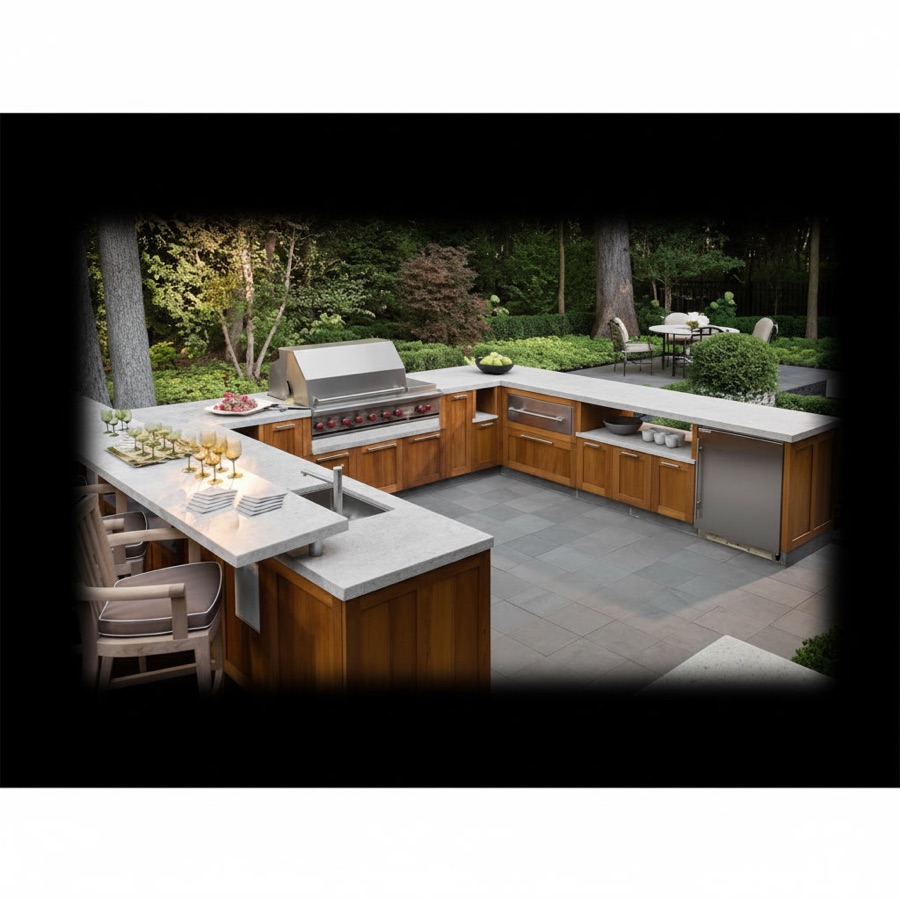
Outdoor kitchen with built-in appliances, light granite worktop and treated wood structure, U-shaped

The Great U of Teak and Granite in the Woods

The U spreads generously over blue stone paving and the woods embrace it on every side: the treated wood structure, with its warm, orderly doors, bears the light granite worktop running along three sides, carrying the barbecue with its steel hood, the sink, built-in appliances and the counter where high seats await company. Little plants on the tops add their domestic green to the great green of the trees.

Wood and Steel Kitchen: Where Steel Works Well

In a wood and steel kitchen the wood makes the doors, tall units and shelves, while the steel makes the parts that heat up, get wet and get dirty: the worktop, the splashback behind the hob, the sink, the extractor, the grip channels and the trims. A pairing that works: oak doors with a worktop and splashback in satin steel. The contrast is sharp, grain and warmth on one side, a smooth cool surface on the other; the modern country style uses the same idea and adds a marble worktop.

  • Behind the hob: a steel splashback goes where heat and grease spatter arrive, while the wood stays at the distances given in the hob's instructions.
  • Worktop and sink: in steel, where water is at home.
  • Extractor, trims and grip channels: in the same steel, for a single design.
  • Shelves and niches: slim, in steel, beside the solid wood.

Two Points of Care Where Wood Meets Metal

The first concerns iron. Oak and chestnut are rich in tannins: with water and iron they leave blue-black stains. Typical causes are steel wool, rusty nails or feet, and standing water; for this reason, wherever there is damp, stainless steel fixings are used. The second concerns movement: wood takes up and gives off moisture and moves, steel does not, so the joints between the two are designed to follow the wood.

Those who search for a "wood and iron kitchen" will find the principle that matters in steel: a metal where the work is done, wood for the parts you touch. Outdoors the same reasoning leads to a steel structure with a stone worktop: you will find it on the page steel and stone outdoor kitchen.

Rustic Wood and Stone Kitchens: Beams, Splashbacks and Country Style

A stone and wood kitchen, or rustic wood and stone kitchen, uses solid wood for doors, shelves and worktops and stone for what stays fixed and on show: the splashback, the worktop, the structure. Today it comes in two versions: rustic, with exposed beams, or country chic, with clean lines and pale wood.

  • Stone splashback: in the modern rustic kitchen it is the focal point of the wall behind the hob.
  • Walnut or oak doors, with a wooden or stone worktop; cherry and chestnut are the other typical woods.
  • Exposed beams and wood on the floor and window frames too.
  • Earth colours: from hazelnut to beige, through ochre, terracotta and green, to the grey of stone, with details in copper, bronze and brass.

Michelessi builds this pairing in Francesca too, the indoor kitchen in the masonry style: the structure is dry-laid refractory stone blocks, the worktop is marble, the doors are wood. You will find it on the page about masonry-style kitchens; the other indoor kitchens are on the indoor kitchens page. The pairing is also explained on the page stone and wood in the masonry style. The styles have pages of their own: country and rustic wooden kitchen and rustic, country and classic style in refractory stone.

Wood and Marble Kitchen: Pairings by Colour

Marble is cool, glossy and full of light; wood is warm and matt. The contrast between the two is the basis of every wood and marble kitchen, and it works tone on tone as well. These are the pairs that hold up:

Marble or stoneWood that pairs with itEffect
White marble (Carrara, Calacatta, Statuario)Pale woods: natural oak, maple, beechBright, Nordic in feel
Beige or cream marbles and stones (Botticino, travertine)Ash, pale walnutSoft and warm
Black marble (Nero Marquina, a Spanish marble)Teak, dark oak, wengeDark and deep
Grey-veined marbles (such as Bardiglio)Bleached larch, grey oakShaded, in cool tones
Pink marble or onyxCherry, white lacquerDelicate

Other possible pairs: Calacatta with an oak worktop, or the reverse, that is oak base units and a Calacatta worktop; dark walnut with a black marble worktop. The marble pages show the vein of each stone: Calacatta, Carrara, Statuario, Nero Marquina, travertine and onyx.

Light Wood and Marble

A light wood and marble kitchen can start from white marble: Carrara or Calacatta with natural oak, maple or beech. White and pale wood in alternation lighten small spaces. With beige or cream marbles, ash and pale walnut sit better. Oak tends to darken with light: today's sample is not the colour of a few years from now, as the page on the oak kitchen explains.

Dark Wood and Black Marble

A dark wood and marble kitchen can go two ways. The first is contrast with black marble: dark walnut with a black worktop, or teak, dark oak or wenge with Nero Marquina. The second is a softer contrast, with walnut walls and an island with a grey marble worktop. A dark wooden worktop hides scratches and stains better than a pale one. For colours in general there is the page on the light or dark wood kitchen; for walnut, the one on the walnut kitchen.

Kitchen Island in Marble and Wood: Where Each Material Goes

In a marble and wood kitchen island the marble worktop sits on wooden base units: the stone takes pans, water and chopping boards, the wood is what you open and touch. It can also be reversed, with pale marble base units and a darker wooden worktop. The same logic applies to the whole modern wood and marble kitchen, with flat doors and recessed grips.

  • Island top and ends: marble on the top; the ends in the same slab, mitred at 45° so the vein runs on without a break (the waterfall), or in wood, leaving the stone only the top. More detail is on marble kitchen island.
  • Splashback: a marble backdrop behind dark-stained oak doors, where a washable surface is needed. You will find it on marble kitchen splashback.
  • Walls and wall units: pale wooden wall units with walls clad in polished marble.
  • Water zone: sink and draining area in stone, so the wood stays dry. Door finishes and hinges are on the page doors, hinges and finishes.

Which Worktop on Wooden Doors: Marble, Granite, Quartzite, Sintered Stone or Steel

On wooden doors the worktop is chosen by use: marble gives character but fears acids and withstands moderate heat; granite and quartzite stand up better to heavy use; sintered stone has a regular surface; steel belongs where the fire is.

WorktopCharacterPoints of careWith wood
MarbleA unique vein in every slab, polished or honedFears lemon, vinegar, wine and tomato; moderate heat, so use a trivetOak, walnut, ash, following the colours in the table above
GraniteCompact, in different tones and finishesLess sensitive to acids than marbleOak
QuartziteMarble-like veining with greater hardnessCheck on the sample: some stones sold under this name are marblesPale and natural woods
Sintered stone (Dekton, Laminam at 12 mm, also 20)Regular surface, with a marble or stone effectDoes not absorbFlat doors, modern kitchens
SteelSatin, uniformStainless fixings where there is damp, for woods with tanninsOak and natural woods, behind the hob

Wood Changes Over Time, Stone Much Less

Wood changes colour with light and with the years, stone much less: this is why it pays to choose the slab first, since it is unique, and then the wood, looking at both samples in the real light of the room, morning and evening.

  • Oak tends to darken.
  • Cherry goes from pinkish brown to golden brown and darkens in light.
  • Canaletto walnut, which is American, lightens over time; national walnut is a different species.
  • Chestnut turns reddish.

The 3D design shows vein and grain in place before cutting; species and finish are decided in front of the samples.

Wood, Stone and Steel Outdoors

Outdoors the pairings are stricter. Michelessi outdoor kitchens have a structure of dry-laid refractory stone, steel or treated wood; the worktops are granite, quartzite, sintered stone, marble (with its cautions about temperature swings) or compact, treated travertine. Composite quartz is not used outdoors. Which woods stand up in the open is explained on the page outdoor wooden kitchen.

How to Care for Wood, Marble and Steel in the Same Kitchen

A soft cloth and water are the basis for all three materials; what changes is what must be kept away: acids from the marble, standing water from the wood.

  • Marble: lemon, vinegar, wine and tomato are wiped off at once; clean with lukewarm water and neutral detergent. The guide is marble worktop care and maintenance.
  • Wood: a soft, barely damp cloth, no abrasives, then dry; no steel wool on oak or chestnut. Finishes, oiling and renewal are on the page solid wood kitchen.
  • Steel: a cloth and water, then dry.

More questions on cleaning and renewing are on the page wooden kitchens: questions and answers.

How Much Does a Wood and Marble, Stone or Steel Kitchen Cost?

There is no price per metre that applies to everyone, and we do not publish price lists: what counts is the construction of the wood, the species, the finish, the door, the worktop (the item in which our marble workshop comes in), the island, the hardware and the appliances. The factors are explained on the page how much does a wooden kitchen cost.

From the Site Survey to Installation

The quote and the 3D design are free everywhere; the site survey is free in Rome, Latina and throughout Lazio, and outside Lazio we start from your measurements and photographs, with a guided remote survey; the slabs can also be viewed by video call. In the Aprilia workshop the slabs are set beside the wood samples before cutting; installation is by our own team, throughout Italy and abroad too. The steps, one by one, are on the page made-to-measure wooden kitchens.

To choose the wood there are the pages on the solid wood kitchen, on real wood or wood effect and on chestnut, ash, cherry and fir; for the overall picture, made-to-measure kitchens.

The quote is free: request it here.

Frequently asked questions

Frequently asked questions

Which wood goes with marble?

It depends on the colour of the marble. White marble, such as Carrara and Calacatta, sits with pale woods: natural oak, maple, beech. Beige or cream marbles go with ash or pale walnut; black marble with teak, dark oak or wenge; grey-veined marbles with bleached larch or grey oak. The contrast between glossy marble and matt wood is the basis of everything.

Light wood and marble kitchen: which marble to choose?

Start from white marble, Carrara or Calacatta: with natural oak, maple or beech it gives a bright kitchen, Nordic in feel, and lightens small spaces. With ash or pale walnut, beige or cream marbles sit better. Choose the slab first, since it is unique, then the wood, looking at the samples in the real light of the room.

Dark wood and marble kitchen: how do they pair?

With black marble the kitchen becomes deep: dark walnut with a black worktop, or teak, dark oak or wenge with Nero Marquina, a Spanish marble. The alternative is a softer contrast: walnut walls and an island with a grey marble worktop. A dark wooden worktop, moreover, hides scratches and stains better than a pale one.

Wood and steel kitchen: where does the steel go?

It goes where there is fire, water and grease: the worktop and the splashback behind the hob, the sink, the extractor, the grip channels and the trims. The wood stays on doors, tall units and shelves, at the distances given in the hob's instructions. A pairing that works: oak doors with a worktop and splashback in satin steel.

Wood and steel in the same kitchen: are there risks?

Two points of care. Oak and chestnut contain tannins that, with iron and water, leave blue-black stains: avoid steel wool, rusty nails or feet and standing water, and use stainless steel fixings where there is damp. Also, wood moves with moisture and steel does not, so the joints are designed to follow the wood.

Marble and wood near the sink: what precautions are needed?

Marble fears acids, wood fears standing water. Lemon, vinegar, wine and tomato are wiped off the marble at once; the wood is cleaned with a barely damp cloth and then dried, and hidden leaks are fixed immediately. Sink and draining area are made in stone, so the wood stays dry.

Which stone goes with wood in a rustic kitchen?

A rustic wood and stone kitchen can have a stone splashback as the focal point, a worktop in granite, quartzite or travertine and walnut or solid oak doors, with exposed beams. Granite is less sensitive to acids than marble. Those who want stone in the structure too will find Francesca: refractory stone, marble worktop, wooden doors.

How is a marble and wood island made?

The most common case is a marble worktop on wooden base units: the stone takes pans, water and chopping boards, the wood is what you open and touch. It can be reversed, with pale marble base units and a darker wooden worktop. The ends are marble, mitred at 45° so the vein runs on without a break (the waterfall), or wood.

How much does a wood and marble kitchen cost?

We do not publish price lists, because the price changes with every project: it depends on how the wood is built (solid or veneered), the species and the finish, the worktop (marble, stone or steel) and its thickness, the island, the hardware and the appliances to be built in. The quote is free everywhere, with the 3D design.

Do you build wood and marble kitchens outside Lazio too?

Yes. The quote and the 3D design are free everywhere, and installation is by our own team throughout Italy; we follow projects abroad too, such as Dubai. The free site survey applies in Rome, Latina and Lazio; outside Lazio we start from your measurements and photographs, with a guided remote survey; the slabs can also be viewed by video call.

Can marble and wood be combined in a masonry-style kitchen?

Yes: that is Francesca, the Michelessi indoor kitchen in the masonry style. The structure is dry-laid refractory stone blocks, the worktop is marble and the doors are wood. We use no mortar or cement, which tend to crack with heat and damp: each block can be replaced on its own.

Call us WhatsApp