Skip to content
Made in Italy

Since 1976 — Wooden kitchens

Walnut Kitchen, Made to Measure: Common or Black Walnut

WOOD · STEEL · MARBLE · STONEWARE

In short

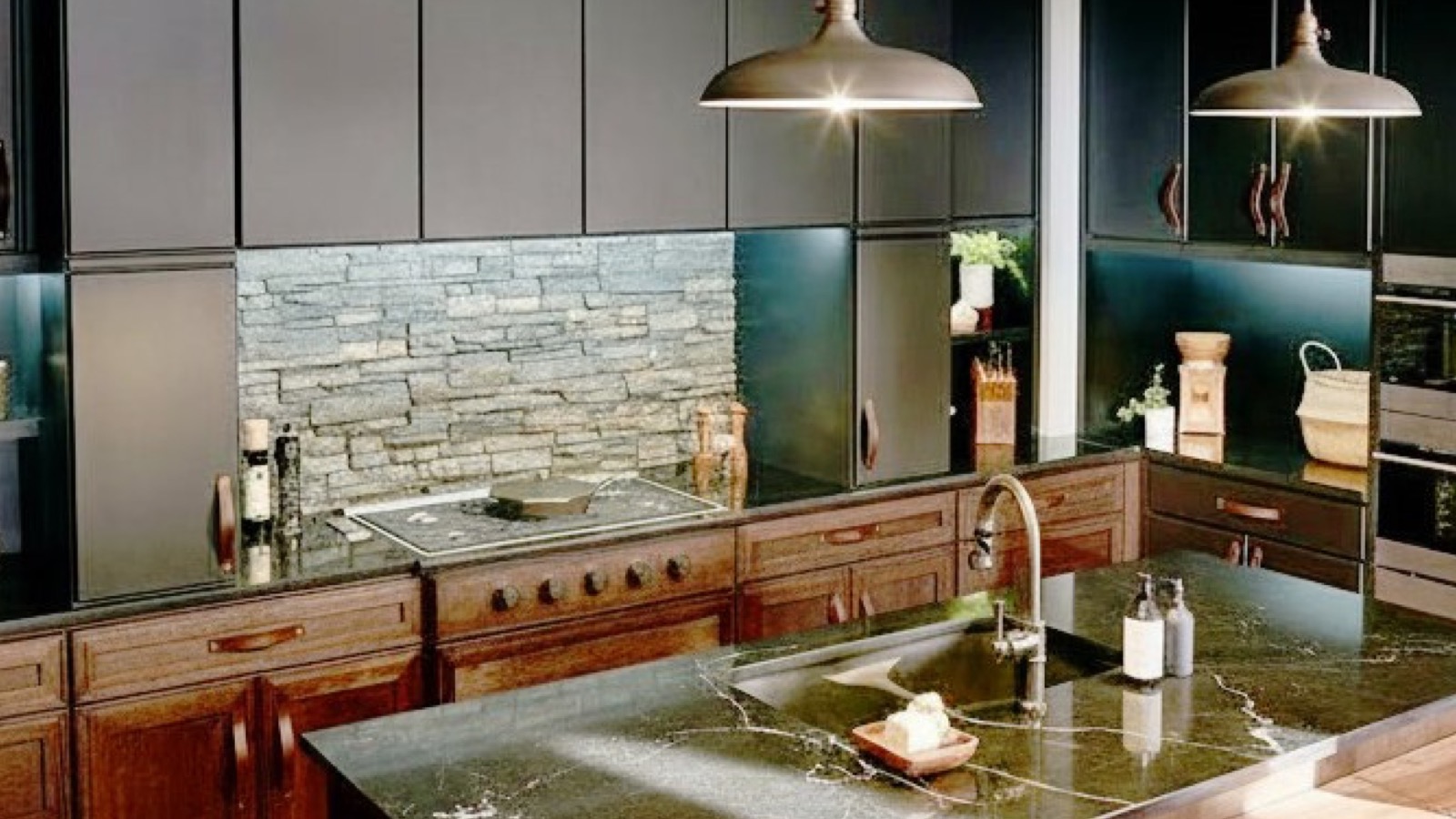
Solid walnut kitchen with polished veined marble worktop and natural stone feature wall
Solid walnut kitchen with polished veined marble worktop and natural stone feature wall — photograph of a Michelessi project.

The block — a Michelessi vision

From the block,
blow after blow

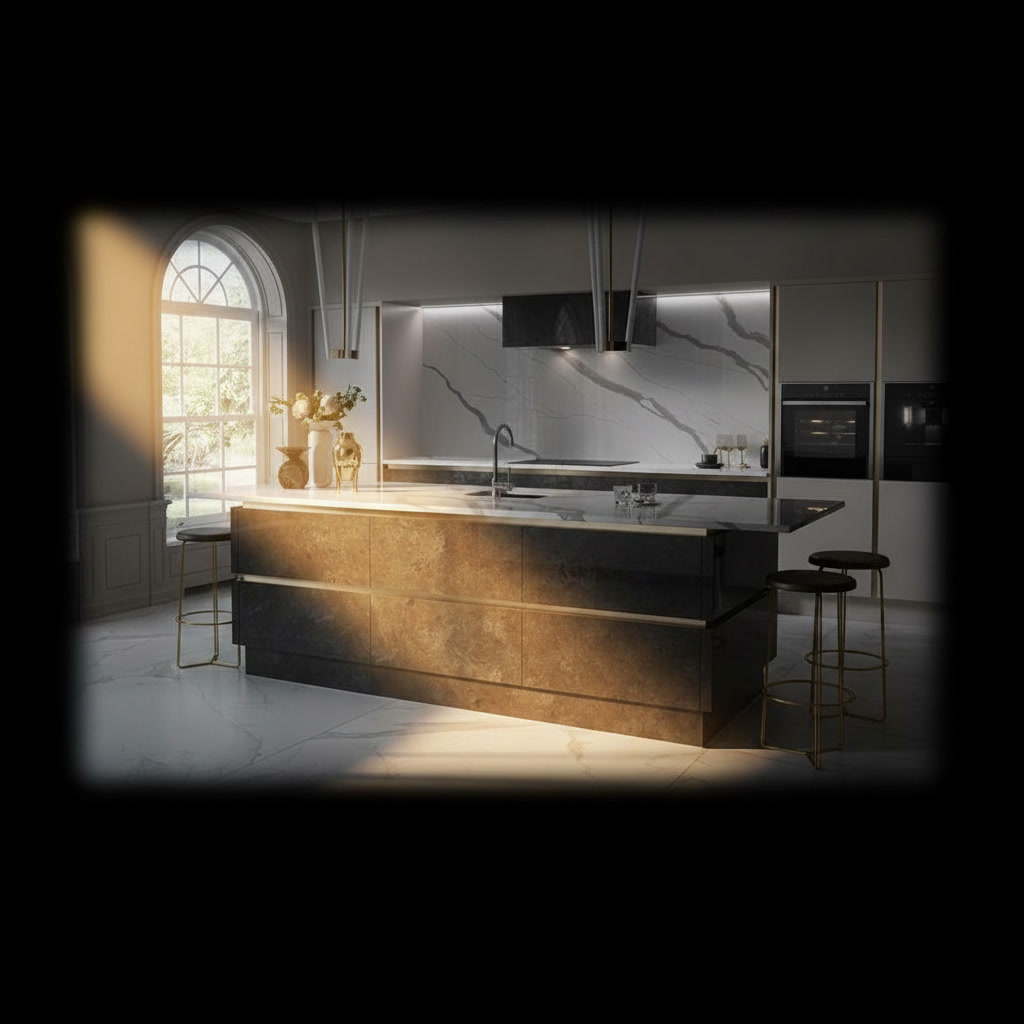
01 A raw block of Calacatta Viola waits under the spotlight, in the dark kitchen with brass profiles. Mallet and chisel are already on the floor: the island is still all inside the stone.

02 Blow after blow the faces are squared, chips fly, white dust rises into the light. The chisel scores the drawers, opens the recess for the hob, carves the sink: the shape of the island comes out of the block slowly, without haste.

03 Then the stone is honed and polished: the purple vein catches the light, brass edges close the drawers, the black hob sinks into its recess, the gold tap finds its place. The island remains, and a veil of dust on the floor.

Keep scrolling — the scene follows you

Bespoke walnut kitchen: what it is and who builds it

A walnut kitchen is a kitchen with doors and cladding in walnut, with a strong grain and a colour that runs from light brown to chocolate. There are two species: noce nazionale, common walnut (Juglans regia), and noce canaletto, American black walnut (Juglans nigra). It is built by Michelessi SRL, in Aprilia between Rome and Latina, and installed throughout Italy.

We do not sell the worktop alone: we design and build the whole kitchen to measure, with solid walnut doors and a worktop in marble, stone or porcelain stoneware. Michelessi has worked stone since 1976: the wood and the stone are born in the same project, with the same drawing and the same installation. Anyone looking for a walnut kitchen has three choices to make: which walnut, modern or classic, with which worktop. You will find them here, inside the made-to-measure wooden kitchens section.

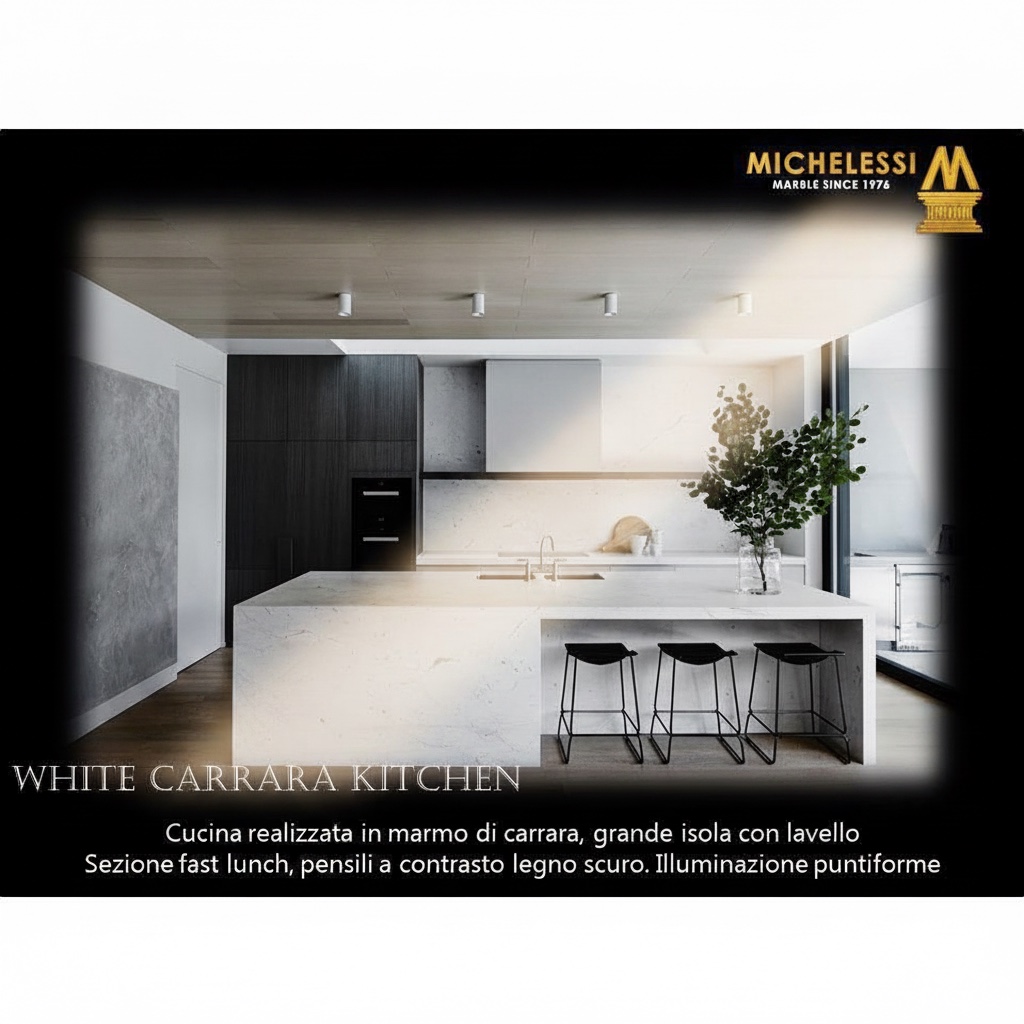
Carrara marble kitchen with large island, fast-lunch section and dark wood columns

White Carrara Kitchen

A stone-effect wall forms the neutral backdrop, and track spotlights rain pointed light onto the protagonist: the great Carrara marble island, with its integrated sink and the fast-lunch section where three black stools line up in good order. The stone descends along the sides and draws a compact, luminous volume, crossed by discreet veins; behind, dark wood columns create the contrast that gives the whole scene its depth, while a potted tree brings a note of living green. It is the formula of the well-tempered contemporary: white and dark, stone and wood, technical light and ancient matter. Carrara marble, cut to measure, holds the centre of the composition with the ease of a champion. Michelessi attends to every step — slab selection, cuts, recesses, finish — with the rigour of Italian craftsmanship: because an island like this is the heart of the home, and the heart admits no approximation.
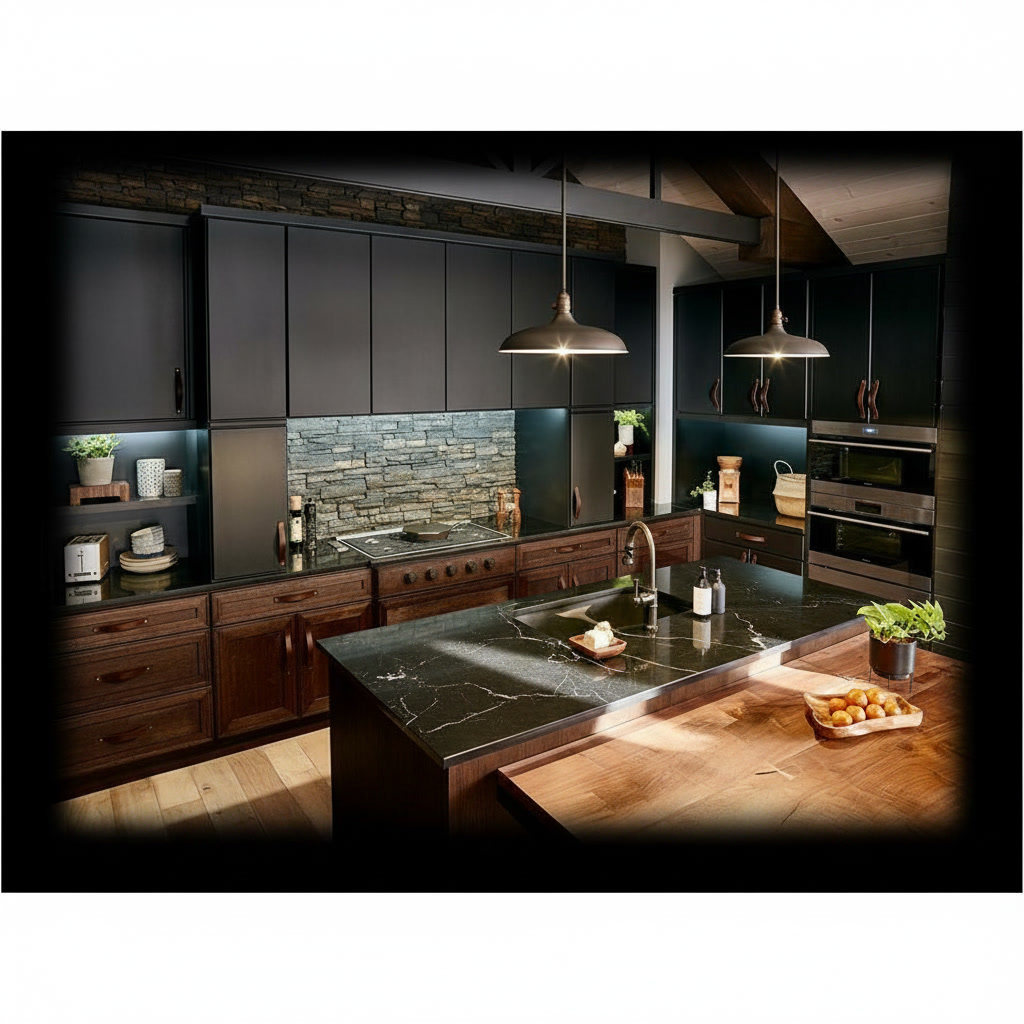
Solid walnut kitchen with polished veined marble worktop and natural stone feature wall

Solid walnut kitchen with polished veined marble worktop and natural stone feature wall

The atmosphere is that of a luxury refuge: solid walnut doors, precisely framed, run beneath the band of exposed natural stone cladding the cooking wall, lit from under the wall units; black volumes of cabinets and columns close the composition above, and copper lamps descend over the island. The polished veined marble top — dark, deep, mirroring — crowns the island with its adjoining solid wood table, where bread and boards await the evening. Complete with appliances, this is a kitchen of true materials taken to their highest degree: wood, stone, marble, copper — no imitation anywhere. Such pairings demand a sure director: tones, textures and reflections must be dosed for the whole to stay harmonious. This is the maturity of Michelessi indoor kitchens: bespoke, with Italian craftsmanship in marble and solid wood alike — and an atmosphere that, once lived, is never forgotten. True materials down to the last detail: the only scenery that is never struck.

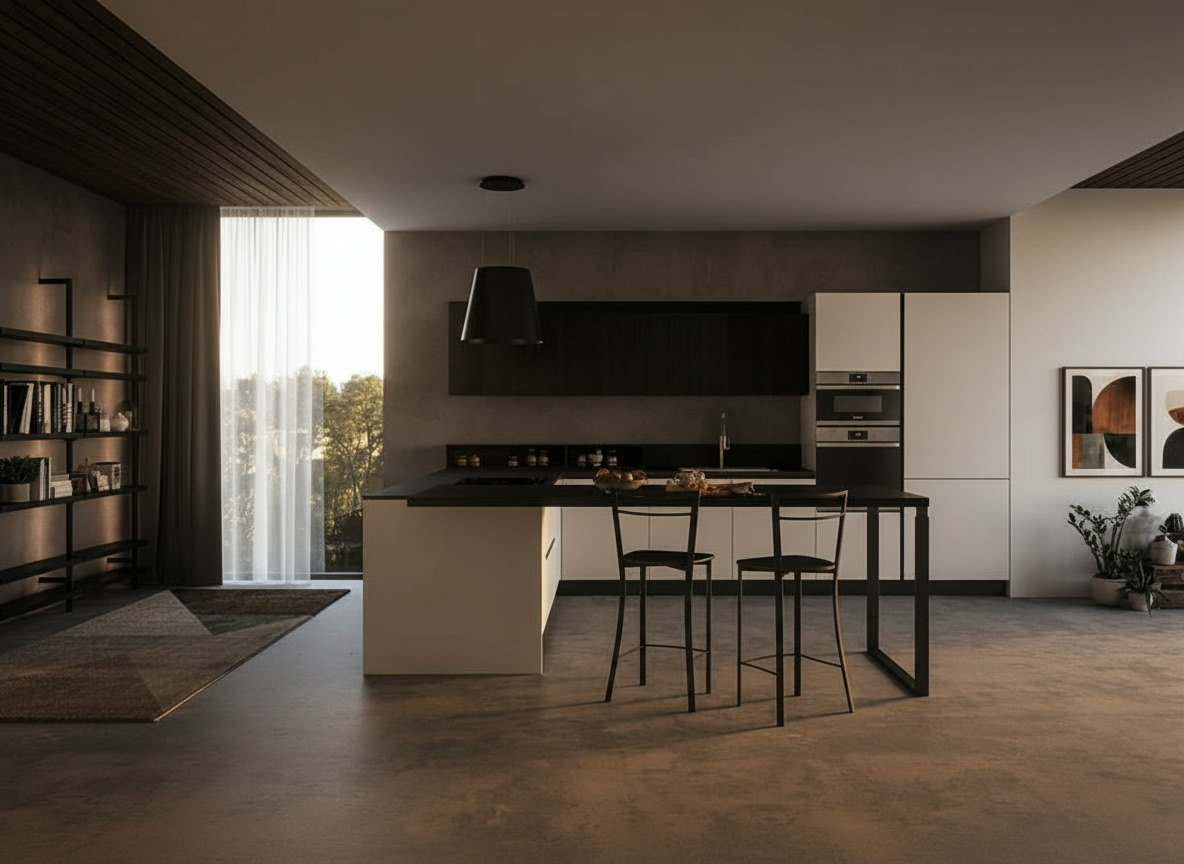
Modern black and white kitchen with dark wood wall units, black hood and metal table

Black and White with an Inlay of Dark Wood

The stone-effect wall stands as a neutral ground and lets the volumes speak: the white peninsula with its thin black worktop, dark wood wall units aligned beneath the black hood, white columns with built-in ovens. To one side, the black metal bookcase carries its light shelves, and the black-framed table with slender chairs draws the dining area on the grey floor. A composition in black and white, warmed by wood and measured like an architectural photograph. It is the graphic register of contemporary design, living on exact proportions and well-chosen surfaces. Michelessi indoor kitchens interpret it to measure: every contrast is dosed with the right materials — matte laminates, dark wood species, technical worktops, up to marble worked in the tradition of Italian craftsmanship — so that the result stays sharp without turning cold. The home, in the end, is grateful: with order, light and character.

Masonry kitchen corner with built-in oven, gas hob and solid walnut doors

The Corner of Fire, Sculpted in Masonry

The corner is the heart of this masonry kitchen: the great white-plastered hood descends like a sail above the fire zone, where the oven sets into the pale stone with its mouth ready to warm; to one side, the second black oven awaits its turn, and the gas hob gleams on the other arm of the travertine counter. Below, solid walnut doors with worked frames close the masonry compartments, while the glazed terracotta floor returns the room's warm light. This is the domestic architecture of the hearth, updated with intelligence: masonry for solidity and memory, travertine for generous, tireless counters, wood to warm the gaze and the hands. Building such a corner requires a dialogue of several trades — mason, marble-worker, cabinetmaker — orchestrated by Michelessi's bespoke practice: kitchens still built the old way, to outlast any fashion.

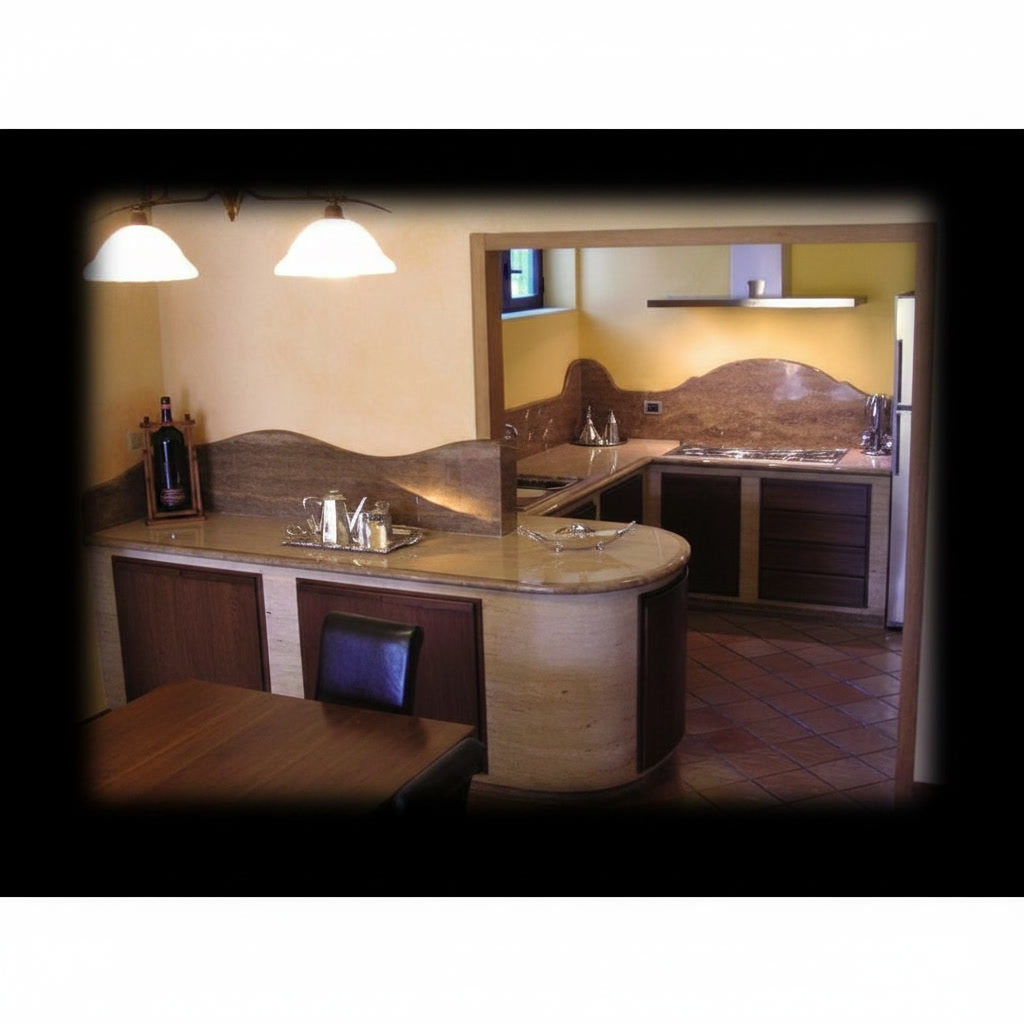
Finished Letizia masonry kitchen with Roman travertine counters, shaped upstand and walnut doors

Letizia Complete: Roman Travertine and Solid Walnut

And here she is, finished: the Letizia kitchen lights its pendant lamps above the curved counter and reveals the result of the journey — Roman travertine counters edged in Noce travertine, the shaped upstand undulating along the walls, solid walnut doors set into the masonry. The hob and stainless steel hood, the sink and built-in dishwasher work within the construction without disturbing its harmony; the peninsula gathers its stools, ready for breakfast. Whoever saw the empty room and the worksite knows what stands behind this image: measurements, blocks of stone, expert hands, days of work done with bent back and attentive eye. It is the complete arc of the bespoke: from bare space to family kitchen, built to last for generations. Michelessi signs it with its own travertine work and the Italian craftsmanship of always: because kitchens that bear a woman's name, like Letizia, carry within them the story of those who wanted them and those who built them.

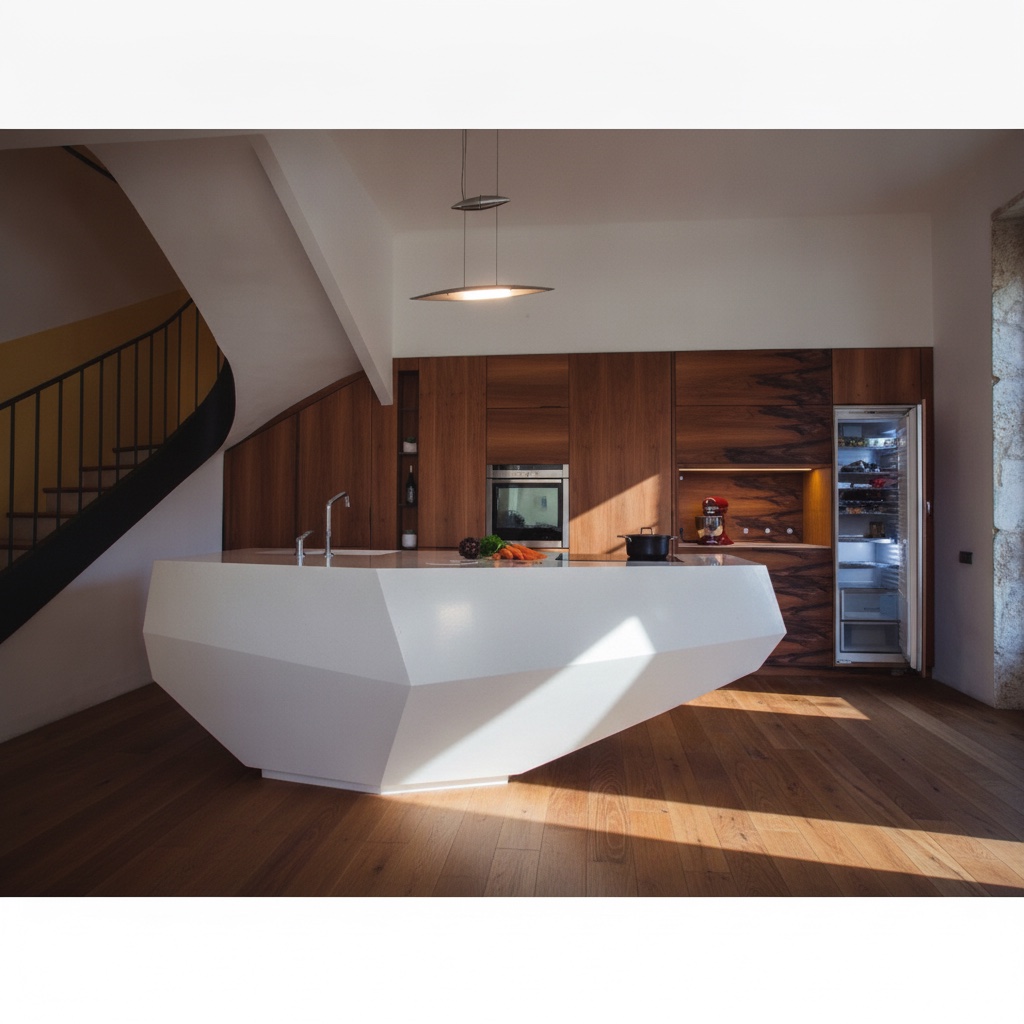
Solid wood kitchen with faceted white central island with integrated sink

Solid wood kitchen with faceted white central island with integrated sink

The island looks folded by giant hands: a white volume, faceted like origami, tilts its planes towards the floor and carries on its surface an integrated sink with a slender mixer. Around it, solid wood boiserie with walnut grain dresses the fitted wall — appliances built in, the refrigerator open in a gesture of daily life — while a black spiral staircase turns its sculpture at the back. A suspended lamp draws a circle of light over the island. This is the meeting of joinery and geometry: wood that reassures, white that dares. A faceted island puts every joint to the test, because tilted planes forgive nothing: they demand exact cuts and millimetre-perfect assembly. It is the field where true made-to-measure distinguishes itself — Michelessi indoor kitchens, with Italian craftsmanship that can build even the forms that look impossible, and make them work every day.

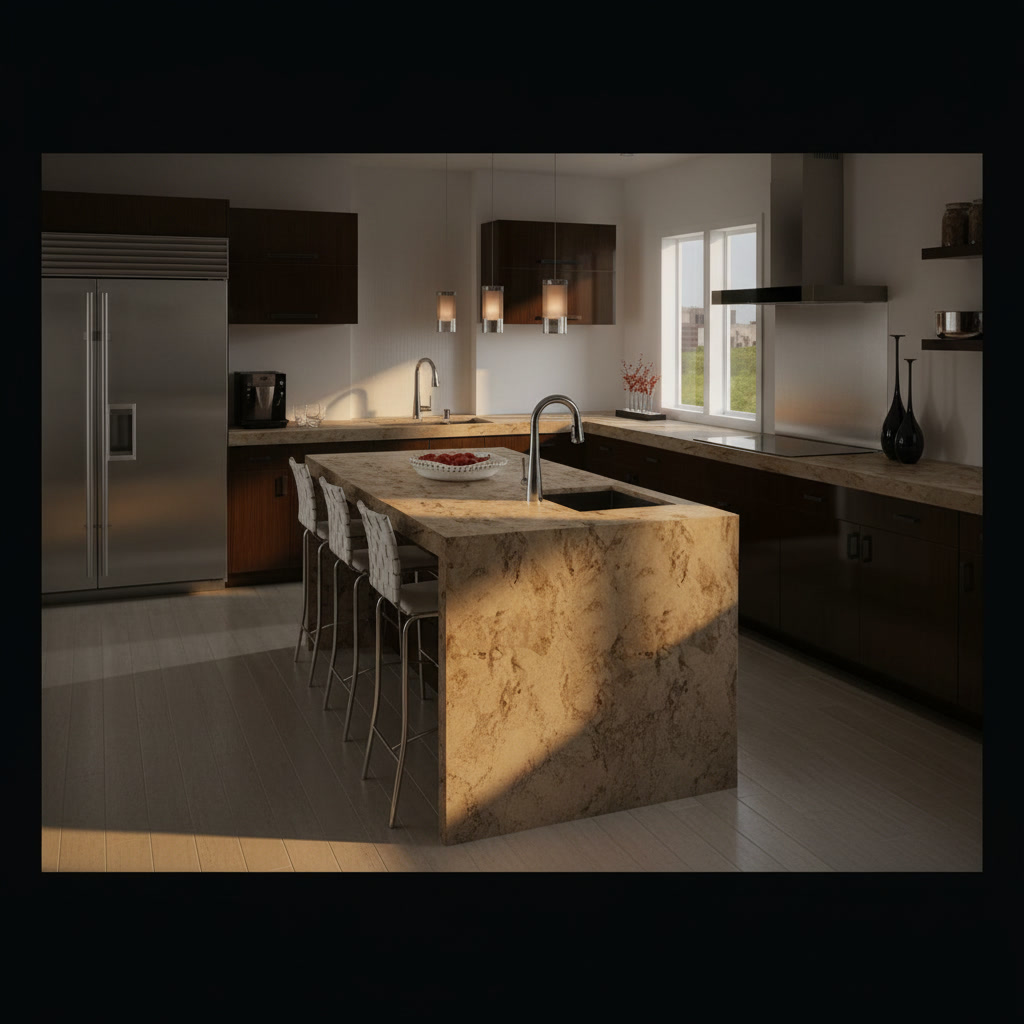
Kitchen with dark wood cabinets, top and central island in pale spotted marble

Spotted Marble Top

The dark wood of the cabinets forms a deep backdrop, and the spotted marble illuminates the scene: the top runs along the wall and returns on the central island, where the pale stone, flecked with umber and grey markings like a natural pelt, cascades down the sides. Slender white stools face the counter; the steel refrigerator and the sink with its mixer complete the working zone, while the window at the back lets a thread of daylight into the gathered atmosphere. Spotted marble is a stone with a rhythm of its own: its mottled pattern must be followed, distributed with balance between top and sides so the result appears spontaneous — and spontaneity, in these cases, is the fruit of calculation. Michelessi's bespoke work orchestrates the slabs with the eye of Italian craftsmanship: and the contrast with the dark wood, in the end, makes both materials sing. A warm, serious kitchen, with a flash of the wild.

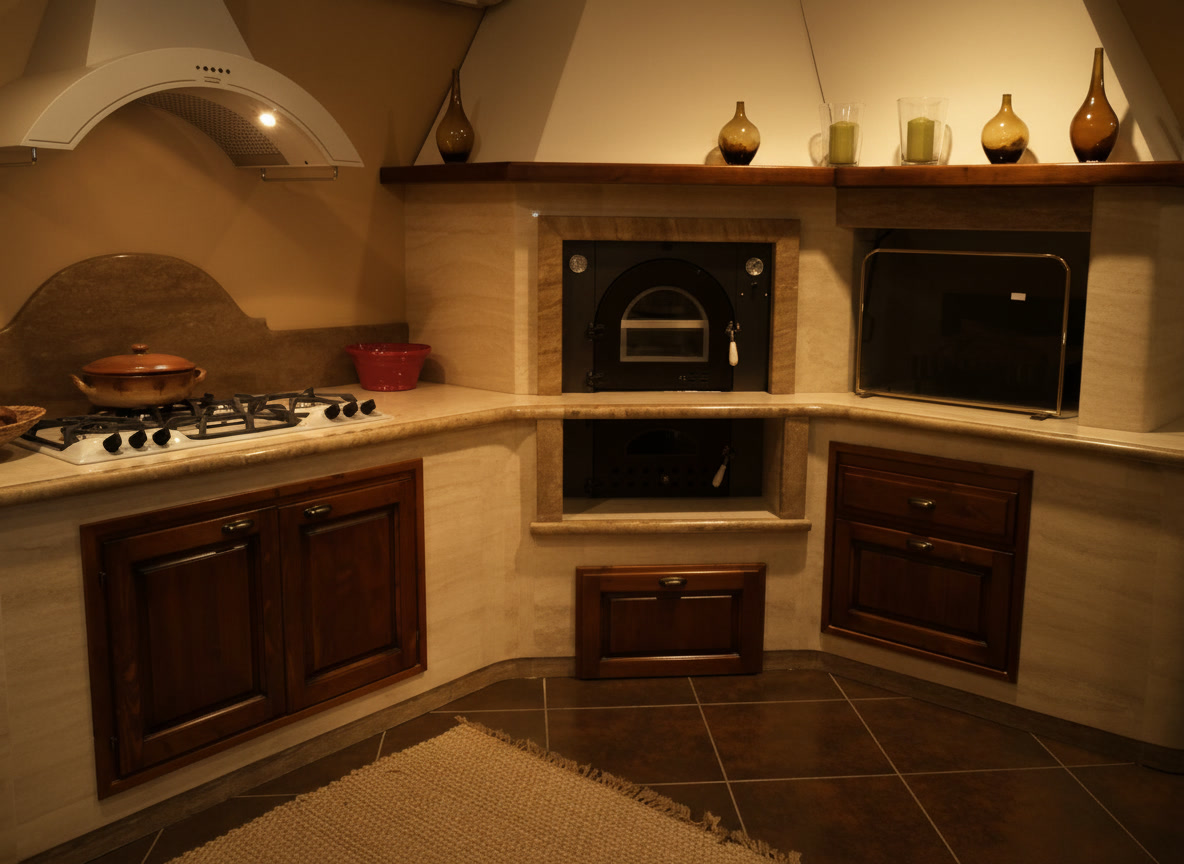
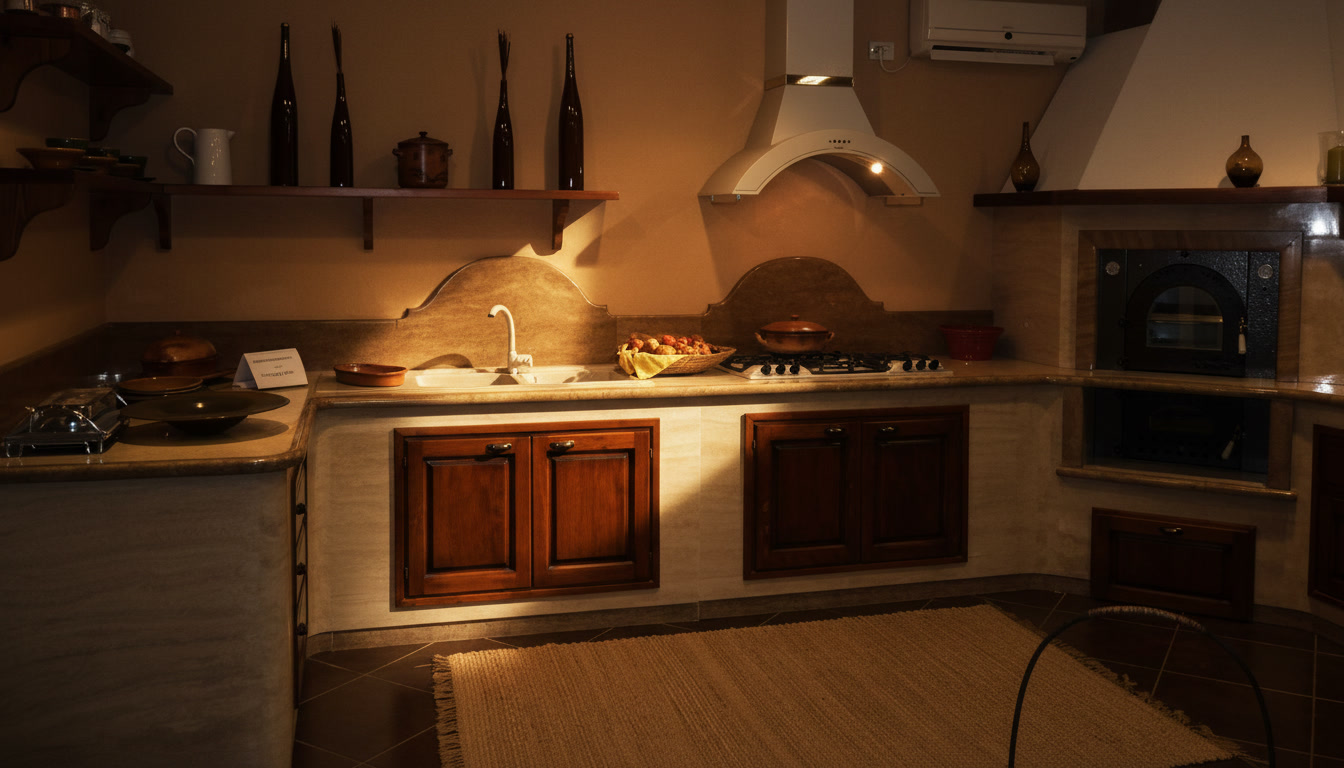
Masonry kitchen with wooden shelf, gas hob and stone oven corner

The Plate Shelf Above the Burners

The dark wooden shelf crosses the wall carrying ceramic plates and kitchen woods, hung and leaned as in a family workshop; below, the travertine counter hosts the sink and the battery of gas burners, while in the corner the stone structure of the oven advances with its generous presence. Solid walnut doors, framed in pale masonry, punctuate the base; a woven mat softens the terracotta underfoot. This is the daily life of a well-lived masonry kitchen: everything within reach, everything solid, everything true. Here the stonework serves practicality — continuous counters, corners put to work, surfaces that bear pans and years — without renouncing the grace of the finishes. It is the way of building that Michelessi defends in its bespoke work: kitchens conceived for real cooking, where beauty is not ornament but domestic substance, resting on travertine and walnut.

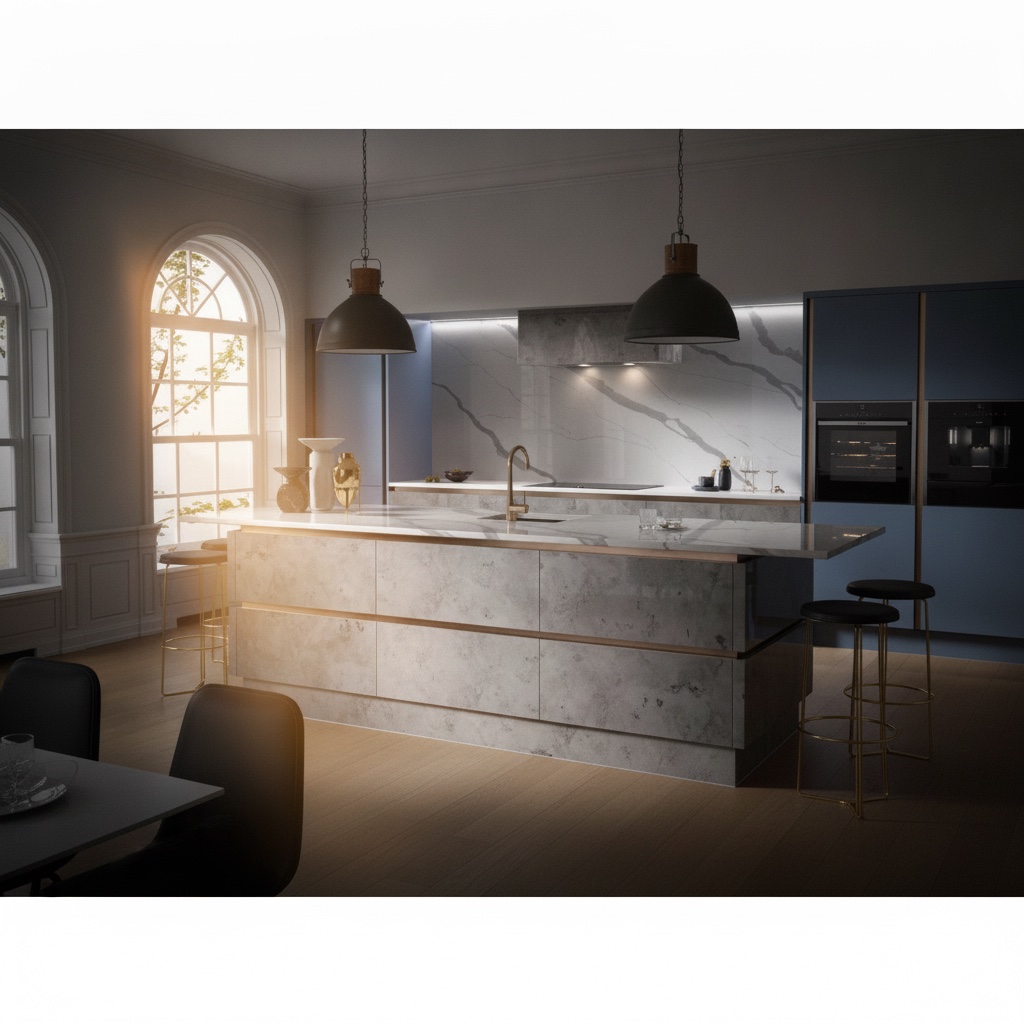
Stoneware-clad kitchen with island, integrated sink, induction hob, hood and oven

Stoneware-clad kitchen with island, integrated sink, induction hob, hood and oven

The island presents itself in its pale stone-effect stoneware dress, crossed by slender inserts that mark out its drawers; above, the top integrates sink and induction hob in a single working surface, served by burnished taps. Behind, a marble-effect stoneware wall rises beyond the cooking zone, while powder-blue columns — with black ovens recessed — add the colour that gentles the whole scene. Dark bell lamps, stools at the counter, tall windows of a stately apartment: the ensemble has an urban, serene elegance. A wooden structure clad in stoneware is a sound formula: the constructive warmth of wood, the resistance of ceramic at the surface. With hood and oven completing the equipment, it is an indoor kitchen ready for real life: Michelessi builds it to measure, attending to joints, recesses and tonal pairings with an artisan's care. The powder blue, then, is the touch that lingers in the eye.

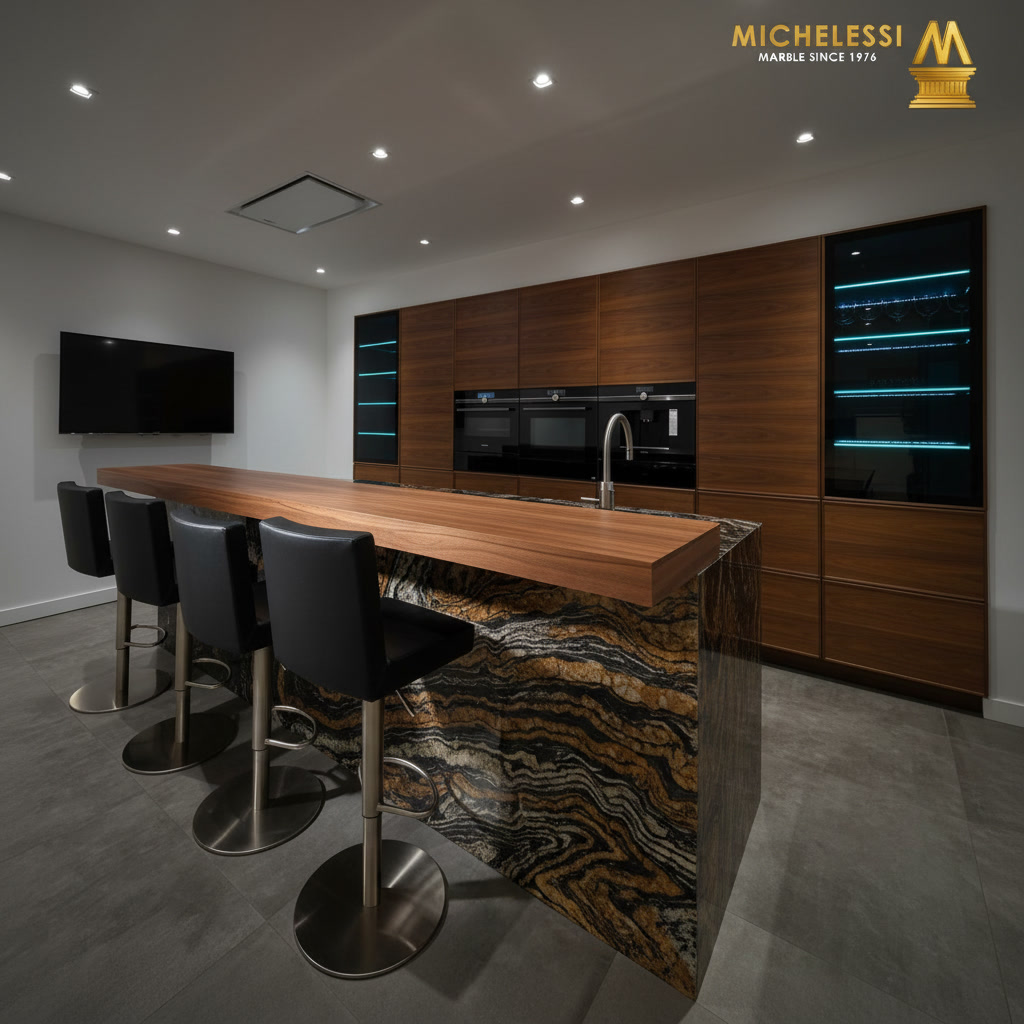
Central quartzite island with spectacular veining, wooden counter and black stools

Central quartzite island with spectacular veining, wooden counter and black stools

The island is a fire made stone: quartzite with amber and black veining blazes along the flanks in its impetuous figuring, polished until it mirrors the room; above, a solid wood counter lays down its warm board and gathers black swivel stools. The sink sits flush in the top; behind, walnut boiserie conceals and reveals — black ovens, backlit vitrines of bottles, a recessed television. A pale floor leaves the whole stage to the material. This is the project for those who want a collector's stone at the heart of the home: quartzite, with its unrepeatable figure, is not chosen from a catalogue — it is encountered, slab by slab. Bespoke stonework orchestrates its veining across top and flanks, with cuts and joints that honour the natural movement. This is the art of Michelessi: craftsmanship that knows when a stone deserves the stage, and builds one around it.

Kitchen with island clad in grey porcelain stoneware with golden profiles and marble wall

Kitchen with island clad in grey porcelain stoneware with golden profiles and marble wall

Arched windows and a wall of veined marble effect give the room the breath of a palazzo; at the centre, the island clad in stone-grey porcelain dresses itself in golden profiles — fine lines running along the volumes like threads of light — and carries the integrated sink with its gold tapware. Stools with gilded details complete the register, together with dark columns housing the built-in ovens. Fully equipped, this is a kitchen that plays the luxury card openly: technical materials treated like jewels, measured reflections, a curated scenography. The porcelain stoneware bears the practical side with its tireless surface; the gold does its own work, which is to shine. Made-to-measure holds it all in balance: proportions, alignments, cut-outs. This is the glamorous face of Michelessi indoor kitchens: artisan craftsmanship that knows how to be sober when needed — and magnificent when the project asks. The gold here is not ostentation: it is a line of light drawn with a ruler.

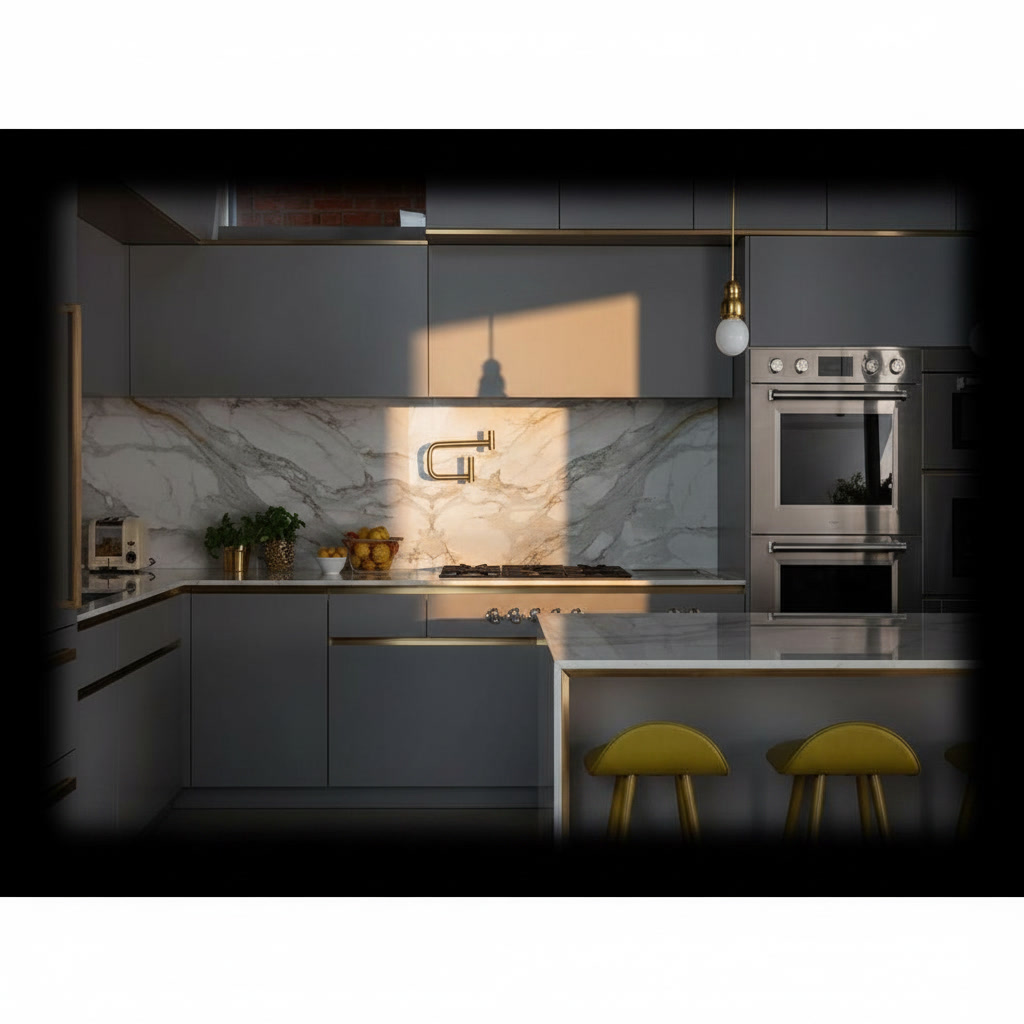
Classic grey kitchen with veined travertine top, oven, sink and yellow stools

Classic grey kitchen with veined travertine top, oven, sink and yellow stools

The lines are elegant and the colour knows it: uniform grey doors, crossed by golden profiles that draw the handles and frames, meet a veined travertine counter — pale stone with a moving figure that also clads the wall behind the burners, as one single mineral gesture. Twin ovens sit in their column, the sink works beneath a suspended brass bulb, and yellow stools light the counter with their note of sun. Complete with oven, sink and range, this is a classic kitchen of contemporary proportions: few elements, all of them right. Veined travertine is the silent protagonist: Roman stone, warm and luminous, worked to measure in counters and cladding with the care its history deserves. This is the Michelessi métier: craftsmanship that sets gold against stone without ever sliding into excess — because true elegance is known by its restraint. The yellow stools confirm it: elegance, now and then, also knows how to smile.

Walnut kitchen: common walnut or American black walnut (canaletto)?

Common walnut and canaletto are not the same wood. The first is Juglans regia; canaletto, the Italian trade name, is Juglans nigra, American black walnut. Colour, behaviour over time and hardness all differ. The data come from The Wood Database and the American Hardwood Export Council.

WhatCommon walnut (nazionale)American black walnut (canaletto)
SpeciesJuglans regiaJuglans nigra
ColourFrom light brown to chocolate, with dark streaks; sometimes grey, purple or red tonesHeartwood from light brown to dark chocolate, sometimes purplish; creamy white sapwood
Janka hardness1,220 lbf (5,410 N)1,010 lbf (4,490 N)
Natural durabilityModerately durableVery durable
Worth knowingA strong, irregular grain, recognisable at a glanceLightens with time

The Janka scale measures the force needed to drive a steel ball halfway into wood: the higher the number, the harder the wood. For comparison, European oak is 1,120 lbf: common walnut is a little harder, canaletto a little softer. In an indoor kitchen natural durability (resistance to rot and insects) matters little; colour, grain and finish matter.

To choose, look at a sample of each species in the light of your own room: the tone changes with the finish and from one board to the next. Always ask for the botanical species to be written on the quote: "walnut" in the name of a finish may mean the wood, only the veneer, or only the colour. For those weighing walnut against oak, there is the page oak kitchen; the other woods are on chestnut, ash, cherry and fir.

Solid walnut, blockboard or walnut-effect kitchen

A solid walnut kitchen is one in which walnut runs through the full thickness of the parts, even when each part is made of several strips of the same species glued together. In the trade, however, the word "walnut" stretches: it helps to know four different constructions.

ConstructionWhat it isReal walnut?Can the surface be redone?
Solid woodWalnut through the full thicknessYes, throughoutYes: it is sanded and refinished
Blockboard faced in walnutA core of solid timber strips, covered with walnut sheetsYes, on the surfaceOnly within the thickness of the facing layer
Veneer on a panelA thin sheet of walnut glued to chipboard, MDF or plywoodYes, on the surfaceOnly within the thickness of the facing layer
Walnut-effect (melamine, laminate)Paper printed with the grain, on resinNo: it is an imitationNo, it cannot be sanded

"Melamine walnut" and "walnut-effect" mean a panel that imitates wood: it is easy to clean and costs less, but it is not walnut. A modern walnut-effect kitchen can be a legitimate choice if the look is what you want; the quote just has to say which construction and which species.

Solid wood is not necessarily more stable: with strong swings in humidity it deforms more, and a framed door with a panel is one way of controlling the movement of the wood. To recognise a real walnut door the sure proof is the construction section of the door, written on the quote; the checks by eye and the differences between constructions are on the pages solid wood kitchen and real wood or wood-effect kitchen.

Modern walnut kitchen: flat doors, stone worktop, visible grain

The modern walnut kitchen has flat, frameless doors, recessed grips or inset profiles, and leaves the grain on show. The design is essential: few elements, a continuous stone worktop, steel appliances framed by the wood. Three arrangements:

  • A fitted wall of walnut: tall units and wall units in walnut rising to the ceiling, with oven, fridge and pantry built in. Trade magazines cite canaletto for wardrobes and panelling.
  • An island with a marble worktop: the marble top sits on walnut bases or, the other way round, the bases are pale stone and the top is darker wood. These are the two solutions designers propose for islands; for the marble island, monolithic or waterfall, there is the page on the marble kitchen island.
  • Walnut with greys and blacks: among published examples is a wall in canaletto walnut with an island with a grey marble snack top and black tall units.

Handles, hinges and opening systems are on the page doors, hinges and finishes; the starting layouts are in the kitchen layouts to start from. Walnut also sits well in kitchens built in the masonry style, in refractory stone blocks with wooden doors: see the page masonry and wood kitchen.

Classic walnut kitchen: framed doors, mouldings, marble worktop

The classic walnut kitchen has framed or moulded doors, with a frame and a central panel, shaped profiles, cornices and plinths. Walnut and cherry are the species that go with this style. We design it for the room, not from a catalogue of modules.

The classic worktop is marble with a shaped edge. With light walnut, beige and cream marbles work well, such as Botticino and travertine; with dark walnut, Nero Marquina, a Spanish marble, gives a firm contrast. Anyone who wants a classic kitchen with a more rustic character will find beams, stone and wood on the page country and rustic wooden kitchen.

Light or dark walnut kitchen: how the colour changes

The tone of the walnut is chosen with the sample, the light in the room and the finish (oil, wax or varnish). Two designers' rules help to decide.

  • Light walnut: with beige or cream marbles it makes a tone-on-tone pairing, warm and bright.
  • Dark walnut: with a black marble worktop it makes a sharp contrast. If the worktop is wood, the dark tone hides scratches and stains better than the light one.

White, black, beige and green have a page of their own: light or dark wood kitchen, colours and pairings.

Walnut with marble, stone or steel: the pairings

Walnut and marble go well together because they are opposites: marble is cold to the touch and glossy, wood is warm and matt. Marble brings the light, walnut warms it. Michelessi works both in the same project, and the table sums up the most common pairs.

WalnutWorktopEffect
LightBotticino, travertine, beige and cream marblesTone on tone, warm and bright
DarkNero Marquina (Spanish marble)A sharp contrast
Light or darkCalacatta, Statuario, CarraraWhite brightens the kitchen, walnut warms it
AnyGranite, quartzite, Dekton, LaminamWorktops that are less sensitive to acids and hot pans

Marble withstands moderate heat and is sensitive to acids, such as lemon and vinegar: it should be dried at once, and boiling-hot pans should go on a trivet. Those who cook a great deal often choose granite, quartzite or a sintered stone such as Dekton, or Laminam porcelain stoneware in 12 mm slabs. Steel comes in with the oven, induction hob, extractor and sink and, if you wish, with satin steel worktops and splashbacks. More pairings are on the page wood and marble, stone or steel kitchen and in marble and wood kitchen.

How much does a walnut kitchen cost, classic or modern?

A walnut kitchen costs more than a kitchen that imitates walnut: trade guides place solid wood among the most expensive solutions and laminate among the cheapest. We do not publish price lists: what counts is construction, species (common or canaletto) and selection, finish, door, measurements, hardware, worktop and appliances. The factors are explained on the page how much does a wooden kitchen cost; the quote and the 3D design are free wherever you are.

How to clean and renew a walnut kitchen

A walnut kitchen is cleaned with a soft, barely damp cloth, with no abrasive cleaners, and dried at once. The finish matters more than the species: varnished wood needs gentle cleaners, oiled wood is refreshed with oil or wax. To renew, solid walnut is sanded and refinished, veneer only within the thickness of the walnut layer. Oil, grease and the zones to protect are on the page solid wood kitchen.

Walnut in the kitchen: strengths and limits

Walnut gives the kitchen a recognisable grain and a warm tone; the points to watch are cost, water and heat.

  • Strengths: the strong grain; the warm colour; a Janka hardness of 1,220 lbf for common walnut, against 320-380 lbf for the firs and spruces, soft woods that mark more easily; solid wood can be sanded and refinished.
  • Limits: it costs more than the materials that imitate it; it dislikes standing water; canaletto changes tone with time.
  • Near the hob and the oven: trade sources give different guidance on heat, and safety distances depend on the appliance's instructions. That is why it makes sense to put stone near the hob and the oven, and wood where the kitchen opens: doors, tall units, shelves.

A walnut outdoor kitchen?

This page deals with walnut in an indoor kitchen. Outdoors, in an uncovered kitchen, wood is exposed to rain, sun and damp, and woods of declared durability for outdoor use are chosen, such as teak and iroko, or modified woods such as thermally modified timber. The page outdoor wooden kitchen covers them; Michelessi outdoor kitchens are under outdoor kitchens.

From the site survey to installation

The path is the same as for every Michelessi kitchen: a free site survey in Lazio (outside Lazio, your measurements and photographs with a guided remote survey; the slabs can also be viewed by video call), a free 3D design everywhere, in which the species, the finish and the tone of the walnut are decided, installation by our own team throughout Italy. The steps, one by one, are on the page made-to-measure wooden kitchens.

To go further: questions and answers, indoor kitchens and modular marble kitchens.

The quote is free: request it here.

Frequently asked questions

Frequently asked questions

What is the difference between common walnut and canaletto walnut?

They are two different species. Common walnut (noce nazionale) is Juglans regia, from light brown to chocolate with dark streaks; canaletto is Juglans nigra, American black walnut, from light brown to dark chocolate, and it lightens with time. Janka hardness is 1,220 lbf for common walnut and 1,010 for canaletto. It is worth comparing the samples in the light of your own room.

Can a walnut kitchen be modern?

Yes. The modern style comes from the design, not the wood: flat, frameless doors, recessed grips or inset profiles, visible grain, a continuous worktop in marble, stone or porcelain stoneware. Dark walnut with a black marble worktop is a pairing that designers publish. Michelessi designs and builds it to measure, in Aprilia, and installs it throughout Italy.

Is walnut right for a classic kitchen?

Yes: walnut and cherry are the species that go with the classic style. The door is framed or moulded, with a frame and a central panel. The worktop is beige or cream marble, such as Botticino or travertine, if the walnut is light; Nero Marquina, a Spanish marble, if it is dark. The kitchen is designed to measure, on the real heights of the room.

How much does a walnut kitchen cost?

No price applies to every kitchen, and Michelessi does not publish price lists. The cost depends on the construction (solid wood, blockboard or veneer), the species, the finish, the type of door, the linear metres, the hardware, the worktop, the appliances and any special work. Solid walnut is among the most expensive solutions. The quote and 3D design are free anywhere; the site survey is free in Lazio.

Which worktop goes with a walnut kitchen?

With light walnut, beige and cream marbles such as Botticino and travertine work well; with dark walnut, Nero Marquina, a Spanish marble, gives a sharp contrast. Calacatta, Statuario and Carrara brighten the kitchen. For heavy use, granite, quartzite, Dekton and Laminam are less sensitive to acids and hot pans, while marble withstands moderate heat.

How do you clean a walnut kitchen?

The finish matters more than the species. Use a soft, barely damp cloth, with no abrasive cleaners, and dry at once; liquids are dabbed up, not spread. Varnished wood needs a gentle cleaner; oiled or waxed wood is refreshed with oil or wax. Fresh grease comes off with kitchen paper and a paste of bicarbonate of soda and water, then a damp cloth.

How often should a walnut kitchen be oiled?

It depends on use and product: the guidance from manufacturers of wooden kitchens ranges from every six months to every two years. If the cycle is neglected, oiled wood stains. Scratches and small dents are sanded and treated again with oil. Varnished wood is not re-oiled, but a deep scratch is hard to touch up and may mean revarnishing the whole surface.

How do you renew a walnut kitchen?

Solid oiled walnut is sanded and oiled again; varnished wood is sanded and revarnished all over. Veneer can be sanded only within the thickness of the walnut layer, which is thin. That is why it is worth asking in advance for the construction section of the door and having the quote say whether it is solid wood, blockboard or veneer.

Walnut kitchen or walnut-effect kitchen: what is the difference?

A walnut kitchen uses walnut wood, solid or as the facing of a panel. A walnut-effect kitchen, or melamine walnut, has a panel faced with printed paper and resin: it imitates the grain, is easy to clean and costs less, but it is not walnut and cannot be sanded. Ask the quote to state the species and the construction of the door.

How can I tell whether a door is real walnut?

Look at the edges: if a thin line runs from one corner to the other, the door is not solid wood; the grain on the outer face should match the grain on the back. That is not enough, because well-matched veneer can look like a single board: the sure proof is the construction section of the door and the botanical species written on the quote.

Can you have a walnut outdoor kitchen?

Walnut is meant for the indoor kitchen. Outdoors, in an uncovered kitchen, the wood is exposed to rain, sun and damp, and woods of declared durability for outdoor use are chosen, such as teak and iroko, or modified woods such as thermally modified timber. Michelessi builds outdoor kitchens with a structure of dry-laid refractory stone blocks, of steel or of treated wood.

Call us WhatsApp