Skip to content
Made in Italy

Since 1976 — Wooden kitchens

Wood Effect Kitchen or Real Wood: Solid, Veneer, Laminate

WOOD · STEEL · MARBLE · STONEWARE

In short

Veined travertine island with leather stools, grey kitchen with sink, induction and oven
Veined travertine island with leather stools, grey kitchen with sink, induction and oven — photograph of a Michelessi project.

The block — a Michelessi vision

From the block,
blow after blow

01 A raw block of Calacatta Viola waits under the spotlight, in the dark kitchen with brass profiles. Mallet and chisel are already on the floor: the island is still all inside the stone.

02 Blow after blow the faces are squared, chips fly, white dust rises into the light. The chisel scores the drawers, opens the recess for the hob, carves the sink: the shape of the island comes out of the block slowly, without haste.

03 Then the stone is honed and polished: the purple vein catches the light, brass edges close the drawers, the black hob sinks into its recess, the gold tap finds its place. The island remains, and a veil of dust on the floor.

Keep scrolling — the scene follows you

Real wood or wood effect kitchen: the difference in brief

A real wood kitchen has visible surfaces made of wood; a wood effect (or fake wood) kitchen has a surface that only reproduces its pattern. Real wood can be solid, meaning the same species throughout the thickness of the piece, or veneered, meaning a thin sheet of wood glued to a base. Wood effect is a print: laminate, melamine-faced board or porcelain stoneware with a wood-look decoration.

Who builds it: Michelessi SRL, stone masons in Aprilia, between Rome and Latina, since 1976. We design and build our wooden kitchens to measure, with solid wood doors and carcasses in solid wood or blockboard, and install them with our own team throughout Italy. Here each material is described with its strengths and its limits. The overview of the whole department is on the page made-to-measure wooden kitchens.

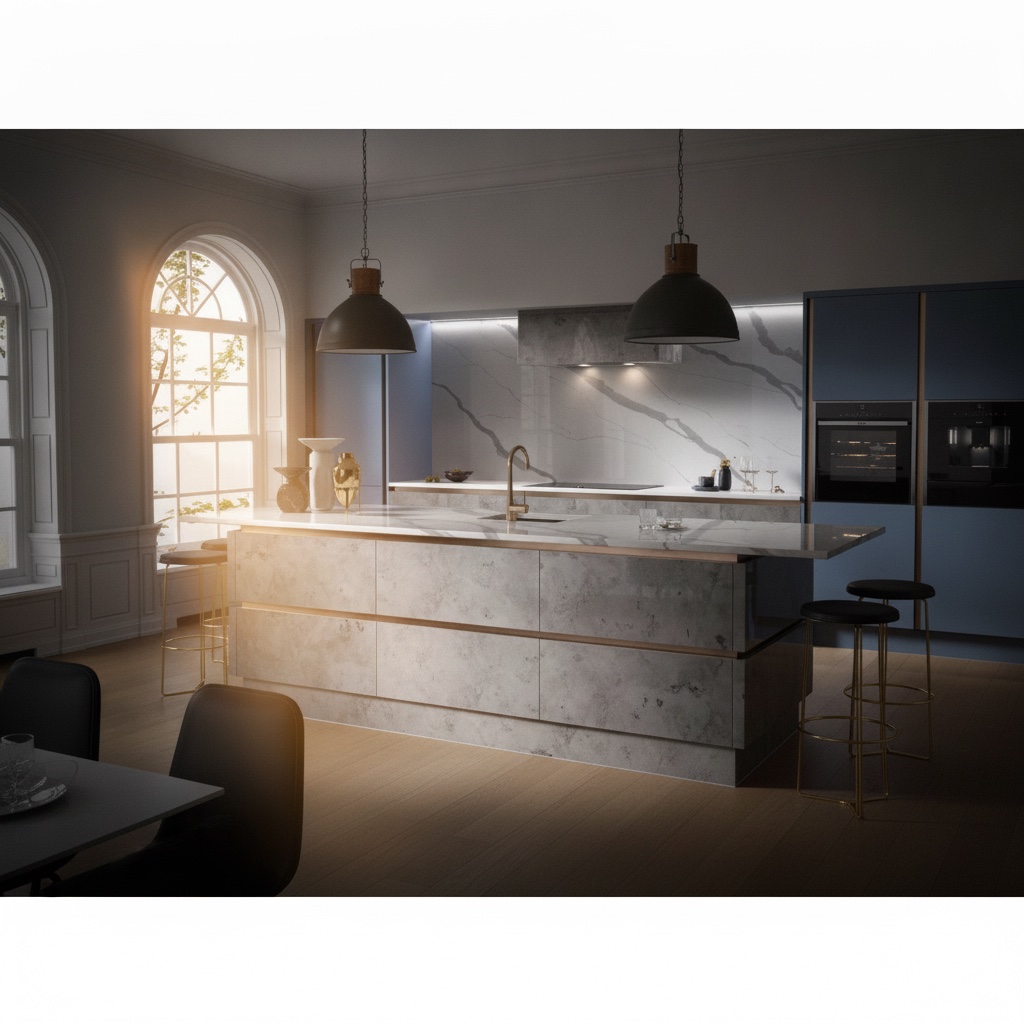
Stoneware-clad kitchen with island, integrated sink, induction hob, hood and oven

Stoneware-clad kitchen with island, integrated sink, induction hob, hood and oven

The island presents itself in its pale stone-effect stoneware dress, crossed by slender inserts that mark out its drawers; above, the top integrates sink and induction hob in a single working surface, served by burnished taps. Behind, a marble-effect stoneware wall rises beyond the cooking zone, while powder-blue columns — with black ovens recessed — add the colour that gentles the whole scene. Dark bell lamps, stools at the counter, tall windows of a stately apartment: the ensemble has an urban, serene elegance. A wooden structure clad in stoneware is a sound formula: the constructive warmth of wood, the resistance of ceramic at the surface. With hood and oven completing the equipment, it is an indoor kitchen ready for real life: Michelessi builds it to measure, attending to joints, recesses and tonal pairings with an artisan's care. The powder blue, then, is the touch that lingers in the eye.
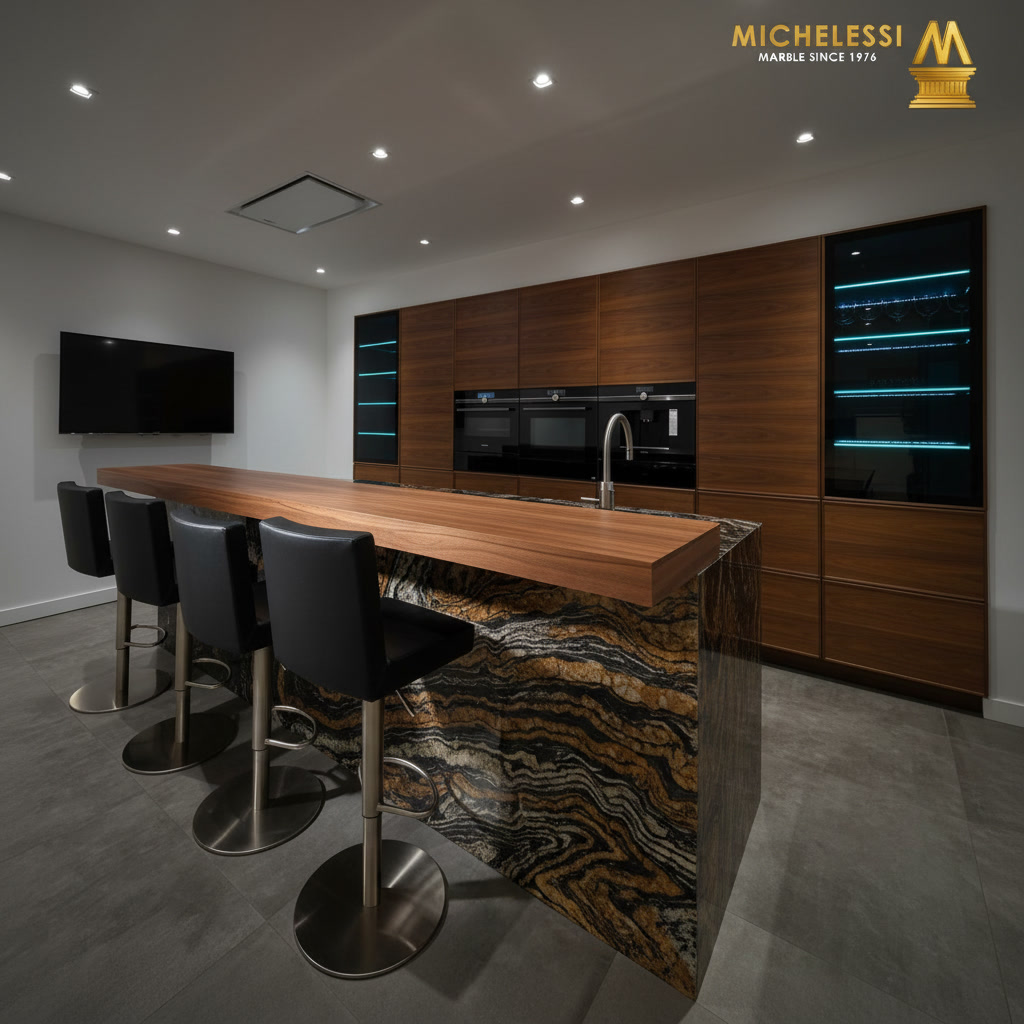
Central quartzite island with spectacular veining, wooden counter and black stools

Central quartzite island with spectacular veining, wooden counter and black stools

The island is a fire made stone: quartzite with amber and black veining blazes along the flanks in its impetuous figuring, polished until it mirrors the room; above, a solid wood counter lays down its warm board and gathers black swivel stools. The sink sits flush in the top; behind, walnut boiserie conceals and reveals — black ovens, backlit vitrines of bottles, a recessed television. A pale floor leaves the whole stage to the material. This is the project for those who want a collector's stone at the heart of the home: quartzite, with its unrepeatable figure, is not chosen from a catalogue — it is encountered, slab by slab. Bespoke stonework orchestrates its veining across top and flanks, with cuts and joints that honour the natural movement. This is the art of Michelessi: craftsmanship that knows when a stone deserves the stage, and builds one around it.

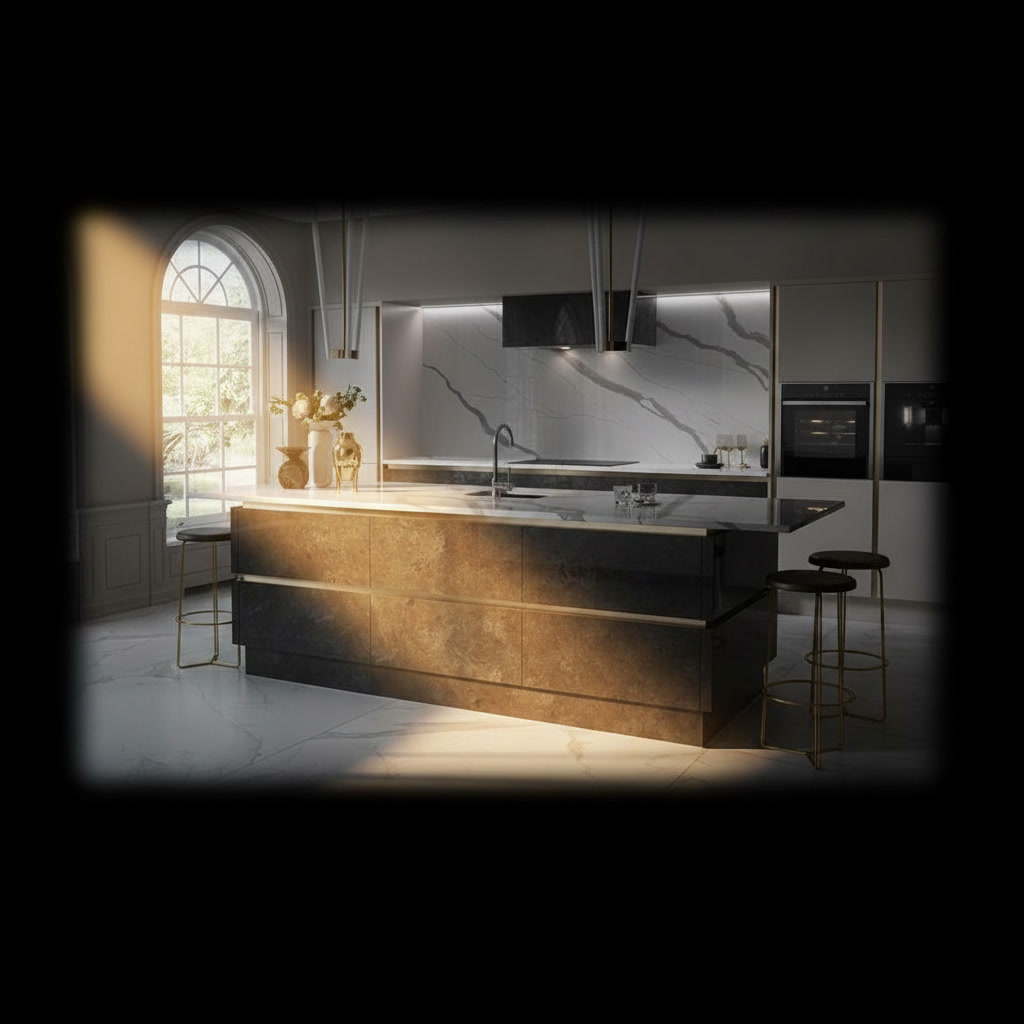
Kitchen with island clad in grey porcelain stoneware with golden profiles and marble wall

Kitchen with island clad in grey porcelain stoneware with golden profiles and marble wall

Arched windows and a wall of veined marble effect give the room the breath of a palazzo; at the centre, the island clad in stone-grey porcelain dresses itself in golden profiles — fine lines running along the volumes like threads of light — and carries the integrated sink with its gold tapware. Stools with gilded details complete the register, together with dark columns housing the built-in ovens. Fully equipped, this is a kitchen that plays the luxury card openly: technical materials treated like jewels, measured reflections, a curated scenography. The porcelain stoneware bears the practical side with its tireless surface; the gold does its own work, which is to shine. Made-to-measure holds it all in balance: proportions, alignments, cut-outs. This is the glamorous face of Michelessi indoor kitchens: artisan craftsmanship that knows how to be sober when needed — and magnificent when the project asks. The gold here is not ostentation: it is a line of light drawn with a ruler.

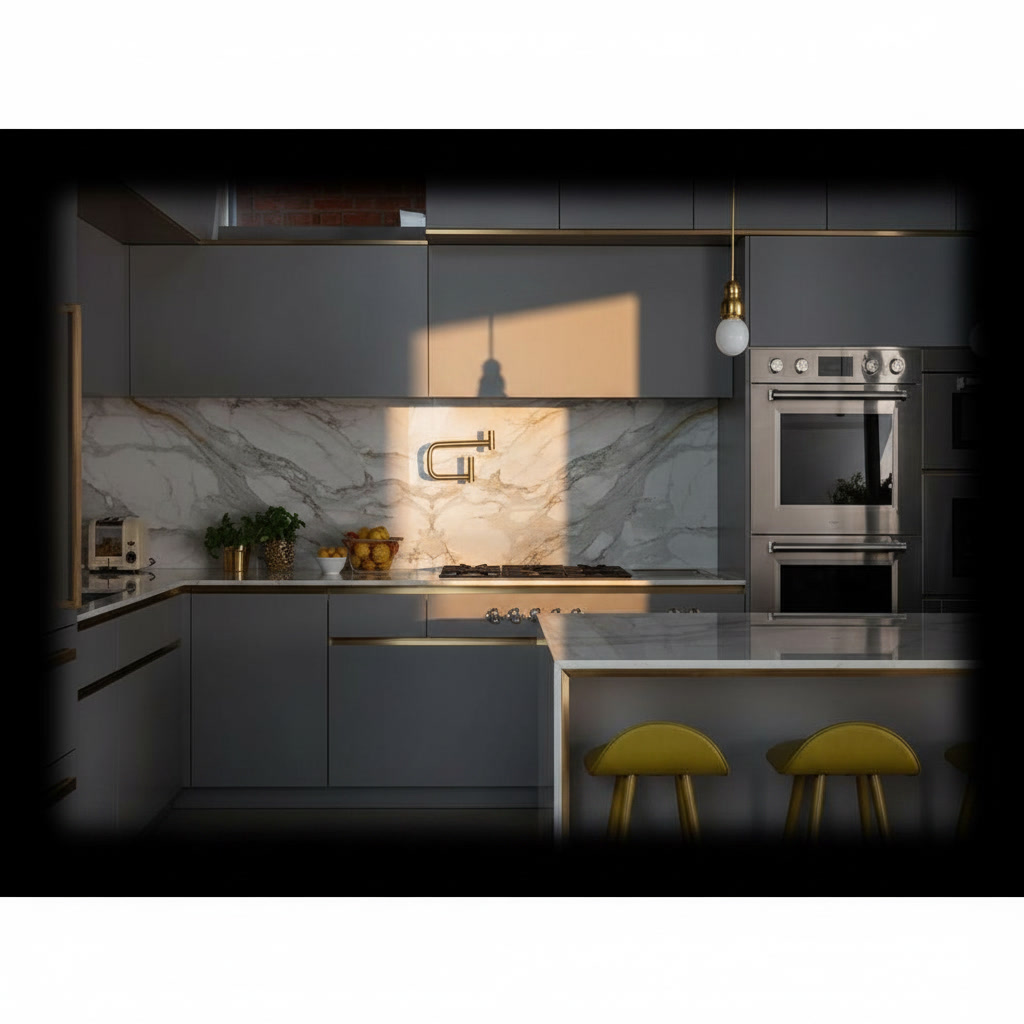
Classic grey kitchen with veined travertine top, oven, sink and yellow stools

Classic grey kitchen with veined travertine top, oven, sink and yellow stools

The lines are elegant and the colour knows it: uniform grey doors, crossed by golden profiles that draw the handles and frames, meet a veined travertine counter — pale stone with a moving figure that also clads the wall behind the burners, as one single mineral gesture. Twin ovens sit in their column, the sink works beneath a suspended brass bulb, and yellow stools light the counter with their note of sun. Complete with oven, sink and range, this is a classic kitchen of contemporary proportions: few elements, all of them right. Veined travertine is the silent protagonist: Roman stone, warm and luminous, worked to measure in counters and cladding with the care its history deserves. This is the Michelessi métier: craftsmanship that sets gold against stone without ever sliding into excess — because true elegance is known by its restraint. The yellow stools confirm it: elegance, now and then, also knows how to smile.

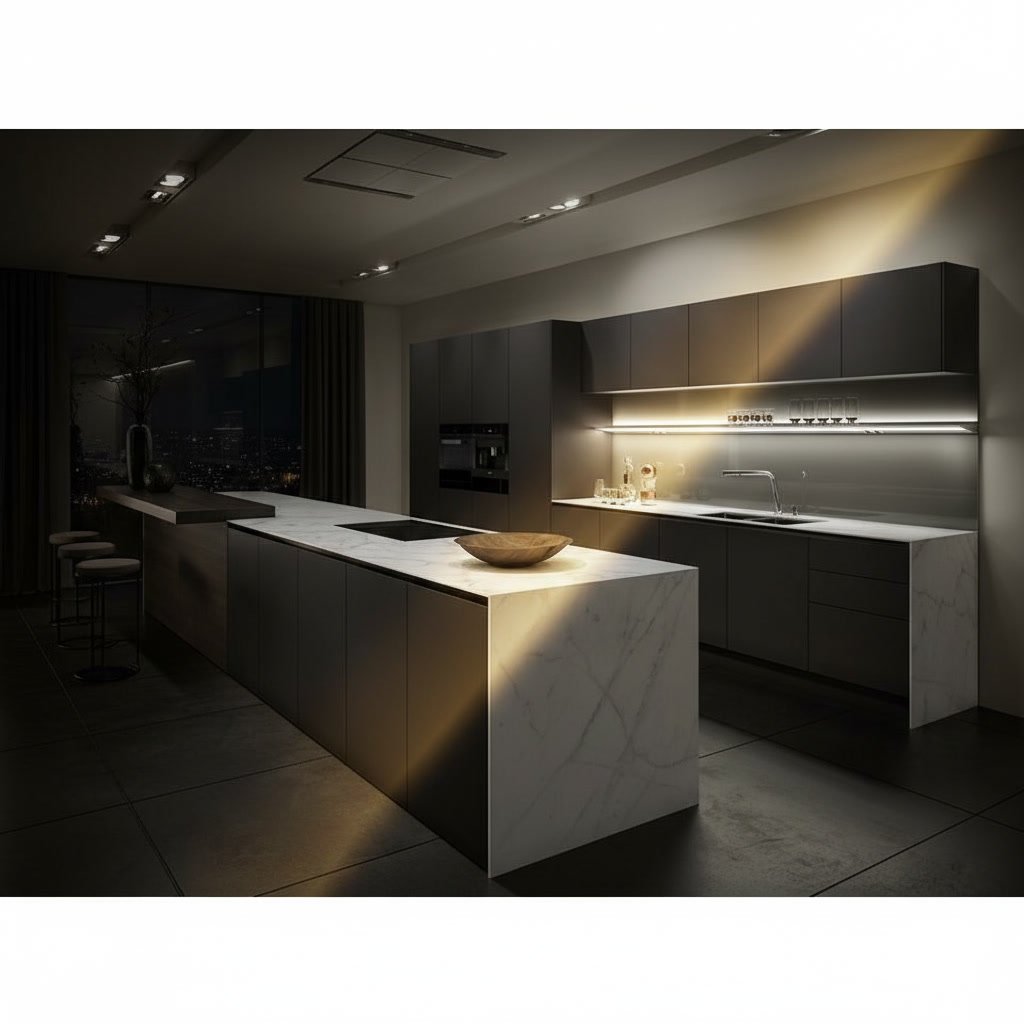
Dark lacquered wooden kitchen with veined travertine island with bar table and induction

Dark lacquered wooden kitchen with veined travertine island with bar table and induction

It is the hour when the city lights up, and the kitchen answers with its veined travertine island: pale stone, crossed by grey veining, falls in a waterfall along the flanks and carries the integrated induction hob, extending into a bar table where dark stools wait. Around it, surfaces of dark lacquered wood absorb the spotlight; a fitted wall with its LED strip lights the worktop, and doors keep everything in its place. Complete with sink and oven, this is a kitchen of metropolitan charm: sharp contrasts, noble materials, a penthouse atmosphere. The veined travertine is the luminous heart of the dark: working it in a waterfall demands exact joints and orchestrated veining — the bespoke stonework Michelessi practises with the artisan craftsmanship of always. The result is an island that seems lit from within: stone that gives light, while everything around it chooses shadow. Elegant darkness plays the backdrop: the pale stone takes, deservedly, the stage.

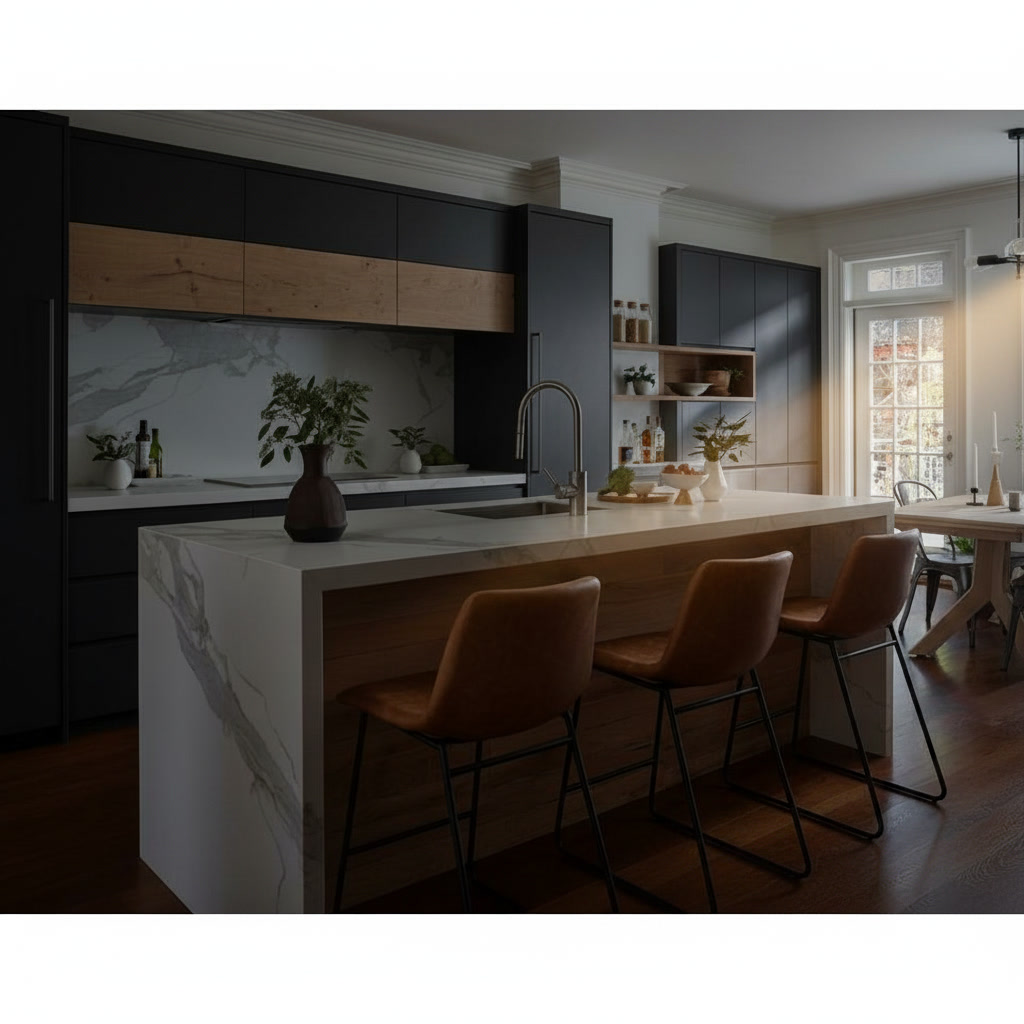
Veined travertine island with leather stools, grey kitchen with sink, induction and oven

Veined travertine island with leather stools, grey kitchen with sink, induction and oven

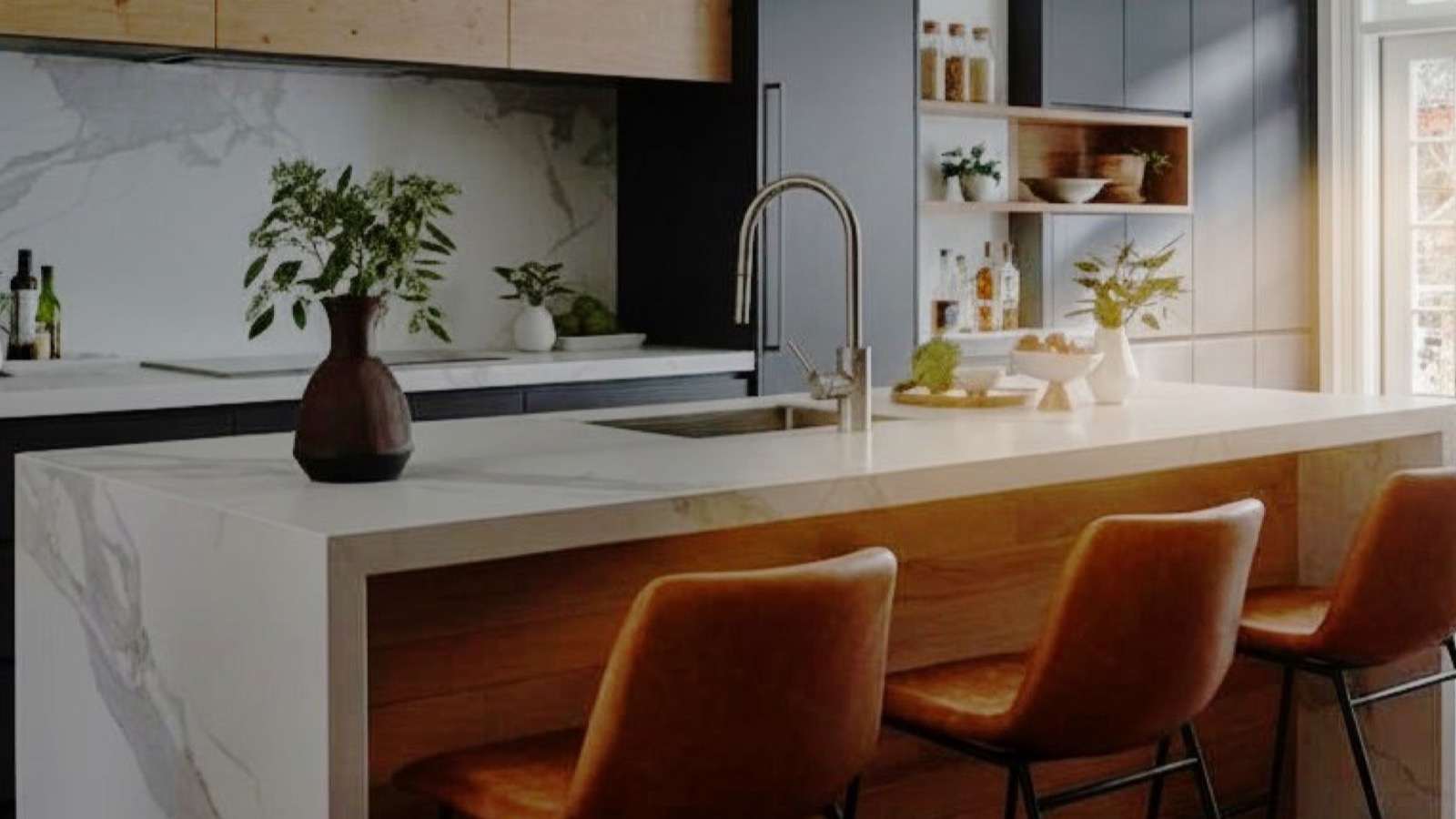
The island falls in a waterfall of pale veined stone: the travertine top continues down the flanks without breaking its figure, and three cognac leather stools draw up with their club-room elegance. Behind, the dark grey kitchen works with the sink beneath a suspended wooden shelf, the induction hob, the oven and well-ordered doors; a pale veined wall amplifies the light, and flowers on the counter complete the grace of the whole. A brown timber floor anchors the composition. This is warm contemporary style played on the right materials: stone that ennobles, leather that ages well, grey as the backdrop. The travertine waterfall — mitred joints at forty-five degrees, veining aligned — is the detail that marks serious work: Michelessi work, Italian craftsmanship in stone for made-to-measure indoor kitchens. The cognac of the stools does the rest: it invites you to stay.

Solid wood kitchen: what it is

A solid wood kitchen is a kitchen whose wooden parts are made of the same species throughout their thickness. The piece can be made of several elements of the same species glued together: a single plank is not required. Inside the door there is the same wood you see outside, which is why solid wood can be sanded back and refinished over the years.

In catalogues the word "solid" carries different shades of meaning, and it helps to read how each brand describes its construction. One manufacturer declares kitchens in solid wood and multilayer board; another presents as "lightened solid wood" (massello alleggerito) a 4 mm layer of fine wood over aluminium profiles, as an interiors magazine reports. Species, finishes and care of solid wood have a page of their own: solid wood kitchen. For the two most requested species there are oak kitchen and walnut kitchen; the other woods are on chestnut, ash, cherry and fir.

Blockboard and edge-glued wood: real wood reassembled

Blockboard is a panel with a core of solid wood strips, at least 9 mm thick, covered with peeled or sliced sheets of wood. One maker of solid wood kitchens declares that it uses blockboard and multilayer board to gain more stability than solid wood alone offers.

Edge-glued wood (lamellare) is a different construction: strips of solid wood glued end to end and along the edges, giving uniform, stable panels. It is the typical material of edge-glued wood worktops. In short, edge-glued wood is solid wood reassembled; blockboard with an oak face is real wood, but the oak lies only in the covering sheet. The difference is read in the technical data sheet, not by eye.

Veneered kitchen: real wood on the surface only

Veneer is a thin sheet of real wood glued to a base of chipboard, MDF, plywood or even solid wood. Sliced veneers run from 0.5 to 3.5 mm according to a trade data sheet, while for an interiors magazine it takes 0.9 mm to call it veneer: the sources do not agree. The look is that of real wood, with its own grain, and a well-matched veneer can look like a single plank. The limit is repair: the surface can be sanded only within the limits of the covering layer, and a scratch that goes through it is not easily touched up.

Series-production makers use it too: a trade magazine reports that for one of them the most requested finish is natural oak veneer, with worktops in porcelain stoneware or Fenix, and that another offers veneered doors in heat-treated oak, with satin steel worktops and splashbacks.

Wood effect kitchen: laminate, melamine-faced board and porcelain stoneware

A wood effect kitchen has the grain reproduced on the surface and no wood on show. There are three families, and they differ in how they are made.

Laminate

Laminate is made of several layers of paper impregnated with thermosetting resins, topped with a sheet that prints the grain. The colour is constant because it is a photograph, and some models imitate wood to the touch as well. It costs less than wood and is easy to clean.

Melamine-faced board

Melamine-faced board is chipboard covered with a paper about a tenth of a millimetre thick, impregnated with melamine resin: the resin makes the paper waterproof. Names such as "walnut melamine" or "beech effect" indicate a panel that imitates wood. It is the cheapest of the materials on this page.

Wood effect porcelain stoneware

Porcelain stoneware (gres) is a ceramic fired at 1,200-1,300 °C until the body begins to vitrify (the definition given by an Italian dictionary); the wood effect version carries a decoration that reproduces the pattern of wood. In the kitchen it is used as slabs for worktops, splashbacks and cladding. For worktops Laminam makes porcelain stoneware slabs 12 mm thick (12+), also 20 mm (20+), and declares that they are non-porous and withstand the direct heat of pots and pans. A ceramic manufacturer indicates as limits the higher cost than laminate, the cold feel to the touch, and work that has to be entrusted to specialist firms.

Porcelain stoneware should not be confused with sintered stones such as Dekton, which are a different material. Laminam porcelain stoneware, like marble and stone, is one of the materials we work for worktops.

How to tell whether a kitchen is made of real wood

The safe check is documentary: ask for the construction section of the door and for the botanical species written on the quotation. A first check can be made by eye, but on its own it is not enough. Five checks, in order:

  1. The edges: if a thin line runs along the edges from one corner to the other, the door is not solid wood.
  2. The back: the grain on the outer face of the door must match the grain on the back.
  3. The name of the finish: "walnut melamine" or "beech effect" indicate a panel that imitates wood; "oak" in the name may mean the species, only the veneer or only the colour.
  4. The construction section: frame, panels and core of the door, described separately.
  5. The species written on the quotation, with the product sheet: materials of the structure and the coverings, cleaning instructions.

A grain that seems continuous proves nothing: a well-matched veneer looks like a single plank. Even in a kitchen presented as solid wood, the back and the drawer bottoms may be in another material: that is why the section is requested part by part, from anyone who gives a quotation, ourselves included.

Real wood or wood effect: the comparison table

Solid wood, edge-glued wood and veneer are real wood (the last only on the surface); laminate, melamine-faced board and porcelain stoneware are wood effect. The table sums up, material by material, how each is made, how it is repaired and how to recognise it.

MaterialHow it is madeIs it real wood?How it is repairedHow to recognise it
Solid and edge-glued woodSame species throughout the thickness; edge-glued wood is made of glued stripsYes, throughout the thicknessCan be sanded back and refinishedNo line along the edges; grain that matches on the back
Veneer (also on blockboard)A thin sheet of real wood on a baseYes, but only on the surfaceSanded within the limits of the layerThin line along the edges; construction section
LaminatePaper with resins and a sheet that prints the grainNo, it is a printCannot be sanded; easy to cleanConstant colour; "effect" in the name of the finish
Melamine-faced boardChipboard covered with paper and melamine resinNo, it is a printCannot be sanded; the resin makes the paper waterproof"Walnut melamine", "beech effect"
Wood effect porcelain stonewareCeramic fired at 1,200-1,300 °C with a wood decorationNo, it is ceramicCannot be sanded like wood; non-porous surface declared by the manufacturerSlab cold to the touch; the manufacturer's data sheet

Wooden kitchen or laminate: which to choose

Laminate costs less than wood, is easy to clean and has a constant colour; wood costs more, but it can be sanded and repaired. No answer suits everyone: it depends on how the kitchen is lived in and how much real wood matters. One point worth clarifying is stability: solid wood is not necessarily more stable. Wood takes up and gives off moisture, and with sharp swings solid wood may warp more than a panel; that is why blockboard and multilayer board are also used.

When real wood is the better choice

  • When you want to be able to renew the doors over the years, sanding them and redoing the finish.
  • When the real grain matters, with its variations from one piece to the next.

When a wood effect is enough

  • When you need the same colour across the whole composition.
  • When easy cleaning matters more than anything else.

Walnut-coloured modern kitchen: colour or species?

"Walnut colour" is a colour, not a species: a walnut-coloured kitchen may be real walnut, another wood that has been stained, or a panel that imitates it. The real walnut used in kitchens is of two different species: European walnut (Juglans regia) and black walnut, the American walnut (Juglans nigra), which lightens over time. A stained or pigmented wood makes the colour more uniform, but a deep scratch shows the colour underneath.

The modernity of a kitchen lies more in the design, with flat doors and no handles on show, than in the material. Faced with "walnut colour" or "wood effect", the question is always the same: what is under the colour? The two species of walnut are compared on the page walnut kitchen; light and dark tones, with their pairings, are on light or dark wood kitchen.

Real wood with a marble, stone or porcelain stoneware worktop

Wooden doors with a marble or stone worktop are a classic pairing: marble is cool and glossy, wood warm and matt. The worktop is one of the parts of the kitchen most exposed to water, scratches and heat, and it is also where our workshop comes in: we have worked stone since 1976 and, for worktops, marble, granite, quartzite, Laminam porcelain stoneware and Dekton sintered stone, with the slabs chosen one by one, cut on numerically controlled machines and finished by hand.

Marble withstands moderate heat and fears acids such as lemon and vinegar; granite, quartzite, porcelain stoneware and sintered stone stand up better to heavy use. Those who want wood on the worktop too choose a real wood worktop, with its upkeep, or a porcelain stoneware slab with a wood decoration, whose surface the manufacturer declares non-porous. The pairings are described in marble and wood kitchen and in wood and marble, stone or steel kitchen; the stones are under marbles.

How long it lasts and how it is renewed

For the materials of indoor doors and units no serious source gives a lifespan in years, and we promise none: what can be said is how each one ages and whether it can be made like new.

Solid wood changes tone in the light: oak warms and tends to darken, cherry darkens, American walnut lightens. Laminate and melamine-faced board have a uniform colour from one piece to the next, because the grain is printed, but they cannot be sanded; porcelain stoneware is ceramic and is not renewed like wood. How each material is repaired is in the table above.

Real wood has two zones to protect: near the sink and the dishwasher standing water must be wiped off at once (with iron, oak and chestnut stain because of their tannins); near the hob the sources disagree and the hob manufacturer's instructions apply. Cleaning, finishes and upkeep, from oil to varnish, are on the page about solid wood.

How much it costs: the order of the materials

Among the materials of doors and units, solid wood is one of the most expensive options; in order of cost come solid wood first, then veneered blockboard or multilayer board, then laminate and melamine-faced board. We do not publish price lists, because the price also depends on the species, the finish, the type of door, the measurements, the worktop and the hardware. The factors are explained on the page how much does a wooden kitchen cost.

From design to installation

The path is the same as for every Michelessi kitchen: a free 3D design everywhere, a free site survey in Rome, Latina and Lazio, installation by our own team throughout Italy; the steps are on the page made-to-measure wooden kitchens. For the style with beams and stone there is the country and rustic wooden kitchen; the other indoor kitchens are under indoor kitchens, more answers in wooden kitchens: questions and answers. Outdoors the rules change: see outdoor wooden kitchen.

The quotation is free wherever you are: request it here.

Frequently asked questions

Frequently asked questions

What is the difference between a real wood kitchen and a wood effect kitchen?

In a real wood kitchen the visible surfaces are wood: solid, meaning the same species throughout the thickness, or veneered, meaning a sheet of wood on a base. In a wood effect kitchen the grain is a print on laminate, melamine-faced board or porcelain stoneware. They differ in how they age and in whether the surface can be sanded and renewed.

Solid, edge-glued and blockboard: what is the difference?

Solid wood is wood of the declared species throughout the thickness, even when made of several glued pieces of the same species. Edge-glued wood is solid wood reassembled: strips glued end to end and along the edges, giving uniform, stable panels, typical of worktops. Blockboard has a core of solid timber strips covered with sheets: with an oak face it is real wood, but the oak lies only in the covering.

Are veneer and solid wood the same thing?

No. Veneer is real wood on the surface only: a thin sheet, a few millimetres thick at most, glued to a base of chipboard, MDF, plywood or solid wood. Solid wood is the same wood throughout the thickness. Veneer can be sanded only within the limits of its layer; solid wood can be sanded back and refinished.

How can I tell whether a kitchen is made of real wood?

Look at the edges: a thin line from one corner to the other means the door is not solid wood. The grain at the front must match the grain at the back. The safe check is documentary: ask for the construction section of the door and the botanical species written on the quotation, because "oak" in the name of a finish may mean only the colour.

Wooden kitchen or laminate: which is better?

It depends on use. Laminate costs less, is easy to clean and has a constant colour; wood costs more, but it can be sanded and repaired. Those who want a kitchen that can be made like new over the years, and the real grain, choose wood; those who want an identical colour everywhere and the simplest cleaning may choose a wood effect.

Is solid wood always more stable than blockboard?

Not necessarily. Wood takes up and gives off moisture, and with sharp swings solid wood may warp more than a panel. That is why blockboard, with a core of strips covered by sheets of wood, and multilayer board are also used. Stability depends on the species, the construction of the door and the environment in which the kitchen lives.

What is wood effect porcelain stoneware and is it suitable for a kitchen?

It is a ceramic fired at 1,200-1,300 °C, with a decoration that reproduces wood. In the kitchen it is used as slabs for worktops, splashbacks and cladding. For worktops Laminam declares non-porous slabs that withstand the direct heat of pots. A ceramic manufacturer notes the limits: higher cost than laminate, a cold feel, installation by specialist firms.

Does "walnut colour" mean real walnut?

No: "walnut colour" is a colour, not a species. It may be real walnut (European or black walnut, two different species), another wood that has been stained, or a melamine-faced panel that imitates it. A pigmented stain makes the colour uniform, but a deep scratch shows what lies underneath. To be sure, ask for the botanical species written on the quotation.

Can a wood effect kitchen be sanded and refinished?

No. In laminate and melamine-faced board the grain is printed on paper; porcelain stoneware is a ceramic surface. In no case can it be sanded and renewed like solid wood. Veneer can be sanded only within the limits of the layer of wood that covers it, while solid wood can be sanded back and refinished.

How long does a real wood kitchen last?

For the materials of indoor doors and units no serious source gives a lifespan in years, and we promise none. What can be said is how they age: solid wood can be sanded back and refinished; veneer can be sanded within the limits of its layer; laminate and melamine-faced board have a uniform colour but cannot be renewed. Care, humidity and the finish also count.

Who builds made-to-measure wooden kitchens near Rome?

Michelessi SRL, in Aprilia, on the Pontina road between Rome and Latina, has worked stone since 1976. We design and build our wooden kitchens to measure, with solid wood doors and carcasses in solid wood or blockboard, and install them with our own team throughout Italy. The quotation is free wherever you are; in Rome, Latina and throughout Lazio the site survey is free too.

Call us WhatsApp