Skip to content
Made in Italy

Since 1976 — Wooden kitchens

Country Kitchen and Rustic Wooden Kitchen: Beams and Stone

WOOD · STEEL · MARBLE · STONEWARE

In short

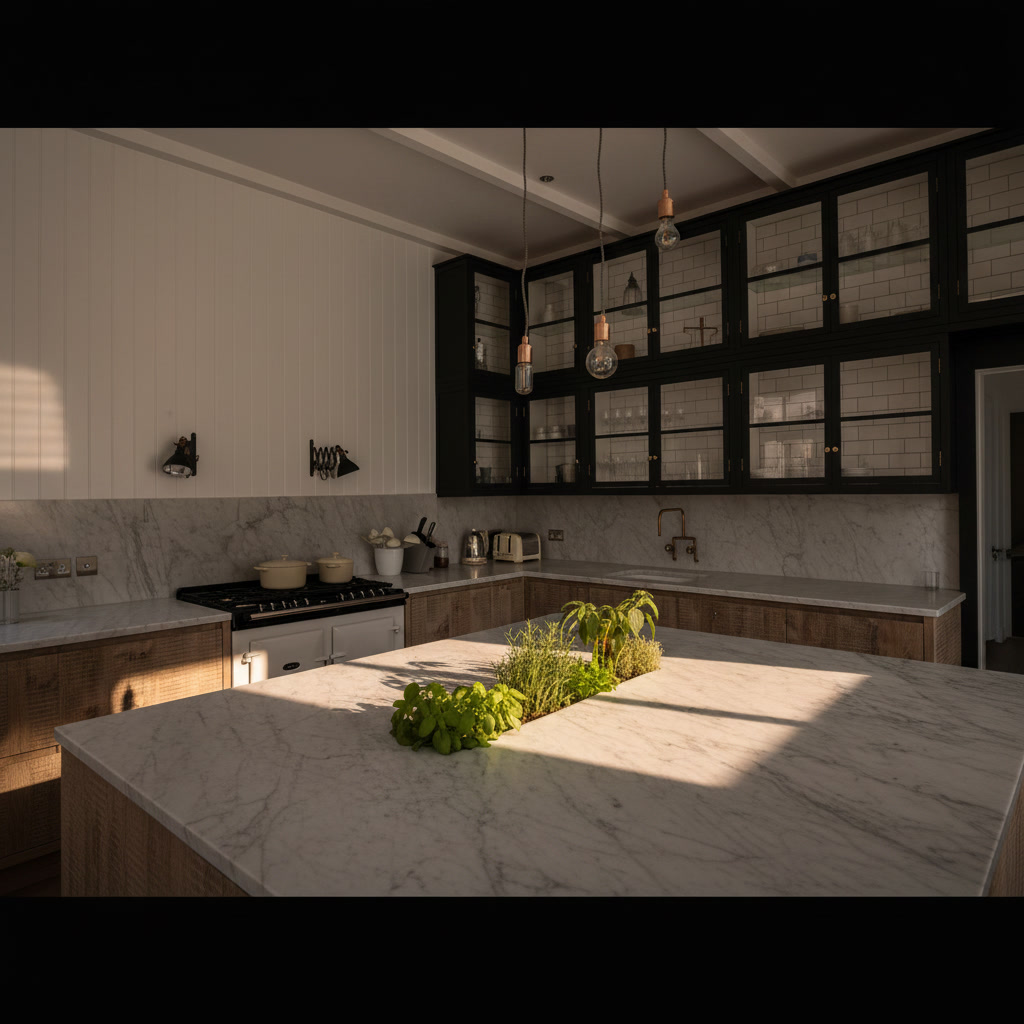
Carrara marble kitchen with contrasting black glass-front cabinets and island with fresh herbs
Carrara Farm Kitchen — photograph of a Michelessi project.

The block — a Michelessi vision

From the block,
blow after blow

01 A raw block of Calacatta Viola waits under the spotlight, in the dark kitchen with brass profiles. Mallet and chisel are already on the floor: the island is still all inside the stone.

02 Blow after blow the faces are squared, chips fly, white dust rises into the light. The chisel scores the drawers, opens the recess for the hob, carves the sink: the shape of the island comes out of the block slowly, without haste.

03 Then the stone is honed and polished: the purple vein catches the light, brass edges close the drawers, the black hob sinks into its recess, the gold tap finds its place. The island remains, and a veil of dust on the floor.

Keep scrolling — the scene follows you

What is a country kitchen, and how does it differ from a rustic one?

A country kitchen is a wooden kitchen with a simple design: a sturdy worktop, few ornaments and colours that come from the materials. The rustic kitchen is the same idea made more tactile, with exposed beams, stone and the knots of the wood on show. It is the style of the country house, the farmhouse and the mountain home.

Who builds it: Michelessi SRL, in Aprilia on the Pontina road between Rome and Latina, with installation throughout Italy. We have worked stone since 1976, and we design and build to measure kitchens with solid wood doors and a marble or stone worktop.

Made to measure means that the kitchen is born from the room: beams, walls that are out of square, niches and the fireplace are the starting point of the design, not an obstacle. This page belongs to the made-to-measure wooden kitchens department.

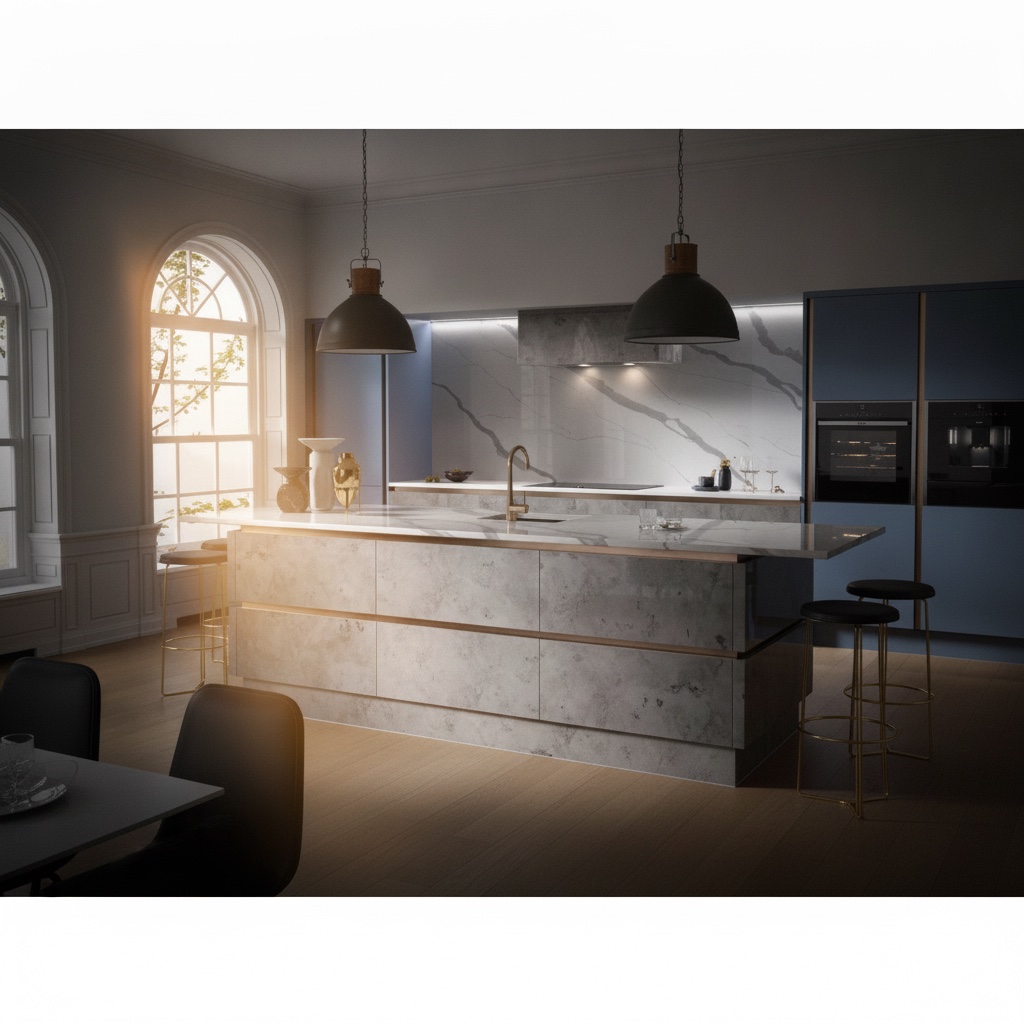
Stoneware-clad kitchen with island, integrated sink, induction hob, hood and oven

Stoneware-clad kitchen with island, integrated sink, induction hob, hood and oven

The island presents itself in its pale stone-effect stoneware dress, crossed by slender inserts that mark out its drawers; above, the top integrates sink and induction hob in a single working surface, served by burnished taps. Behind, a marble-effect stoneware wall rises beyond the cooking zone, while powder-blue columns — with black ovens recessed — add the colour that gentles the whole scene. Dark bell lamps, stools at the counter, tall windows of a stately apartment: the ensemble has an urban, serene elegance. A wooden structure clad in stoneware is a sound formula: the constructive warmth of wood, the resistance of ceramic at the surface. With hood and oven completing the equipment, it is an indoor kitchen ready for real life: Michelessi builds it to measure, attending to joints, recesses and tonal pairings with an artisan's care. The powder blue, then, is the touch that lingers in the eye.
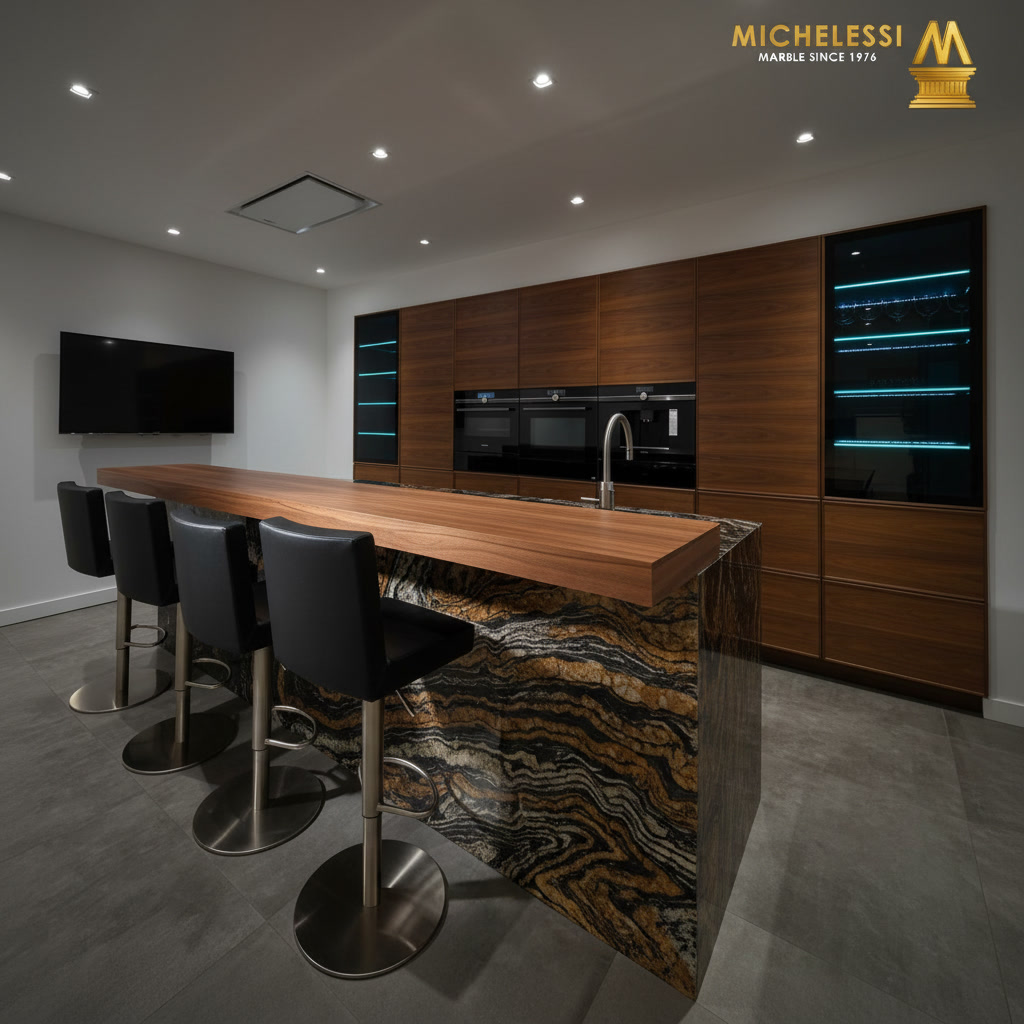
Central quartzite island with spectacular veining, wooden counter and black stools

Central quartzite island with spectacular veining, wooden counter and black stools

The island is a fire made stone: quartzite with amber and black veining blazes along the flanks in its impetuous figuring, polished until it mirrors the room; above, a solid wood counter lays down its warm board and gathers black swivel stools. The sink sits flush in the top; behind, walnut boiserie conceals and reveals — black ovens, backlit vitrines of bottles, a recessed television. A pale floor leaves the whole stage to the material. This is the project for those who want a collector's stone at the heart of the home: quartzite, with its unrepeatable figure, is not chosen from a catalogue — it is encountered, slab by slab. Bespoke stonework orchestrates its veining across top and flanks, with cuts and joints that honour the natural movement. This is the art of Michelessi: craftsmanship that knows when a stone deserves the stage, and builds one around it.

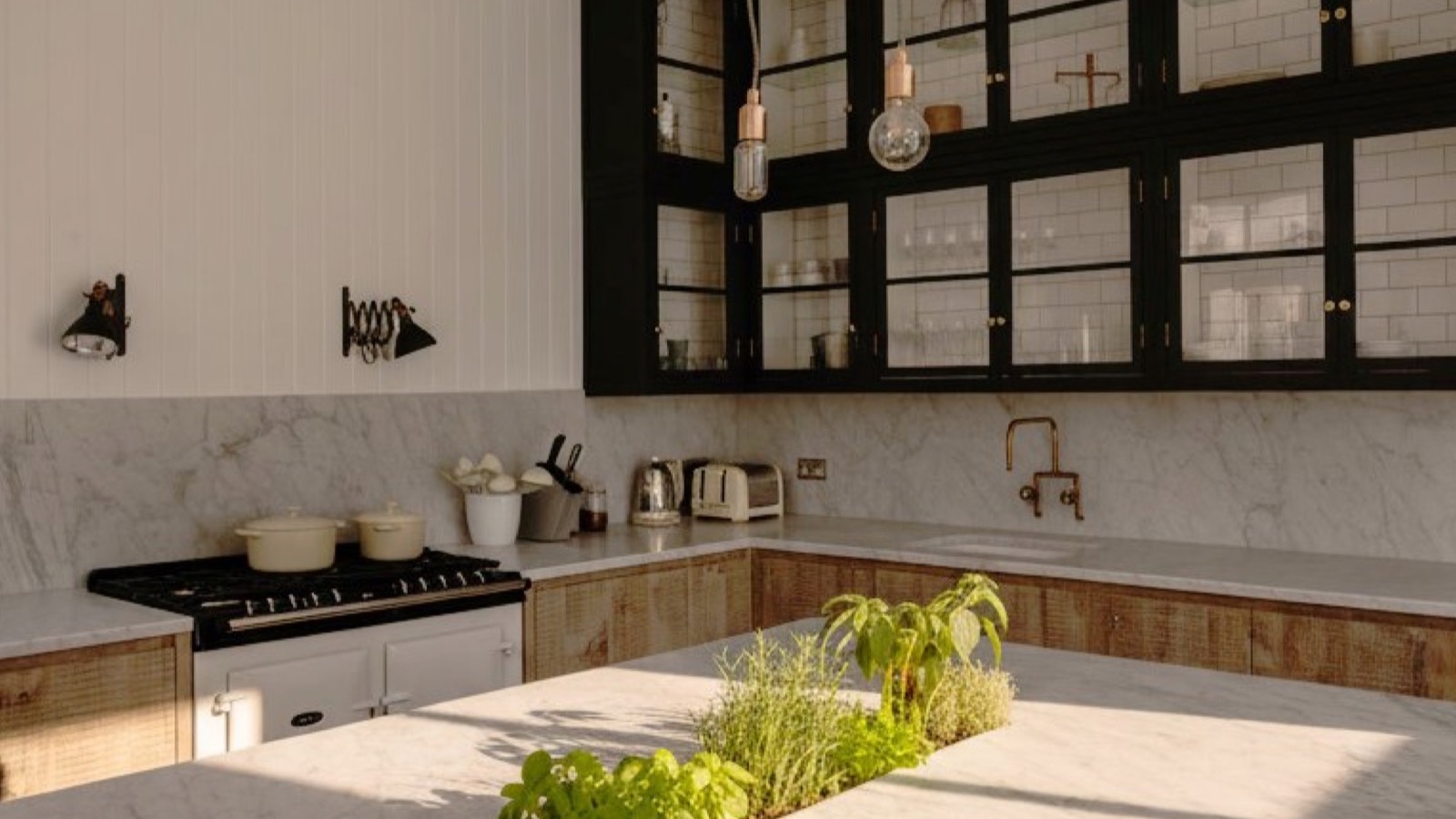
Carrara marble kitchen with contrasting black glass-front cabinets and island with fresh herbs

Carrara Farm Kitchen

There is a country soul in this kitchen, dressed in noble stone: the counters and central island are Carrara marble, grey veins running free beneath the industrial lamps; above, black cabinets with glazed fronts display glassware and crockery like a family dresser reimagined. The white plank wall, the natural wood drawers, the range with its black burners: each element plays the contrast between rustic and refined. And at the centre, on the island with its vegetable rack, bunches of fresh herbs bring the kitchen garden into the marble. This is the charm of the Italian farm kitchen: true materials, a domestic patina, and bespoke stonework holding it all together — balanced by Michelessi with the sure hand of Italian craftsmanship, because even a kitchen with a farmhouse heart deserves the dignity of the most celebrated stone in the world. Basil on cool marble completes the picture better than any frame.

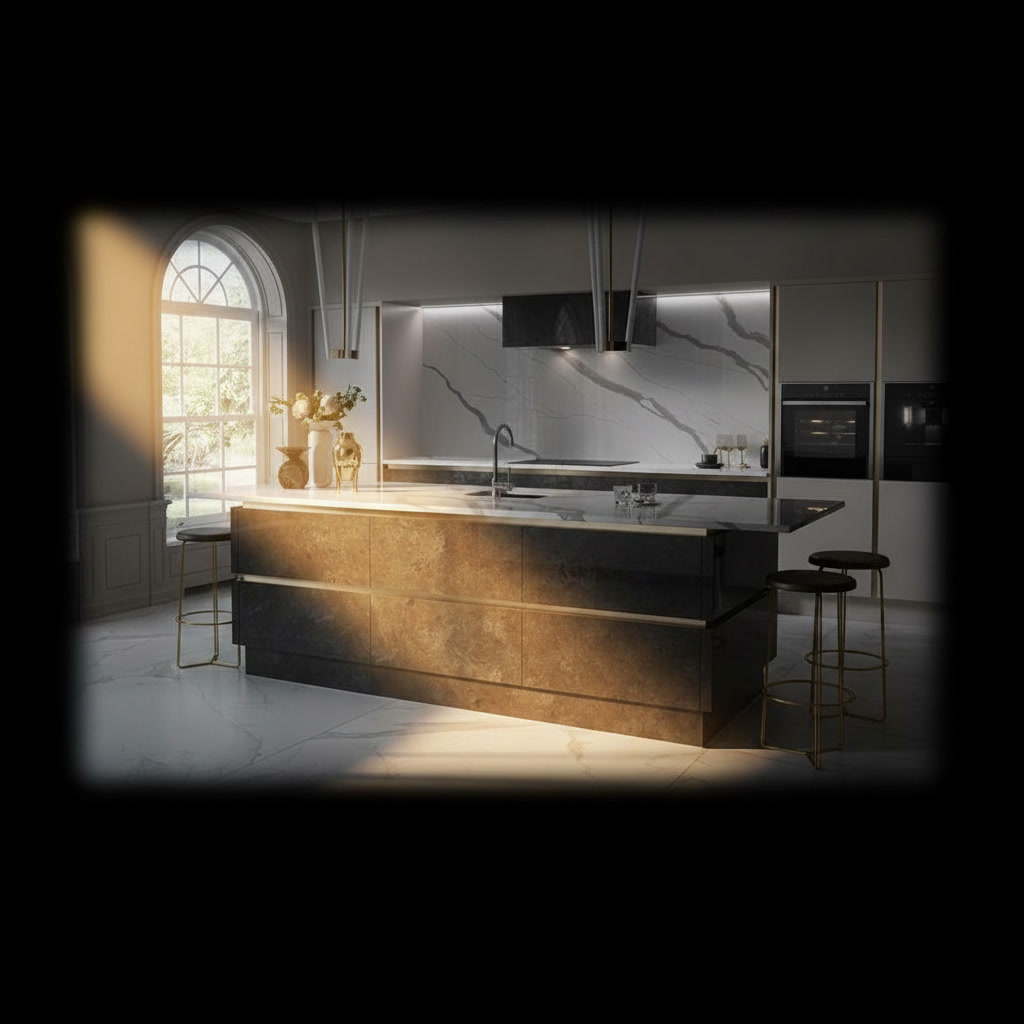
Kitchen with island clad in grey porcelain stoneware with golden profiles and marble wall

Kitchen with island clad in grey porcelain stoneware with golden profiles and marble wall

Arched windows and a wall of veined marble effect give the room the breath of a palazzo; at the centre, the island clad in stone-grey porcelain dresses itself in golden profiles — fine lines running along the volumes like threads of light — and carries the integrated sink with its gold tapware. Stools with gilded details complete the register, together with dark columns housing the built-in ovens. Fully equipped, this is a kitchen that plays the luxury card openly: technical materials treated like jewels, measured reflections, a curated scenography. The porcelain stoneware bears the practical side with its tireless surface; the gold does its own work, which is to shine. Made-to-measure holds it all in balance: proportions, alignments, cut-outs. This is the glamorous face of Michelessi indoor kitchens: artisan craftsmanship that knows how to be sober when needed — and magnificent when the project asks. The gold here is not ostentation: it is a line of light drawn with a ruler.

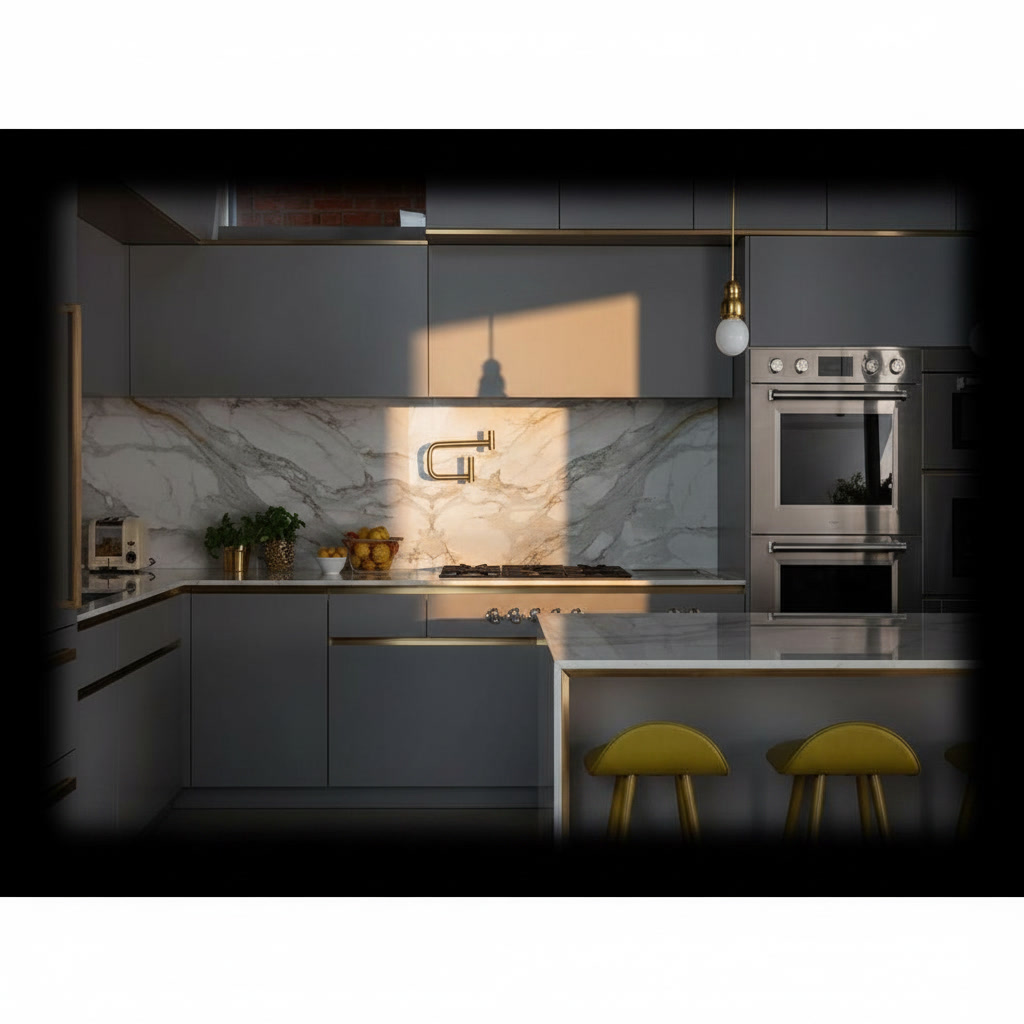
Classic grey kitchen with veined travertine top, oven, sink and yellow stools

Classic grey kitchen with veined travertine top, oven, sink and yellow stools

The lines are elegant and the colour knows it: uniform grey doors, crossed by golden profiles that draw the handles and frames, meet a veined travertine counter — pale stone with a moving figure that also clads the wall behind the burners, as one single mineral gesture. Twin ovens sit in their column, the sink works beneath a suspended brass bulb, and yellow stools light the counter with their note of sun. Complete with oven, sink and range, this is a classic kitchen of contemporary proportions: few elements, all of them right. Veined travertine is the silent protagonist: Roman stone, warm and luminous, worked to measure in counters and cladding with the care its history deserves. This is the Michelessi métier: craftsmanship that sets gold against stone without ever sliding into excess — because true elegance is known by its restraint. The yellow stools confirm it: elegance, now and then, also knows how to smile.

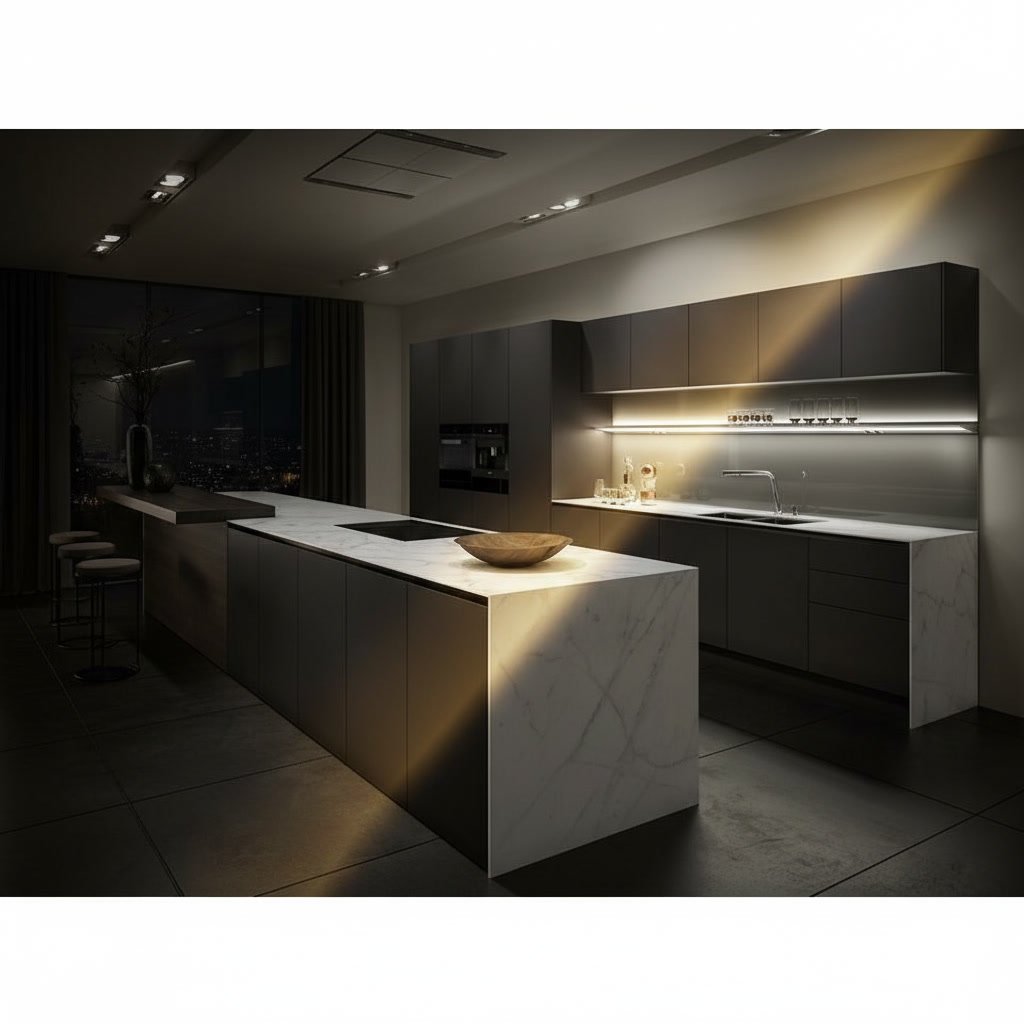
Dark lacquered wooden kitchen with veined travertine island with bar table and induction

Dark lacquered wooden kitchen with veined travertine island with bar table and induction

It is the hour when the city lights up, and the kitchen answers with its veined travertine island: pale stone, crossed by grey veining, falls in a waterfall along the flanks and carries the integrated induction hob, extending into a bar table where dark stools wait. Around it, surfaces of dark lacquered wood absorb the spotlight; a fitted wall with its LED strip lights the worktop, and doors keep everything in its place. Complete with sink and oven, this is a kitchen of metropolitan charm: sharp contrasts, noble materials, a penthouse atmosphere. The veined travertine is the luminous heart of the dark: working it in a waterfall demands exact joints and orchestrated veining — the bespoke stonework Michelessi practises with the artisan craftsmanship of always. The result is an island that seems lit from within: stone that gives light, while everything around it chooses shadow. Elegant darkness plays the backdrop: the pale stone takes, deservedly, the stage.

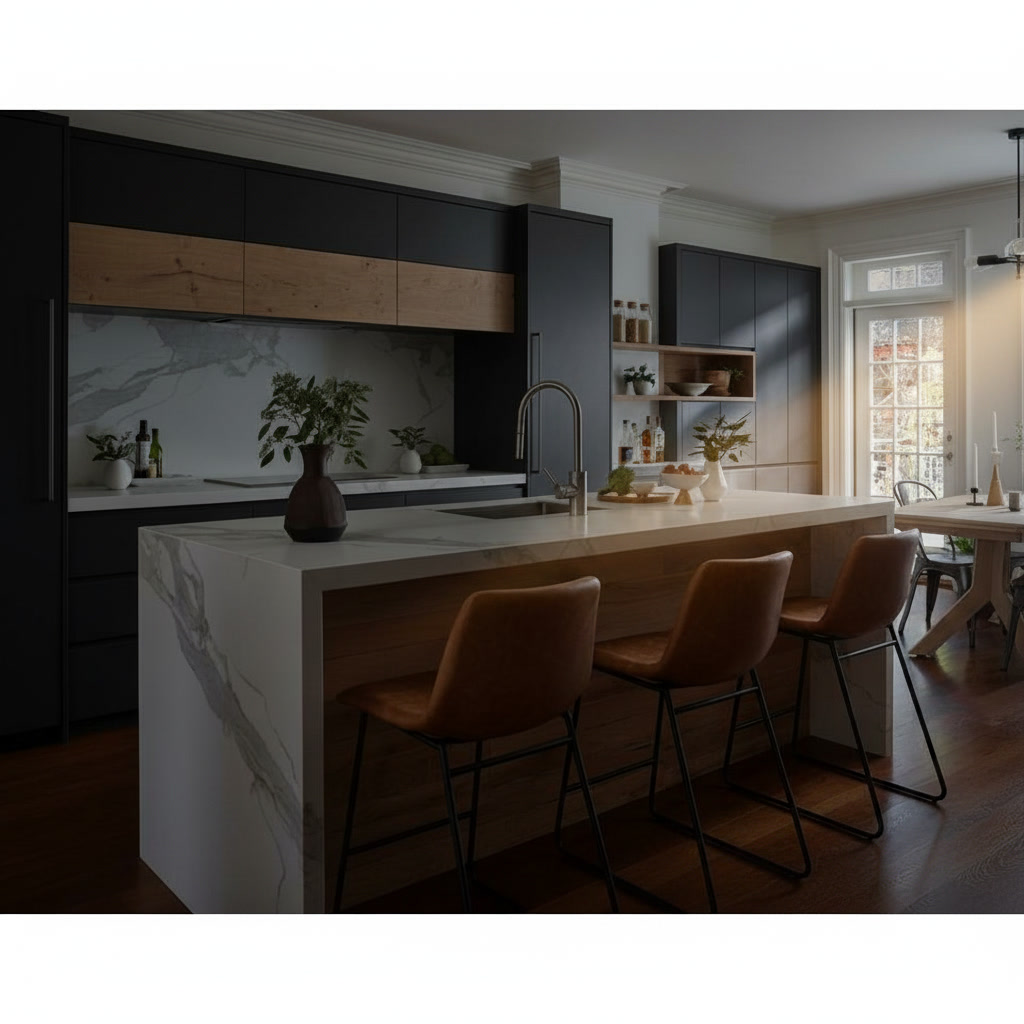
Veined travertine island with leather stools, grey kitchen with sink, induction and oven

Veined travertine island with leather stools, grey kitchen with sink, induction and oven

The island falls in a waterfall of pale veined stone: the travertine top continues down the flanks without breaking its figure, and three cognac leather stools draw up with their club-room elegance. Behind, the dark grey kitchen works with the sink beneath a suspended wooden shelf, the induction hob, the oven and well-ordered doors; a pale veined wall amplifies the light, and flowers on the counter complete the grace of the whole. A brown timber floor anchors the composition. This is warm contemporary style played on the right materials: stone that ennobles, leather that ages well, grey as the backdrop. The travertine waterfall — mitred joints at forty-five degrees, veining aligned — is the detail that marks serious work: Michelessi work, Italian craftsmanship in stone for made-to-measure indoor kitchens. The cognac of the stools does the rest: it invites you to stay.

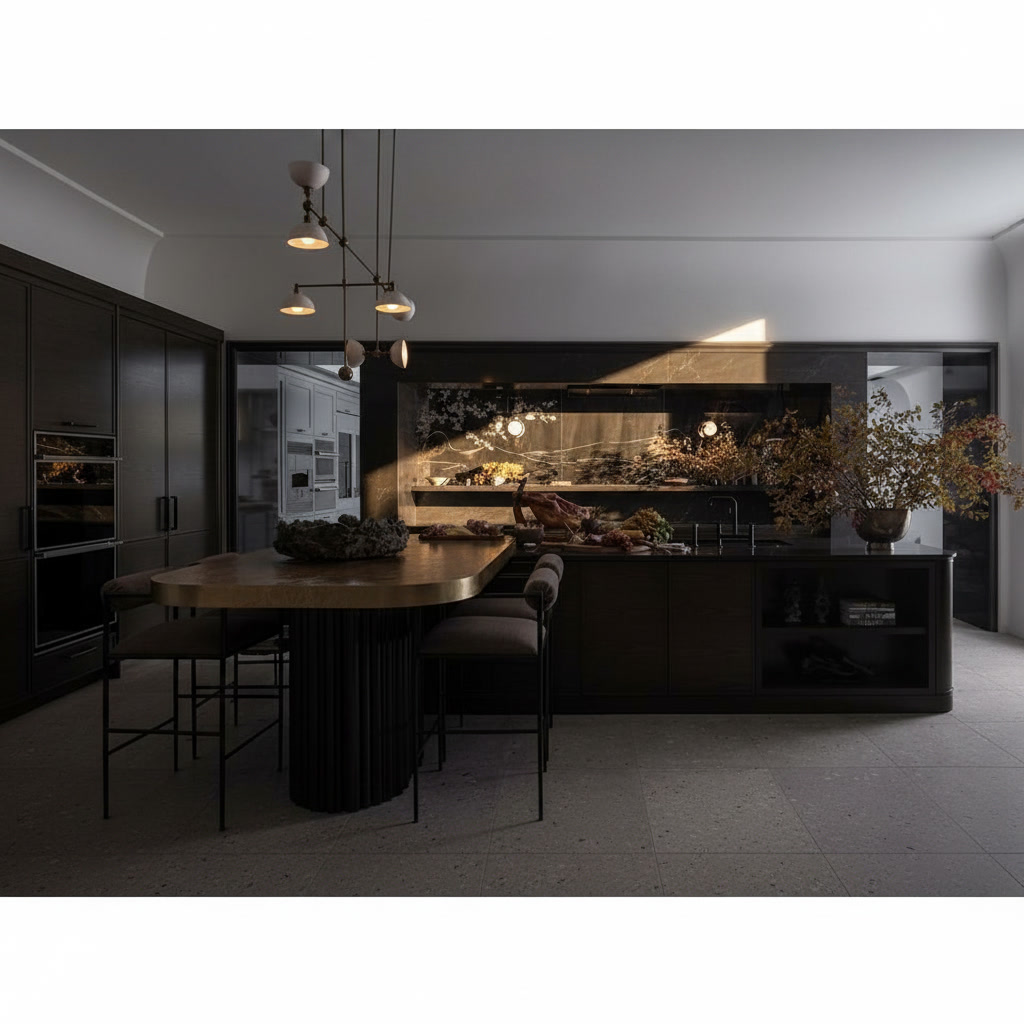
Polished solid wood kitchen with oval table, island with sink and brass details

Polished solid wood kitchen with oval table, island with sink and brass details

The scene has the depth of a formal interior: dark volumes in polished solid wood, low shelves with chosen objects, a fitted wall housing the ovens — and at the centre the oval table in blond wood, carried by its sculptural base, standing beside the island with its sink. Articulated lamps descend from the ceiling on industrial joints; upholstered stools complete the invitation. Complete with appliances, this is a kitchen for houses that live by night: deep materials, calibrated light, conviviality drawn into the design. Polished solid wood demands impeccable finishing — every reflection is an examination — and the joinery delivers it. This is the high register of Michelessi indoor kitchens: bespoke work from master hands, and an oval table that gathers people the way only edgeless forms can: naturally. Around that blond wood, even the simplest evenings take on the slow pace of special occasions.

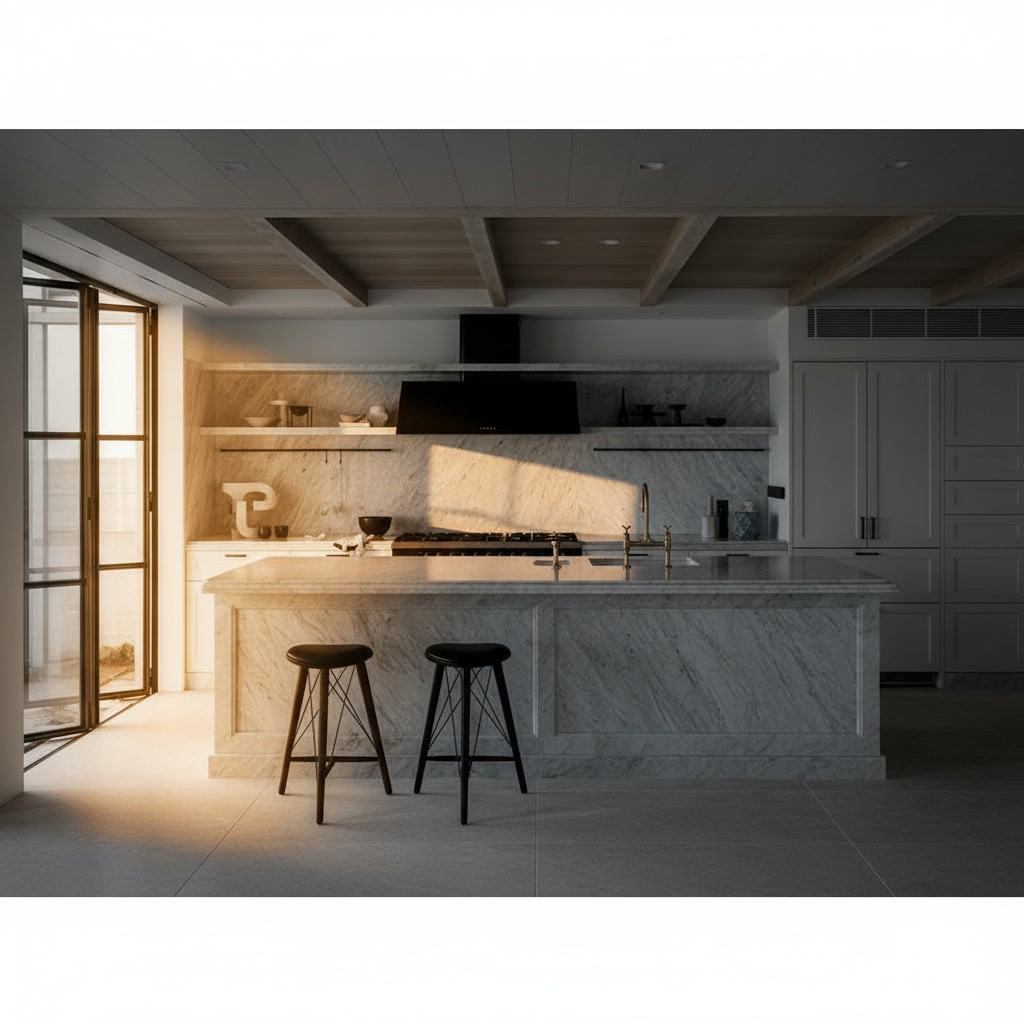
Kitchen with island entirely in Carrara marble, contrasting black hood and dark stools

Black and White Kitchen

Light pours in generously and sets the white of the Carrara marble alight: the island, carved entirely from this noble stone, reveals grey veins that drift beneath the surface like currents under ice. Above, pale ceiling beams measure out the space, while the black hood stakes its bold contrast at the centre of the scene, paired with the burners just as the design intended. A marble upstand carries the story along the wall, and two dark stools at the counter add the everyday note: this is where breakfast happens, between stone and wood. Bespoke marble work is what sets Michelessi apart — every slab chosen, cut and finished so the veining flows naturally from one surface to the next, with the quiet confidence of Italian craftsmanship. Black and white, here, is no renunciation of colour: it is a declaration of style.

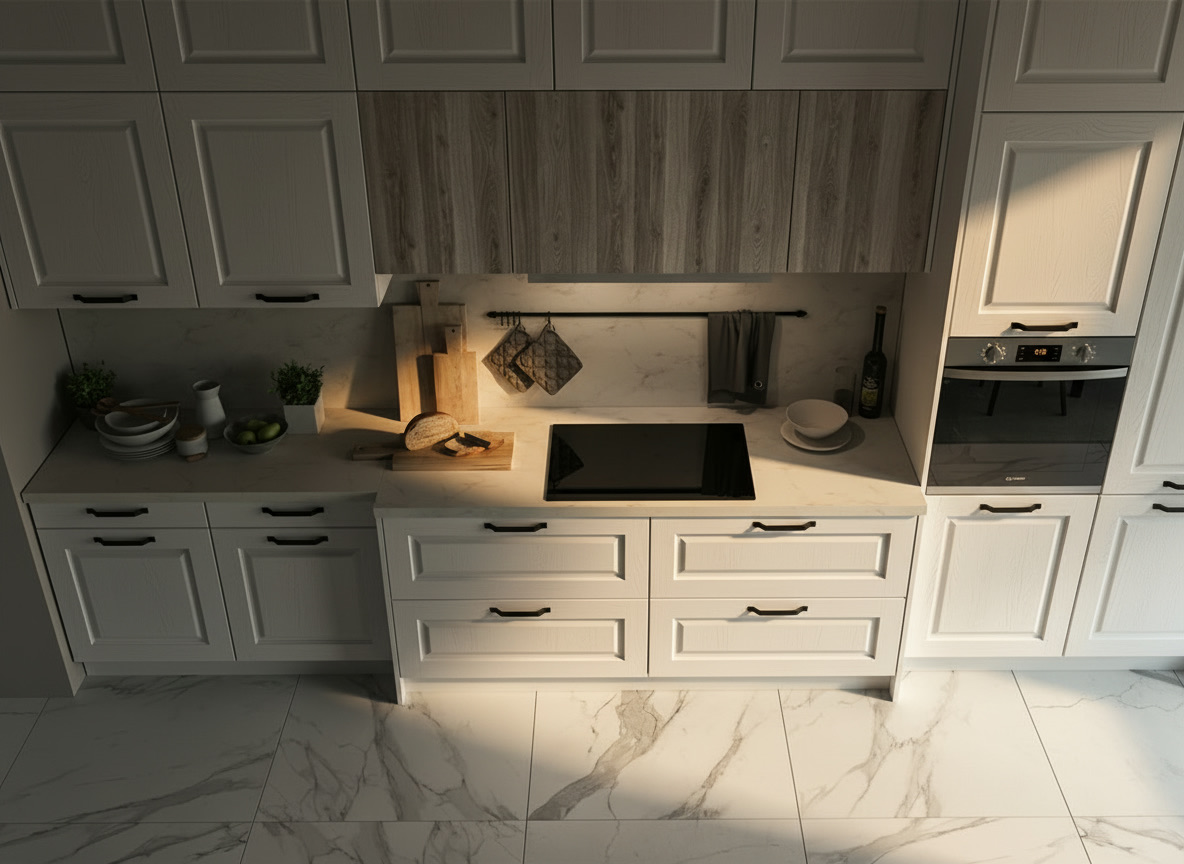
Classic white kitchen with framed doors and white marble floor with grey veining

Classic Candour on Veined Marble Floors

Seen slightly from above, the kitchen unfolds like a well-written page: white framed doors, orderly deep drawers, the pale worktop with its black induction hob, wood-effect panelling warming the wall. But it is the floor that steals the scene: great slabs with the look of white marble, crossed by grey veins running free from one side of the room to the other, like rivers seen from the sky. Such is the power of marble — true protagonist of the Italian tradition — to ennoble everything that rests upon it. Michelessi indoor kitchens are born inside this culture: the company has always worked marble to measure and knows how to set it beside modular finishes with balance, from worktop to floor. White, here, is not the absence of colour: it is a light that welcomes — the same light the marble workshops have pursued for generations, slab after slab. A floor like this is not crossed absent-mindedly: it is inhabited, with the gratitude owed to beautiful things.

Country, country chic, Provençal and rustic kitchens: the differences

Country, country chic, Provençal and rustic are variants of the same style: they differ in brightness, in the amount of ornament and in the presence of beams and stone. The table summarises how to tell them apart.

StyleHow to recognise itColours and materialsWorktop and details
CountryWood at the centre, simple furniture, no heavy ornamentShades of wood from hazelnut to beige; ochre, terracotta, green, blue, stone greyStone or wooden worktop; copper, bronze and brass in the details
Country chicLightened country, with honest materialsPale natural wood and pale coloursStone, metal, glass; brass lights
ProvençalCountry from the south of France, with exposed-beam ceilingsThose of country: shades of wood, ochre, green, blueAs in country: copper, bronze and brass in the details
RusticThe most tactile: beams, stone and knots on showCherry, oak, walnut, chestnut, with or without knotsStone splashback; wooden or stone worktop
Modern countryClean lines on a country baseWood with steel and aluminiumMarble worktop; little decoration

Michelessi makes them all on the same base: solid wood doors and a marble or stone worktop. The wood species, the finish and the colour change.

Country chic kitchen: pale wood, pale colours and honest materials

A country chic kitchen is a lightened country kitchen: pale natural wood, pale colours and no heavy ornament. It stands on materials rather than decoration: real wood, stone, a few details in metal or glass and brass lights.

  • Woods: natural oak, pale or bleached ash, maple, beech.
  • Marble worktop: white marble (Carrara, Calacatta) sits well with pale woods; beige or cream marbles with ash or pale walnut.

White, blue or green country kitchen: choosing the colour

In a country kitchen white is the brightest colour, blue and green the most rural, dark wood the most cosy. The base is the shades of the wood; on top come ochre, terracotta, green, blue and the grey of stones.

  • White country kitchen: the brightest, suited to small rooms; with pale wood on the worktop it stays warm.
  • Blue or green: colours of the countryside, which sit well on the doors while the wood and the worktop stay natural.
  • Dark wood: walnut or dark oak give a cosy kitchen; a dark wooden worktop hides scratches and stains better than a pale one.
  • Painted doors: with an open-pore lacquer the grain and knots can still be read; with a closed pore they are covered.

The pairings with white, black, beige and green are on the page light or dark wood kitchen.

Provençal country kitchen: exposed beams and country colours

A Provençal country kitchen is the country kitchen of the south of France, recognisable by ceilings with exposed beams. For the rest it has the shades of wood and the colours of country: ochre, terracotta, green, blue and the grey of stones, with copper, bronze and brass in the details. If the room has beams, the extractor hood, lights and doors are designed around their height; if it has none, the style stands on the doors, the worktop and the colours.

Rustic wood and stone kitchens: beams, splashback and worktop

A rustic wood and stone kitchen is a solid wood kitchen that leaves its materials on show: the ceiling beams, the stone of the splashback, the knots and the grain of the doors. The elements that recur in rustic kitchens are few:

  • Exposed wooden beams on the ceiling.
  • A rustic stone splashback, which becomes the focal point of the wall.
  • Solid wood doors, usually cherry, oak, walnut or chestnut, with or without knots.
  • A wooden worktop, even a dark one, or a stone or marble one.
  • Wood elsewhere too: floor and window frames of the same character.

Knotted or knot-free is an aesthetic choice: with knots the kitchen is more rustic, without them it is cleaner. A knot that is permitted and filled is a feature of the wood, not a defect.

Beams, walls out of square, niches and tall units are the reason the rustic kitchen is made to measure: standard modules do not follow a crooked wall.

Which wood for a country or rustic kitchen

For the country and rustic style the usual choices are chestnut, oak, walnut and cherry; ash, paler, goes with country chic, and in the mountain style fir and pine are used as well. The species is decided with you at the design stage. Janka hardness measures the force needed to drive an 11.28 mm steel ball halfway into the wood: the higher it is, the less the wood marks. The values come from The Wood Database, with the wood at 12% moisture.

SpeciesAppearanceJanka hardnessWorth knowing
Chestnut (Castanea sativa)Light to medium brown, turning reddish with time680 lbf (3,010 N)The wood of rustic kitchens. Rich in tannin: iron on damp wood stains it
European oak (Quercus robur)Light to medium brown, straight grain1,120 lbf (4,980 N)The species manufacturers are asked for most; it tends to darken
English walnut (Juglans regia)From light brown to chocolate, marked grain1,220 lbf (5,410 N)Black walnut is another species (Juglans nigra, 1,010 lbf) and lightens with time
Cherry (Prunus avium)Pinkish brown, then golden1,150 lbf (5,120 N)Darkens in the light
Ash (Fraxinus excelsior)Light brown, beige sapwood1,480 lbf (6,580 N)The hardest on the list, but the least stable: it moves with humidity
Silver fir and Norway spruceFrom creamy white to reddish brown320 and 380 lbfSoft wood: it marks more easily. Mountain style

For chestnut the sources disagree (680 lbf against 540), but either value sits above fir (320-380) and below oak (1,120). The species one by one are on the pages oak kitchen, walnut kitchen and chestnut, ash, cherry and fir; the construction is on the page solid wood kitchen.

The worktop and the splashback: marble, stone or wood

For a country kitchen the worktop is travertine, white marble, granite or sintered stone, or else wood: the choice depends on how you cook. In the Aprilia workshop the slabs are chosen one by one and cut on numerically controlled machines, with the finishing done by hand. Four routes:

  • Travertine: the warm beige, suited to the rustic kitchen (see the travertine page).
  • White marble (Carrara, Calacatta): for country chic and modern country.
  • Granite, quartzite, sintered stone (Dekton, Laminam in 12 mm, also 20 mm): for those who cook a lot and want a worktop that fears acids and hot pans less.
  • Wood: warm, repaired by sanding and re-oiling; it holds up near the sink if water is wiped off at once.

Marble withstands moderate heat and fears acids, such as lemon and vinegar: wipe it dry at once and put boiling pans on a trivet. The pairings with wood are on the page wood and marble, stone, steel kitchen and on the marble and wood kitchen page.

Modern country kitchen: how to make a wooden kitchen modern

A modern country kitchen keeps the wood and removes the superfluous: flat doors, steel or aluminium in the details, a marble worktop. Country chic already goes in this direction, because it joins wood and stone with clean lines. A modern kitchen with wooden beams follows the same logic: the beam brings the warmth, the rest stays clean.

If the wooden kitchen already exists, its look can be changed by painting the fronts: with enamels if you want to leave the grain visible, with an acrylic or chalk paint if you want to change it completely. The opposite route, making a modern kitchen rustic, takes four moves: exposed beams, wood on the floor and window frames too, a rustic stone splashback, walnut doors.

Finishes and care: oil, wax, varnish

Oil enters the pores and leaves the wood natural to the touch, but it has to be renewed; varnish forms a film and wipes clean with a damp cloth, but a deep scratch is hard to touch up. Cleaning is that of any wooden kitchen: a soft, barely damp cloth, no steel wool on oak and chestnut, clearances from the hob set in the design from the hob's instructions. How often to oil, how to remove grease and how to renew are on the page solid wood kitchen.

Hinges, doors and finishes are on the page doors, hinges and finishes.

Solid wood or wood effect in a country kitchen

Solid wood is the declared species through the whole thickness; veneer is real wood only on the surface; wood-effect laminate is a print on resin. Our doors are solid wood. To recognise it, ask for the construction section of the door and for the botanical species written on the quote. The comparison is on the page real wood or wood effect.

A rustic kitchen in the masonry style: Francesca

Those who look for the rustic kitchen of the farmhouses have an alternative: Francesca, an indoor kitchen with a structure of refractory stone, a marble worktop and wooden doors. We do not build in masonry: we use refractory stone blocks fitted together dry, in the masonry style. The style is described on the page rustic, country and classic masonry kitchen; the rest of the collection is among the indoor kitchens and the models.

How much does a made-to-measure country kitchen cost?

There is no figure that holds for every country kitchen: the price depends on factors that change with each project, and we do not publish price lists. What counts is the construction, the species and the selection with or without knots, the finish, the door, the metres, the out-of-measure work such as beams, niches and walls out of square, the worktop and the appliances. The factors are explained on the page how much does a wooden kitchen cost.

And outdoors? The outdoor wooden kitchen

Outdoors wood changes the rules: durable or modified species are needed, and fir, ash and cherry left natural are not suitable. Which woods hold up is on the page outdoor wooden kitchen. Michelessi outdoor kitchens have a structure of dry-laid refractory stone, steel or treated timber, and are gathered on the page outdoor kitchens.

From the 3D design to installation

The 3D design and the quotation are free wherever you are; in Rome, Latina and throughout Lazio the site survey is free too, while outside Lazio we start from your measurements and photographs, with a guided remote survey; the slabs can also be viewed by video call. Then the kitchen is installed by our own team throughout Italy; the steps, one by one, are on the page made-to-measure wooden kitchens. For other questions there is the page wooden kitchens: questions and answers.

The quotation is free: request it here.

Frequently asked questions

Frequently asked questions

What is a country kitchen?

A country kitchen is a wooden kitchen with a simple design: a sturdy worktop, few ornaments and colours that come from the materials, such as the shades of the wood, ochre, green, blue and the grey of stones. Michelessi SRL, in Aprilia, designs and builds it to measure, with solid wood doors and a marble or stone worktop.

What is the difference between a country kitchen and a rustic kitchen?

The country kitchen is simple and domestic, with wood at the centre and pale or warm colours; the rustic one is more tactile and puts beams, stone and the knots of the wood on show. They are variants of one style: the base, namely solid wood doors and a stone or marble worktop, can be the same, while the species, the finish and the colour change.

What is a country chic kitchen?

A country chic kitchen is a lightened country kitchen: pale natural wood, pale colours and no heavy ornament, with honest materials such as real wood, stone, metal and glass, and brass lights. A white marble worktop, such as Carrara or Calacatta, sits well with pale woods; beige or cream marbles go with ash or pale walnut.

What is a Provençal country kitchen?

It is the country kitchen of the south of France, recognisable by ceilings with exposed beams: if the room has them, the kitchen is designed around their height. For the rest it has the shades of wood and the colours of country, such as ochre, terracotta, green, blue and the grey of stones, with copper, bronze and brass in the details.

Which wood is used for a rustic kitchen?

Usually chestnut, oak, walnut and cherry; in the mountain style fir and pine as well. According to The Wood Database, Janka hardness is 1,120 lbf for European oak, 1,220 for English walnut, 680 for chestnut (other sources say 540) and 320-380 for fir: the higher the value, the less the wood marks. The species is chosen together at the design stage.

Can a country kitchen be modern?

Yes. The modern country kitchen keeps the wood and removes the superfluous: flat doors, steel or aluminium in the details and a marble worktop. Country chic already goes in this direction, because it joins wood and stone with clean lines. Wooden beams also suit a modern kitchen: they bring warmth, and the rest stays clean.

How do you make a modern kitchen look rustic?

With four moves: exposed beams, wood on the floor and window frames too, a rustic stone splashback as the focal point and walnut or another warm wood for the doors. A dark wooden worktop hides scratches and stains better. In a new kitchen these elements are designed together, so that beam, extractor hood and doors work with one another.

Which worktop for a country kitchen: wood, marble or stone?

It depends on how you cook. White marble, such as Carrara or Calacatta, is bright but fears acids (lemon, vinegar) and withstands moderate heat; travertine gives the warm beige of the rustic kitchen; granite, quartzite and sintered stones stand up better to heavy use. Wood is warm and can be repaired by sanding and re-oiling, but it fears standing water.

How often should an oiled country kitchen be oiled?

It depends on use and on the product: manufacturers' guides give different intervals, from six months to two years. In a country kitchen oil is the most coherent finish, because it forms no film and leaves the wood natural to the touch, with knots and grain on show; it does have to be refreshed, though, otherwise the wood stains. A mark is sanded and re-oiled. Oil-soaked cloths are flammable.

How much does a made-to-measure country kitchen cost?

There is no figure that holds for all: the price depends on the construction (solid wood, veneer or laminate), the species, the finish, the type of door, the linear metres, out-of-measure work such as beams and walls out of square, the ironmongery, the worktop and the appliances. The quotation is free wherever you are; in Rome, Latina and throughout Lazio the site survey is free too.

Does Michelessi build country kitchens outside Lazio too?

Yes. The 3D design and the quotation are free wherever you are, and installation by our own team covers all of Italy. In Lazio the site survey is free; outside Lazio we start from your measurements and photographs, with a guided remote survey; the slabs can also be viewed by video call. Our head office and workshop are in Aprilia, Via Pontina km 45.350, between Rome and Latina.

Call us WhatsApp