Skip to content
Made in Italy

Since 1976 — Wooden kitchens

Wooden Kitchens: 30 Questions on Woods, Care and Cost

WOOD · STEEL · MARBLE · STONEWARE

In short

Classic grey kitchen with veined travertine top, oven, sink and yellow stools
Classic grey kitchen with veined travertine top, oven, sink and yellow stools — photograph of a Michelessi project.

The block — a Michelessi vision

From the block,
blow after blow

01 A raw block of Calacatta Viola waits under the spotlight, in the dark kitchen with brass profiles. Mallet and chisel are already on the floor: the island is still all inside the stone.

02 Blow after blow the faces are squared, chips fly, white dust rises into the light. The chisel scores the drawers, opens the recess for the hob, carves the sink: the shape of the island comes out of the block slowly, without haste.

03 Then the stone is honed and polished: the purple vein catches the light, brass edges close the drawers, the black hob sinks into its recess, the gold tap finds its place. The island remains, and a veil of dust on the floor.

Keep scrolling — the scene follows you

Made-to-measure wooden kitchen: which wood to choose, from oak and walnut to chestnut and ash

For a made-to-measure wooden kitchen the most popular woods are oak, walnut, cherry and ash; chestnut, fir and larch belong to the rustic and mountain styles. Who builds it: Michelessi SRL, in Aprilia, between Rome and Latina; we have worked stone since 1976, we design and build wooden kitchens to measure and we install them with our own team throughout Italy.

The thirty questions below are the ones people really search for online; each answer is short and self-contained. More in the wooden kitchens department. Answers updated October 2026.

Which wood should you use to make a kitchen?

Oak is among the most requested species and hard woods mark less. In the Janka hardness test (The Wood Database) European ash reaches 6,580 N, European oak 4,980 N and silver fir 1,420 N; ash, however, moves a great deal with humidity.

Which woods are used for a made-to-measure kitchen?

Usually oak, walnut (European or American), cherry and ash; rustic and mountain styles also use chestnut, fir and larch. Colour, grain and change over time matter: cherry darkens in the light, while American walnut lightens. More species: chestnut, ash, cherry and fir.

Are noce canaletto and noce nazionale the same wood?

No. Noce canaletto is American walnut (Juglans nigra): heartwood from brownish to dark chocolate, lightening over time. Noce nazionale, European walnut (Juglans regia), ranges from light brown to chocolate, with a bold, irregular grain. The species should be written on the quote. Details: walnut kitchen.

What are the pros and cons of an oak kitchen?

Pros: a striped, flame-like grain, a warm colour, a hard wood. Cons: with oil or wax it needs periodic renewal, it tends to darken in the light and, in contact with water and iron (steel wool, rusty nails), it stains blue-black because of tannins. See oak kitchen.

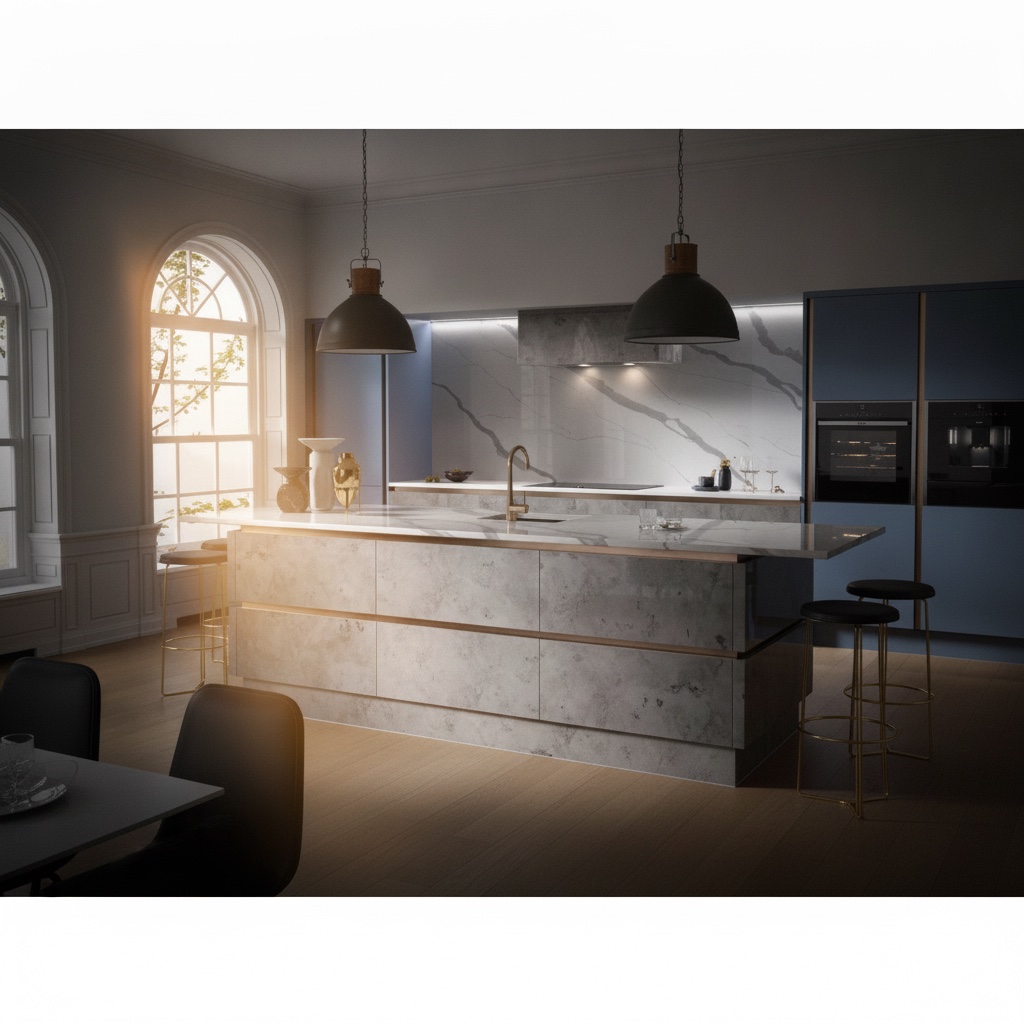
Stoneware-clad kitchen with island, integrated sink, induction hob, hood and oven

Stoneware-clad kitchen with island, integrated sink, induction hob, hood and oven

The island presents itself in its pale stone-effect stoneware dress, crossed by slender inserts that mark out its drawers; above, the top integrates sink and induction hob in a single working surface, served by burnished taps. Behind, a marble-effect stoneware wall rises beyond the cooking zone, while powder-blue columns — with black ovens recessed — add the colour that gentles the whole scene. Dark bell lamps, stools at the counter, tall windows of a stately apartment: the ensemble has an urban, serene elegance. A wooden structure clad in stoneware is a sound formula: the constructive warmth of wood, the resistance of ceramic at the surface. With hood and oven completing the equipment, it is an indoor kitchen ready for real life: Michelessi builds it to measure, attending to joints, recesses and tonal pairings with an artisan's care. The powder blue, then, is the touch that lingers in the eye.

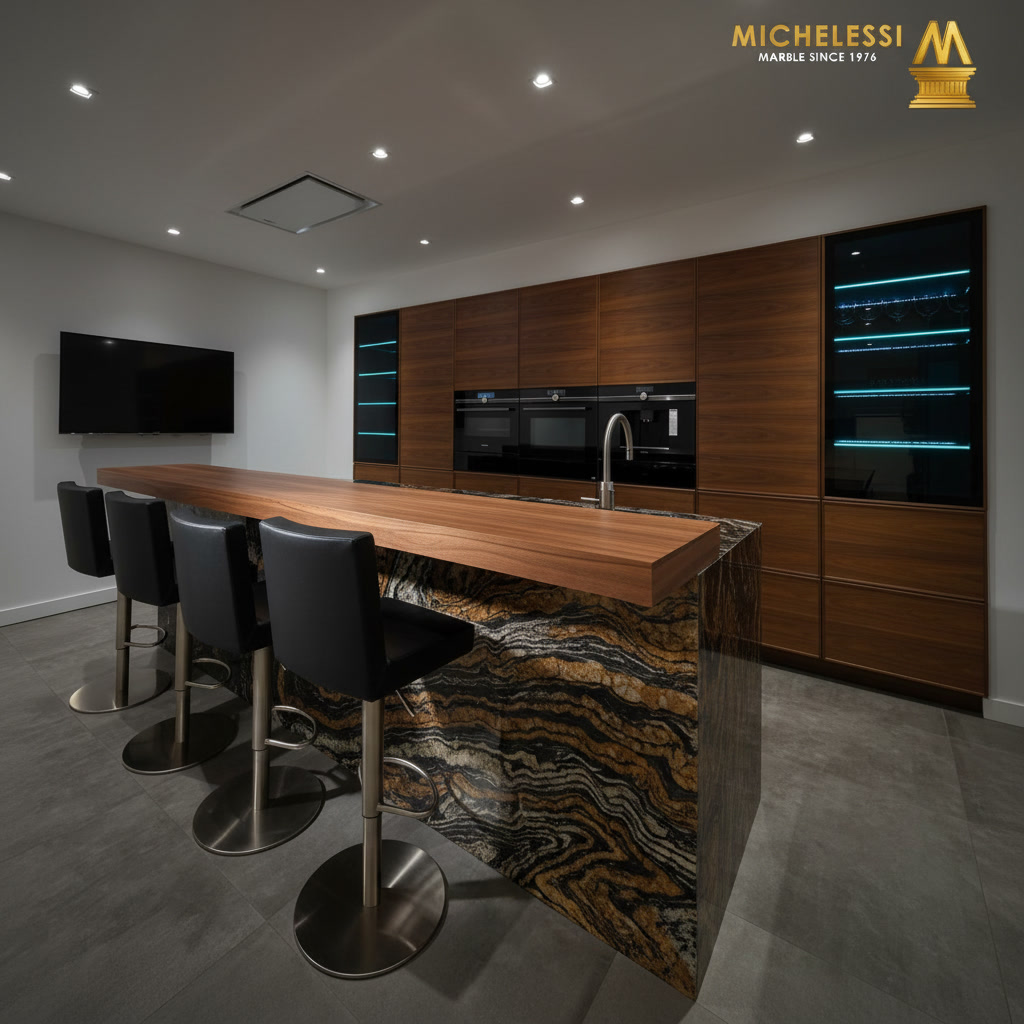
Central quartzite island with spectacular veining, wooden counter and black stools

Central quartzite island with spectacular veining, wooden counter and black stools

The island is a fire made stone: quartzite with amber and black veining blazes along the flanks in its impetuous figuring, polished until it mirrors the room; above, a solid wood counter lays down its warm board and gathers black swivel stools. The sink sits flush in the top; behind, walnut boiserie conceals and reveals — black ovens, backlit vitrines of bottles, a recessed television. A pale floor leaves the whole stage to the material. This is the project for those who want a collector's stone at the heart of the home: quartzite, with its unrepeatable figure, is not chosen from a catalogue — it is encountered, slab by slab. Bespoke stonework orchestrates its veining across top and flanks, with cuts and joints that honour the natural movement. This is the art of Michelessi: craftsmanship that knows when a stone deserves the stage, and builds one around it.

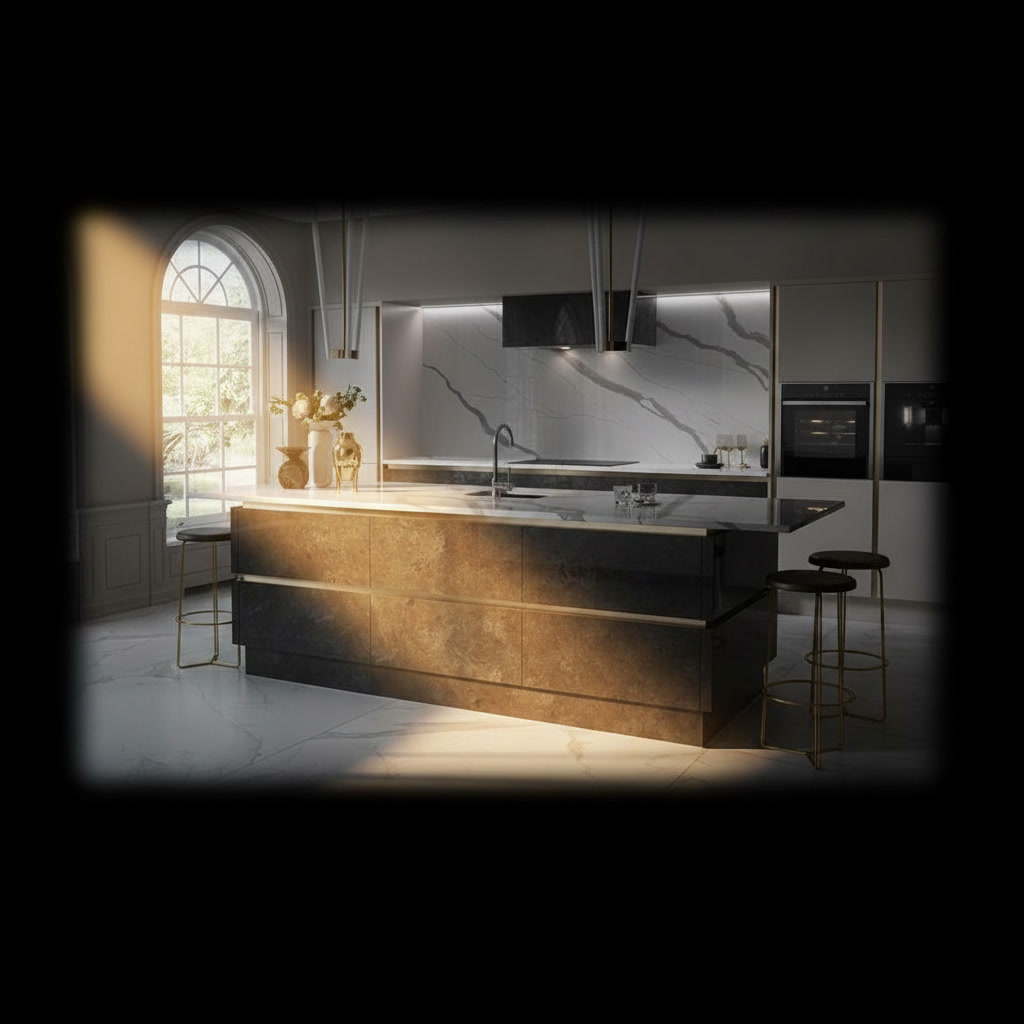
Kitchen with island clad in grey porcelain stoneware with golden profiles and marble wall

Kitchen with island clad in grey porcelain stoneware with golden profiles and marble wall

Arched windows and a wall of veined marble effect give the room the breath of a palazzo; at the centre, the island clad in stone-grey porcelain dresses itself in golden profiles — fine lines running along the volumes like threads of light — and carries the integrated sink with its gold tapware. Stools with gilded details complete the register, together with dark columns housing the built-in ovens. Fully equipped, this is a kitchen that plays the luxury card openly: technical materials treated like jewels, measured reflections, a curated scenography. The porcelain stoneware bears the practical side with its tireless surface; the gold does its own work, which is to shine. Made-to-measure holds it all in balance: proportions, alignments, cut-outs. This is the glamorous face of Michelessi indoor kitchens: artisan craftsmanship that knows how to be sober when needed — and magnificent when the project asks. The gold here is not ostentation: it is a line of light drawn with a ruler.

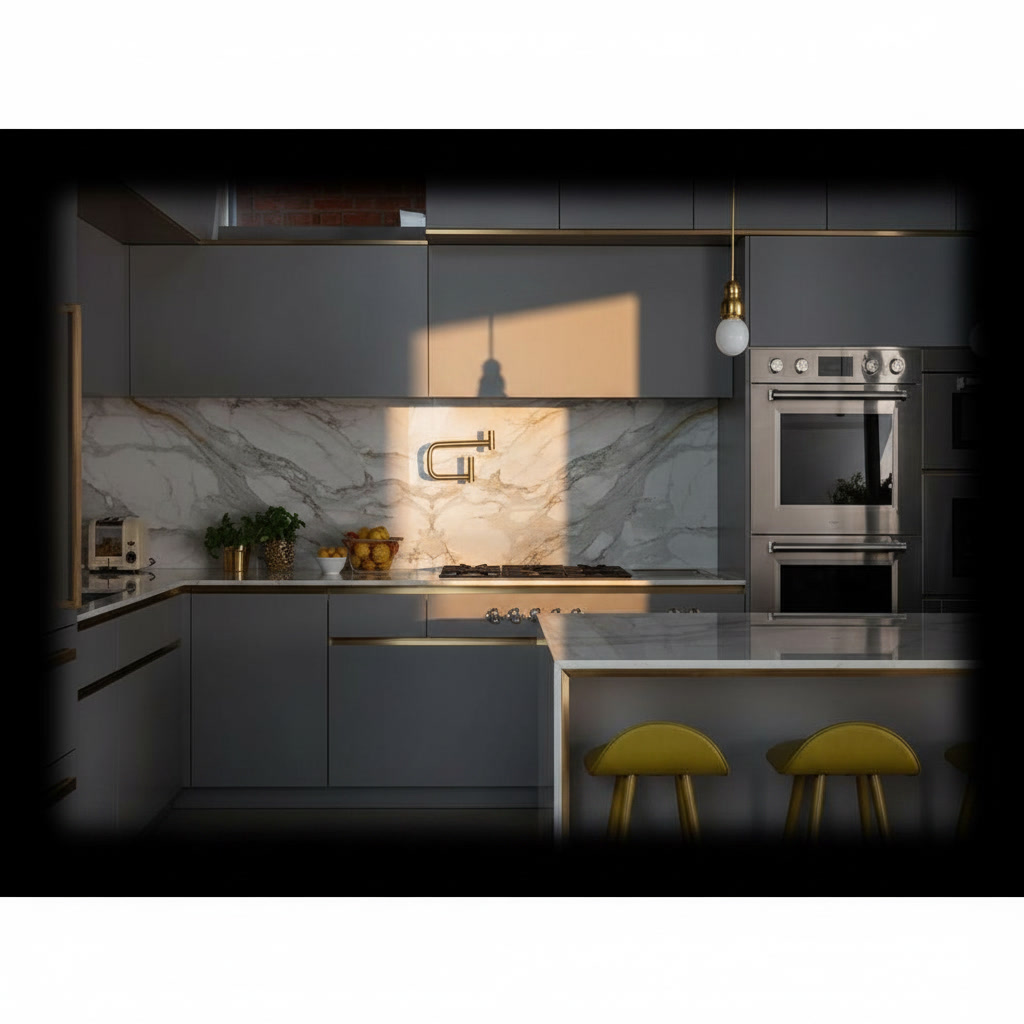
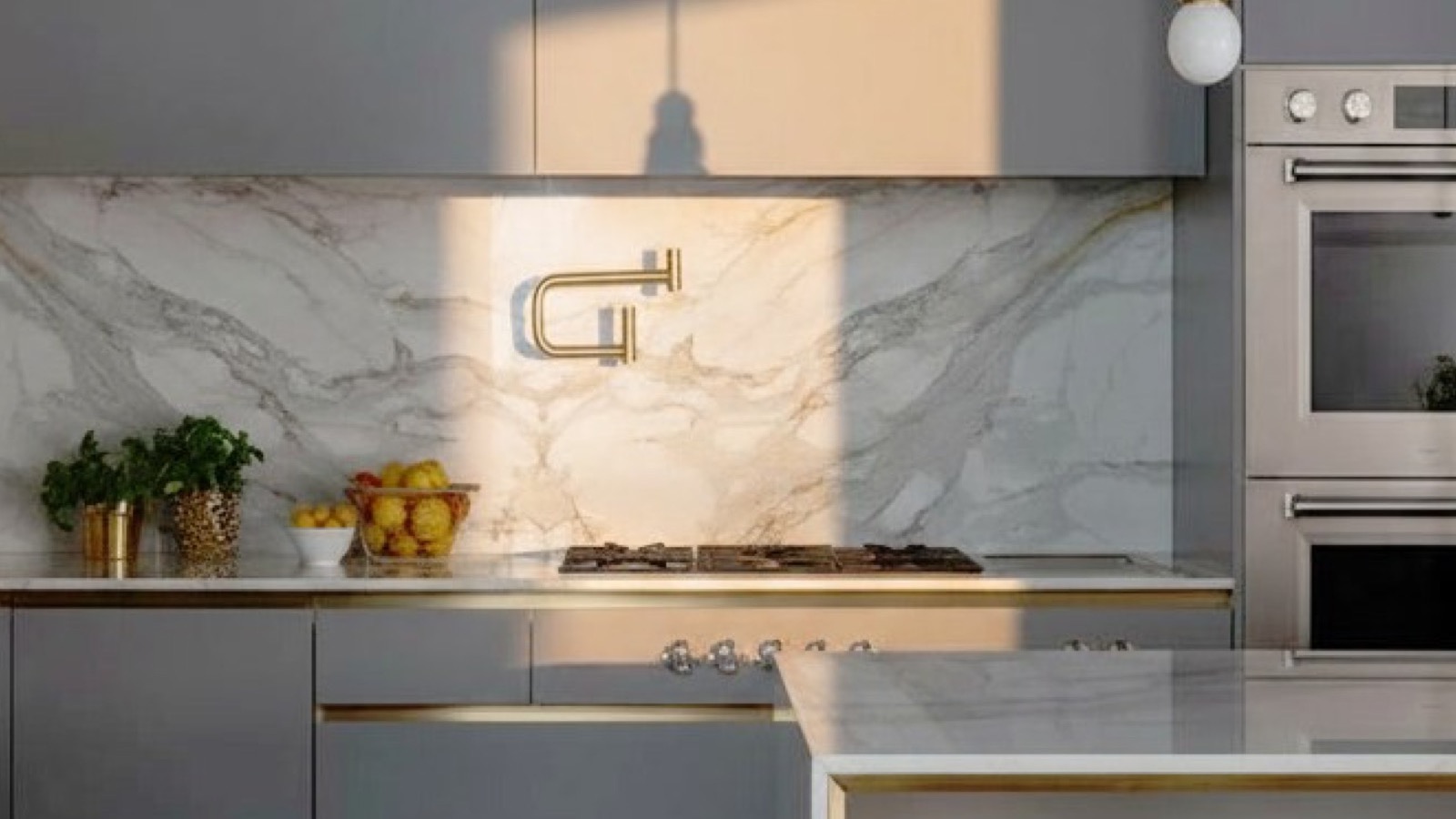
Classic grey kitchen with veined travertine top, oven, sink and yellow stools

Classic grey kitchen with veined travertine top, oven, sink and yellow stools

The lines are elegant and the colour knows it: uniform grey doors, crossed by golden profiles that draw the handles and frames, meet a veined travertine counter — pale stone with a moving figure that also clads the wall behind the burners, as one single mineral gesture. Twin ovens sit in their column, the sink works beneath a suspended brass bulb, and yellow stools light the counter with their note of sun. Complete with oven, sink and range, this is a classic kitchen of contemporary proportions: few elements, all of them right. Veined travertine is the silent protagonist: Roman stone, warm and luminous, worked to measure in counters and cladding with the care its history deserves. This is the Michelessi métier: craftsmanship that sets gold against stone without ever sliding into excess — because true elegance is known by its restraint. The yellow stools confirm it: elegance, now and then, also knows how to smile.

Solid wood kitchen: real wood, veneer or laminate

A solid wood kitchen has its visible parts made of the declared species throughout their thickness; veneer is real wood only on the surface, and wood-effect laminate is a print on resin. Solid wood can be sanded and refinished, but it is not necessarily more stable. Blockboard has a core of solid wood strips faced with wood. Details: solid wood kitchen, real wood or wood-effect.

What is solid wood (or massello)?

Solid wood is wood of the declared species throughout the thickness of the piece, not only on the surface; it can be made of several glued pieces of the same species. “Massiccio” is a synonym, but in the trade the word is stretched: ask for the door's construction section.

Are “real wood” and solid wood the same thing?

No. “Real wood” means the visible surfaces are wood, often a veneer glued onto a support; solid wood is wood throughout its thickness. Only solid wood can be sanded back deeply, but it is not necessarily the more stable when humidity swings strongly.

How can you tell if a kitchen is real wood?

Check the edges and back of the door: a thin line from corner to corner means it is not solid wood, and the front grain should match the back. Well-matched veneer can look like a single board, so ask for the construction section and the species written on the quote.

Wooden kitchen or laminate: which to choose?

Wood-effect laminate costs less and is easy to clean, but it is a print on resin and cannot be sanded. Wood costs more, has a true grain and, if solid, can be repaired by sanding: wood for repairability, laminate to save money.

What is a glued-strip (lamellare) wood worktop?

It is a surface made of solid wood strips glued end to end and along the edges, giving a uniform, stable panel. The wood is real throughout its thickness but made of several elements, unlike a single board or a veneer. The wooden worktop and the glued-strip top are on the page solid wood kitchen.

Solid wood kitchen worktop: pros and cons?

Pros: a warm look and, if marked, it is repaired by sanding and re-oiling. Cons: the oil must be renewed periodically, the wood marks and dislikes standing water and wet iron (steel wool, rusty nails). Hard woods, such as oak and ash, mark less than fir. Finishes and care of the worktop: solid wood kitchen.

Does a wooden worktop cope next to the sink?

It copes if water is dried straight away and the finish is looked after; the enemies are standing water and hidden leaks. Next to sink and hob you can choose granite, quartzite or sintered stone (Dekton), keeping the wood for doors and island.

How to clean and renew a wooden kitchen

A wooden kitchen is cleaned with a soft, barely damp cloth, with no abrasive cleaners, drying any moisture straight away. Oil or wax is refreshed with the same product; varnish needs gentle cleaners. Finishes: doors, hinges and finishes.

How do you clean a wooden kitchen (light, dark, solid wood)?

With a soft, barely damp, well-wrung cloth wiped along the grain, with no abrasives; liquids are dabbed up and moisture is removed straight away. Light or dark, the finish matters, not the colour: varnish needs a gentle cleaner, while oiled wood is refreshed with oil or wax.

How do you clean a walnut or oak kitchen?

The rules for any wooden kitchen apply, because the finish matters more than the species: barely damp cloth, liquids dabbed up, surface dried at once. On oak, and on chestnut too, no steel wool and no prolonged contact between iron and water: the tannins react and leave blue-black stains.

How do you clean a wooden kitchen naturally?

For fresh grease, remove the excess with kitchen paper, apply a paste of bicarbonate of soda and water, then wipe with a damp cloth and dry. If the surface is oiled, rub a thin film of oil over the area. No abrasives and no standing water on the wood.

How often should a wooden kitchen be oiled?

It depends on use and on the product: manufacturers' instructions give different intervals, from every 6-12 months to every 1-2 years. If renewal is neglected, the surface stains more easily. Cloths soaked in oil are flammable and must be disposed of with care.

How do you renew a dark wooden kitchen?

It depends on the finish. If it is oiled, sand lightly and re-oil. If it is varnished, a deep scratch cannot be touched up well: usually the surfaces are sanded and fully revarnished. Alternatively the fronts can be painted with acrylic or chalk paint.

How do you renew a walnut or oak kitchen?

Solid wood can be sanded and refinished, removing marks and scratches even in depth. Veneer can only be sanded within the limits of its covering layer, which is often thin. Before deciding, check whether the doors are solid wood or veneered.

How much does a made-to-measure or solid wood kitchen cost?

There is no price per metre that applies to everyone: a made-to-measure wooden kitchen costs according to construction, species, finish, doors, measurements and worktop. The quote is free everywhere; the site survey is free in Rome, Latina and throughout Lazio. The factors: how much a wooden kitchen costs.

How much does a made-to-measure wooden kitchen cost?

There is no figure that applies to everyone: the price depends on construction (solid, blockboard, veneer), species, finish, type of door, linear metres, worktop, fittings and out-of-standard work. Wood costs more than laminate and melamine. For the cost you need the design: the quote is free.

How much does a solid wood kitchen cost?

Solid wood is among the most expensive options, more than veneer, laminate and melamine. The price changes with species, selection (with or without knots), finish and worktop, which may be marble or stone. We do not publish figures: the quote is free.

How much does an oak kitchen cost?

Oak is in great demand, also because it is a quality wood without excessive cost. The price changes a great deal between solid and veneered and with selection (with or without knots), finish, measurements and worktop. A reliable figure is given only after the design.

How long does a made-to-measure wooden kitchen take?

There is no single time for every kitchen: a made-to-measure kitchen starts from the 3D design and then needs production and installation, which vary with species, finish, number of pieces and measurements. That is why we give no weeks before the design: times are agreed with you.

Modern or rustic, light or dark wooden kitchen: pairings with marble, stone and steel

Wood goes well with marble, stone and steel: the basis is the contrast between a warm, matt surface, the wood, and a cool, polished one, the marble or steel. We have worked marble and stone since 1976 and build islands, worktops and whole kitchens. More: wood with marble, stone, steel.

Do marble and wood go well together?

Yes: marble is cool and polished, wood warm and matt, and the contrast works tone on tone as well. A typical solution is an island with a marble top and wooden base units. Marble dislikes acids and tolerates only moderate heat. See the marble and wood kitchen.

Which wood goes with marble?

It depends on the marble: with white (Carrara, Calacatta), pale woods such as natural oak, maple and beech; with beige or cream, ash and light walnut; with black (Nero Marquina), teak, dark oak or dark walnut; with veined greys, bleached larch or grey oak; with pink, cherry.

Oak kitchen: black or white worktop?

Natural oak with white marble gives a luminous kitchen, and a pale worktop makes golden oak stand out; dark oak with black marble gives a more intense one. For a worktop that does not fear acids and temperature swings, dark granite or quartzite is better.

White kitchen with a light or dark wooden worktop?

Pale wood with white lightens small spaces, and a lacquered light blue can be added; a dark wooden worktop hides scratches and stains better than pale wood. The choice depends on light, size and use. More pairings: light or dark wood.

Which floor goes with an oak kitchen?

Two routes: an oak herringbone floor, for a warm, continuous room, or a dark stone such as granite, for a clear contrast; with a dark stone floor a granite worktop is coherent. We also work floors in marble and stone, made to measure.

Which wall colour goes with an oak kitchen?

Natural, earthy tones work: beige, terracotta, coffee brown. Oak also takes white, which lightens small kitchens, and green, which goes well with oak panelling and wall units. The final choice is made on the sample, in the light of your own room.

How do you make a wooden kitchen look modern?

With lines and pairings: smooth, handle-free fronts, a worktop in white marble or stone and steel details. On an existing kitchen the fronts can also be painted: enamels to leave the grain visible, or acrylic or chalk paint to change the look completely. The style is on the page modern country kitchen.

How do you make a modern kitchen look rustic?

With exposed beams, wood on the floor and window frames too, a rustic stone splashback and walnut or chestnut doors. A wooden worktop and natural colours, from hazel to beige, complete the country style; copper, bronze and brass are the details. More: rustic and country kitchen.

Outdoor wooden kitchen: which woods stand up outdoors

Outdoors, durable or modified woods stand up, such as teak, iroko, chestnut and heat-treated wood; untreated fir, ash and cherry are not suitable. Michelessi outdoor kitchens have a structure of dry-laid refractory stone, of steel or of treated timber, with worktops in granite, quartzite or sintered stone; wood is used for the doors. See outdoor wooden kitchen and outdoor kitchens.

Can you make an outdoor wooden kitchen?

Yes, with durable or modified woods and regular maintenance. An uncovered outdoor kitchen falls into use class 3.2 (EN 335): teak, iroko, chestnut and heat-treated wood stand up; untreated fir, ash and cherry do not. Wood turns grey and the treatment must be renewed.

WoodNatural durability (EN 350)Good to know
TeakClass 1, heartwood onlyUntreated, it turns grey: a change of colour, not damage
IrokoClass 1-2Resists rot and insects; used in place of teak
ChestnutClass 2Rich in tannin: iron on damp wood stains it and corrodes fixings
Heat-treated woodClass 2 (manufacturer's figure)More stable; turns grey in 3-6 months without UV protection
Untreated fir, ash, cherryFir 4; ash perishable; cherry moderately to non-durableNot suitable outdoors without modification

Sources: CNR-IVALSA and The Wood Database. Classes apply to heartwood; comparison values, not guarantees.

The quote is free: request it here.

Frequently asked questions

Frequently asked questions

Are “real wood” and solid wood the same thing?

No. “Real wood” means the visible surfaces are wood, often a veneer glued onto a support; solid wood is wood throughout its thickness. Only solid wood can be sanded back deeply, but it is not necessarily the more stable when humidity swings strongly.

What is a glued-strip (lamellare) wood worktop?

It is a surface made of solid wood strips glued end to end and along the edges, giving a uniform, stable panel. The wood is real throughout its thickness but made of several elements, unlike a single board or a veneer.

Solid wood kitchen worktop: pros and cons?

Pros: a warm look and, if marked, it is repaired by sanding and re-oiling. Cons: the oil must be renewed periodically, the wood marks and dislikes standing water and wet iron (steel wool, rusty nails). Hard woods, such as oak and ash, mark less than fir.

Does a wooden worktop cope next to the sink?

It copes if water is dried straight away and the finish is looked after; the enemies are standing water and hidden leaks. Next to sink and hob you can choose granite, quartzite or sintered stone (Dekton), keeping the wood for doors and island.

How do you clean a wooden kitchen naturally?

For fresh grease, remove the excess with kitchen paper, apply a paste of bicarbonate of soda and water, then wipe with a damp cloth and dry. If the surface is oiled, rub a thin film of oil over the area. No abrasives and no standing water on the wood.

How do you renew a dark wooden kitchen?

It depends on the finish. If it is oiled, sand lightly and re-oil. If it is varnished, a deep scratch cannot be touched up well: usually the surfaces are sanded and fully revarnished. Alternatively the fronts can be painted with acrylic or chalk paint.

Call us WhatsApp