Skip to content
Made in Italy

Since 1976 — Bespoke kitchens

Luxury Kitchens: Bespoke in Marble, Solid Wood and Steel

WOOD · STEEL · MARBLE · STONEWARE

In short

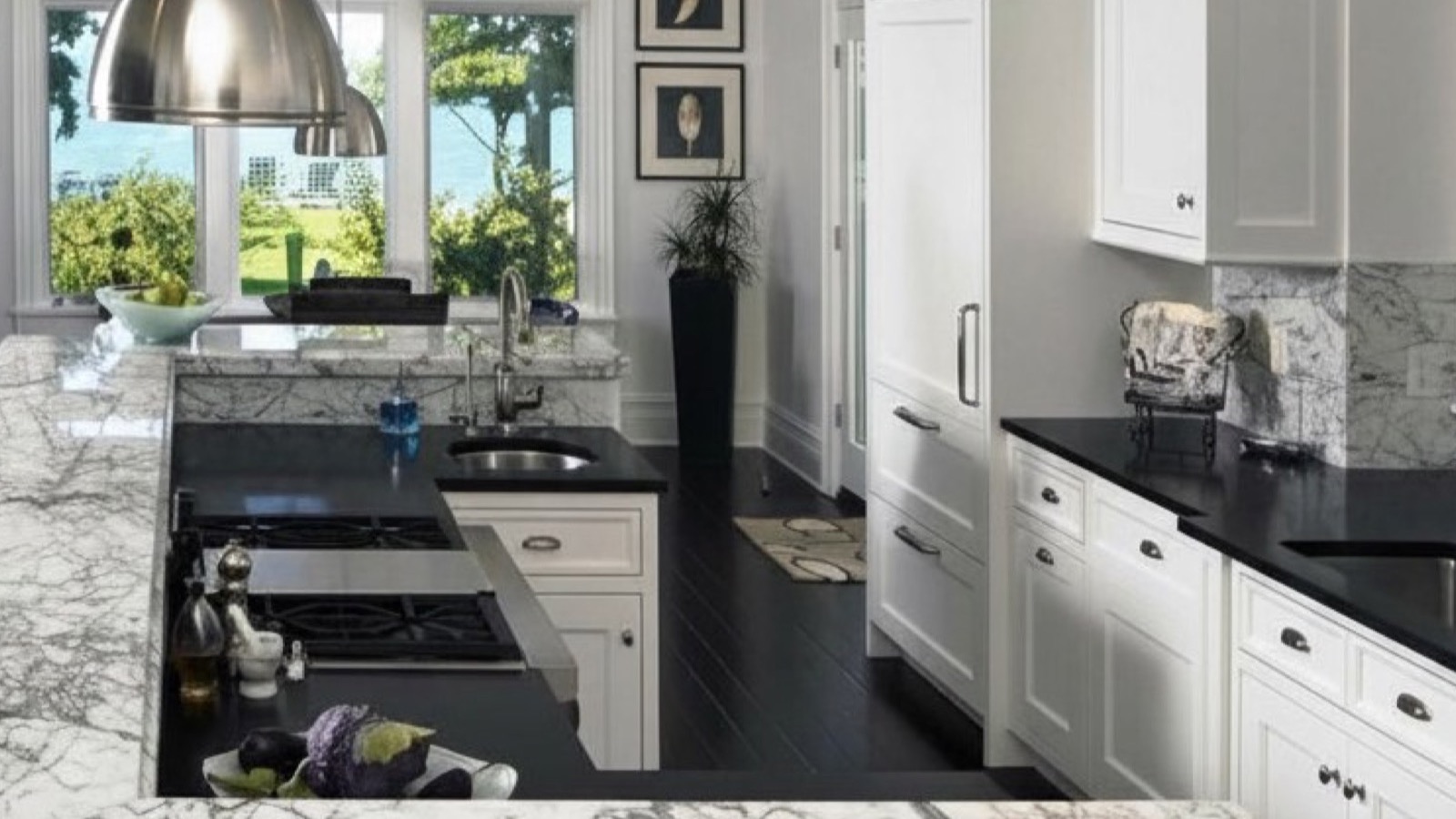
Elegant kitchen with accentuated-vein Carrara marble counters and black quartz tops
White Elegance Kitchen — photograph of a Michelessi project.

The block — a Michelessi vision

From the block,
blow after blow

01 A raw block of Calacatta Viola waits under the spotlight, in the dark kitchen with brass profiles. Mallet and chisel are already on the floor: the island is still all inside the stone.

02 Blow after blow the faces are squared, chips fly, white dust rises into the light. The chisel scores the drawers, opens the recess for the hob, carves the sink: the shape of the island comes out of the block slowly, without haste.

03 Then the stone is honed and polished: the purple vein catches the light, brass edges close the drawers, the black hob sinks into its recess, the gold tap finds its place. The island remains, and a veil of dust on the floor.

Keep scrolling — the scene follows you

Luxury kitchens: what makes a kitchen luxurious

A luxury kitchen is a bespoke kitchen in which the materials, craftsmanship, design and details are chosen for that room and for the people who live in it, rather than taken from a catalogue. Who builds it: Michelessi SRL, Aprilia, with installation throughout Italy. We have worked stone since 1976, on the Via Pontina between Rome and Latina, and we design and build complete kitchens to measure (marble, stone, solid wood, steel, porcelain stoneware), indoors and outdoors.

Luxury is not measured by the number of appliances or the name on the door, but by four things you can see and touch:

  • the materials: real stone, steel and solid wood, rather than printed or laminated coverings that imitate them;
  • the craftsmanship: slabs chosen one by one, numerically controlled cutting, hand finishing;
  • the design: it starts from a survey of your room, out-of-square walls included, not from a row of modules;
  • the details: joints, edges, doors, extractor, light.

This page explains the criteria one by one, so that you can judge any kitchen, ours included. We do not rank brands. The overview is on the page bespoke kitchens.

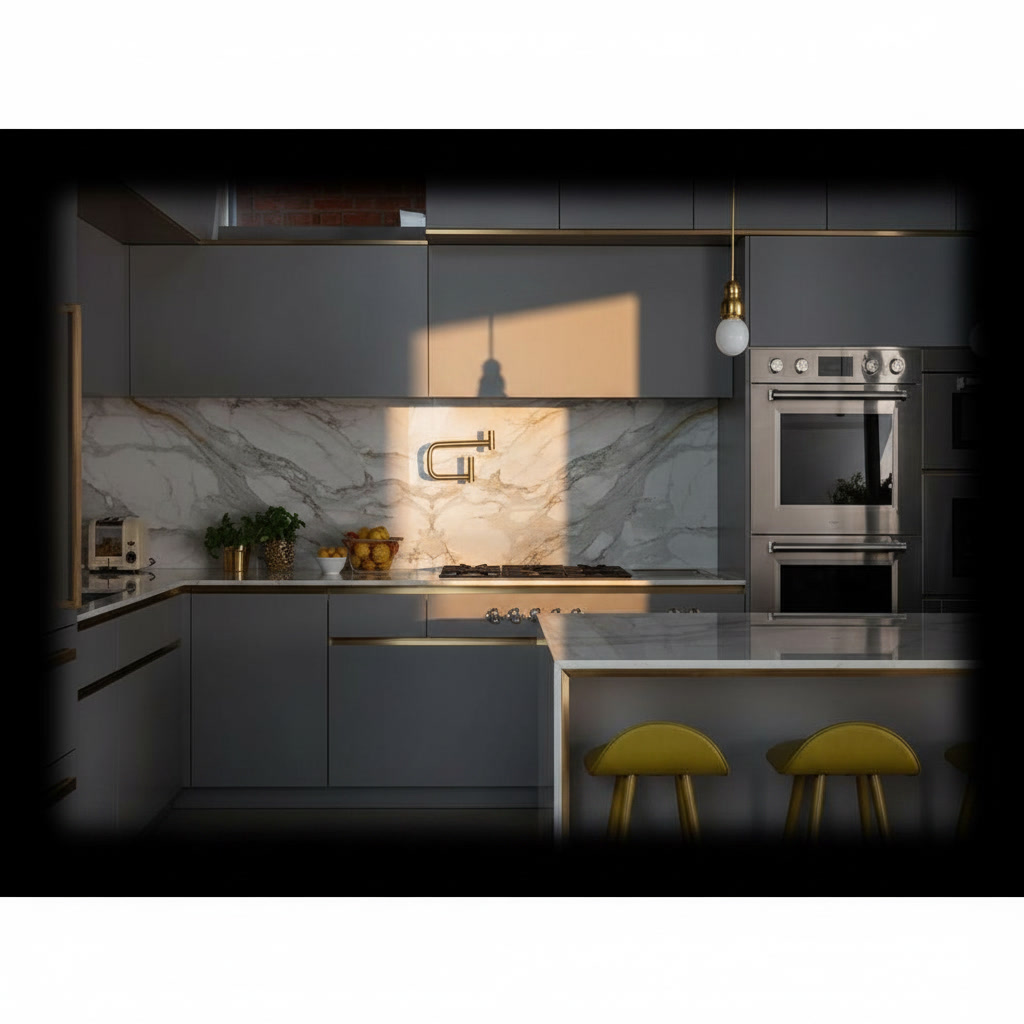
Classic grey kitchen with veined travertine top, oven, sink and yellow stools

Classic grey kitchen with veined travertine top, oven, sink and yellow stools

The lines are elegant and the colour knows it: uniform grey doors, crossed by golden profiles that draw the handles and frames, meet a veined travertine counter — pale stone with a moving figure that also clads the wall behind the burners, as one single mineral gesture. Twin ovens sit in their column, the sink works beneath a suspended brass bulb, and yellow stools light the counter with their note of sun. Complete with oven, sink and range, this is a classic kitchen of contemporary proportions: few elements, all of them right. Veined travertine is the silent protagonist: Roman stone, warm and luminous, worked to measure in counters and cladding with the care its history deserves. This is the Michelessi métier: craftsmanship that sets gold against stone without ever sliding into excess — because true elegance is known by its restraint. The yellow stools confirm it: elegance, now and then, also knows how to smile.

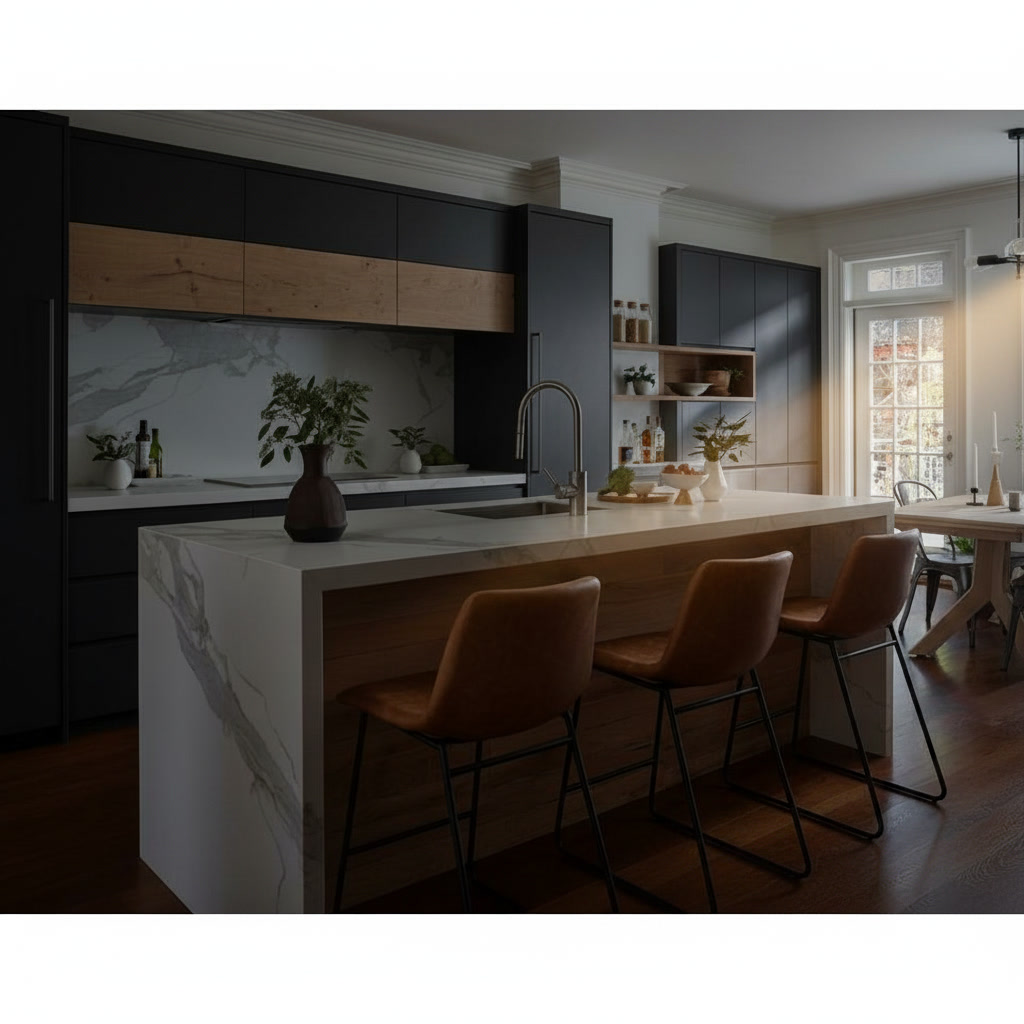
Veined travertine island with leather stools, grey kitchen with sink, induction and oven

Veined travertine island with leather stools, grey kitchen with sink, induction and oven

The island falls in a waterfall of pale veined stone: the travertine top continues down the flanks without breaking its figure, and three cognac leather stools draw up with their club-room elegance. Behind, the dark grey kitchen works with the sink beneath a suspended wooden shelf, the induction hob, the oven and well-ordered doors; a pale veined wall amplifies the light, and flowers on the counter complete the grace of the whole. A brown timber floor anchors the composition. This is warm contemporary style played on the right materials: stone that ennobles, leather that ages well, grey as the backdrop. The travertine waterfall — mitred joints at forty-five degrees, veining aligned — is the detail that marks serious work: Michelessi work, Italian craftsmanship in stone for made-to-measure indoor kitchens. The cognac of the stools does the rest: it invites you to stay.

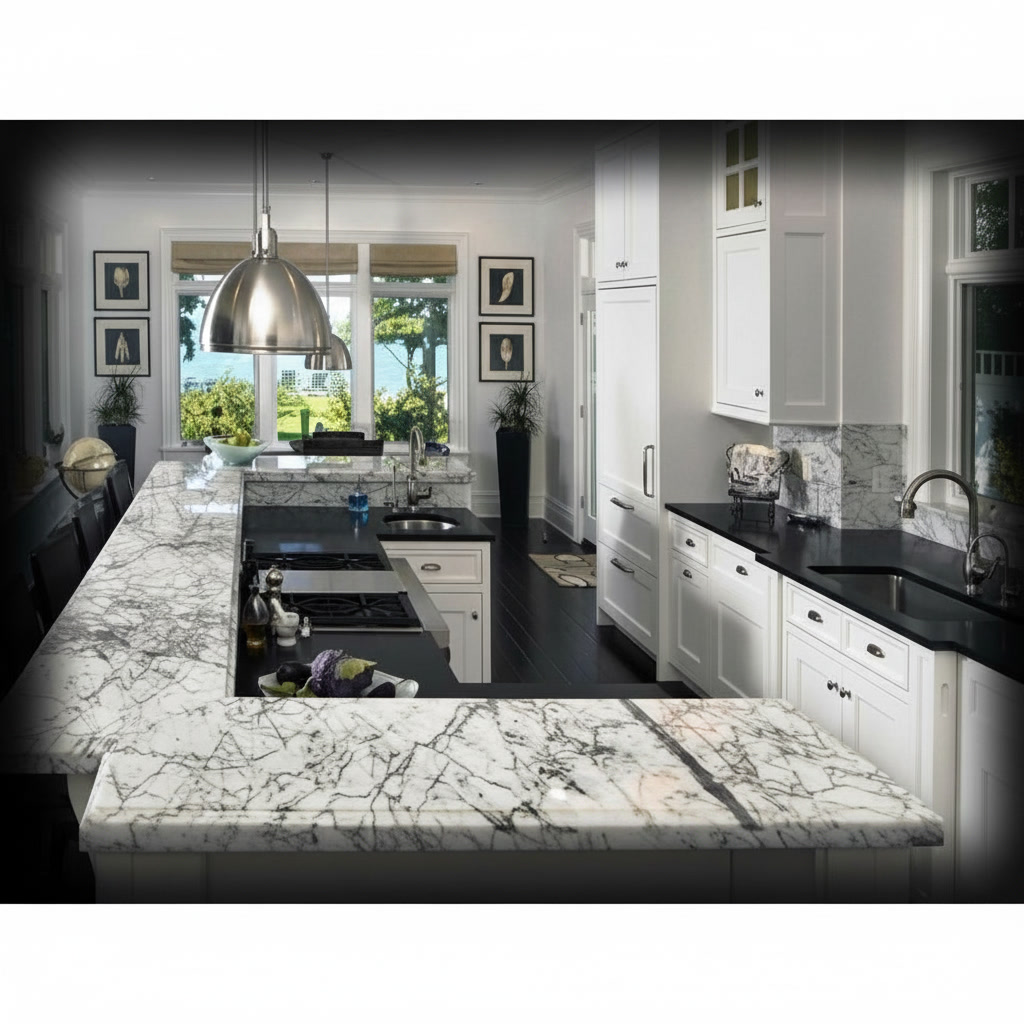
Elegant kitchen with accentuated-vein Carrara marble counters and black quartz tops

White Elegance Kitchen

The project plays a refined match: alternating counters in Carrara marble with accentuated veining — the stone coursed by dense, dramatic grey ramifications — with tops in black quartz, deep and uniform. The result is a visual rhythm that carries the gaze along the whole kitchen: restless white, quiet black, white again. The double-level island integrates the burners and the basin, served by the great steel dome lamp; around it, white cabinets of classic design, paintings on the walls and garden light beyond the windows complete an elegance of the well-bred house, inhabited with taste. Alternating stones so different demands a confident direction: coherent thicknesses, twin edges, clean transitions. It is the competence Michelessi brings to bespoke work in marble and quartz, with a fine instinct for equilibrium: because contrasts, when well orchestrated, do not divide — they compose. Restless white and quiet black: an alternation the eye follows without ever tiring.

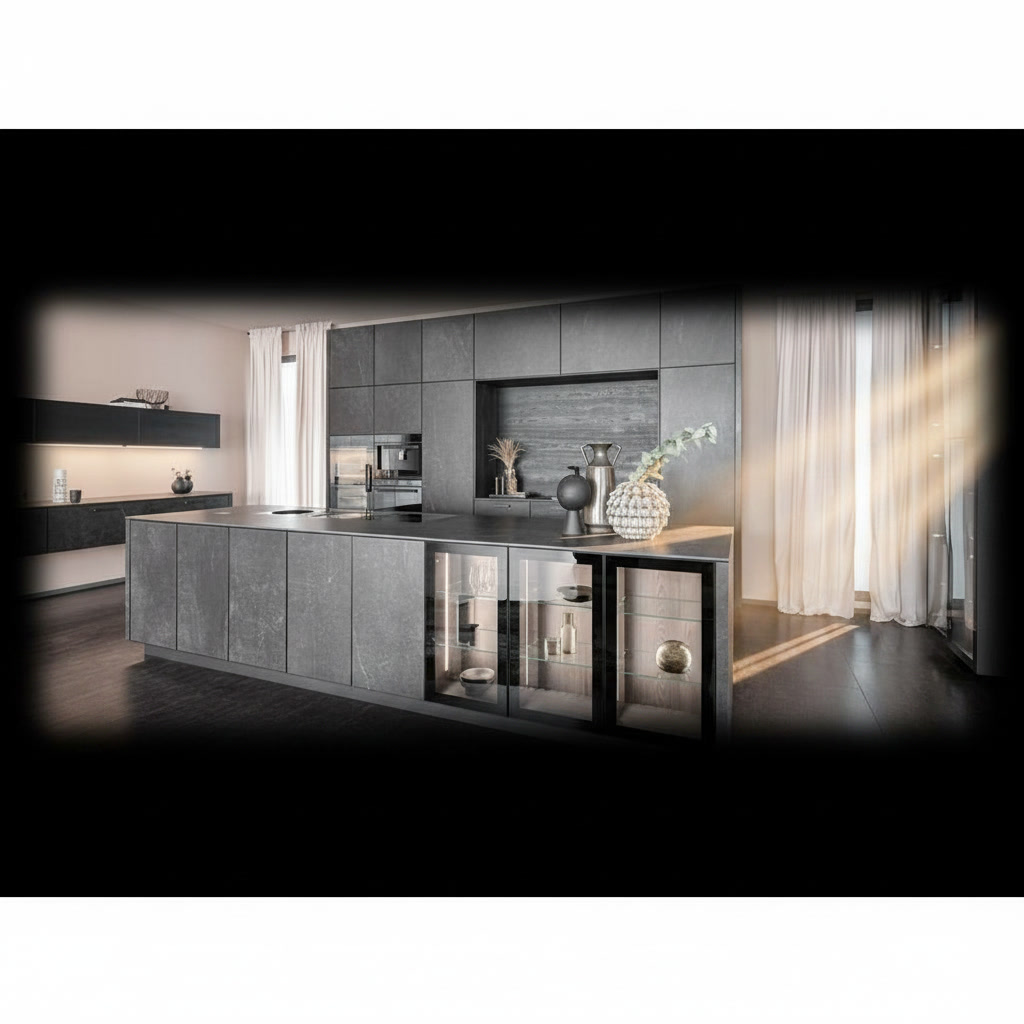
Elegant lacquered wooden kitchen with Laminam and glass top and LED-lit shelves

Elegant lacquered wooden kitchen with Laminam and glass top and LED-lit shelves

Pale curtains frame the scene like a curtain just raised: the lacquered kitchen in stone-grey finishes composes its central island and bases with glass shelves lit by LED — low vitrines where glasses and bottles shine with their own light. The Laminam and glass top runs dark and thin; a vase of dried branches signs the composition. Above, a black shelf with spotlights directs the light. This is the nocturnal elegance of houses that love to entertain: surfaces that barely reflect, measured transparencies, a calibrated atmosphere. Laminam provides the service; glass and LED provide the scenography. To design illuminated vitrines within base units demands planned wiring and clean assembly: no visible cables, no misplaced shadows. It is the care Michelessi brings to its made-to-measure indoor kitchens: a wooden structure, Italian craftsmanship, and light treated as a material — the most precious of them all.

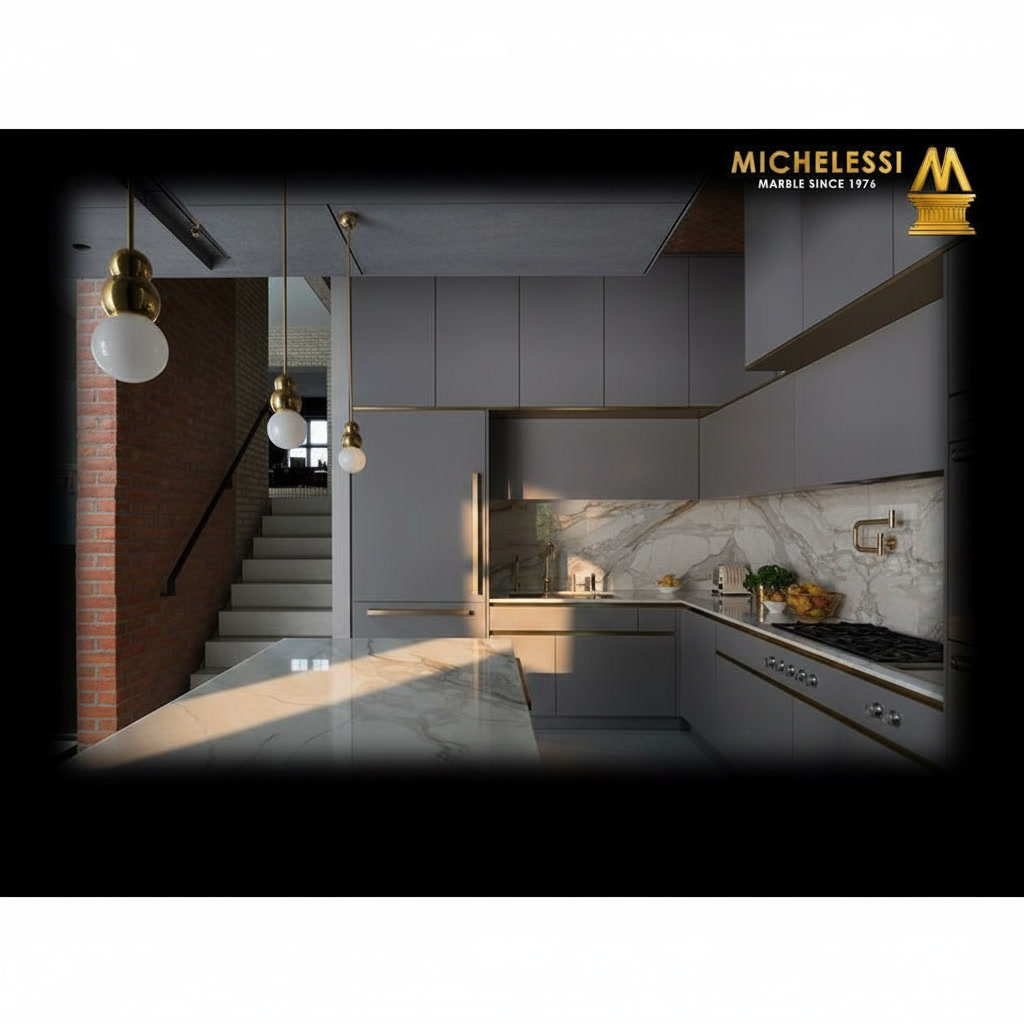
Grey lacquered wooden kitchen with veined travertine top and splashbacks and brick wall

Grey lacquered wooden kitchen with veined travertine top and splashbacks and brick wall

The exposed brick wall climbs with the staircase and tells the building's story; the kitchen answers with its mineral elegance: a counter and splashbacks in veined travertine — pale stone that also clads the working wall with its moving figure — framed by handleless dove-grey doors. Brass globe lamps descend on cue; an island with the sink completes the working zone, and a window at the back brings in the day. This is the elegant design the project declares: few materials, all of them true, orchestrated with calm. Stone splashbacks are the connoisseur's detail: they protect the walls and turn function into decoration, veining rising vertical like water against the current. It is the bespoke stonework Michelessi executes with the artisan craftsmanship of always: travertine treated as protagonist, the brickwork respected as a good neighbour — and the balance between them making all the difference.

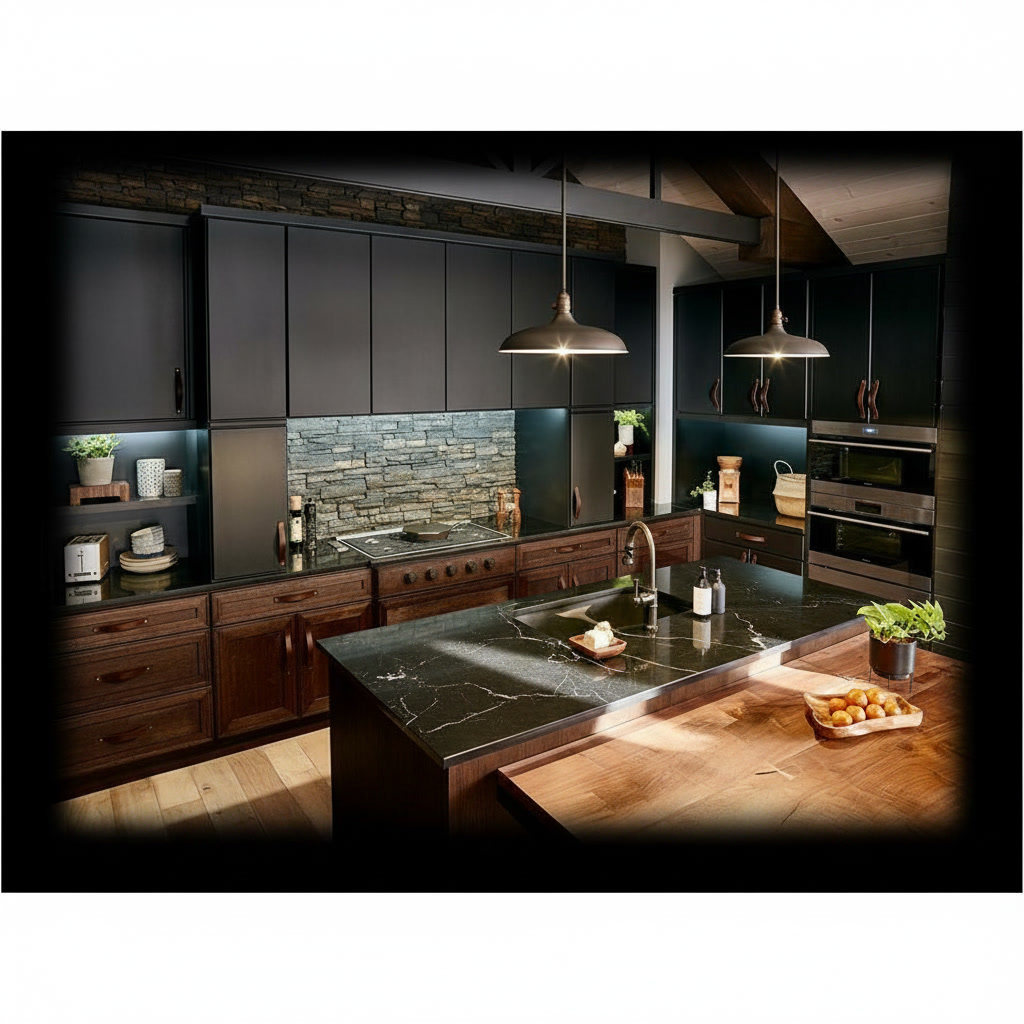
Solid walnut kitchen with polished veined marble worktop and natural stone feature wall

Solid walnut kitchen with polished veined marble worktop and natural stone feature wall

The atmosphere is that of a luxury refuge: solid walnut doors, precisely framed, run beneath the band of exposed natural stone cladding the cooking wall, lit from under the wall units; black volumes of cabinets and columns close the composition above, and copper lamps descend over the island. The polished veined marble top — dark, deep, mirroring — crowns the island with its adjoining solid wood table, where bread and boards await the evening. Complete with appliances, this is a kitchen of true materials taken to their highest degree: wood, stone, marble, copper — no imitation anywhere. Such pairings demand a sure director: tones, textures and reflections must be dosed for the whole to stay harmonious. This is the maturity of Michelessi indoor kitchens: bespoke, with Italian craftsmanship in marble and solid wood alike — and an atmosphere that, once lived, is never forgotten. True materials down to the last detail: the only scenery that is never struck.

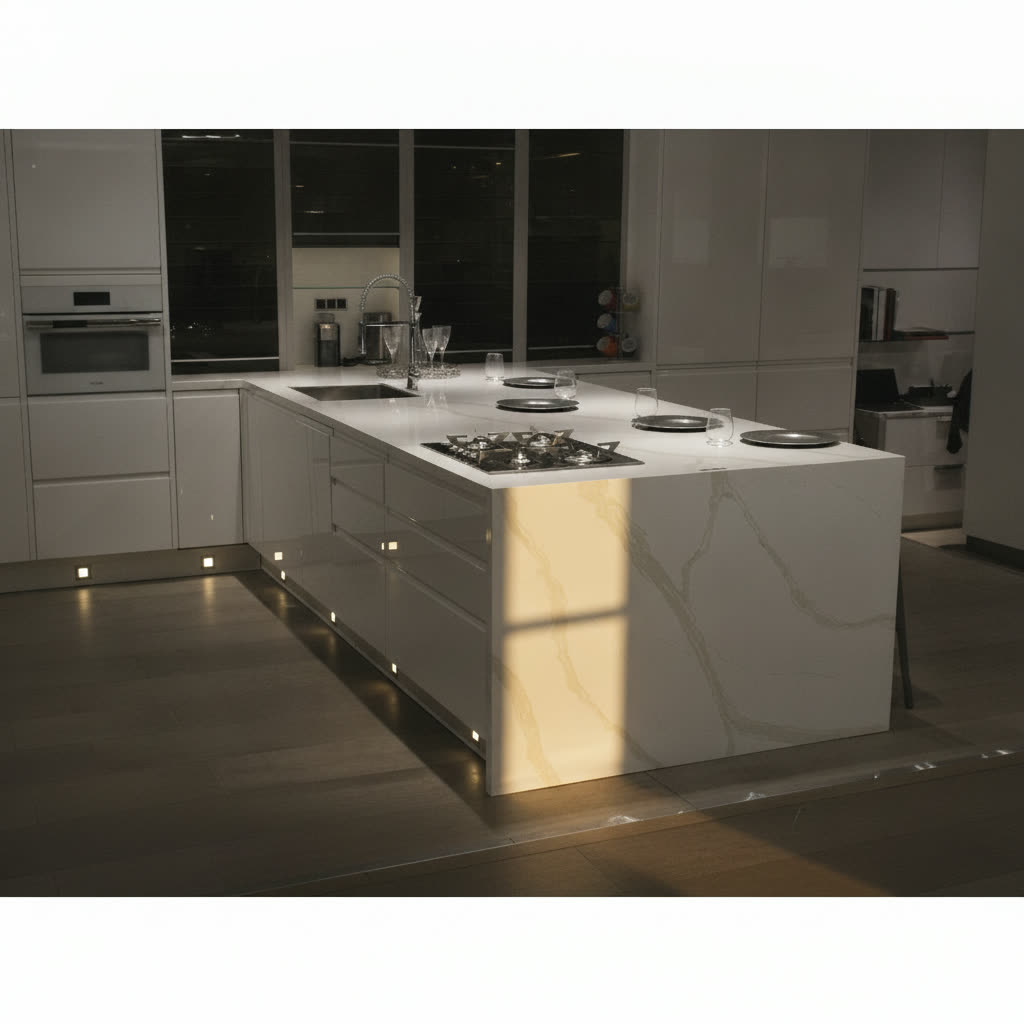
White marble peninsula with grey veining and plinth with pointed accent lighting

White Elegance Kitchen

The peninsula advances like the prow of a white ship: marble with broad, sinuous grey veins dresses the top and descends the side in a single cascade of stone, while at the base the plinth with its pointed lighting kindles small beacons on the floor, lending the volume the appearance of floating. Above, the gas hob and dark cookware ready for use; around, glossy white handle-free drawers and the column with its built-in oven complete the contemporary register. It is a project that attends to the scenography down to the lowest details — literally: raking light at the foot of the stone is a stage gesture, exalting the verticality of the veins. Bespoke marble work governs the whole: selected slabs, masterful joints, exact recesses. Michelessi signs it with the pride of Italian craftsmanship: because even a plinth, where there is vision, becomes part of the poetry. And at night, with the lights glowing at the foot of the stone, the peninsula seems to set sail.

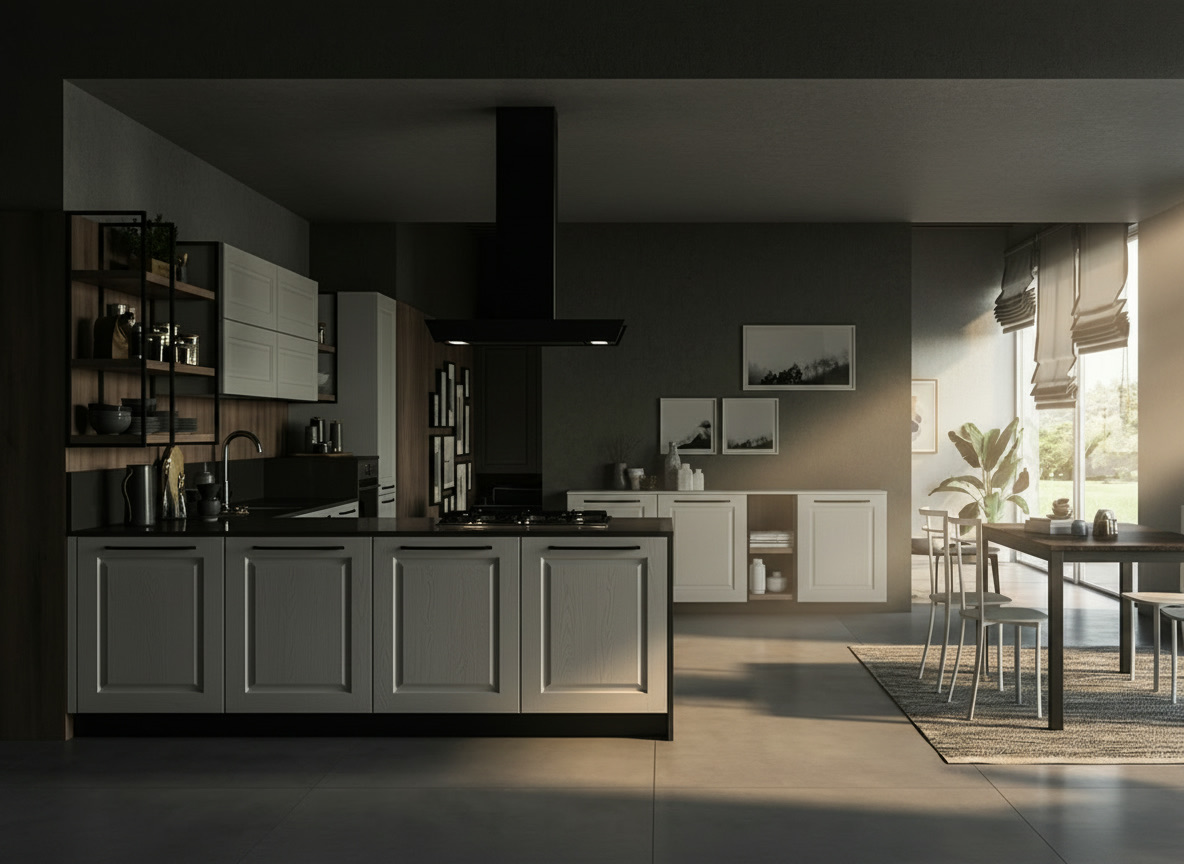
White kitchen with framed-door island, dark suspended hood and wooden wall shelves

The Classic Island Beneath a Hood of Shadow

The island advances to the centre of the room with its row of white framed doors crowned by a dark worktop; above, the dark hood descends vertically and places within the white an elegant, geometric shadow that holds the whole composition in tension. Along the walls, the low sideboard with leaning prints, shelves of wood and metal, a window with Roman blinds: a serene, almost familiar domestic vocabulary. And then the table, with its slender profiles, ready for lunch. This is the formula of the contemporary classic: traditional forms, lightened by modern pairings and a rigorous direction. Michelessi indoor kitchens interpret it to measure: the same framed door can change character with a finish, the same worktop can pass from laminate to quartz to expertly worked marble. Italian craftsmanship lies in calibrating these choices with you, until the kitchen resembles exactly your idea of home.

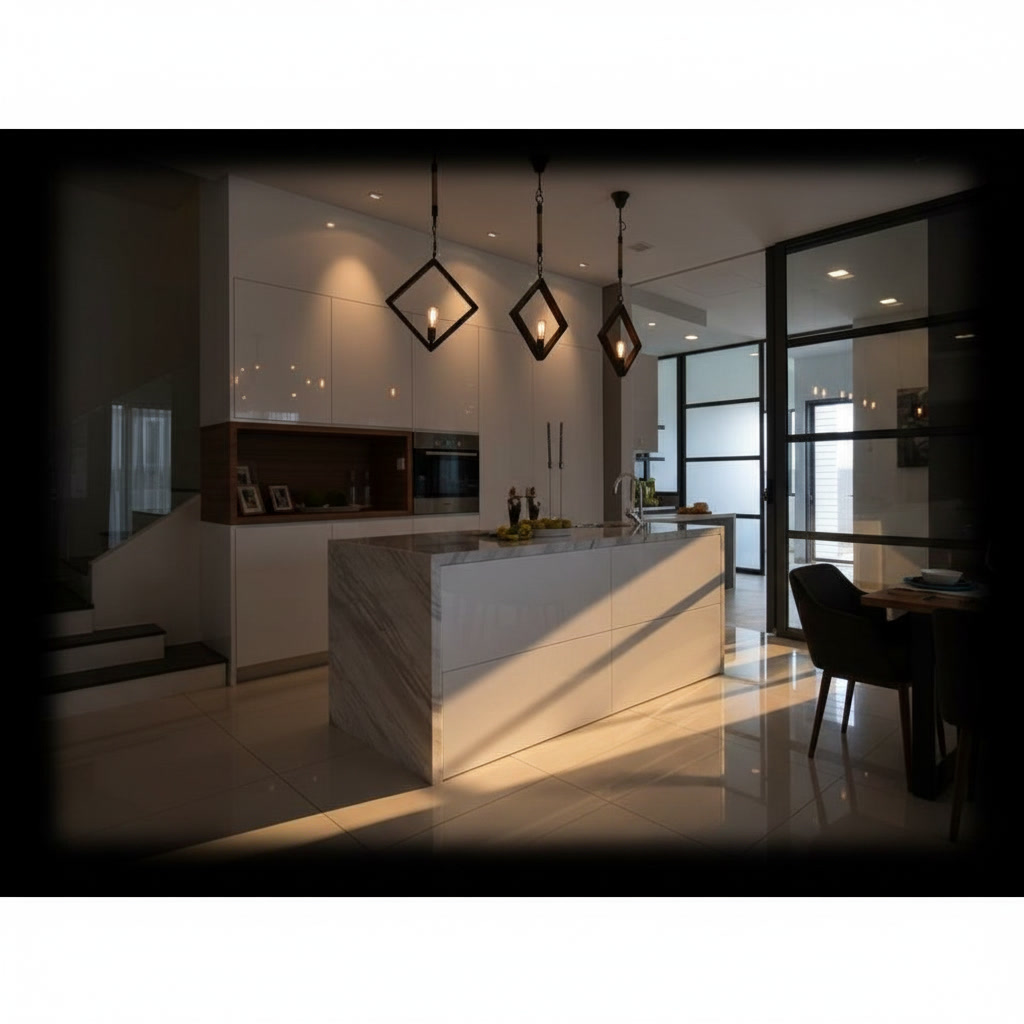
Elegant white kitchen with island with veined travertine waterfall top and sink

Elegant white kitchen with island with veined travertine waterfall top and sink

Lamps of black metal geometry descend like small suspended sculptures: beneath them, the island carries a veined travertine top that falls in a waterfall along its flank — pale stone, crossed by grey waves, signing the project with its natural elegance. Glossy white bases, a wooden niche with wall units, black-framed glazing that separates without closing: every element keeps to the register of elegant white design the project declares. A dark table carries the conviviality onward beside the kitchen, complete with sink and every appliance. This is the luminous contemporary of houses that love formal purity but will not give up true material: travertine, worked to measure with joints executed to the letter, gives the white its depth. This is the hand of Michelessi in stone: Italian craftsmanship that turns an island into a signed piece — to be used, every day, without ceremony.

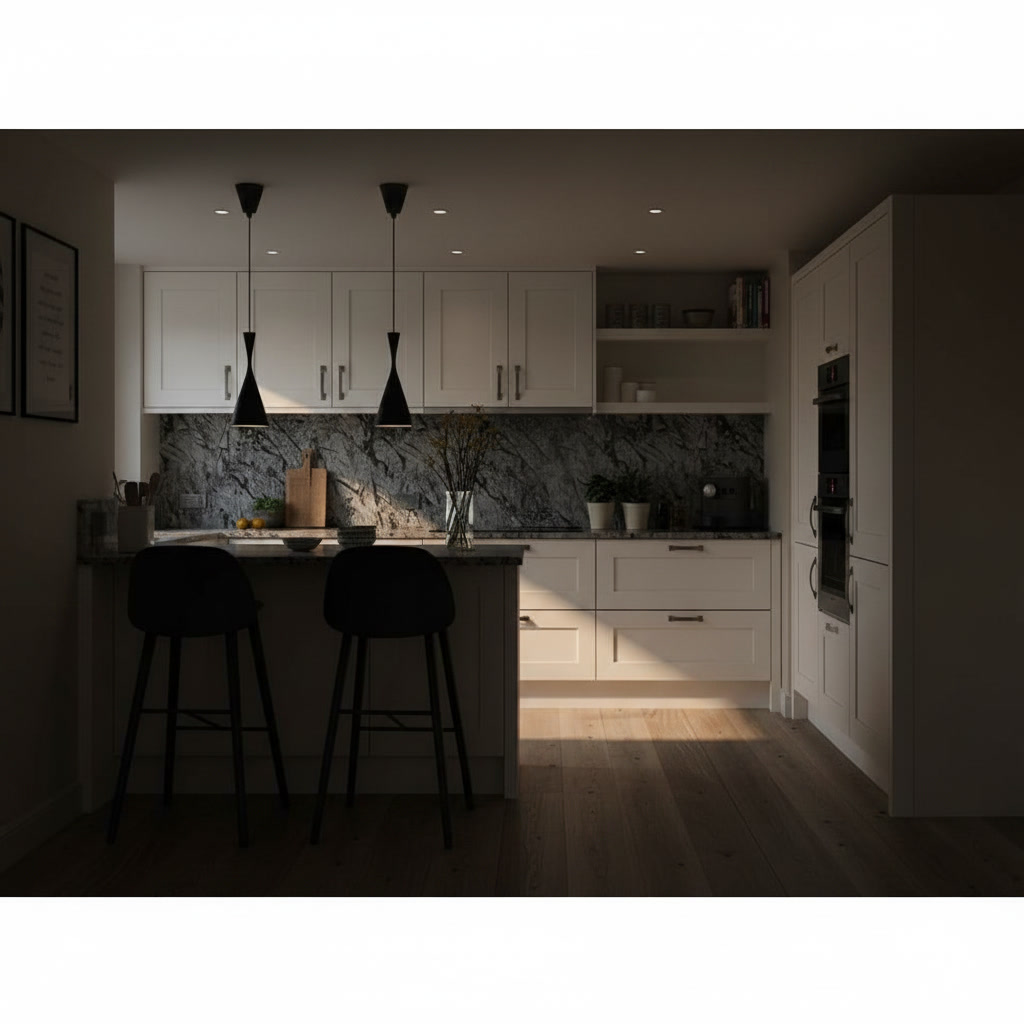
White lacquered kitchen with marble top and counters and grey veined marble splashback

White lacquered kitchen with marble top and counters and grey veined marble splashback

The veined marble splashback is the kitchen's painting: pale stone, crossed by dense grey veining, runs behind the worktop and turns the wall into a mineral landscape. Around it, white lacquer does its work with elegance: framed doors, wall units, shelves of ceramics, and a counter — itself in marble — carrying the working zone to the bar where two black stools draw up beneath drop lamps. Fully equipped, this is a kitchen that entrusts its whole personality to the stone: the right choice, because marble never disappoints. Top and counters worked to measure, with clean edges and exact cut-outs, bear the signature of Michelessi stonework: Italian craftsmanship that selects the slab for its figure and finishes it for daily life. The white, all around, plays the frame — and the marble, as ever, the protagonist.

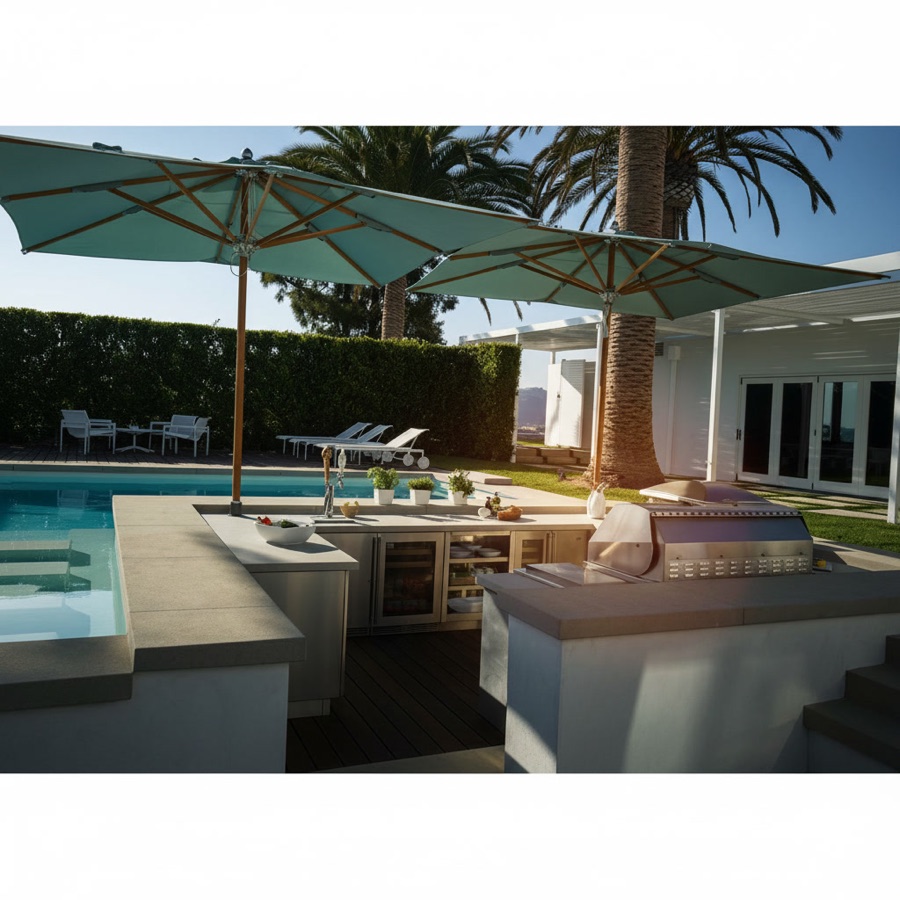
Poolside stone and steel kitchen counter with steel barbecue, wine cooler and aqua-green parasols

Stone and Steel Beneath the Parasols

Aqua-green parasols open their corollas above the pool's edge, and the kitchen works in their shade: pale stone counters spread across white volumes, the steel barbecue lifts its lid with the grill ready, the glass-fronted wine cooler keeps its chill in view. Beyond the water, a white villa and a palm complete a scene of perfect holiday; the sunloungers await the after-lunch hour.

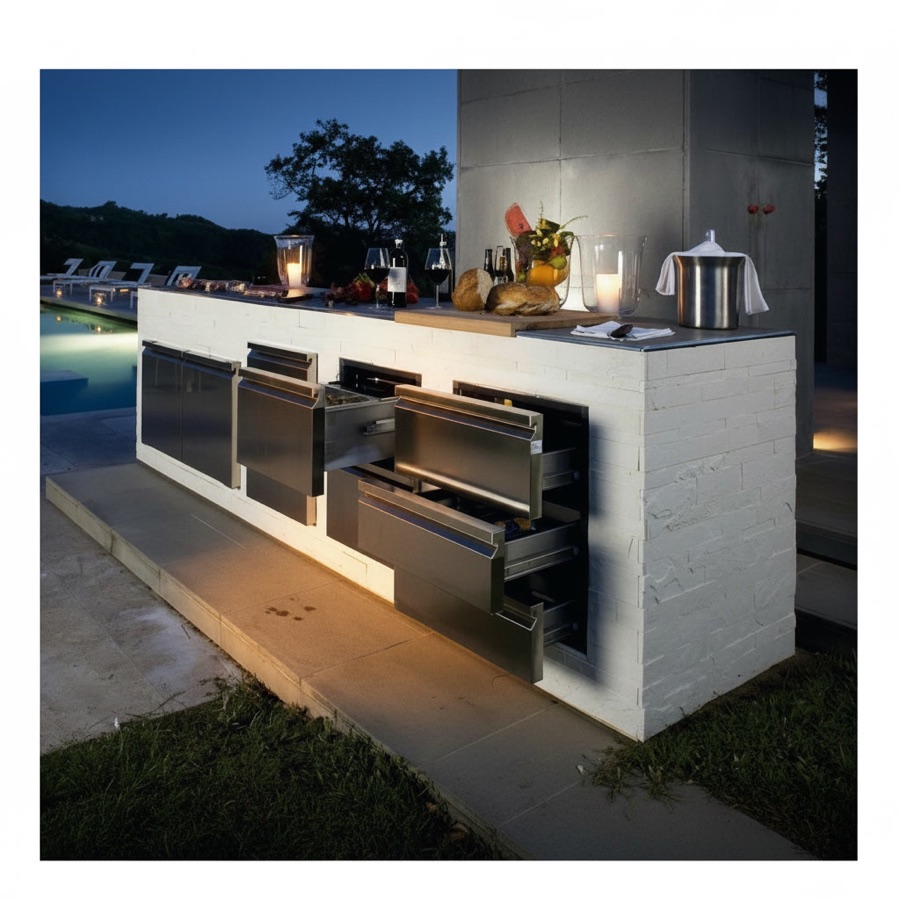
Poolside outdoor kitchen island clad in white stone with built-in stainless steel appliances

White Stone Aglow on the Water

Evening settles on the hills and the pool lights up with reflections: at its edge, the island spreads its cladding of white stone in slender courses, luminous even in the half-dark, and a dark counter where the bottles await the toast. Built-in steel appliances punctuate the front — drawers, doors, satin surfaces gathering the last of the light — ready to serve the night now beginning.

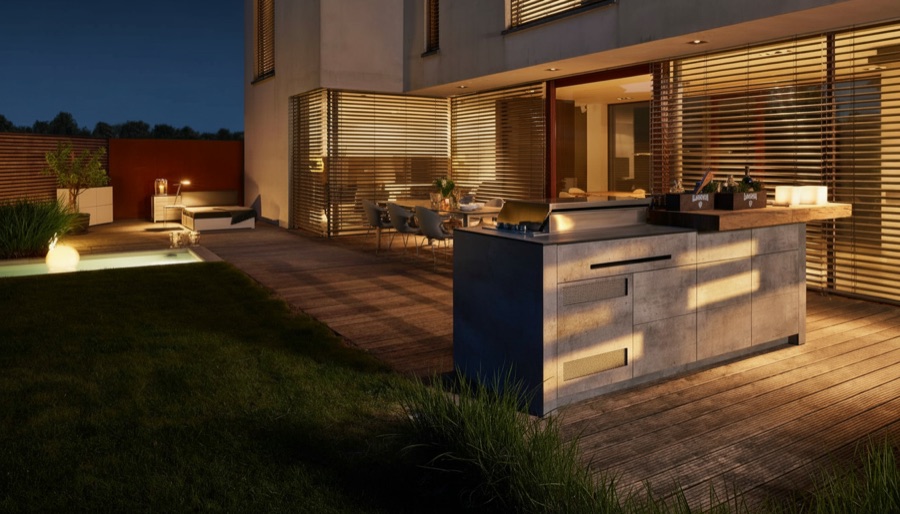
Stone-effect outdoor kitchen island with barbecue on a wooden deck, modern house lit at dusk

A Refractory stone-Effect Island on a Summer Evening

Dusk stains the sky a deep blue and the house lights up behind: great warm windows, horizontal timber, the pool reflecting the last light. In the foreground, on the broad wooden deck, the stone-effect kitchen island waits with the barbecue already prepared and bottles on the counter — a compact, tactile block that seems sculpted in a single gesture. The scene has the suspended quality of the best summer evenings, when the air stands still and dinner outdoors becomes a ritual.

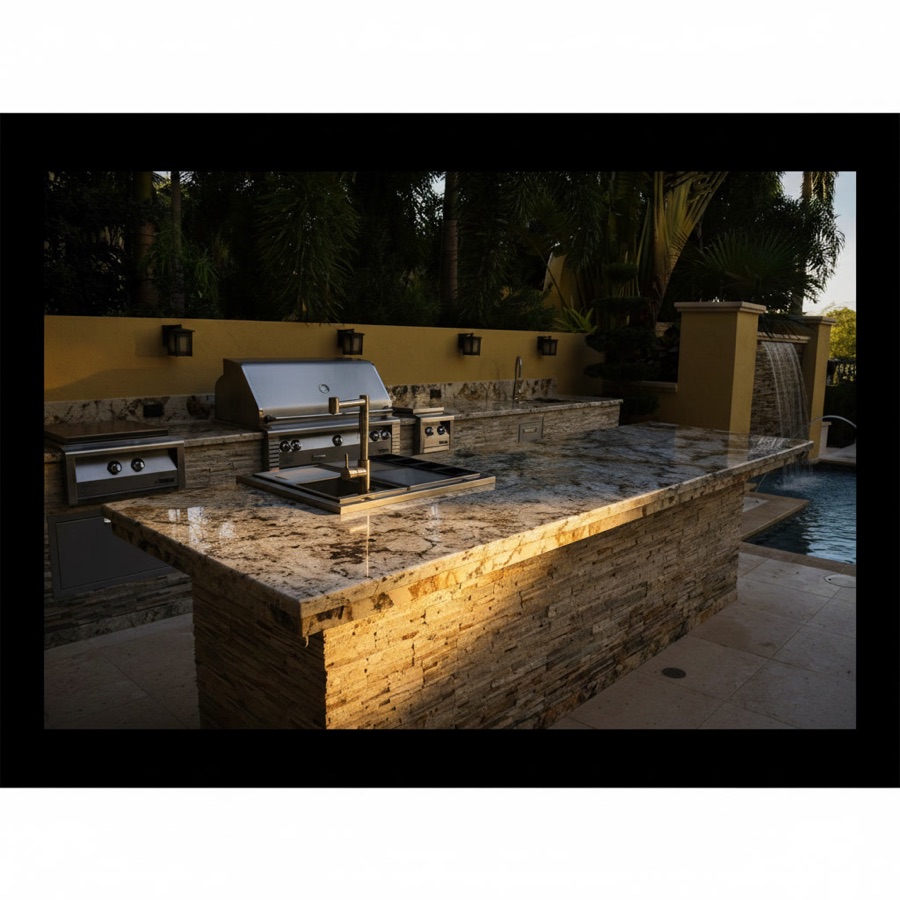
Outdoor kitchen entirely in marble with gas barbecues, steel doors and a pool waterfall behind

An Island of Marble Before the Waterfall

The pool's water falls from the stone wall like a private cascade, and before this theatre the island spreads its tops entirely in marble: slabs veined grey and cream, thick and honed, doubling across two levels and crowning a base clad in fine courses of stone. Gas barbecues work set into the material beneath their steel lids, technical doors gleam in the fronts, and palms close the tropical scene.

Modern and classic luxury kitchens: style does not decide luxury

A modern kitchen and a classic one are luxurious on the same condition: that they are bespoke, made of real materials and crafted with care. The drawing changes, not the criterion. The modern kitchen is the one most people search for; stone and solid wood give shape to both.

StyleDesignMaterials that go with it
ModernFlat frameless doors, a continuous worktop, few wall units or none, recessed gripsCalacatta, Statuario or Carrara for white; Nero Marquina (a Spanish marble) or dark sintered stone for black; oak or ash; brushed steel
ClassicFramed doors with panels, cornices, shaped plinthsSolid walnut, pale marble or travertine

A white luxury kitchen usually starts from a pale marble with pale wooden doors; a black one, from a dark worktop with walnut or dark oak doors. Marble with wood has a page of its own: marble and wood kitchen.

Luxury kitchens in marble, stone, solid wood, steel and porcelain stoneware: the materials

A luxury kitchen uses real materials, declared for what they are: marble and travertine, granite and quartzite, solid wood, stainless steel, porcelain stoneware and sintered stone. Each goes where it works best and has a limit worth knowing before you choose it.

Marble and travertine

Marble is a calcareous stone and is sensitive to acids such as lemon and vinegar (as the Natural Stone Institute states); it tolerates moderate heat. Wipe up spills at once and put boiling pans on a trivet. The profiles are under marbles, Calacatta and travertine.

Granite and quartzite

Granite is a rock of quartz and feldspars. On the Mohs scale quartz scores 7 and orthoclase 6, against 5.1-5.5 for the tip of a steel knife: the knife does not scratch it. It absorbs very little water and, once sealed, resists stains; concentrated heat is not recommended. We cover it on the page granite kitchen.

Solid wood

A solid wood kitchen is one whose doors are made of the declared species through their whole thickness, not of a thin sheet glued onto a panel. We design and build them to measure, in oak, walnut or ash. Solid wood can be sanded and refinished; but wood takes up and gives off moisture, so it is protected with oil or varnish and kept away from leaks. What sets solid wood apart from veneer, species by species, is explained in solid wood kitchen; finishes and hinges are on the page doors, hinges and finishes.

Stainless steel

Stainless steel is an alloy with chromium that forms a self-healing surface layer. AISI 304 contains about 18% chromium and 10% nickel; AISI 316 adds molybdenum and resists chlorine and salt air better, which makes it the usual choice by the sea or a pool. Its weak point is scratching: satin and orbital finishes make marks less visible. Bleach and steel wool are to be avoided. More on the page stainless steel kitchen.

Porcelain stoneware and sintered stone

Porcelain stoneware (Laminam) is a compact ceramic; sintered stone (Dekton) is an ultra-compact surface: they are different materials. For worktops Laminam provides 12 and 20 mm (Laminam 12+ and 20+, nominal thicknesses 12.5 and 20.5). The manufacturers state that they withstand the direct heat of pans and are not harmed by UV rays; Laminam also states that the material is non-porous. They do have precise working rules: Laminam, for instance, asks for holes and cut-outs at least 50 mm from the edge. The comparison is on the pages porcelain stoneware kitchen, Laminam and Dekton.

Put together, the materials are distributed through the kitchen like this. It is a design idea, not a rule.

Part of the kitchenSuitable materialWhy
Island and waterfall endsMarble, travertineThe vein is the drawing of the kitchen
Heavily used worktopGranite, quartzite, porcelain stoneware, sintered stoneHard, with low absorption; heat is managed according to each material's limits
Sink and hob areaStainless steelIt does not suffer from acids as marble does and is easy to clean
Doors and tall unitsSolid woodIt warms the room and can be refinished

Craftsmanship: slabs chosen one by one, numerically controlled cutting, hand finishing

In a luxury kitchen the craftsmanship shows in how the stone is chosen, cut and finished. In the Aprilia workshop the slabs are chosen one by one, by looking at them in person with the kitchen drawing to hand. Then four steps:

  • the vein is followed: worktop, upstand and island ends are cut from the same slab, so that the pattern of the stone carries on from one element to the next;
  • the 45-degree waterfall: the ends join the worktop with a 45-degree mitre, and the island looks like a single block;
  • numerically controlled cutting carries the exact measurements of the design onto the stone for the sink cut-out and the hob holes;
  • hand finishing is for edges, corners and joints, which should almost disappear.

The slab destined for your kitchen is shown to you before it is cut: in person, if you come to Aprilia, or by video call and with samples sent to your home. The process is also told in the guide the Aprilia workshop.

The design: survey, out-of-square walls, 3D drawing and services

A bespoke kitchen starts from a survey of the room, not from an assembly of modules. The modules of fitted kitchens come in fixed widths (15, 30, 45, 60 and 90 cm are the most common, according to Wikipedia); a bespoke kitchen follows the real walls instead, and angles that are not 90 degrees are measured one by one.

Our technical office draws the kitchen in 3D inside your room, with layout, materials and the vein of the chosen slab: you review it and approve it before cutting. The layout too has reference measurements. According to the NKBA guidelines, the triangle between hob, sink and fridge should not exceed 7.9 m in total, with sides between 1.2 and 2.7 m, and the work aisle should be at least 107 cm for one cook and 122 cm for several.

The water, electrical and gas services are for a qualified contractor, who hands over the declaration of conformity (Italian ministerial decree 37/2008). The whole process is on the page kitchen design and renovation.

The details of a luxury kitchen

The details of a luxury kitchen are fine joints, hand-finished edges, an upstand cut from the worktop slab, flush doors, well-ventilated built-in appliances and a ducted extractor. They are the ones you notice in daily use, not in the first photograph.

  • Joints and edges: fine joints, hand-finished edges, an upstand in the same slab as the worktop.
  • Doors and hardware: flush doors, recessed grips or inset profiles, sturdy hinges and runners.
  • Built-in appliances: each compartment is sized to the manufacturer's data sheet, with the ventilation grilles and clearances required.
  • Extractor: ducted to the outside when the room allows (the NKBA suggests at least 150 cfm, about 255 m³/h). Noise is compared only between values declared in the same unit, such as the dB(A) re 1 pW of the data sheets. If the kitchen opens onto the living room, read open-plan kitchen and living room.

Luxury kitchen with an island

The island is often the centrepiece of a luxury kitchen: a stone volume with the worktop running down the ends in a waterfall. It needs space. Italian guides ask for at least 90 cm of aisle between the base units and the island, the NKBA 107 cm with a single cook. If the island holds the hob or the sink, it needs connections, drains under the floor and an island extractor. All the measurements are on the page kitchen with island; the marble island has its own page, marble kitchen island.

Italian luxury kitchen brands: how to compare them without rankings

Anyone searching for Italian luxury kitchen brands finds lists and rankings; we do not publish any, because a luxury kitchen is judged by verifiable criteria and not by a name. These are the questions to ask anyone, us first:

What to askWhy it matters
Does the design start from a survey or from a catalogue of modules?Only a survey follows real walls and angles
Is the wood solid? Ask for the construction section of the door and the species written on the quote“Oak” in the name of a finish may mean the species, only the veneer or only the colour
Can you see the slab before it is cut?No two slabs are alike
Who installs the kitchen?Whoever installs it knows the design and answers for the finished work
What is really made in Italy?The phrase “100% made in Italy” has a definition in law

The definition is in Italian decree-law 135/2009 (art. 16): a product is made entirely in Italy only if its design, planning, manufacturing and packaging all take place exclusively on Italian territory. We state what can be verified: the stone is chosen, cut and finished in the Aprilia workshop, and installation is by our own team.

Luxury outdoor kitchens

A luxury outdoor kitchen is built with sun, rain and frost in mind, not just appearance: a structure of dry-laid refractory stone, steel or treated wood, a worktop chosen among the stones that hold up outdoors, barbecue and oven in refractory stone. The materials one by one, with their cautions, and frost, fridge and gas cylinder are on the dedicated pages. Read complete outdoor kitchen, enclosed and covered outdoor kitchen, luxury outdoor kitchen and outdoor kitchens.

Dubai and the other cities: one real project and six visions

Michelessi delivers and installs abroad too, and Dubai is our real project outside Italy. We tell it on the Dubai project page; for the market itself there is Italian marble kitchens for Dubai. For those who live far away the method does not change: a remote survey from photographs and measurements, a 3D design, samples sent to your home, slabs shown by video call and installation by our own team.

London, Miami, Monte Carlo, St. Moritz, New York and Lake Como are project visions: images of what we could build for you, not delivered works. You will find them at London, Miami, Monte Carlo, St. Moritz, New York and Lake Como.

How much does a luxury kitchen cost?

A luxury kitchen has no list price, because it is bespoke: the cost depends on linear metres and shape (island included), the materials of worktop and doors, appliances, services to be redone and installation. A figure written before the survey would be a fiction. The quote is free anywhere; the site survey is free in Rome, Latina and throughout Lazio. A guide to the factors is at how much does a marble kitchen cost.

Luxury kitchen near Rome and in Lazio: where to see one

The Michelessi workshop and showroom are in Aprilia, at Via Pontina km 45.350, less than an hour from Rome. Here you can see the slabs in person and compare them with doors and light. In Rome, Latina and throughout Lazio the site survey is free; elsewhere we start from a remote survey, and installation is by our own team throughout Italy. The indoor kitchens are under indoor kitchens; for the most frequent questions there is the page bespoke kitchens: questions and answers.

The quote is free: request it here.

Frequently asked questions

Frequently asked questions

What makes a kitchen luxurious?

Four things: real materials, such as stone, solid wood and steel, not imitations; careful craftsmanship, with slabs chosen one by one and hand finishing; a design that starts from a survey of your room; and exact details, from fine joints to flush doors. The number of appliances and the name on the door do not count.

Which are the Italian luxury kitchen brands?

Searches lead to lists and rankings, which depend on the taste and budget of whoever writes them. We do not publish any: we give you the criteria to compare any brand or workshop. Ask whether the design starts from a survey, whether the wood is solid (door section and species written on the quote), how the stone is chosen, who installs, and what is really made in Italy.

How much does a luxury kitchen cost?

There is no price that applies to all, because the kitchen is bespoke. The cost depends on linear metres and shape (island included), the materials of worktop and doors, appliances, services to be redone and installation. Without a survey a figure is not serious. The quote is free anywhere; the site survey is free in Rome, Latina and Lazio.

Modern or classic luxury kitchen: which to choose?

It depends on the home and your taste, not on luxury: both are luxurious if they are bespoke and made of real materials. The modern one has flat doors, a continuous worktop and few wall units; the classic one framed doors, cornices and woods such as walnut. The modern kitchen is the one most people search for. Stone and solid wood can give shape to both.

When can “100% made in Italy” be written?

Under Italian decree-law 135/2009 (art. 16), only when the design, planning, manufacturing and packaging of the product all take place exclusively in Italy; outside those cases the phrase is penalised. Law 350/2003 defines the words “made in Italy” on products not originating in Italy, under the European rules of origin, as a false indication. It is therefore worth asking what, in the kitchen, is really made in Italy.

How can you tell a solid wood kitchen?

Solid wood is the declared species through its whole thickness; veneer is a thin sheet glued onto a panel. The eye is not enough: a continuous grain may be a well-matched veneer. The sure check is documentary: ask for the construction section of the door and for the botanical species written on the quote.

Which materials are used in a luxury kitchen?

Mainly stone and solid wood: marble (Calacatta, Statuario, Carrara, travertine), granite and quartzite, doors in oak, walnut or ash, stainless steel for the work zones, porcelain stoneware and sintered stone for the most heavily used worktops. Each material has a limit: marble is sensitive to acids, steel scratches, wood takes up and gives off moisture.

What measurements does a luxury kitchen with an island need?

Italian guides ask for at least 90 cm between the base units and the island; the NKBA guidelines give 107 cm with one cook and 122 cm with several. If the island holds the hob or the sink, it needs connections, drains under the floor and an island extractor. The full measurements are on the page about the kitchen with an island.

Is there such a thing as a luxury outdoor kitchen?

Yes. Our outdoor kitchens have a structure of dry-laid refractory stone, steel or treated wood, a worktop chosen among the stones that withstand sun, rain and frost, and a barbecue in refractory stone. Luxury outdoors lies in the same four things as indoors: real materials, craftsmanship, design and details. Materials, frost, fridge and roofs are explained on the pages about the complete outdoor kitchen and the enclosed and covered one.

Does Michelessi build luxury kitchens outside Italy too?

Yes: we deliver and install abroad as well, and Dubai is our real project. We work at a distance with a survey from photographs and measurements, a 3D design, samples sent to you and video calls. London, Miami, Monte Carlo, St. Moritz, New York and Lake Como are project visions, not delivered works.

Where can I see a luxury kitchen near Rome?

The Michelessi workshop and showroom are in Aprilia, at Via Pontina km 45.350, between Rome and Latina, less than an hour from Rome. Here you can see the slabs in person and compare them with doors and light. In Rome, Latina and Lazio the site survey is free; installation is by our own team throughout Italy.

Call us WhatsApp