Skip to content
Made in Italy

Since 1976 — Bespoke kitchens

Porcelain Stoneware Kitchen, Made to Measure: Laminam, Dekton

WOOD · STEEL · MARBLE · STONEWARE

In short

Kitchen with island clad in grey porcelain stoneware with golden profiles and marble wall
Kitchen with island clad in grey porcelain stoneware with golden profiles and marble wall — photograph of a Michelessi project.

The block — a Michelessi vision

From the block,
blow after blow

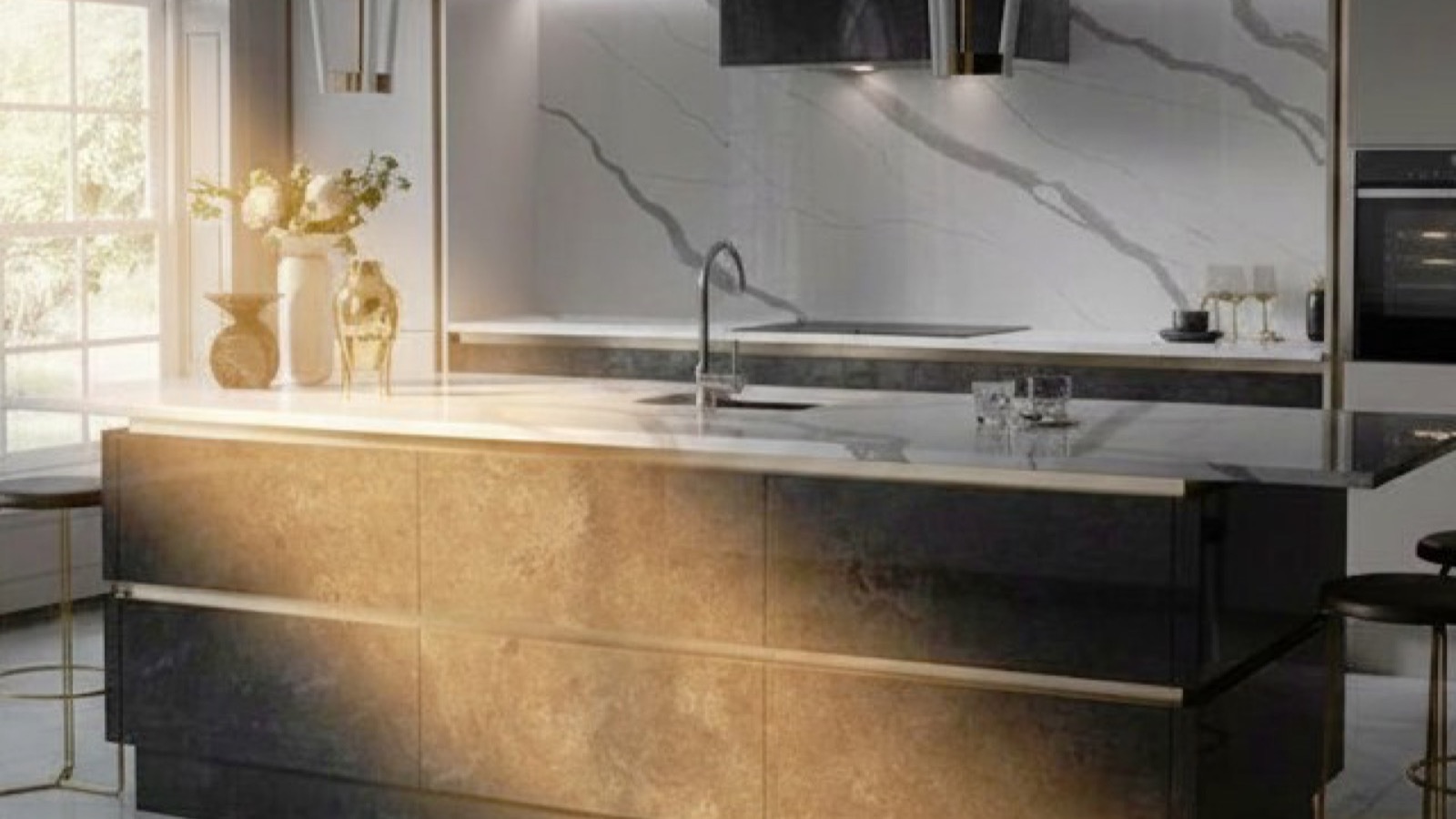
01 A raw block of Calacatta Viola waits under the spotlight, in the dark kitchen with brass profiles. Mallet and chisel are already on the floor: the island is still all inside the stone.

02 Blow after blow the faces are squared, chips fly, white dust rises into the light. The chisel scores the drawers, opens the recess for the hob, carves the sink: the shape of the island comes out of the block slowly, without haste.

03 Then the stone is honed and polished: the purple vein catches the light, brass edges close the drawers, the black hob sinks into its recess, the gold tap finds its place. The island remains, and a veil of dust on the floor.

Keep scrolling — the scene follows you

Porcelain stoneware kitchen, made to measure: what it is and who builds it

A porcelain stoneware kitchen is a bespoke kitchen in which large porcelain stoneware slabs cover the surfaces you see and use: worktop, island, splashback, sometimes the sides. It is built by Michelessi SRL, stone masons in Aprilia since 1976: we design it and build it to measure, work the slabs in our own workshop and install it with our own team throughout Italy, indoors and outdoors.

The Italian encyclopaedia Treccani defines gres as a material obtained by firing, at 1,200-1,300 °C, until the body begins to vitrify. Laminam, whose slabs we work, describes it as an extremely strong and compact ceramic with very low porosity, around 0%.

Anyone searching for a "porcelain stoneware kitchen" almost always finds the worktop alone, offered by ceramic manufacturers and retailers. We mean the whole kitchen: porcelain stoneware where it works best and, around it, solid wood doors, island, tall units and appliances chosen with you. The overview of all the materials is on the bespoke kitchens page.

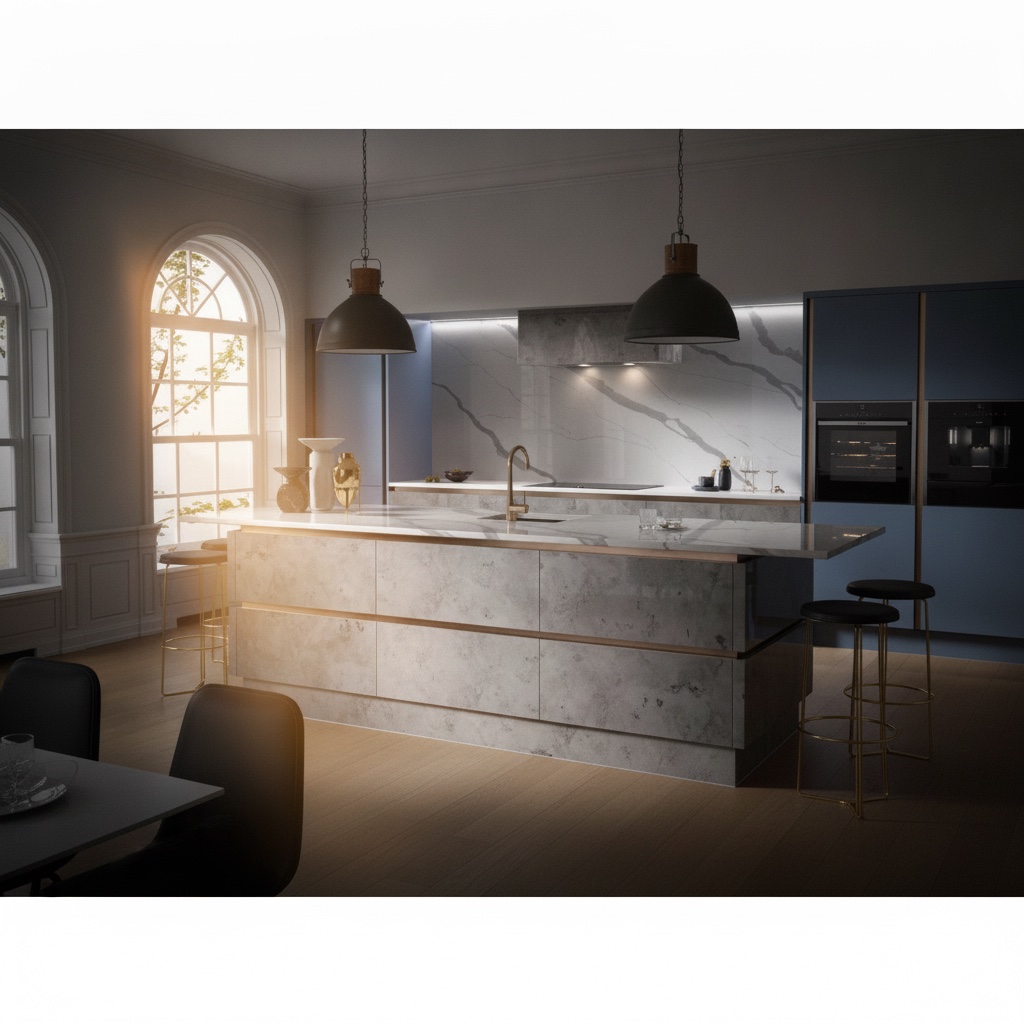
Stoneware-clad kitchen with island, integrated sink, induction hob, hood and oven

Stoneware-clad kitchen with island, integrated sink, induction hob, hood and oven

The island presents itself in its pale stone-effect stoneware dress, crossed by slender inserts that mark out its drawers; above, the top integrates sink and induction hob in a single working surface, served by burnished taps. Behind, a marble-effect stoneware wall rises beyond the cooking zone, while powder-blue columns — with black ovens recessed — add the colour that gentles the whole scene. Dark bell lamps, stools at the counter, tall windows of a stately apartment: the ensemble has an urban, serene elegance. A wooden structure clad in stoneware is a sound formula: the constructive warmth of wood, the resistance of ceramic at the surface. With hood and oven completing the equipment, it is an indoor kitchen ready for real life: Michelessi builds it to measure, attending to joints, recesses and tonal pairings with an artisan's care. The powder blue, then, is the touch that lingers in the eye.
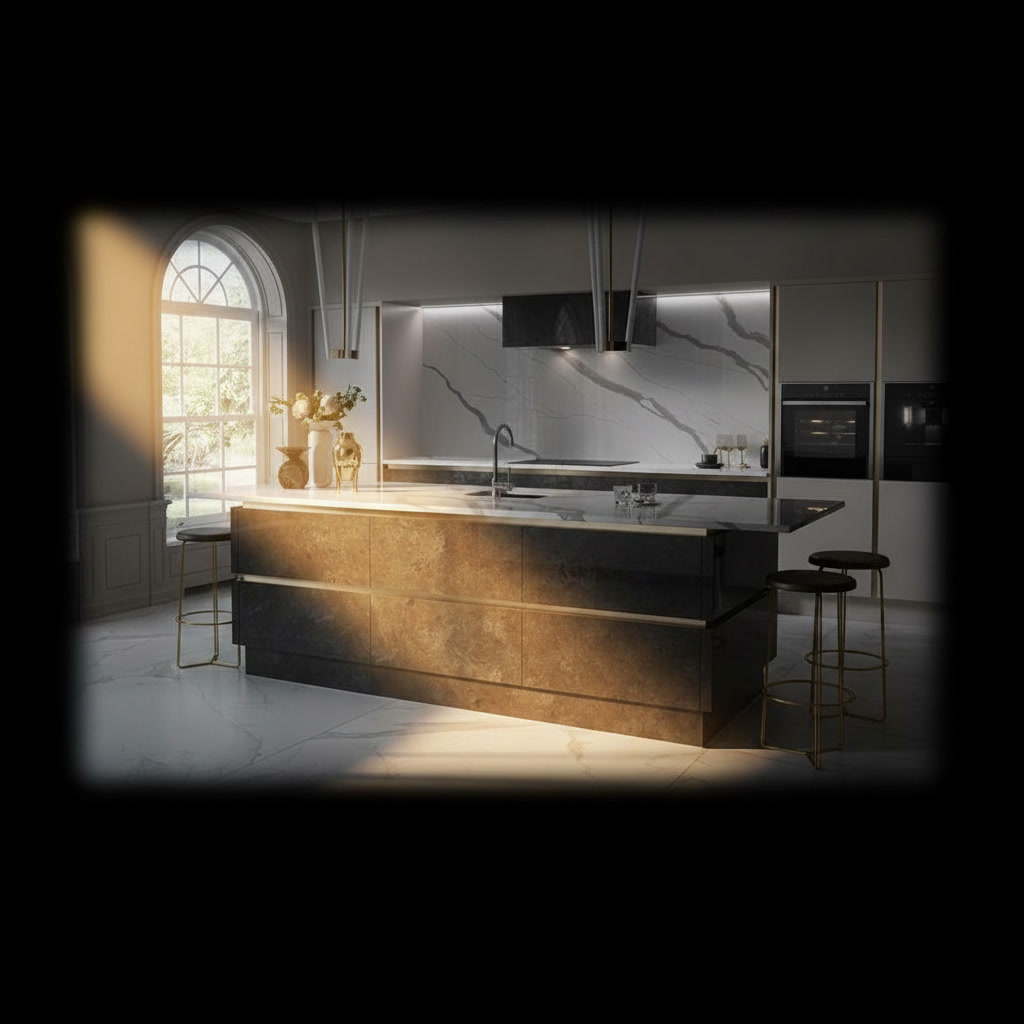
Kitchen with island clad in grey porcelain stoneware with golden profiles and marble wall

Kitchen with island clad in grey porcelain stoneware with golden profiles and marble wall

Arched windows and a wall of veined marble effect give the room the breath of a palazzo; at the centre, the island clad in stone-grey porcelain dresses itself in golden profiles — fine lines running along the volumes like threads of light — and carries the integrated sink with its gold tapware. Stools with gilded details complete the register, together with dark columns housing the built-in ovens. Fully equipped, this is a kitchen that plays the luxury card openly: technical materials treated like jewels, measured reflections, a curated scenography. The porcelain stoneware bears the practical side with its tireless surface; the gold does its own work, which is to shine. Made-to-measure holds it all in balance: proportions, alignments, cut-outs. This is the glamorous face of Michelessi indoor kitchens: artisan craftsmanship that knows how to be sober when needed — and magnificent when the project asks. The gold here is not ostentation: it is a line of light drawn with a ruler.

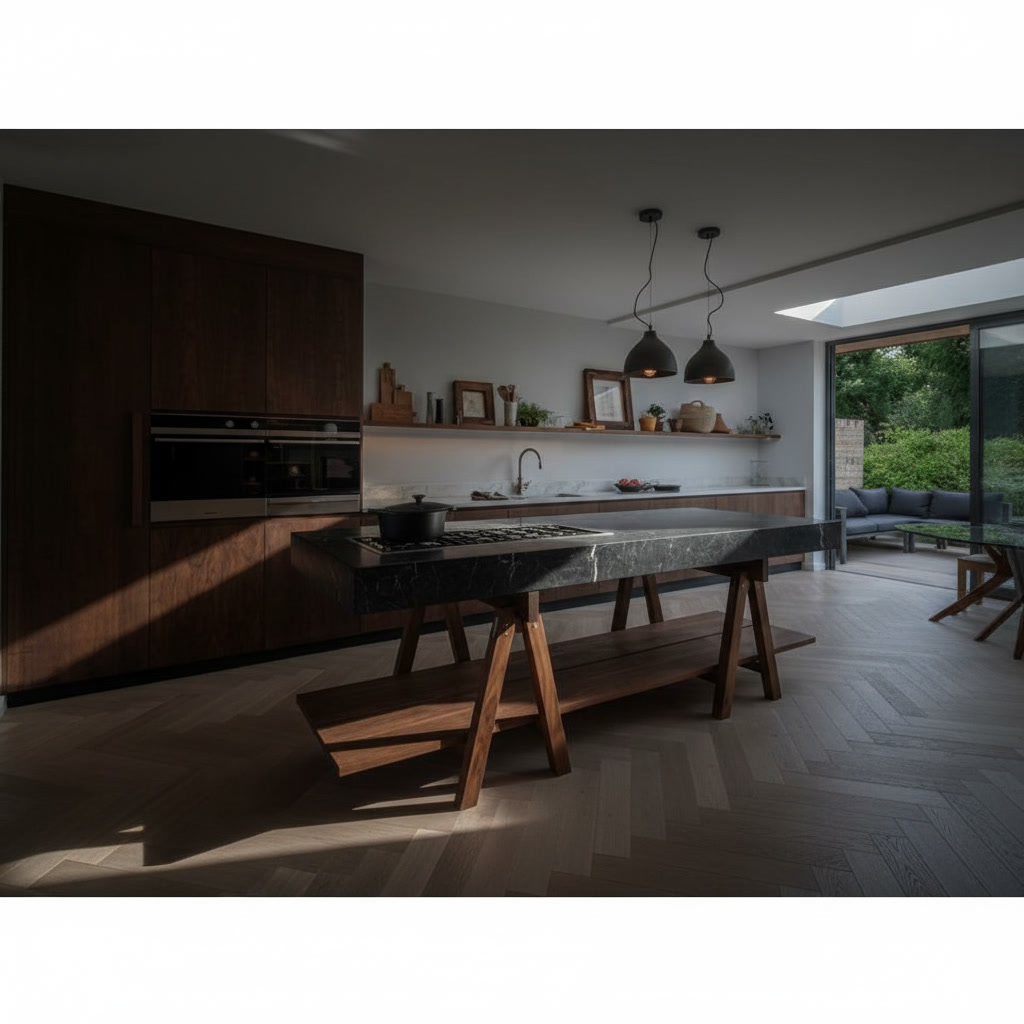
Wooden kitchen clad in porcelain stoneware with worktop on wooden trestles and bench

Wooden kitchen clad in porcelain stoneware with worktop on wooden trestles and bench

A stone-effect top rests on two trestles of solid timber, a matching bench at its side: this is the island-table of a kitchen with the flavour of a contemporary refuge, where the porcelain stoneware surface — sink integrated — meets exposed carpentry as in an atelier. Behind, wooden columns with brown-figured grain house the oven and the pantry; black lamps descend on cue, and the glazing brings the garden into the scene. Fully equipped, this is a kitchen that celebrates construction itself: no plinths to conceal, no closed volumes — the legs are visible, and they are handsome. The contrast of technical stone and structural wood is its language: honest, warm, contemporary. It is the kind of idea that true made-to-measure turns into solid reality: Michelessi indoor kitchens, with Italian craftsmanship unafraid to show — with pride — how things are made.

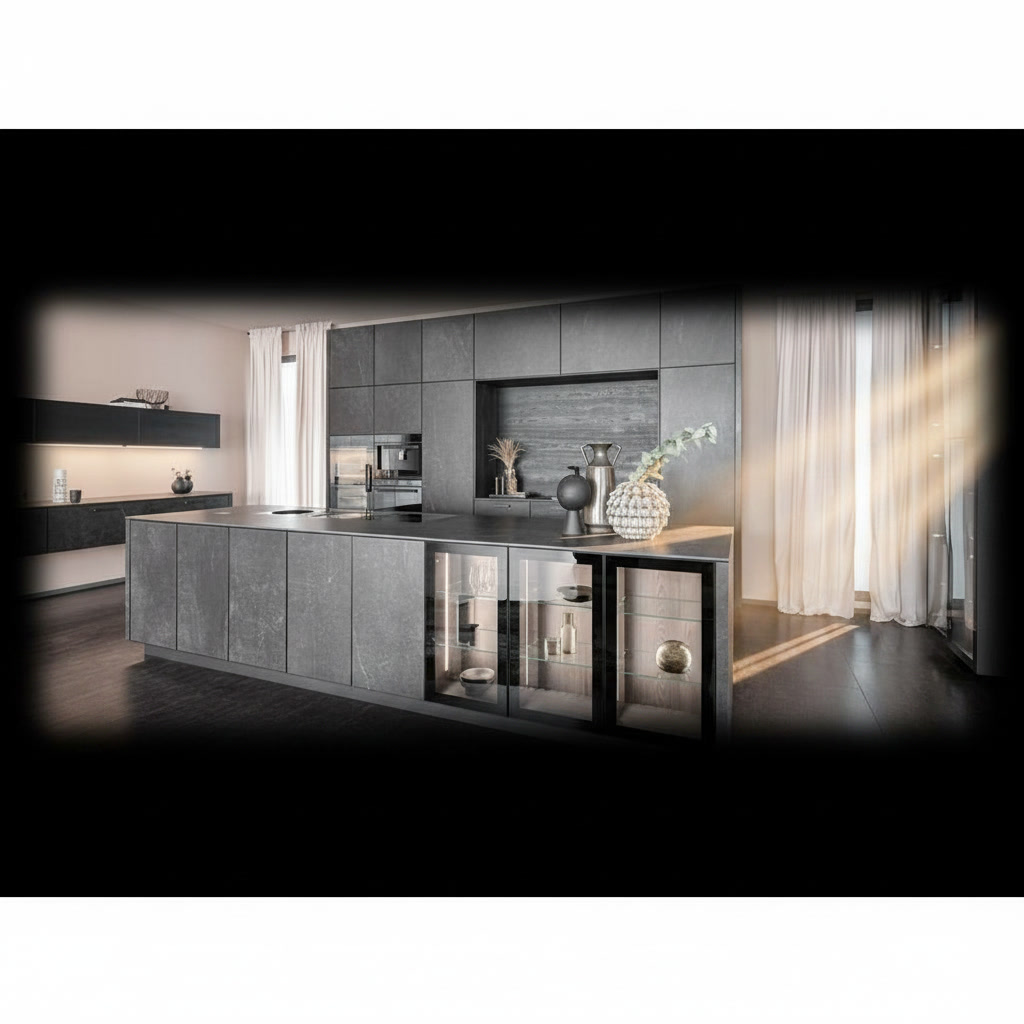
Elegant lacquered wooden kitchen with Laminam and glass top and LED-lit shelves

Elegant lacquered wooden kitchen with Laminam and glass top and LED-lit shelves

Pale curtains frame the scene like a curtain just raised: the lacquered kitchen in stone-grey finishes composes its central island and bases with glass shelves lit by LED — low vitrines where glasses and bottles shine with their own light. The Laminam and glass top runs dark and thin; a vase of dried branches signs the composition. Above, a black shelf with spotlights directs the light. This is the nocturnal elegance of houses that love to entertain: surfaces that barely reflect, measured transparencies, a calibrated atmosphere. Laminam provides the service; glass and LED provide the scenography. To design illuminated vitrines within base units demands planned wiring and clean assembly: no visible cables, no misplaced shadows. It is the care Michelessi brings to its made-to-measure indoor kitchens: a wooden structure, Italian craftsmanship, and light treated as a material — the most precious of them all.

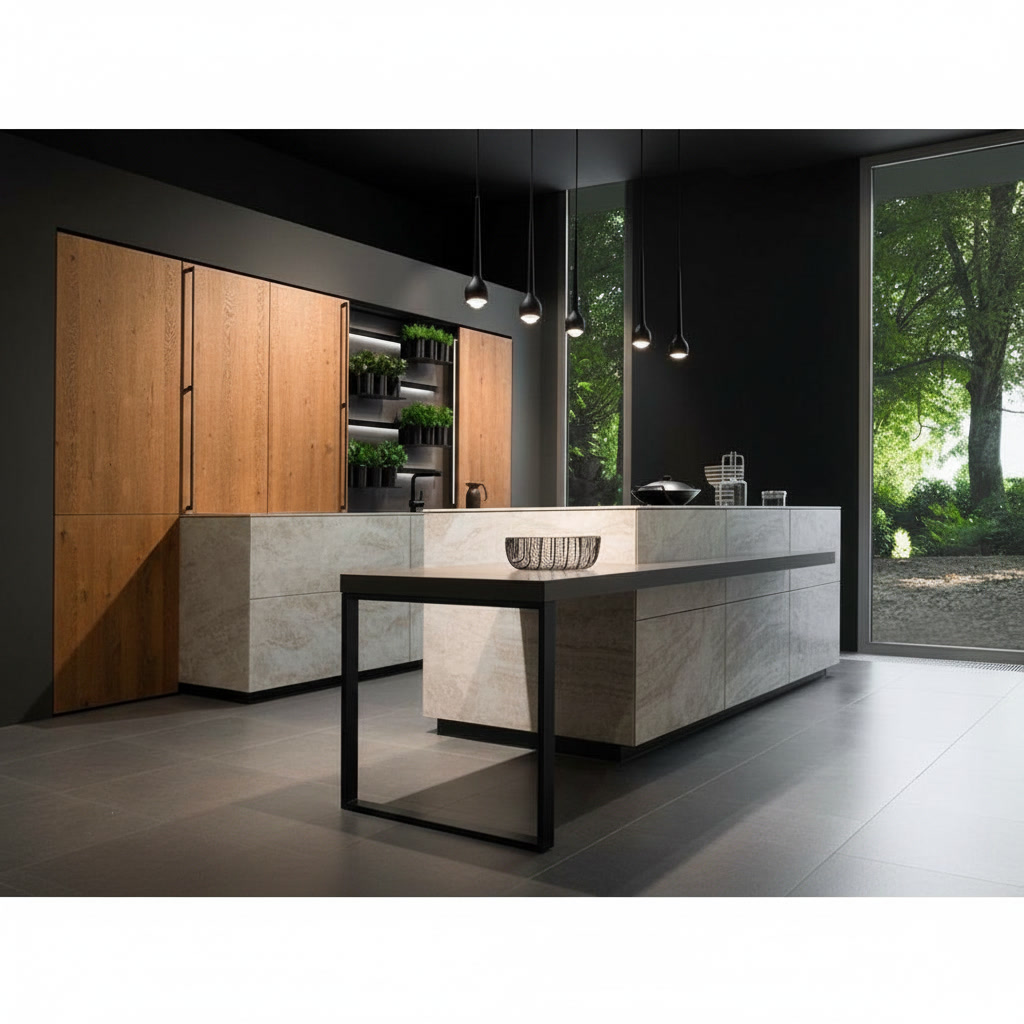
Kitchen clad in stone-effect porcelain stoneware with island and integrated side table

Kitchen clad in stone-effect porcelain stoneware with island and integrated side table

The composition has the rigour of a gallery: volumes clad in stone-effect porcelain stoneware — the central island and a long suspended base — converse with a wall of warm wood, where open compartments host aromatic plants like small vertical gardens. Flanking the island, an integrated side table on a black metal frame extends the worktop into a space for breakfast or the laptop: a design gesture that multiplies its uses. The dark floor makes the mineral greys stand out; a steel bowl on the counter gathers the light. This is material minimalism in its most liveable version: technical surfaces, wood in careful doses, intelligent functions. Stone-effect stoneware delivers the urban aesthetic without its fragilities: it wipes clean, resists, endures. It is the synthesis Michelessi builds to measure in its indoor kitchens, structure in wood, made in Italy from frame to finish — because even a stone-effect surface, well interpreted, knows how to be hospitable.

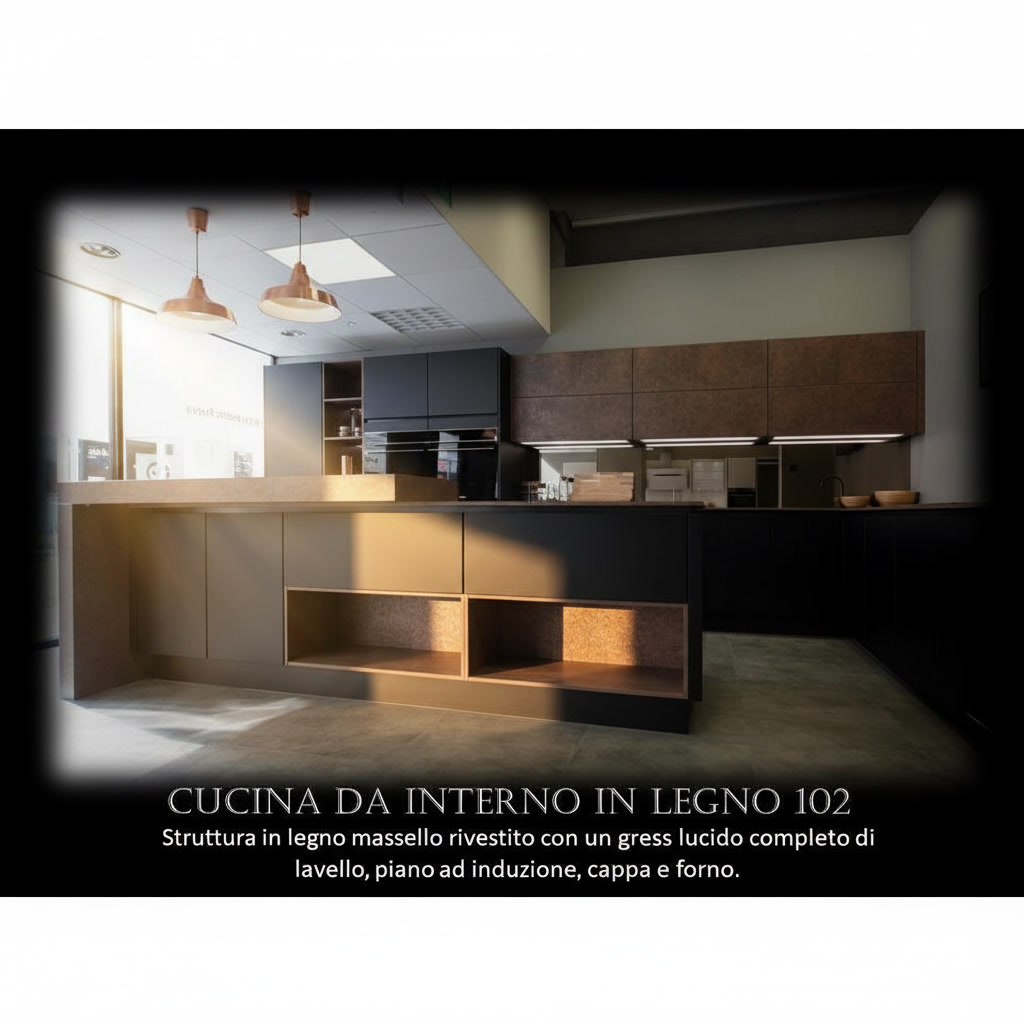
Solid wood kitchen clad in stoneware with dark blue volumes and corten-effect peninsula

Solid wood kitchen clad in stoneware with dark blue volumes and corten-effect peninsula

The pairing is bold and it works: deep matt midnight-blue volumes meet a peninsula clad in rust-effect stoneware — a warm, material surface recalling the corten steel of contemporary architecture. The peninsula's open compartments keep books and objects at hand; above, copper lamps descend like drops of amber light, and dark boiserie with shelves completes the equipped wall. The kitchen, complete with sink, induction hob, hood and oven, shows how stoneware cladding can turn a solid wood structure into an expressive palette: mineral colours, industrial textures, absolute practicality. It is the contemporary taste Michelessi interprets in its bespoke indoor kitchens, with Italian craftsmanship attending to the pairings and finishes. Blue and rust: two tones that are not forgotten, for a kitchen that has no intention of passing unnoticed — a decisive character that, lived with daily, proves surprisingly easy to love.

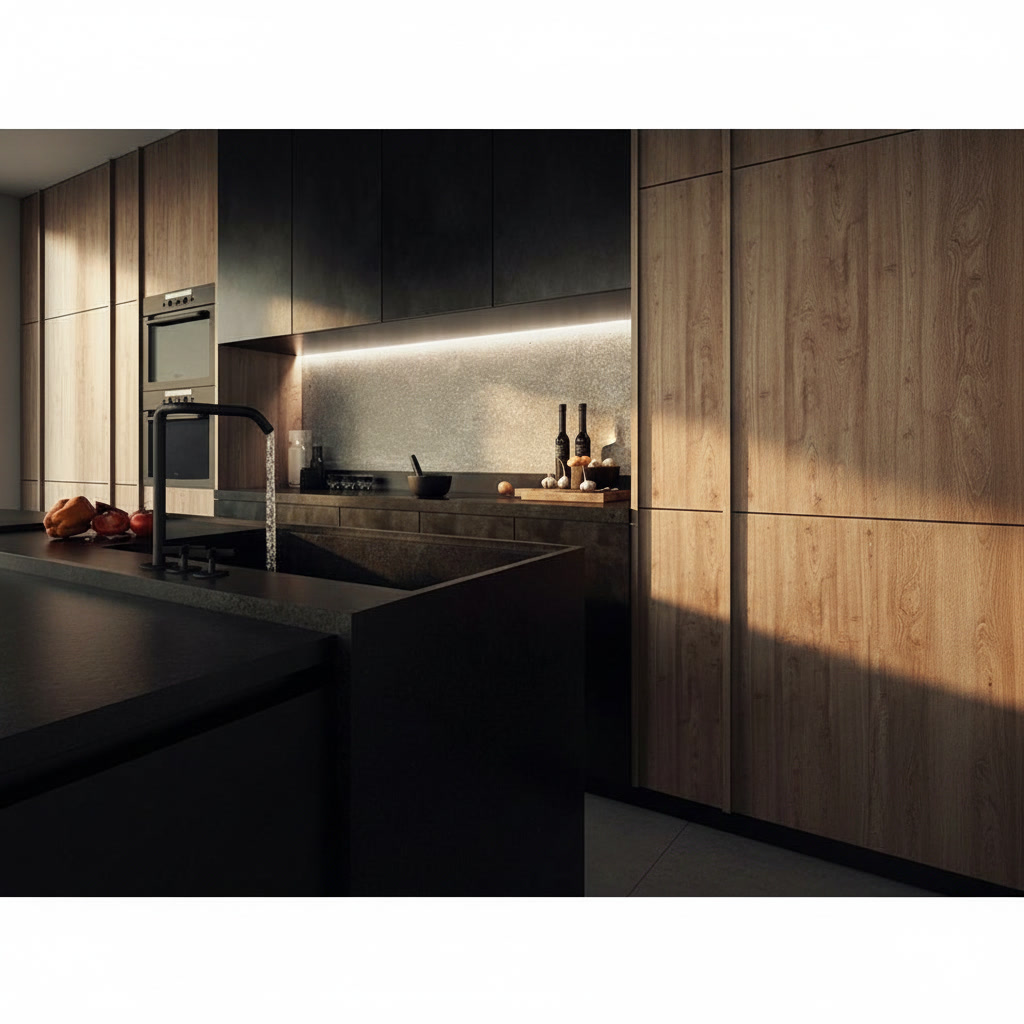
Solid wood kitchen with slatted doors, porcelain stoneware top and integrated sink

Solid wood kitchen with slatted doors, porcelain stoneware top and integrated sink

The light is that of the blue hour, when the kitchen glows with warm LEDs: solid wood columns with vertical slats set their material rhythm along the wall, and a black porcelain stoneware counter runs beneath the strip of light, carrying the integrated sink and its dark mixer. Tomatoes on the counter, bottles beside the stove: daily life enters the scene without posing. Doors organise the compartments with the discretion of well-considered design. This is the kitchen of slow evenings: materials that absorb the light and give it back softened, surfaces that invite unhurried cooking. The black stoneware works tirelessly; the solid wood warms every reflection. It is the balance of technique and atmosphere that Michelessi builds to measure in its indoor kitchens: a wooden structure, Italian craftsmanship, and that well-designed half-light that turns an ordinary Tuesday dinner into a small ritual. In the evening, LEDs aglow, even tidying up becomes an almost meditative gesture.

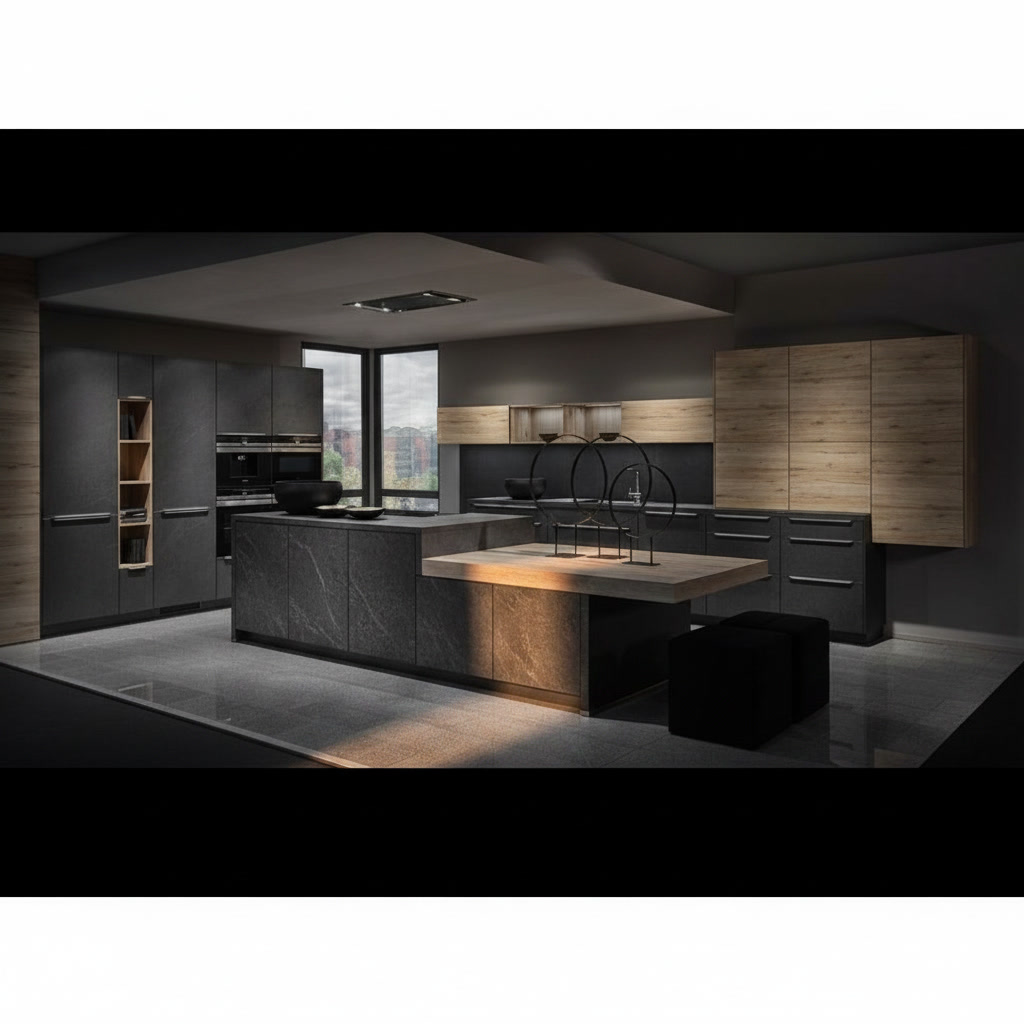
Lacquered wooden kitchen with Laminam top and doors, island with table and ovens

Lacquered wooden kitchen with Laminam top and doors, island with table and ovens

The composition alternates stone grey and pale oak with a sure rhythm: dark columns house the twin ovens, wooden wall units lighten the wall, and at the centre a Laminam island stretches its top into an adjoining table, where dark poufs wait for breakfast. Black lamps descend in a cluster; a ribbon window brings light onto hob and sink. Complete with oven, hob and sink, this is a kitchen that thinks horizontally: long surfaces, distributed functions, conviviality drawn into the design itself. Laminam on top and doors guarantees uniformity and resistance — the technical material that serves the project without limiting it. The lacquered wooden structure keeps the volumes true. It is the practical contemporary of Michelessi indoor kitchens: made to measure in its proportions, craftsmanship in its joints, and an island that never divides — it unites, from the morning coffee to the last conversation. An island that invites you to linger: the poufs, not by chance, are already there.

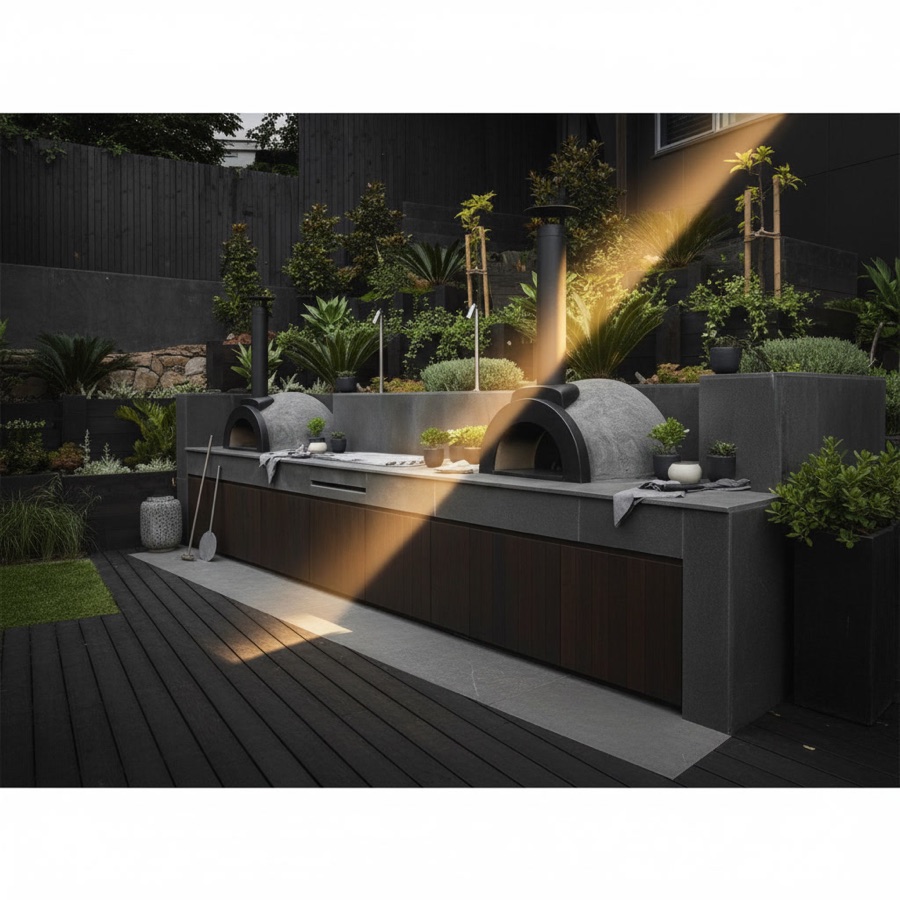
Outdoor kitchen in stone-effect stoneware with exposed dome oven and treated wood doors, among planters

The Roof Garden with the Black Dome

Planters overflow with succulents and herbs, and amid this hanging garden the oven's black dome rises like an almost ancestral presence: its mouth ready for flame, its perfect form promising pizzas and breads as tradition demands. Around it, the kitchen extends its volumes in stone-effect stoneware — textured grey surfaces, resilient and discreet — with treated wood doors adding their measured warmth. Dark decking and buildings blurred on the horizon tell of an urban refuge reclaimed from refractory stone.

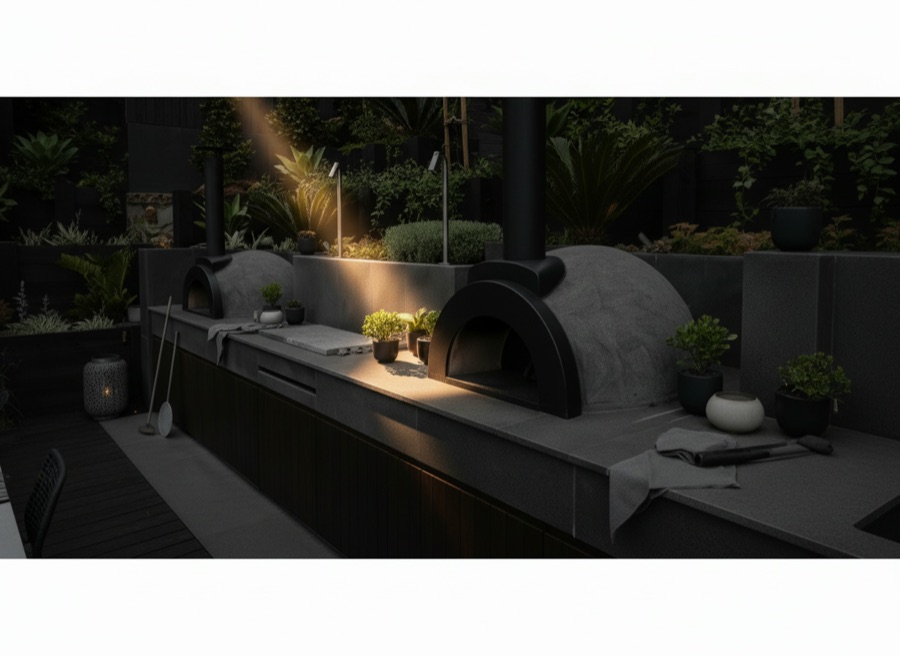
Stone-effect stoneware outdoor kitchen with black dome oven and treated wood doors, on a green terrace

The Open Oven Above a Roof Garden

Among the lush planters of a roof garden, the black dome of the oven rises like a small ancestral architecture. This stone-effect stoneware outdoor kitchen stretches its grey volumes along the terrace: tactile, mineral-toned surfaces in dialogue with the treated wood of the small doors and the exuberant green of the plants. The open oven is the undisputed centrepiece — promising bread, pizzas, slow-rising dough and evenings around the fire — while the rest of the composition works in silence, ordered and resilient.

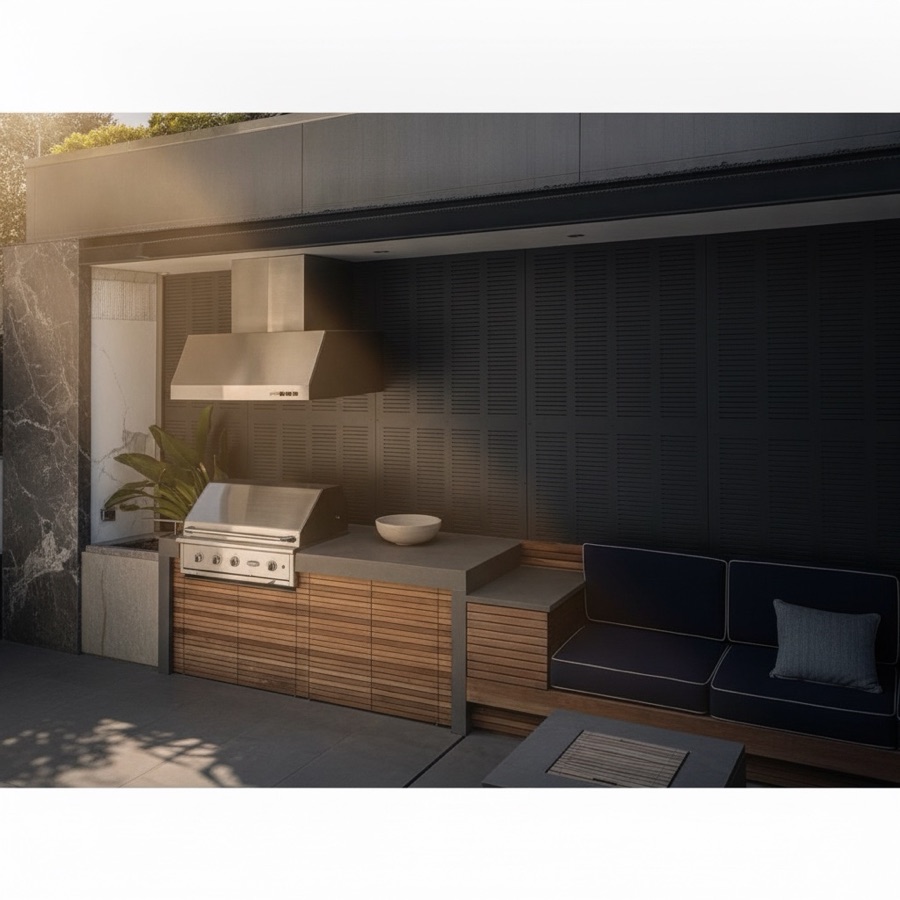
Outdoor kitchen with dark Dekton wall, wood-slat base, gas barbecue and steel hood

Tech Kitchen, Dekton and Wood in Dialogue

The graphite-toned Dekton wall rises compact and technical — the great ultra-compact slab that fears neither scratches, frost nor sun — and the kitchen answers with the warmth of the wooden slats that clad its base. Between them, the stainless gas barbecue works beneath the professional hood descending from the wall; to the side, a bench faced in blue tiles adds an accent of colour that surprises. Above, a planter lets the green spill down.

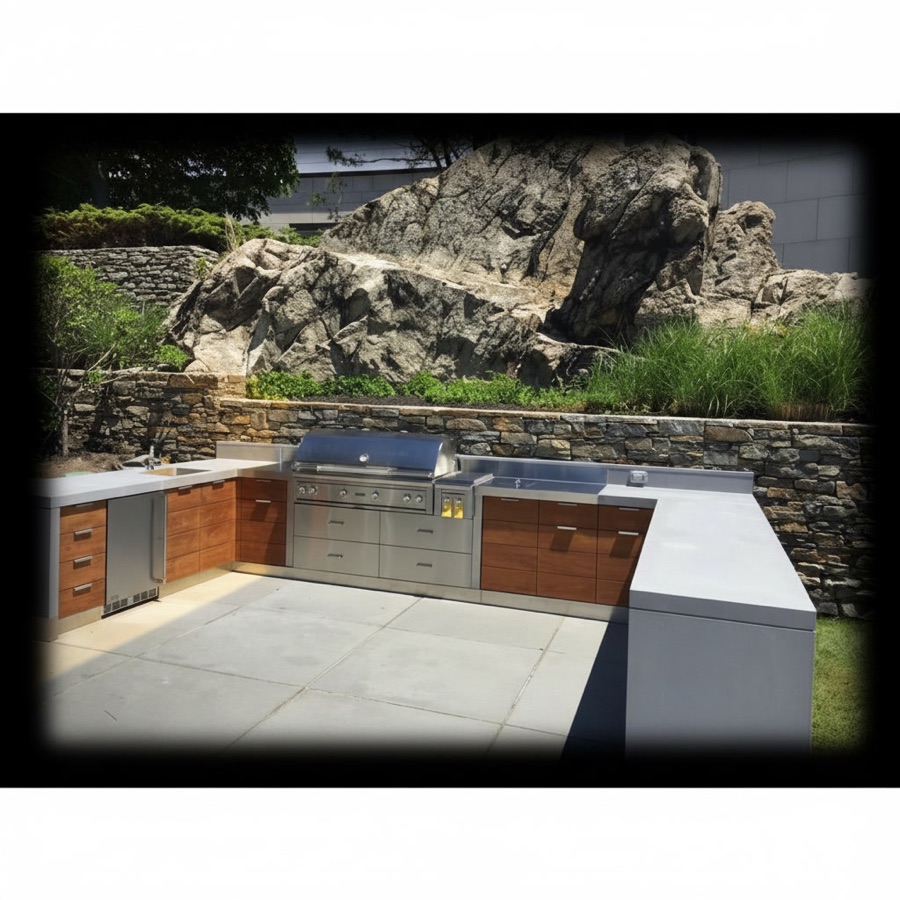
U-shaped maxi outdoor kitchen with sintered stone counter, steel appliances and treated wood doors

The Grand U Before the Rock

The garden's rock face rises theatrical behind, and the kitchen answers with its generous U: a grey sintered stone counter runs unbroken along three sides, doors and drawers in treated wood warm the bases, and steel appliances — the professional barbecue, the technical modules, the service surfaces — equip the line like a full kitchen brigade. Pale stone slabs spread the working floor.

What are the drawbacks of porcelain stoneware in a kitchen? Advantages and limits

Porcelain stoneware is a good material for a kitchen worktop: Laminam states that the surface is non-porous, withstands the direct heat of pans and is cleaned with water and neutral detergent. The drawbacks are few and well known: it feels cold to the touch, working it takes skilled hands, and cut-outs, corners and overhangs have precise rules.

What mattersHow it behavesWhat to know
StainsLaminam states very low porosity, around 0%, and non-porous worktopsWater and neutral detergent are enough for everyday cleaning
HeatLaminam states that its slabs withstand the direct heat of pots and pans without damage; Cosentino writes that Dekton withstands high temperatures without damageThese are manufacturers' statements: a trivet remains a good habit
ScratchesIn a kitchen manufacturer's table, scored from 1 to 5, ceramics get 5 for scratches, stains and heatIt is a commercial table, not a standard
ImpactIn the falling-ball test (400 mm, average value 3 J) the Laminam technical guide reports no damageCut-outs and corners follow precise rules, described below
FeelAn industry source lists a cold feel to the touch among the disadvantagesIt is a matter of taste, best judged in person
FabricationThe same source says specialist fabricators and installers are neededWe cut the slabs in our own workshop and install them with our own team
CostThe same source places it above laminate and quartzIt depends on the project: the factors are further down

Laminam or Dekton: what is the difference?

Laminam is porcelain stoneware; Dekton is not: it is an ultra-compact surface by Cosentino, made by sintering particles. They are two different materials and we work both: that is why we keep them apart.

AspectLaminamDekton
What it isPorcelain stoneware in large slabsUltra-compact surface, produced by ultra-compaction and sintering of particles
ThicknessesFor kitchen worktops: 12 and 20 mm (12+ and 20+, nominal thicknesses 12.5 and 20.5)4, 8, 12, 20 and 30 mm
HeatThe manufacturer states that it withstands the direct heat of pots and pans without damage or deformationThe manufacturer states that it withstands high temperatures without damage
Outdoors and UV raysThe manufacturer states that weather and UV rays do not damage or alter the surfacesThe manufacturer states that it remains unaltered under ultraviolet rays

Colours, finishes and workmanship of each are on the Laminam and Dekton pages; for a comparison with quartz, Fenix and marble there is the guide marble, Dekton, quartz, Fenix: which worktop to choose.

Which thickness for a porcelain stoneware kitchen: 12 or 20 mm?

For the kitchen worktop you choose slabs of 12 or 20 mm, the two thicknesses Laminam provides for kitchen worktops. In its range they are the 12+ and the 20+, reinforced on the back with a glass-fibre mat; for vertical cladding Laminam specifies thinner versions, the 2+, 3+, 5 and 5+.

  • 12 mm: the slim-profile worktop. A ceramics manufacturer notes that 12 mm gives greater strength and impact resistance than thinner slabs.
  • 20 mm: the worktop with a full look and a thicker edge; it is the other thickness Laminam provides for worktops, and the one to consider for an island with a solid look.
  • Thin versions (2+, 3+, 5, 5+): slabs for splashbacks and vertical cladding, not for the working surface.

For an island with a very thick edge there is the 20 mm slab. A ceramics manufacturer points out that substantial thicknesses are also obtained with thin slabs that clad a "core" of another material: the choice between the two routes is made in the design, looking at the island in person.

Porcelain stoneware kitchen with an island: cut-outs, corners and overhangs

A porcelain stoneware island is made with slabs on the top and the sides, and has to be designed within the limits the manufacturer sets out in its technical guide. For Laminam they are these.

Limit stated by LaminamWhat it means for your kitchen
Holes and cut-outs at least 50 mm from the edgeHob and sink leave a solid strip along the edge
Inside corners with a radius of at least 5 mm; at 90° the work is not recommended and increases crazingThe corners of the cut-outs are rounded, never sharp
Undermount sink: a bevel of at least 2 mmThe edge of the cut-out is eased
Overhangs tested with 100 kg at 50 mm from the edge; beyond that, steel-profile reinforcement is needed, with a maximum span of 1,200 mmThe breakfast bar with stools is sized in the design
L-shaped worktops in a single piece only on perfectly flat basesThe base of the kitchen is levelled before installation

These are a manufacturer's rules, and we respect them in the design before cutting the slab. For island dimensions, clearances and the hob there is the page on the bespoke kitchen with an island; the natural stone island is under marble kitchen island.

Porcelain stoneware and solid wood kitchen: the doors

In our porcelain stoneware kitchens the porcelain stoneware clads worktop, island and splashback, while the doors are made to measure in solid wood, or in steel. It is the pairing that shares out the tasks: the surface that takes pans, knives and water is a slab, the one you touch and open every day is wood.

The search "porcelain stoneware doors" exists, and deserves an honest answer: the manufacturer specifies thin slabs for vertical cladding, and for a whole door there is no general rule we can give you. Every project is checked with the slab manufacturer before it is promised. Finishes, hinges and opening systems for wooden doors are on the page doors, hinges and finishes; the pairing of stone and wood has its own page in marble and wood kitchen; the difference between real wood doors and wood-effect doors is explained in the twin department, in real wood or wood-effect kitchen; steel doors are under stainless steel kitchen.

Marble-effect or stone-effect porcelain stoneware kitchen

Porcelain stoneware can reproduce the look of marble or stone: it is the choice for those who want that pattern on a non-porous surface. Real marble remains something else: it is a calcareous stone, sensitive to acidic solutions such as lemon and vinegar, as the Natural Stone Institute points out, and every slab has its own vein. Choose marble if the unique slab matters to you; choose porcelain stoneware if you want that pattern with less to worry about. The same goes for the wood-effect porcelain stoneware kitchen: the slab reproduces the grain of wood on worktop and splashback, where real wood would suffer from water and heat, and the doors remain in solid wood.

What mattersLaminam porcelain stonewareGraniteMarble
PatternReproduces marble and stoneFine grain, speckledA different vein on every slab
HeatThe direct heat of pans, the manufacturer statesAbout 250 °C, but not concentrated heatA trivet is wiser
Stains and acidsNon-porous surfaceTreated with a sealer to reduce stains; far more resistant to acids than marbleFears lemon and vinegar: wipe it dry at once
Scratches5 out of 5 in one manufacturer's tableMinerals harder than a steel bladeSofter: it is made of calcite, a mineral less hard than quartz
OutdoorsUV rays do not alter it, the manufacturer statesYes, in Michelessi outdoor kitchensWith care over temperature swings

Granite has a page of its own: bespoke granite kitchen; for marble, the Calacatta page shows an example of a marble vein. Dark stoneware beside wood is one of the choices of the top-end modern kitchen, in bespoke luxury kitchens; if the kitchen opens onto the living room, a non-porous worktop is an easy one to keep tidy, as the page open-plan kitchen and living room explains.

Porcelain stoneware outdoor kitchen

Yes: Laminam porcelain stoneware and Dekton are also used outdoors, because the manufacturers state that UV rays do not alter them. A quartz is different: for Silestone, Cosentino writes that outdoor use is not recommended, because UV rays can damage the surface.

Outdoors, porcelain stoneware and Dekton make the worktop; the structure beneath, the refractory stone barbecue, frost and the fridge are explained material by material on the page complete outdoor kitchen; for Dekton outdoors there is Dekton outdoor kitchen, and solutions under a porch or veranda are in enclosed and covered outdoor kitchen. All the outdoor kitchens are gathered under outdoor kitchens.

How to clean porcelain stoneware, and can you cut on it?

For everyday cleaning, water and neutral detergent are enough: Laminam says so for its kitchen worktops, which are non-porous.

As for cutting directly on the worktop, Cosentino for Dekton and a ceramics manufacturer for porcelain stoneware say that it can be done. A chopping board still protects the knives, and we recommend one.

How much does a bespoke porcelain stoneware kitchen cost

The price of a bespoke porcelain stoneware kitchen depends on the project, and without a survey a figure is not serious. We do not publish price lists, because the factors that move it change with every kitchen:

  • linear metres and shape, island included;
  • slab thickness and format, 12 or 20 mm;
  • workmanship: holes, cut-outs, undermount sink, reinforced overhangs;
  • doors, tall units and splashback, in solid wood, steel or slab;
  • appliances, services and location, with installation as a separate item.

The survey, the connection of the services and the 3D design are explained on the page kitchen design and renovation. The quote is free everywhere; in Rome, Latina and throughout Lazio the site survey is free too.

From the site survey to installation, throughout Italy

For porcelain stoneware the decisive step is the design: cut-outs, corners and overhangs are checked against the manufacturer's guide before the slab is cut in the Aprilia workshop, where Michelessi has worked stone since 1976 and built modular kitchens since 2022. The six steps common to every kitchen, from site survey to installation by our own team throughout Italy, are on the page how a bespoke kitchen comes about; abroad we have one real project, in Dubai. For other questions there is the page bespoke kitchens: questions and answers; fireplaces, stoves and barbecues are on michelessi.it, the site of our technical products.

The quote is free: request it here.

Frequently asked questions

Frequently asked questions

What are the drawbacks of porcelain stoneware in a kitchen?

The drawbacks are few: it feels cold to the touch, an industry source places its cost above laminate and quartz, and it needs expert fabricators and installers. Holes, corners and overhangs have precise rules, set out by Laminam in its technical guide. Michelessi cuts the slabs in the Aprilia workshop and installs them with its own team, throughout Italy.

Is porcelain stoneware a good material for a kitchen worktop?

Yes. Laminam states very low porosity, around 0%, a non-porous worktop that withstands the direct heat of pots and pans and is cleaned with water and neutral detergent. These are the manufacturer's statements, to be read together with the working rules. For the worktop alone there is also a dedicated Italian page.

Are Laminam and Dekton the same thing?

No. Laminam is porcelain stoneware, that is, fired ceramic in large slabs. Dekton is an ultra-compact surface by Cosentino, made by ultra-compaction and sintering of particles. The thicknesses differ (Dekton goes up to 30 mm, Laminam for worktops offers 12+ and 20+) and the stated performance is similar: we work both, each with its own page.

Which thickness for a porcelain stoneware kitchen: 12 or 20 mm?

12 mm gives a slim-profile worktop; a ceramics manufacturer cites greater strength and impact resistance for this thickness compared with thinner slabs. 20 mm gives a full edge and a solid look, the one to consider for an island. These are the two thicknesses Laminam provides for worktops, and the choice is made on the project.

Can a hot pan be put on porcelain stoneware?

Laminam states that its slabs withstand the direct heat of pots and pans without damage or deformation; Cosentino writes that Dekton withstands high temperatures without damage. These are manufacturers' statements, not tests of ours: for pans just taken off the heat a trivet remains a good habit.

Can you cut directly on a porcelain stoneware worktop?

Cosentino for Dekton and a ceramics manufacturer for porcelain stoneware say that food can be cut directly on the worktop. We still recommend a chopping board, which protects the knives: the surface does not need it, the blade does. For everyday cleaning, Laminam indicates water and neutral detergent.

Is a porcelain stoneware kitchen suitable for outdoors?

Yes: Laminam and Cosentino state that UV rays do not alter their surfaces. A quartz is different: for Silestone, Cosentino does not recommend outdoor use. The Michelessi outdoor kitchen has a structure of dry-laid refractory stone, steel or treated wood, with the worktop chosen in the design.

Can a porcelain stoneware island be made?

Yes, with slabs on the top and the sides. A thick edge is obtained with 20 mm slabs or, as a ceramics manufacturer points out, with thin slabs that clad a "core" of another material. Laminam sets the limits: holes at least 50 mm from the edge, inside corners with a radius of at least 5 mm and, for generous overhangs, reinforcement with steel profiles with a maximum span of 1,200 mm.

Can porcelain stoneware doors be made?

The search exists, but for a whole door there is no general rule we can give: Laminam specifies thin slabs for vertical cladding, and every project is checked with the manufacturer before it is promised. In our kitchens the porcelain stoneware clads worktop, island and splashback, while the doors are made to measure in solid wood or in steel.

What is the most resistant material for a kitchen worktop?

There is no official ranking. In one kitchen manufacturer's table, scored from 1 to 5, ceramics get 5 out of 5 for scratches, stains and heat. The right material depends on use, on the look you want and on the care you are willing to give it.

Is marble-effect porcelain stoneware better than real marble?

It is neither better nor worse: it is a different choice. Porcelain stoneware reproduces the pattern of marble on a non-porous surface; real marble is a calcareous stone, sensitive to lemon and vinegar, and every slab has its own vein. Those who cook a lot and want no special care choose porcelain stoneware, those who want the unique slab choose marble.

How much does a bespoke porcelain stoneware kitchen cost?

It depends on the project: linear metres and shape, slab thickness and format, workmanship such as holes, cut-outs and undermount sink, doors, appliances, services and installation. We do not publish price lists. The quote is free everywhere; the site survey is free in Rome, Latina and throughout Lazio.

Call us WhatsApp