Skip to content
Made in Italy

Since 1976 — Bespoke kitchens

Granite Kitchen, Made to Measure: Colours, Finishes, Care

WOOD · STEEL · MARBLE · STONEWARE

In short

Circular outdoor kitchen in treated marble and granite with professional steel barbecue and night lighting
The Curve of Stone That Welcomes the Evening — photograph of a Michelessi project.

The block — a Michelessi vision

From the block,
blow after blow

01 A raw block of Calacatta Viola waits under the spotlight, in the dark kitchen with brass profiles. Mallet and chisel are already on the floor: the island is still all inside the stone.

02 Blow after blow the faces are squared, chips fly, white dust rises into the light. The chisel scores the drawers, opens the recess for the hob, carves the sink: the shape of the island comes out of the block slowly, without haste.

03 Then the stone is honed and polished: the purple vein catches the light, brass edges close the drawers, the black hob sinks into its recess, the gold tap finds its place. The island remains, and a veil of dust on the floor.

Keep scrolling — the scene follows you

Granite kitchen: what it is and who builds it

A granite kitchen is a bespoke kitchen in which granite, a rock of quartz and feldspar, covers the surfaces you see and use: worktop, island, splashback, sides. It is built by Michelessi SRL, stone masons in Aprilia since 1976: we design it, build it to measure and install it with our own team throughout Italy, indoors and outdoors.

For the Italian encyclopaedia Treccani, granite is a plutonic or intrusive rock made of quartz and alkali feldspars, usually orthoclase: hard minerals, from which come the qualities that matter in a kitchen.

Those who search for a "granite kitchen" almost always find just the worktop. We mean the whole kitchen: granite where it works best and, around it, a kitchen designed and built to measure, with solid wood or steel doors, an island, tall units and appliances chosen with you. For the worktop alone there is the guide marble, stoneware, Dekton, quartz or Fenix: which worktop; the overview of all the materials is on the page bespoke kitchens.

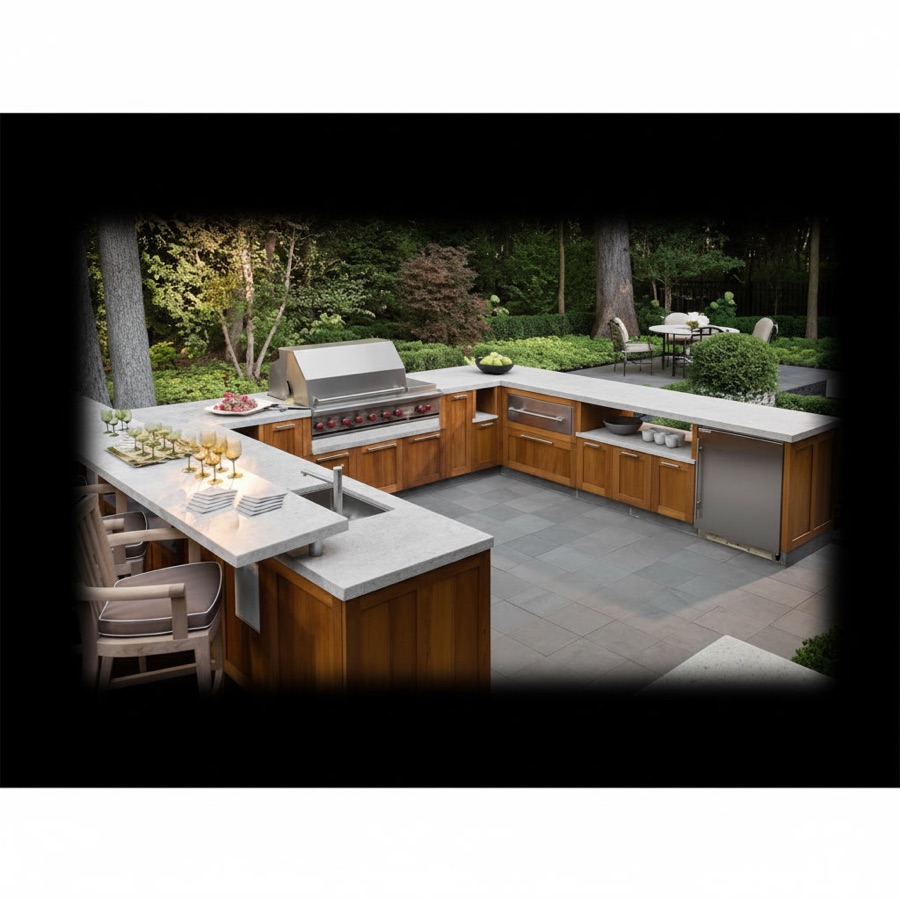
Outdoor kitchen with built-in appliances, light granite worktop and treated wood structure, U-shaped

The Great U of Teak and Granite in the Woods

The U spreads generously over blue stone paving and the woods embrace it on every side: the treated wood structure, with its warm, orderly doors, bears the light granite worktop running along three sides, carrying the barbecue with its steel hood, the sink, built-in appliances and the counter where high seats await company. Little plants on the tops add their domestic green to the great green of the trees.
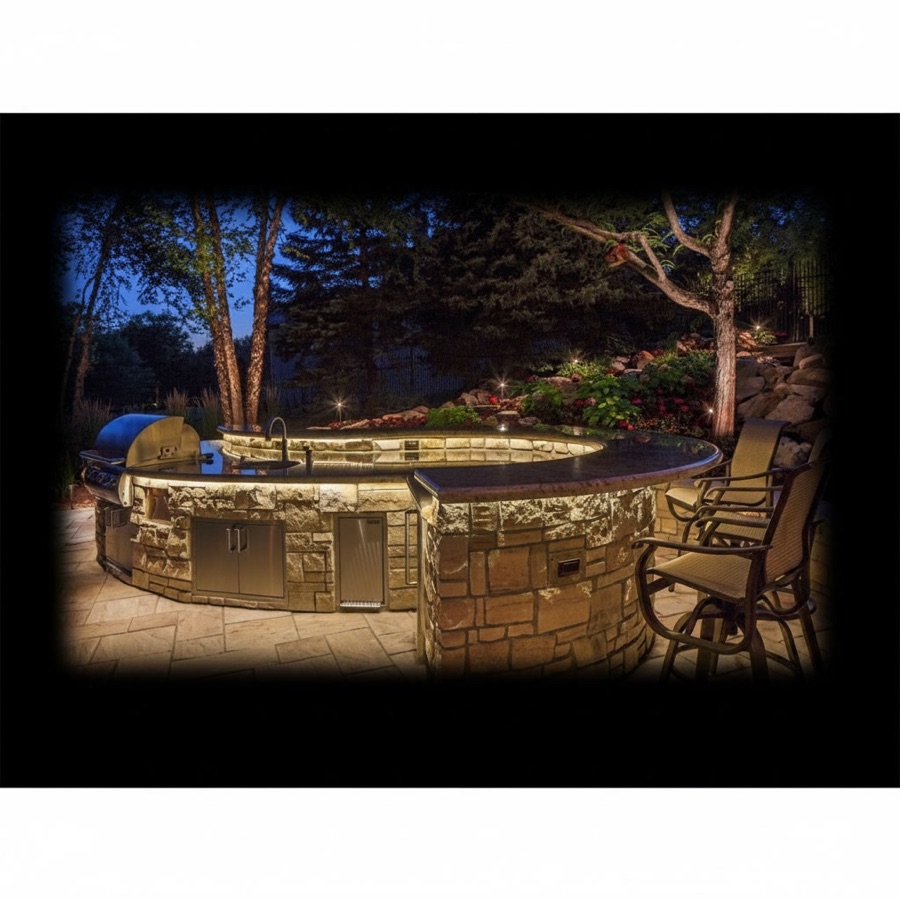
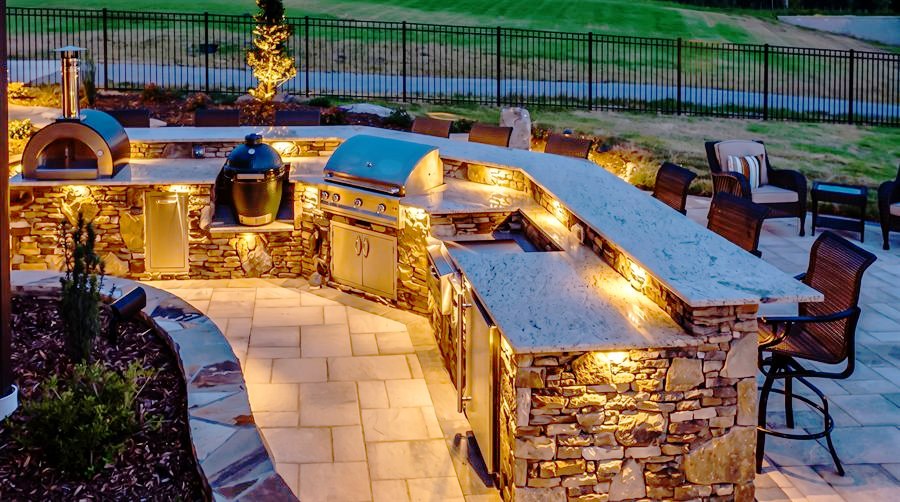
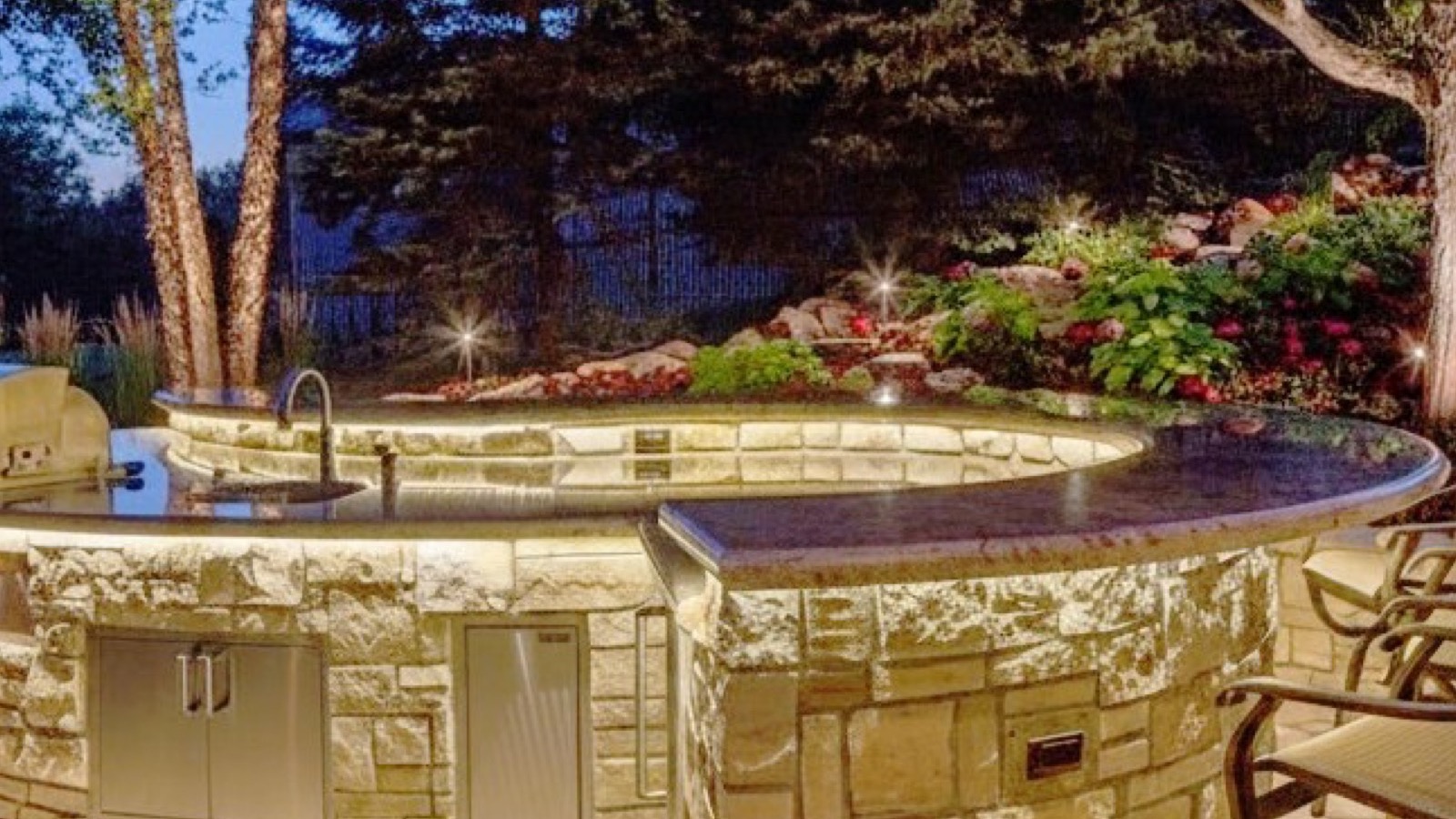
Circular outdoor kitchen in treated marble and granite with professional steel barbecue and night lighting

The Curve of Stone That Welcomes the Evening

The night is an accomplice: warm lights run beneath the counter and trace the curve of the kitchen like a luminous ribbon, while the base of stone in irregular courses anchors the composition to the garden. The dark stone counter follows the circumference without a single hard corner, receiving the professional steel barbecue on its left flank and then stretching toward the bar, where tall seats await the guests. Treated marble and granite, protagonists of the construction, withstand the seasons while keeping their depth; the built-in refrigerator works discreetly in the base.

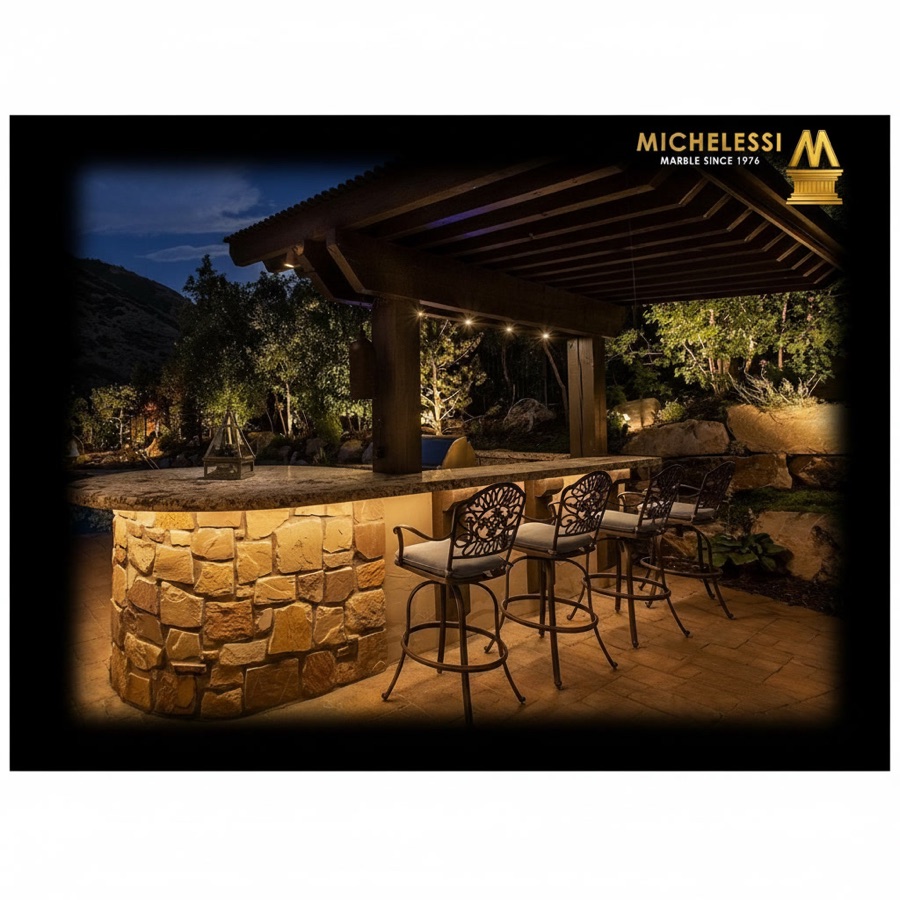
Outdoor kitchen in rough stone and granite with professional barbecue, counter and stools under a lit pergola

Golden Stone Beneath the Pergola, by Night

Night kindles the scene and the stone answers in tones of gold: the curved counter, built in rough stone, runs beneath the dark-beamed pergola while warm lights sculpt each block. Above, the granite top spreads its dark, patient surface; stools with wrought-iron scrolls await the guests, and the professional barbecue works in the shelter of the structure. Beyond the perimeter, the lit garden climbs towards the rocks like a small natural amphitheatre.

Project vision: large curved stone outdoor kitchen with illuminated granite worktops, pizza oven and barbecue, at night

The Stone Curve That Lights Up the Night

Night is its moment: the great curved stone kitchen ignites with warm lights that run beneath the granite worktops and turn the garden into a convivial amphitheatre. The composition describes a broad, generous curve — the pizza oven at one end, its mouth ready; at the centre the steel barbecue and its hood; all around, the counter inviting guests to draw near with a stool and a glass.

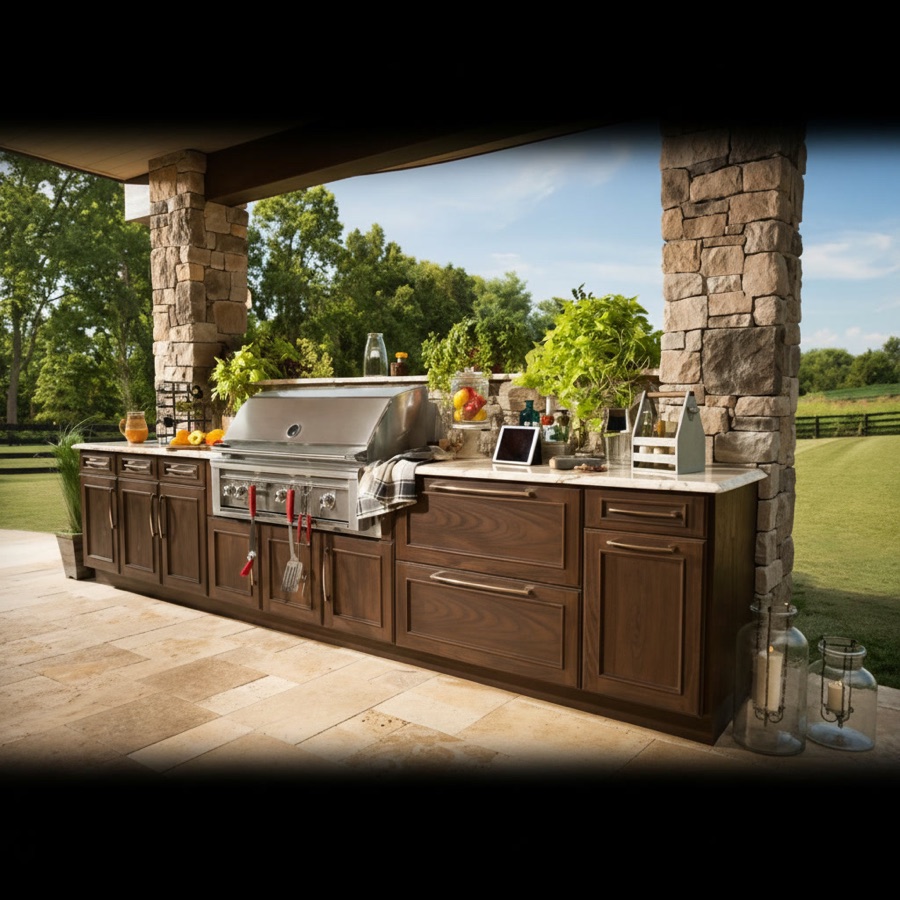
Outdoor kitchen in granite and walnut wood with hooded gas barbecue, between stone columns and lawn

Walnut and Granite Between Stone Columns

Stone columns frame the composition like a portal: between them, the kitchen extends its walnut-toned wooden bases — classic framed doors with the air of serious cabinetmaking — crowned by the light granite worktop already bearing the trays of service. The gas barbecue commands the centre beneath its steel hood, ready for the brigade; fruit and bottles on the counters tell of a day of guests. Beyond the portico, the lawn runs to the fences.

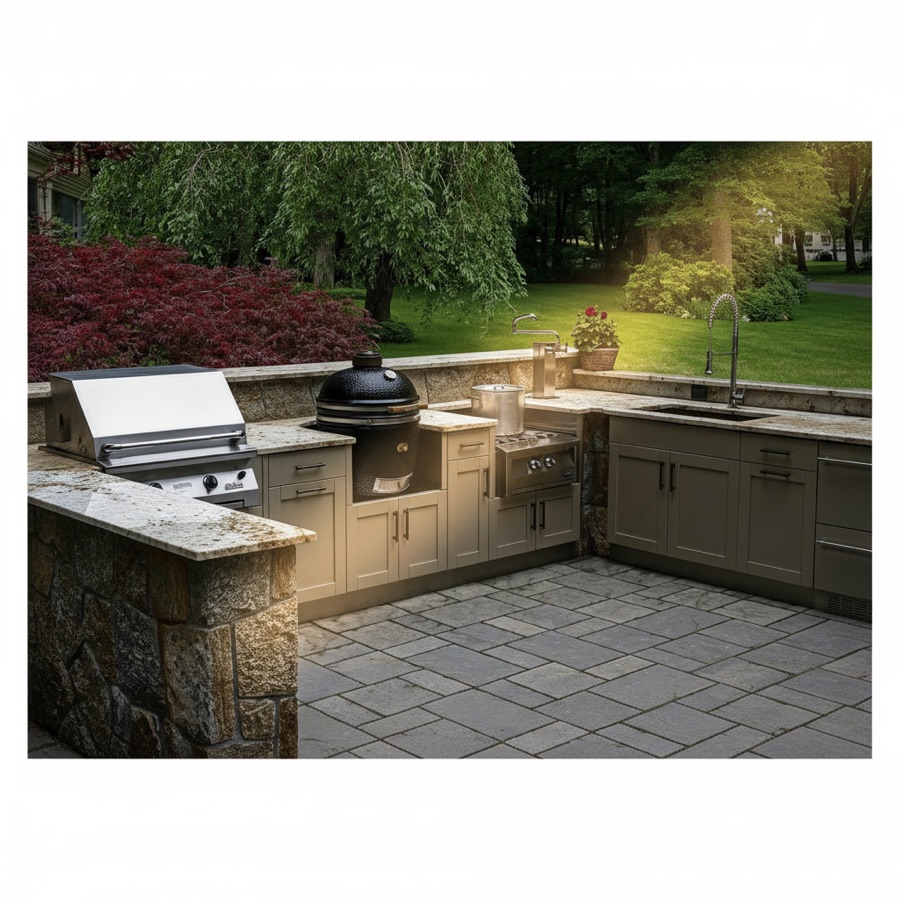
Outdoor kitchen with rounded worktop, sage green doors, round grill, barbecue and corner sink, in a garden

Sage Curves in an English Garden

The sage green of the doors converses with lawn and trees: the kitchen bends around a corner of the English garden, its warm-toned granite worktop flowing softly into stone flanks. Along the line work the steel barbecue, the black round grill for patient cooking, the corner sink with its tall tap; pots of herbs punctuate the counters. Pale slab paving spreads the space to the green.

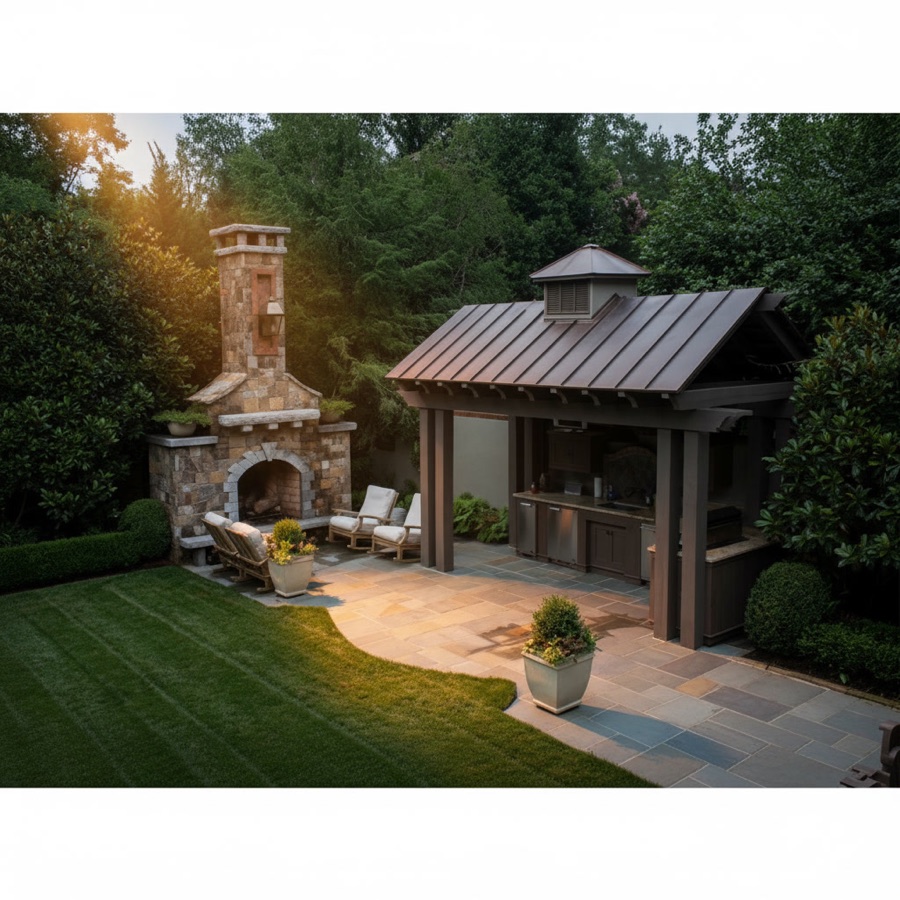
Outdoor kitchen with granite and wood top, metal-roof canopy, stone fireplace, barbecue and sink

The Pavilion and the Fireplace, Two Towers in Green

The garden hosts two sister architectures: the kitchen pavilion, its metal-roofed canopy and brown columns sheltering the granite counter, the built-in barbecue and the sink; and a little way off, the great stone fireplace, a white bench at its feet, promising flames and conversation deep into the night. Between them, a lawn drawn by hedges and a stone path linking the two worlds — that of cooking and that of lingering.

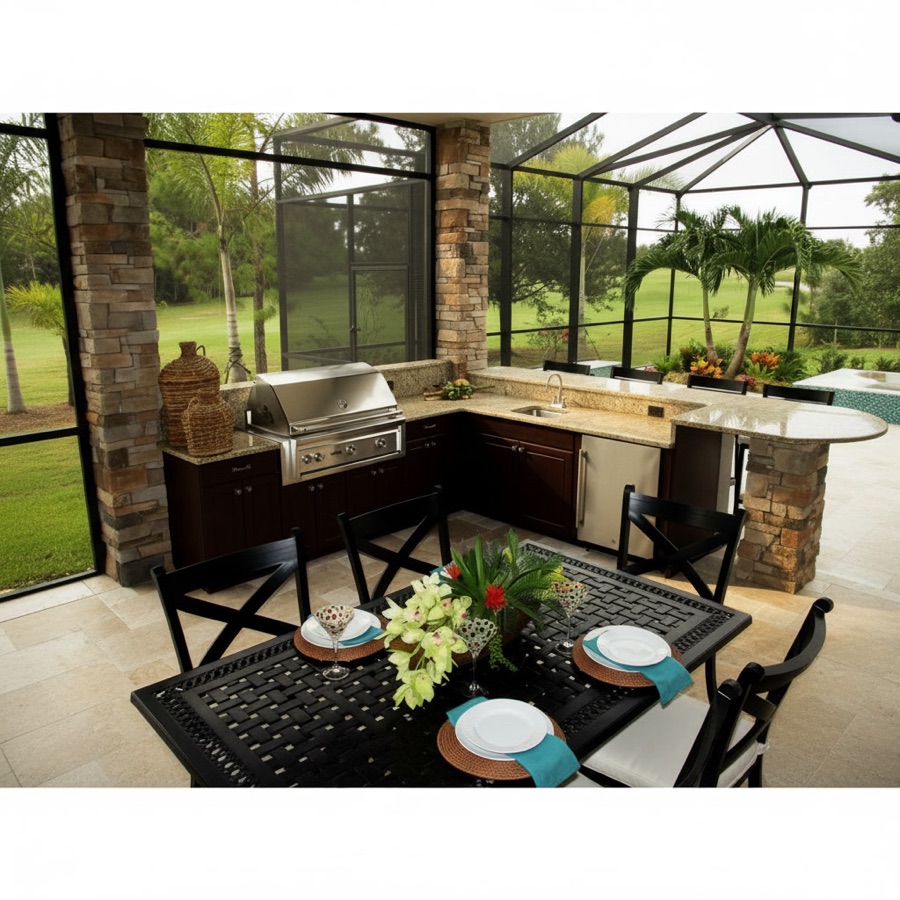
Outdoor kitchen in a greenhouse with granite top, rounded counter, built-in appliances and iron table

Cooking in the Greenhouse, Green Beyond the Mesh

The greenhouse's mesh walls let the garden in while keeping the harshest of summer out: within this transparent room, the kitchen spreads its stone-clad bases beneath a rounded granite counter that bends softly along the corner. The steel barbecue works at the centre, built-in appliances complete the equipment, and the wrought-iron table — already laid with flowers — awaits dinner two steps from the burners. Beyond the mesh, the lawn runs towards the trees.

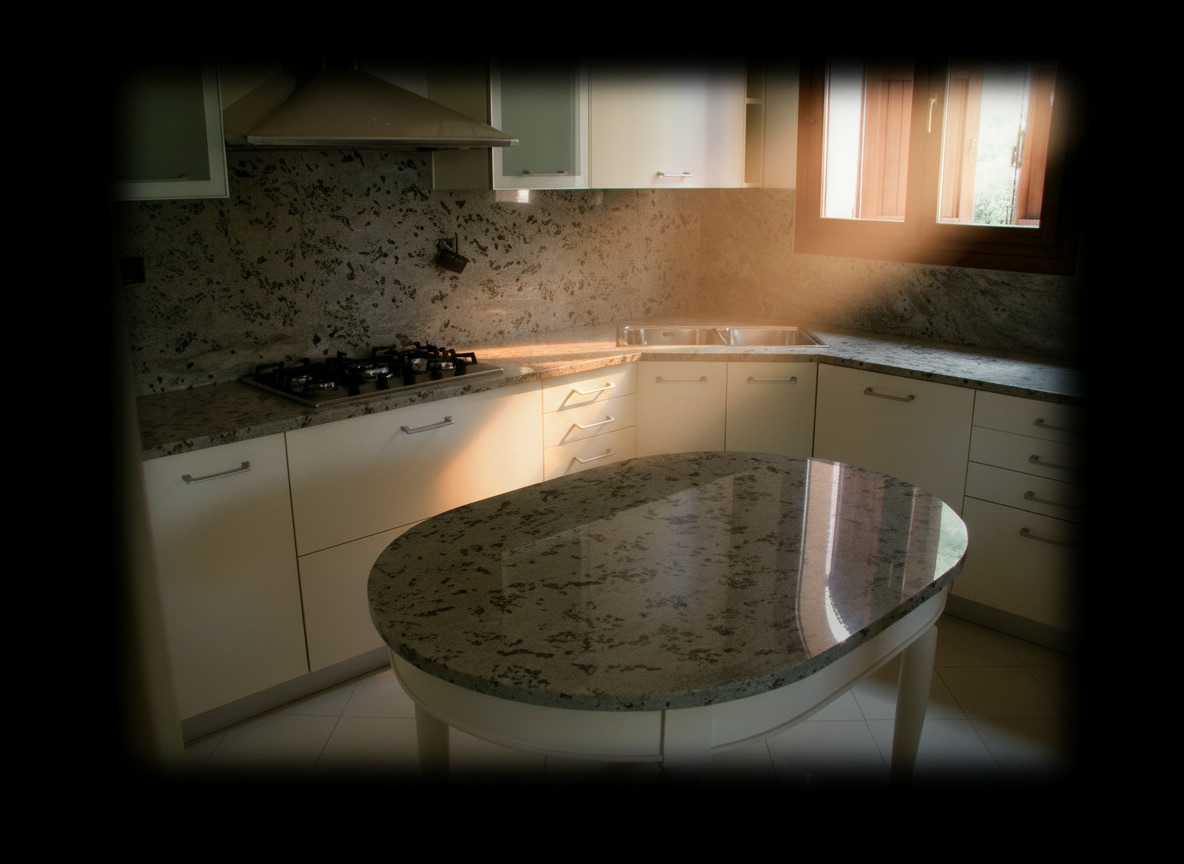
Classic kitchen with grey granite worktops and upstand, oval island on a white wooden cabinet

Old Style Kitchen: the Grey Granite of Home

It is the light of an ordinary afternoon, entering through the wooden-shuttered window and settling on the things of home. Grey granite worktops and upstand, flecked with dark crystals, trace the L of the work area: the steel hob, the sink beneath the corner window, cream doors with simple handles.

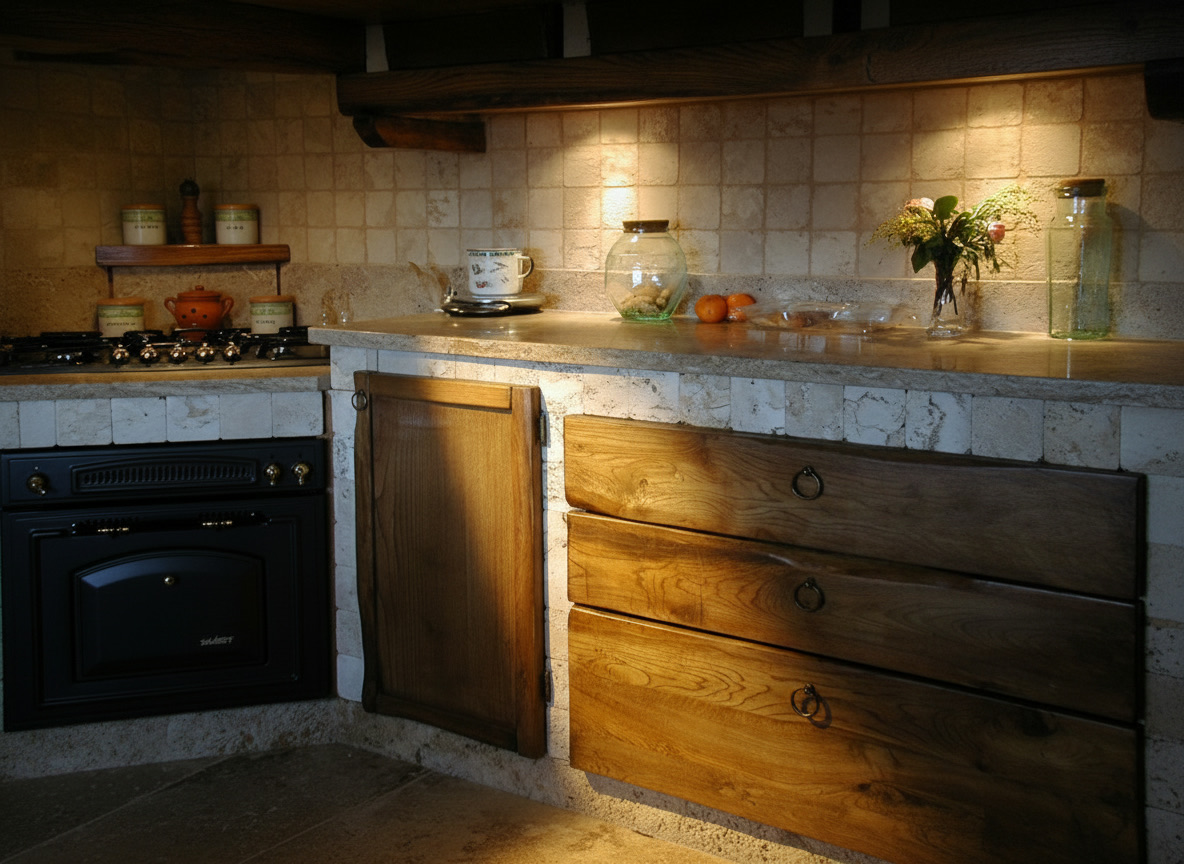
Rustic masonry kitchen with rough wood doors, granite counter and plinth, travertine tiled wall

Rustic Kitchen: Masonry, Granite and Travertine

Here you can almost smell fresh bread and summer preserves: this is a rustic masonry kitchen, the kind built to last as long as the house. Rough wooden doors and deep drawers, with their iron ring handles, carry the beautiful marks of living material; the black range with its old-style oven waits for firewood on feast days. The counter is granite, dark and dependable, with a matching plinth finishing the masonry; the wall is clad in travertine tiles with soft joints, which the warm lamplight toasts like golden bread. On the counter, the biscuit jar, flowers, the teapot: life, simply. In a kitchen like this, bespoke stonework places itself at the service of tradition: granite cut to the masonry's measure, travertine laid by the rule of art. It is the craft in its most affectionate form, the one Michelessi reserves for houses that smell of family.

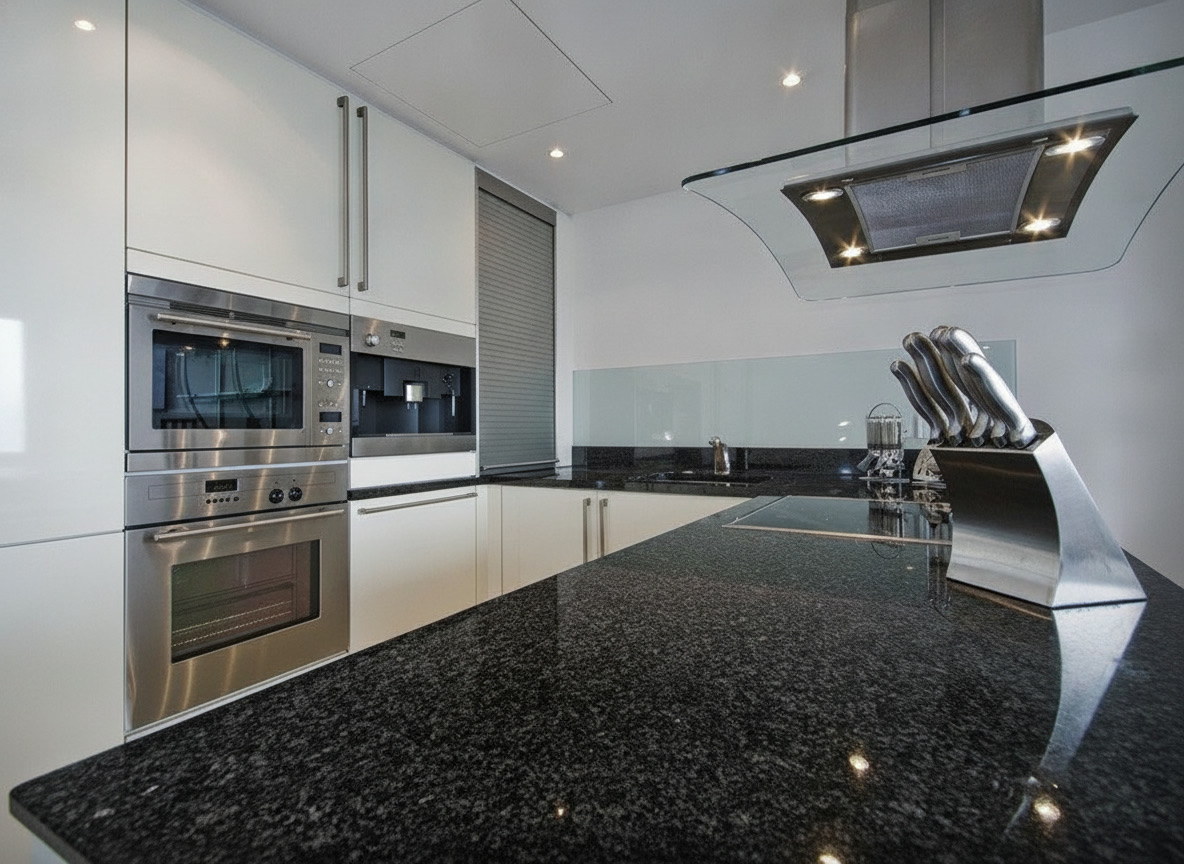
Kitchen with Nero Africa granite peninsula, induction hob, built-in appliances and glass hood

Peninsular Granite Kitchen: Nero Africa Up Close

The steel knife block mirrors itself in the counter as on a nocturnal lake: the peninsula is in Nero Africa granite, a deep stone strewn with mineral glints, polished until it turns almost liquid. The camera crosses it on the diagonal: the induction hob surfaces flush, the dark sink waits beneath the window of light, the curved hood of glass and steel glides over the whole like a wing. Around it, the white kitchen works in silence: tall units with built-in oven and coffee machine, serving hatches with aluminium tambour doors, long steel handles. Nero Africa granite is a connoisseur's choice: resistant like few others, effortlessly elegant, perfect for those who live their kitchen intensely. Bespoke work exalts its depth with flush recesses and crisp edges — handcrafted in Italy, in the Michelessi balance of natural materials chosen well, technology integrated, and every detail stitched with care.

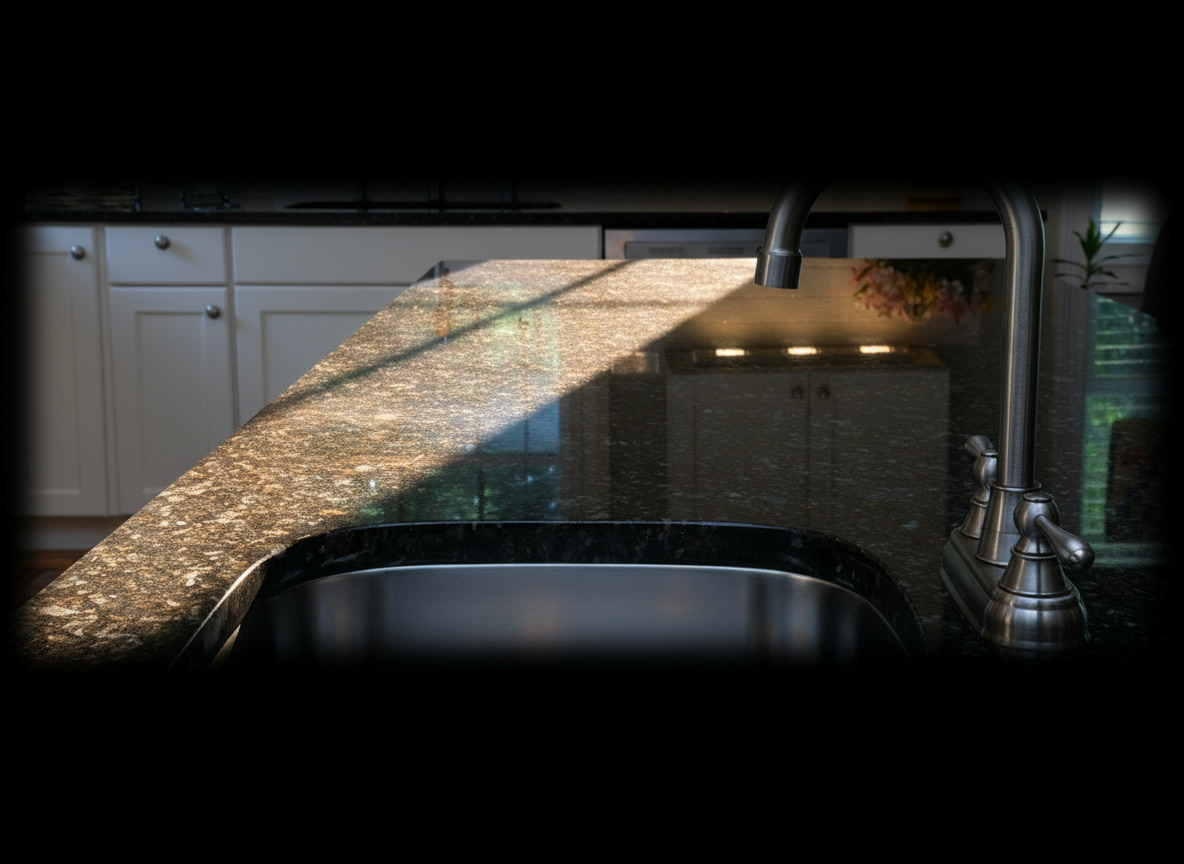
Polished black granite kitchen counter with rounded sink recess and classic taps

Black Granite Top: the Sink's Gentle Hollow

Garden light comes through the window and slides across the black granite like a pond at dusk: the counter is a dark expanse strewn with glints, polished until it mirrors the white cabinet doors. At the centre of the frame, the gesture that marks work done well: the sink's housing is not a sharp cut but a rounded, modelled edge, guiding hand and water toward the steel basin. Classic taps, with arched neck and lever handles, complete the picture with their old-world elegance. In the background, the white kitchen and flowers at the window remind us this is a home, not a showcase. Modelling granite around a sink calls for patient tools and steady hands: the hardest stone demands the greatest gentleness. It is the daily paradox of bespoke work, which the Michelessi workshop has always resolved with skill and serenity.

Is granite a good material for a kitchen? Pros and drawbacks

Yes: granite is hard, barely porous and withstands heat, so it suits anyone who cooks every day. The drawbacks are few and well known: it should be sealed to limit stains, it does not like concentrated heat, and on acids such as lemon and vinegar the manufacturers do not agree.

What mattersHow it behavesWhat to do
ScratchesIts minerals rate 6 and 7 on the Mohs scale, the tip of a steel knife 5.1 to 5.5No special precautions for knives and utensils
StainsAbsorbs 0.05 to 0.40% of its weight in waterWater- and oil-repellent impregnating sealer, renewed regularly
HeatWithstands about 250 °CTrivet for scorching pans; no concentrated heat sources
AcidsFar more resistant than marble; sources disagree on damage from lemon and vinegarWipe dry at once, keep the worktop sealed
CleaningWarm water, neutral soap, soft spongeNo abrasives or acidic cleaners

For those looking for the broad vein of marble, granite offers a finer pattern, grained or speckled: a limit of taste, not of performance. On hygiene, the Natural Stone Institute (the American trade association for natural stone) reports that it retains bacteria less than most surfaces; this is a single source, from the trade.

Hardness of granite: does it scratch with a knife?

No: on the Mohs scale the minerals of granite rate 6 (orthoclase) and 7 (quartz), the tip of a steel knife 5.1 to 5.5, while marble, made of calcite, rates 3. The Natural Stone Institute confirms that the hardness of the minerals in most granites exceeds that of kitchen utensils.

A worktop worn by the years does not have to be replaced: it can be honed, polished or brushed again, as the manufacturers explain.

Porosity: does granite stain, and should it be treated?

It stains little, but it should be treated: granite absorbs 0.05 to 0.40% of its weight in water, and a water- and oil-repellent impregnating sealer reduces staining further. The Natural Stone Institute notes that sealers are sometimes used to boost resistance to stains.

Two manufacturers recommend regular impregnation, preceded by the treatment that makes the stone repellent to water and oil. It is usually done before installation and renewed over time: it is the main upkeep granite needs.

Heat and acids: hot pans, lemon and vinegar

Granite withstands up to about 250 °C but not concentrated heat sources; with lemon and vinegar it is far more resistant than marble, although the sources disagree on the damage.

On heat, the Natural Stone Institute gives a tolerance of about 250 °C and advises against localised heat sources, because strong temperature gradients inside the stone can start a crack. One manufacturer allows hot pans straight on the surface, another only briefly: for pans just off the heat we recommend a trivet.

On acids, the same association writes that siliceous stone resists most of those found in a kitchen; one manufacturer rules out permanent damage from lemon and vinegar, another warns they can stain. To be safe, wipe dry at once and keep the worktop sealed; acidic cleaners are still not recommended.

Black, white, grey or coloured granite kitchen: the colours

Granite ranges from black to anthracite, from sand to white, through to reds, browns, pinks and blues. These are the families described by manufacturers; within each, the tone changes from slab to slab.

  • Black granite kitchen: a velvety black, often with sparkling flecks depending on the variety; among the blacks is Nero Assoluto. It gives the island a full, solid volume and sits well with dark solid wood or steel.
  • Anthracite: a decisive dark grey, for modern kitchens with steel or dark wooden doors.
  • White or pale granite kitchen: from sand colour to white, for bright rooms, with pale wooden doors.
  • Reds, browns and pinks: warm tones, beside dark wood and terracotta, in classic kitchens.
  • Blue, pale or dark: a stone with character, to be seen in person.

Colour is chosen on the whole slab: in the Aprilia workshop the slabs are chosen one by one, because two slabs of the same variety are never identical. For a black with a white vein there is also Nero Marquina marble, but it fears acids.

Granite finishes: polished, honed, brushed and flamed

The most common finishes are polished, honed and brushed; for outdoors a flamed finish is also worked. The same slab changes colour, feel and ease of cleaning with the finish, which is why it is chosen on a finished sample.

  • Polished: a mirror surface and a deeper colour; it reflects light and shows marks and fingerprints more readily, especially on blacks.
  • Honed: smooth and matt, without reflections, for those who prefer a discreet worktop.
  • Brushed: a slightly textured surface, soft under the fingers.
  • Flamed: a rough, matt skin, meant for outdoors and for areas that get wet; it is explained on the page granite outdoor kitchen.

The workshop's other treatments, edges included, are on the page finishes; granites are among the natural stones.

Whole granite kitchen indoors: structure, doors, island and splashback

An indoor granite kitchen is a complete kitchen: granite covers the worktop, island and splashback, and the rest, structure, doors and tall units, is built to measure in the material you choose. This is where you see the difference between buying a worktop and having a kitchen made.

The worktop and the island

The worktop is continuous, with a steel sink under the edge and the hob set flush; holes and cut-outs are cut on numerically controlled machines to the appliance dimensions, and the edges are finished by hand. The island is seen from every side: top, sides and, if wanted, a counter for stools. Dimensions and clearances are on the page bespoke kitchen with island.

The splashback

A splashback in the same stone as the worktop protects the wall from splashes and reduces the grout lines to clean; where the kitchen opens onto the living room, it gives the kitchen a single volume, as the page open-plan kitchen and living room explains.

Solid wood or steel doors

The solid wood doors are designed to measure together with the kitchen: wood warms a dark granite, pale oak lightens its weight. With stainless steel, granite makes a more technical kitchen: you will find it on the page bespoke stainless steel kitchen. Finishes and hinges are on the page doors, hinges and finishes; the indoor kitchens are under indoor kitchens.

Granite outdoor kitchen: structure, worktop and barbecue

Granite is one of the stones with which Michelessi makes outdoor kitchen worktops; beneath it, the structure is dry-fitted refractory stone, steel or treated wood. The comparison with the other outdoor worktops, with frost, fridge and gas cylinder, is on the page complete outdoor kitchen.

Granite is a choice for the worktop, not for the fire. Barbecues and ovens are in refractory stone, which holds the fire; the granite stays at the sides, where trays and utensils are set down, away from the flame, because concentrated heat sources are what the stone tolerates least.

  • Frost and rain: water expands as it freezes, by about a tenth according to Treccani; the less water enters the stone, the less there is to freeze, and granite absorbs very little.
  • Sun and sea air: assessed case by case, on the sample and at the site survey.

Finishes, colours and care outdoors are covered on the page granite outdoor kitchen; the full overview of outdoor kitchens is under outdoor kitchens; granite under a pergola or behind the doors that close the kitchen is in enclosed and covered outdoor kitchen.

Granite or marble, stoneware and sintered stone: the comparison

Granite is harder than marble and fears acids less; marble has the vein; stoneware and sintered stone, according to their makers, withstand direct heat, and Laminam stoneware is not porous. Which is the more prized is a matter of taste, not of data sheets.

Granite: scratches
Resists knives (minerals 6 and 7 on Mohs); marble, with calcite at 3, is softer.
Granite: acids
Far more resistant than marble, which is calcareous; still wiped dry at once.
Granite: heat
About 250 °C, never concentrated sources; stoneware and sintered stone, the manufacturers state, withstand direct heat.
Granite: outdoors
Yes, in Michelessi outdoor kitchens; marble with caveats, stoneware and Dekton unafraid of UV rays.

Composite quartz is another family: the maker of one of the best-known ranges does not recommend it outdoors, because of UV rays. For marble there is the page marble kitchen worktop; for stoneware and sintered stone (Laminam at 12 and 20 mm, nominally 12.5 and 20.5, and Dekton) the page bespoke porcelain stoneware kitchen; the table comparing all the materials is on the bespoke kitchens page, and the one for all the surfaces in the guide marble, stoneware, Dekton, quartz or Fenix.

How to clean and care for a granite kitchen

Granite is cleaned with warm water, neutral soap and a soft sponge; no abrasives, no acidic cleaners, and not too much water. These are the manufacturers' instructions, in line with the Natural Stone Institute.

  • Every day: a soft sponge and neutral soap; wipe dry the area around the sink and remove lemon, vinegar and grease at once.
  • Now and then: renew the sealer, as manufacturers advise.
  • With stainless steel parts: a damp cloth and neutral detergent along the grain of the finish, with no bleach and no steel wool.
  • After many years: if the surface dulls, the worktop is honed, polished or brushed again.

How much does a granite kitchen or worktop cost?

The price of a granite kitchen is set by the slab and the work, not by a price list per metre: it depends on the variety of granite, the thickness, the metres, the workmanship and the holes, and for a whole kitchen on structure, doors, appliances and services. That is why we publish no figures on the page.

The quote comes in writing, item by item, after the survey. Water, electrical and gas services must by law be entrusted to a qualified contractor. How the job moves from survey to design and services is explained on the page bespoke kitchen design and renovation.

From the site survey to installation

For granite the step that counts is the choice of the slab, in person in the Aprilia workshop, before cutting: grain and colour change from slab to slab and the finish is decided on the sample. The site survey is free in Rome, Latina and Lazio; the quote is free everywhere; outside Lazio the survey is done with measurements and photographs, guided by us over a video call.

The six steps common to every kitchen, from survey to installation by our own team throughout Italy, are on the page how a bespoke kitchen comes about. For other questions there is the page bespoke kitchens: questions and answers; for those looking for a luxury kitchen, the page bespoke luxury kitchens.

The quote is free: request it here.

Frequently asked questions

Frequently asked questions

Is granite a good material for a kitchen?

Yes. Granite is hard (its minerals rate 6 and 7 on the Mohs scale), absorbs very little water, 0.05 to 0.40% of its weight, and withstands about 250 °C. It should be sealed against stains and does not like concentrated heat sources. Michelessi SRL, in Aprilia, works it to measure for worktops, islands and splashbacks, indoors and outdoors.

What are the drawbacks of granite?

Granite has three drawbacks: it should be sealed to limit stains, it does not like concentrated heat, because strong temperature gradients can cause cracks, and on acids such as lemon and vinegar the manufacturers disagree, so you wipe dry at once. There is also a matter of taste: the pattern is grained or speckled, not the broad vein of marble.

Which is more prized, granite or marble?

"Prized" is a matter of taste. On the data, granite is harder (quartz 7 and orthoclase 6, against marble's calcite, which rates 3) and resists acids better; marble has the vein and a light that granite lacks, but it fears acids. The choice depends on how you cook.

What material is granite?

Granite is a plutonic or intrusive rock, formed by quartz and alkali feldspars, usually orthoclase, as the Italian encyclopaedia Treccani defines it. It has a crystalline grain, speckled or lightly mottled. For a kitchen it is cut into slabs, worked on numerically controlled machines, finished by hand and installed on bespoke base units.

Does granite scratch with a knife?

No, granite does not scratch with a knife. The tip of a steel knife rates 5.1 to 5.5 on the Mohs scale, while the minerals of granite rate 6 (orthoclase) and 7 (quartz); the Natural Stone Institute also writes that they exceed the hardness of utensils. For cleaning, a soft sponge and neutral soap are still enough: abrasives are not needed.

Does granite stain, and does it need treating?

Granite stains little, because it absorbs 0.05 to 0.40% of its weight in water, but treatment helps: a water- and oil-repellent impregnating sealer reduces staining further. It is usually applied before installation and renewed regularly. For daily cleaning, warm water, neutral soap and a soft sponge are enough.

Can I put hot pans on granite?

Granite withstands about 250 °C, but the Natural Stone Institute advises against concentrated heat sources, because strong temperature gradients inside the stone can cause cracks. Manufacturers vary in how cautious they are: we recommend a trivet for pans just off the heat. The barbecue fire stays in the refractory stone, not on the granite.

Do lemon and vinegar damage granite?

Lemon and vinegar harm granite far less than marble: the Natural Stone Institute states that siliceous stone resists most of the acids found in a kitchen. One manufacturer rules out permanent damage, another warns of possible stains: so wipe dry at once and keep the worktop sealed. Acidic cleaners are still not recommended.

What colours does granite come in for a kitchen?

Granite for a kitchen ranges from velvety black, often with sparkling flecks, to anthracite; from sand to white; then reds, browns, pinks and blues, pale or dark. Nero Assoluto is one example of a black. Colour is chosen on the whole slab, in the Michelessi workshop in Aprilia, because every slab differs from the next.

Is granite suitable for an outdoor kitchen?

Yes: Michelessi uses granite for outdoor kitchen worktops, with a structure of dry-fitted refractory stone, steel or treated wood. It absorbs very little water, a point in its favour against frost; the barbecue fire stays in the refractory stone. Sun and sea air are assessed case by case, on the sample. Composite quartz, by contrast, is not used outdoors.

How much does a granite kitchen cost?

There is no price per metre that applies to everyone. It depends on the variety of granite, the thickness, the metres, the workmanship and the holes, and for a whole kitchen on structure, doors, appliances and services. Michelessi does not publish price lists: the written quote, item by item, is free everywhere.

Can I have a whole granite kitchen, not just the worktop?

Yes. Granite covers worktop, island, splashback and sides, while structure and doors are made to measure in solid wood or steel. Michelessi designs and builds the whole kitchen, installs it with its own team throughout Italy and finishes it by hand. For the worktop alone there is a guide.

Call us WhatsApp