Skip to content
Made in Italy

Since 1976 — Bespoke kitchens

Stainless Steel Kitchen, Bespoke: Alone or with Marble

WOOD · STEEL · MARBLE · STONEWARE

In short

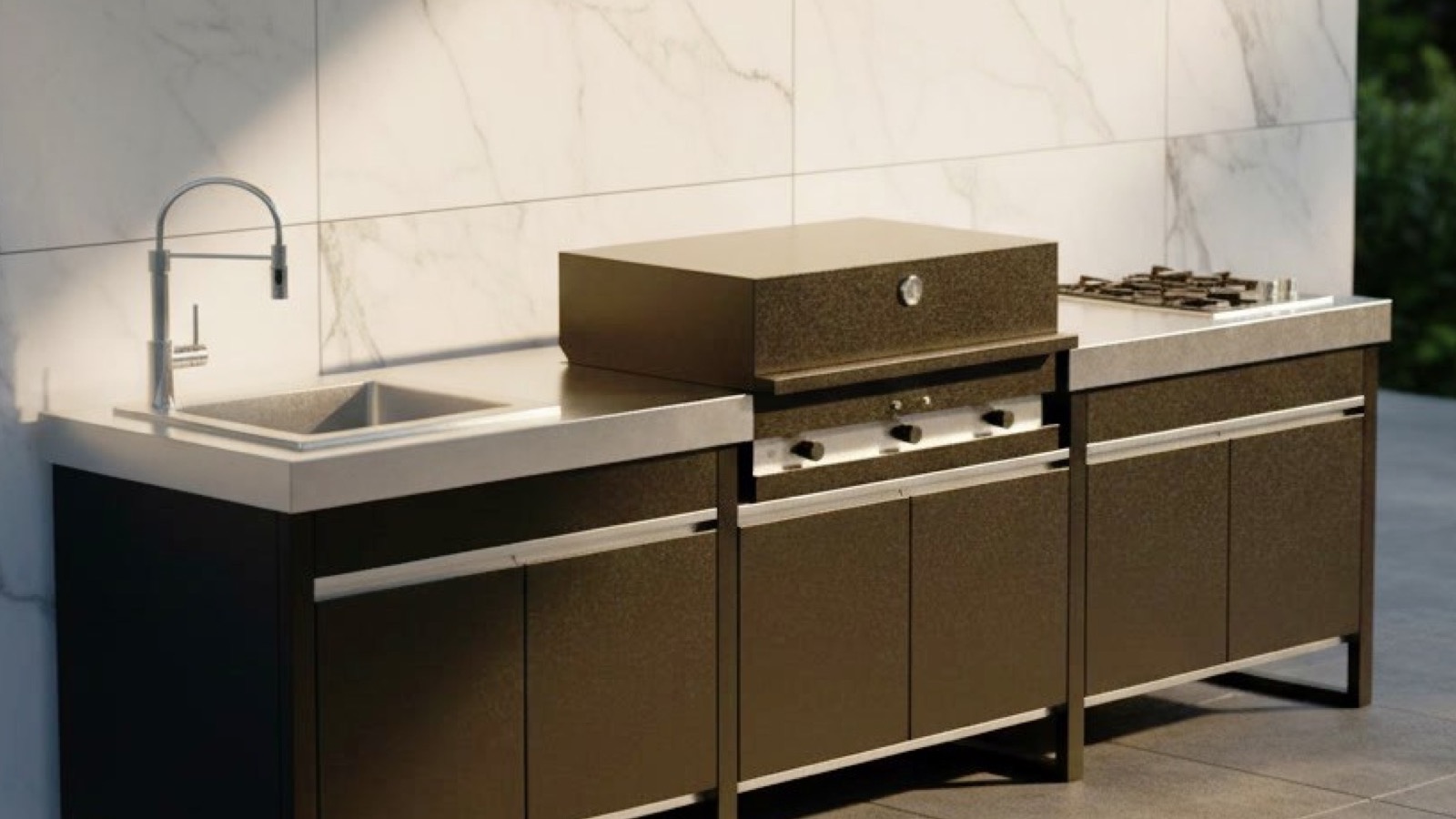
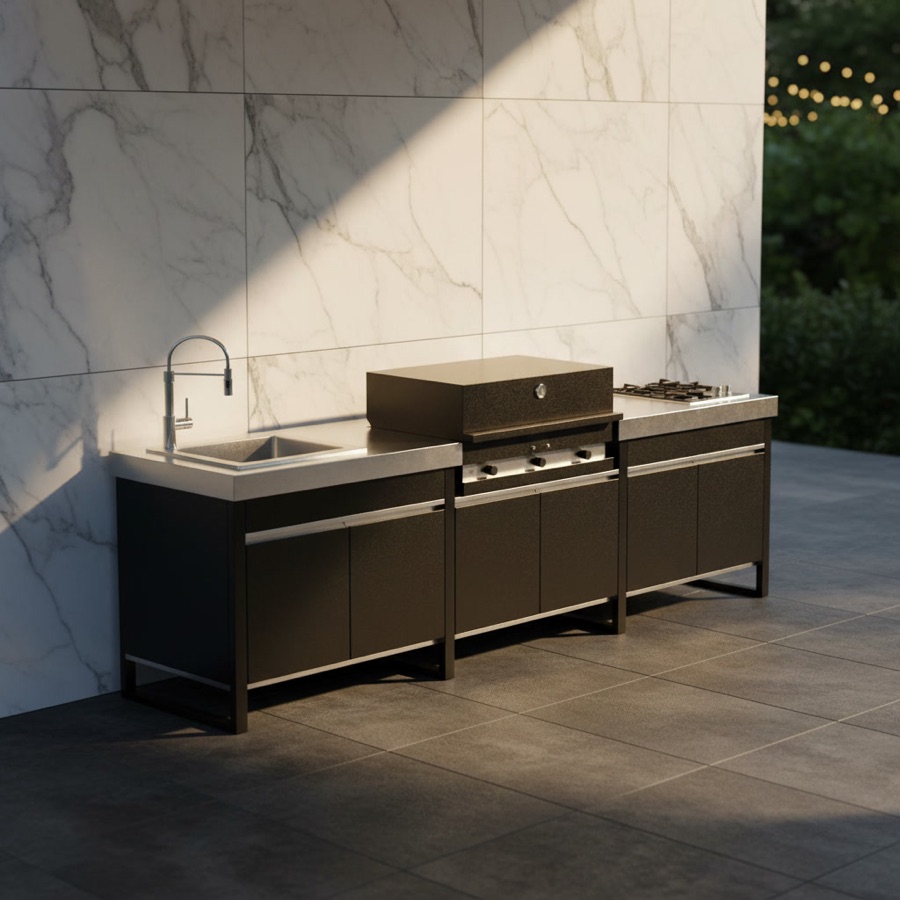
Fogher Larès modular FKC 023 in black with steel top, sink, barbecue and service module
Fogher Larès modular FKC 023 in black with steel top, sink, barbecue and service module — photograph of a Michelessi project.

The block — a Michelessi vision

From the block,
blow after blow

01 A raw block of Calacatta Viola waits under the spotlight, in the dark kitchen with brass profiles. Mallet and chisel are already on the floor: the island is still all inside the stone.

02 Blow after blow the faces are squared, chips fly, white dust rises into the light. The chisel scores the drawers, opens the recess for the hob, carves the sink: the shape of the island comes out of the block slowly, without haste.

03 Then the stone is honed and polished: the purple vein catches the light, brass edges close the drawers, the black hob sinks into its recess, the gold tap finds its place. The island remains, and a veil of dust on the floor.

Keep scrolling — the scene follows you

Bespoke stainless steel kitchen: what it is and who builds it

A bespoke stainless steel kitchen is a kitchen designed to the measurements of your room, with doors, worktop and sink in stainless steel, on its own or paired with marble, stone or solid wood. People who search for a "steel kitchen" or a "stainless kitchen" almost always mean this: not ordinary steel, which oxidises, but the stainless steel of professional kitchens, chosen for hygiene, easy cleaning and its technical look.

Who builds it: Michelessi SRL, Aprilia, installation throughout Italy. We are stone masons at Via Pontina km 45,350, between Rome and Latina, and we have worked stone since 1976. We design and build complete kitchens to measure, indoor and outdoor, in steel, marble, stone, solid wood and porcelain stoneware, and our own team installs them throughout Italy; abroad we have one real project in Dubai, elsewhere we work on request. The process starts with the survey of the room and the 3D design, as explained on the page about kitchen design and renovation; the overall picture is on the bespoke kitchens page.

Fogher Larès modular FKC 023 in black with steel top, sink, barbecue and service module

Fogher Larès modular FKC 023 in black with steel top, sink, barbecue and service module

The FKC 023 composition entrusts the top to steel and the structure to black: above, the technical surface runs uniform, carrying the sink with its spring tap and the built-in barbecue beneath its cover; below, door-fronted modules and a side service unit keep order and multiply the landing space. The contrast between the sheen of the top and the matt of the bases gives the line its clean, professional character. It is the configuration of those who work hard and clean fast: steel forgives everything and never ages.
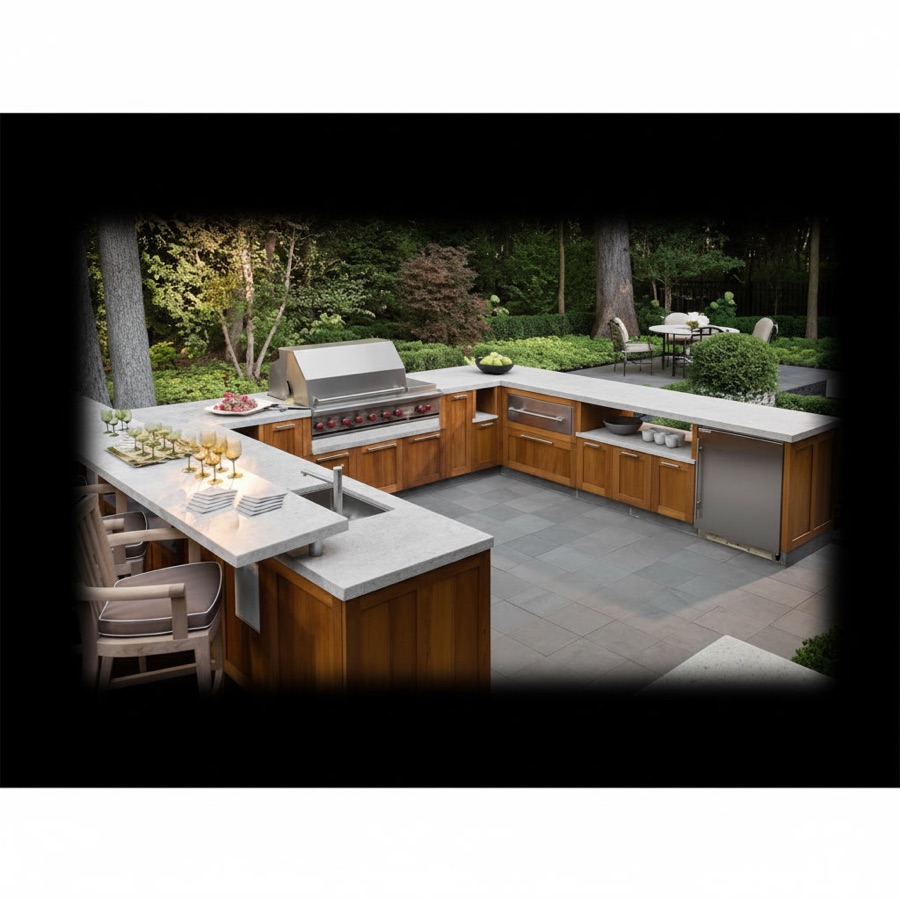
Outdoor kitchen with built-in appliances, light granite worktop and treated wood structure, U-shaped

The Great U of Teak and Granite in the Woods

The U spreads generously over blue stone paving and the woods embrace it on every side: the treated wood structure, with its warm, orderly doors, bears the light granite worktop running along three sides, carrying the barbecue with its steel hood, the sink, built-in appliances and the counter where high seats await company. Little plants on the tops add their domestic green to the great green of the trees.

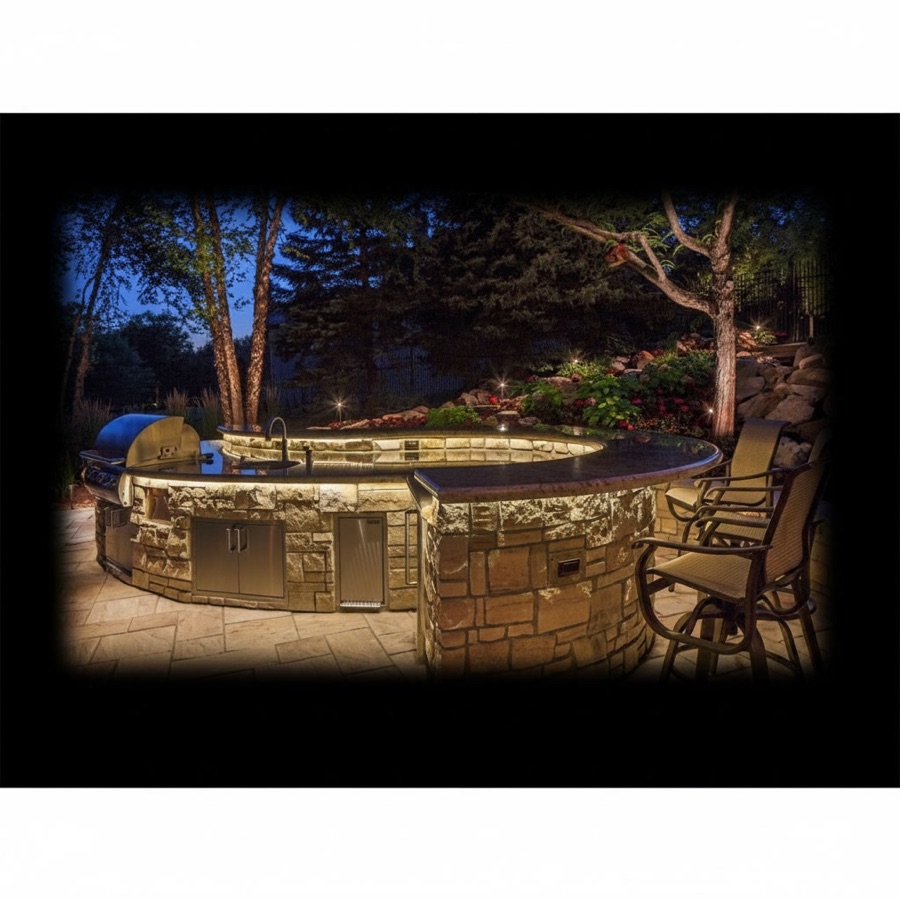
Circular outdoor kitchen in treated marble and granite with professional steel barbecue and night lighting

The Curve of Stone That Welcomes the Evening

The night is an accomplice: warm lights run beneath the counter and trace the curve of the kitchen like a luminous ribbon, while the base of stone in irregular courses anchors the composition to the garden. The dark stone counter follows the circumference without a single hard corner, receiving the professional steel barbecue on its left flank and then stretching toward the bar, where tall seats await the guests. Treated marble and granite, protagonists of the construction, withstand the seasons while keeping their depth; the built-in refrigerator works discreetly in the base.

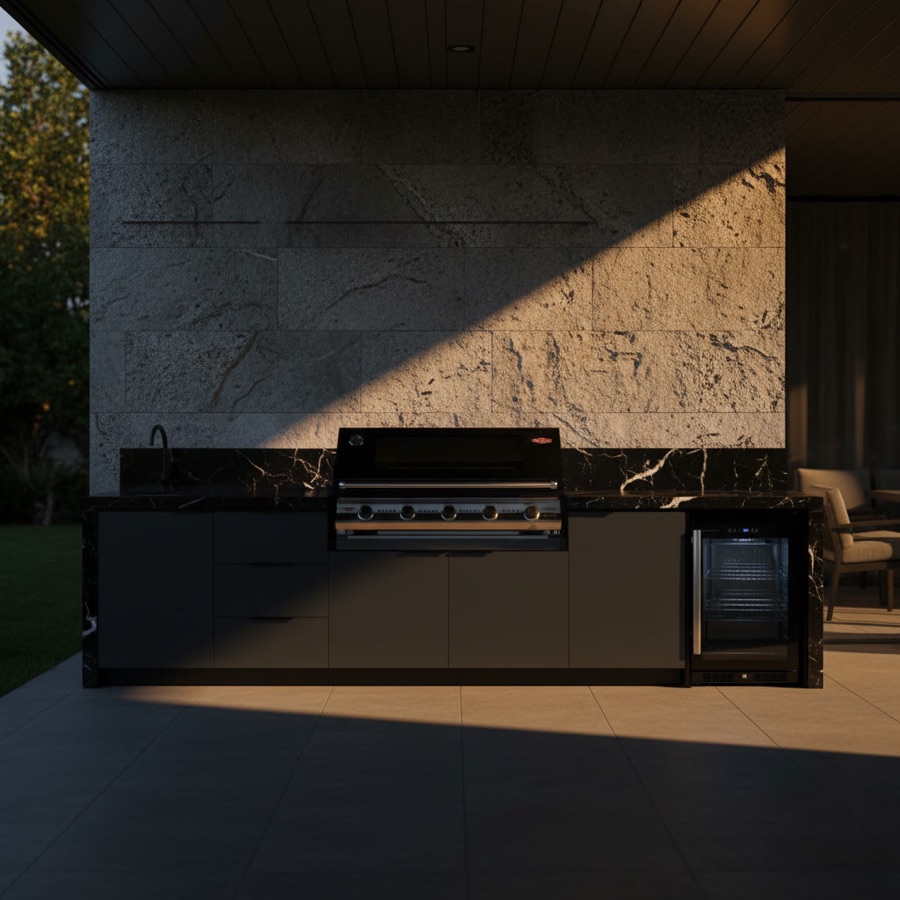
Cabinex Premium series outdoor kitchen with 5-burner BeefEater barbecue, drawers, black sink and fridge display

Cabinex Premium series outdoor kitchen with 5-burner BeefEater barbecue, drawers, black sink and fridge display

Five BeefEater burners at the centre of the anthracite line: the Premium series in this size allows parallel cooking and true service tempo, the generous grill beneath its black lid and the row of steel controls within reach. At the sides, the kitchen organises the trade: the black sink with its flexible tap, the column of drawers that distinguishes the Premium series, doors guarding provisions and gas bottle, the refrigerated display keeping the evening cool.

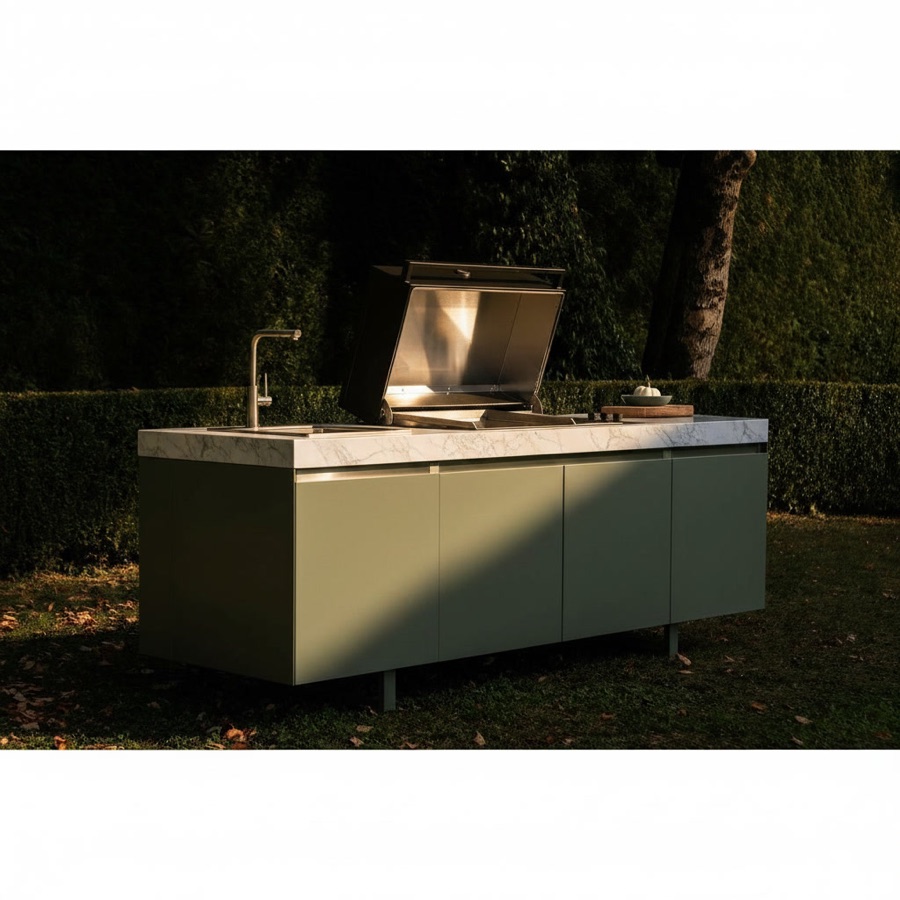
Fogher Agher modular outdoor kitchen in Salvia Antica with open barbecue and sink, in a garden

Agher Salvia Antica: Green at Home in Green

Among hedges and lawn, the Salvia Antica finish proves its vocation: a dusty, gentle green that does not compete with nature but stands beside it, as an equal. The steel lid of the built-in Fògher barbecue is raised and ready; the sink and tap wait at the side, and doors beneath the top close the volume with formal clarity.

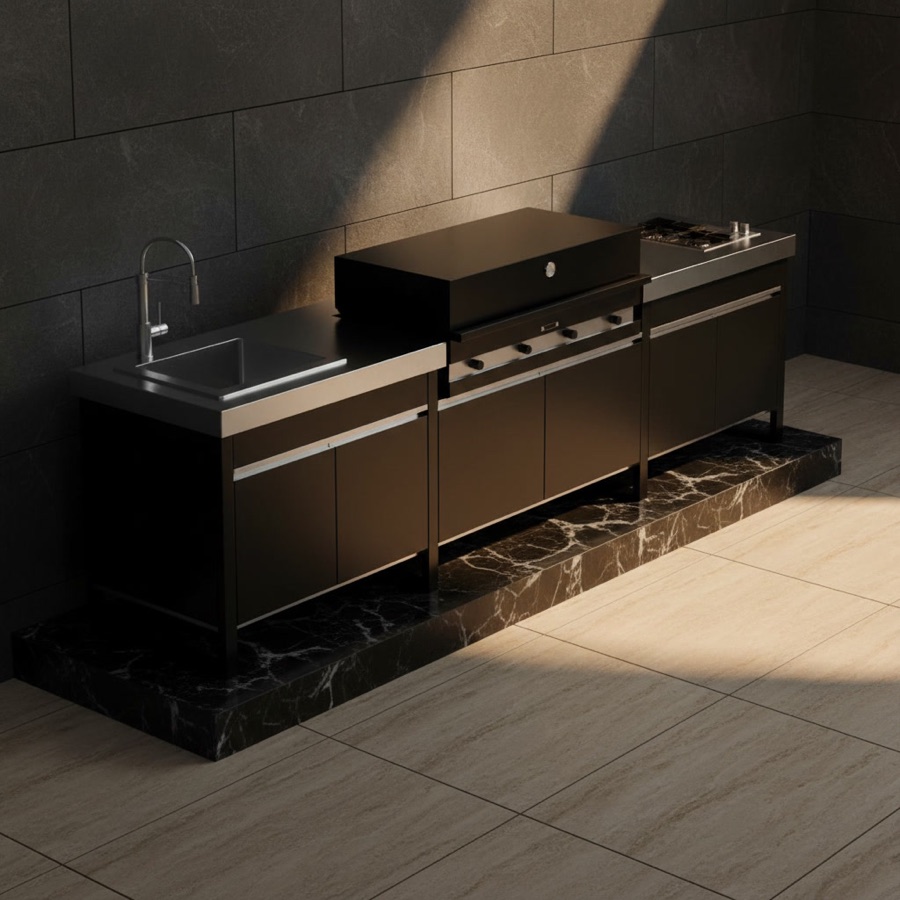
Fogher Larès modular composition FKC 004 in black with sink, built-in barbecue and burner

Fogher Larès modular composition FKC 004 in black with sink, built-in barbecue and burner

The FKC 004 composition stretches the Larès into one long, complete line: the sink with its professional spring tap opens the sequence, the built-in barbecue under its dark cover holds the centre, and the auxiliary burner closes the flank. The steel top runs unbroken above black modules and their doors, while the exposed frame lifts everything from the ground with technical lightness. It is the configuration for those who work in sequence — wash, prepare, cook — without a single wasted step.

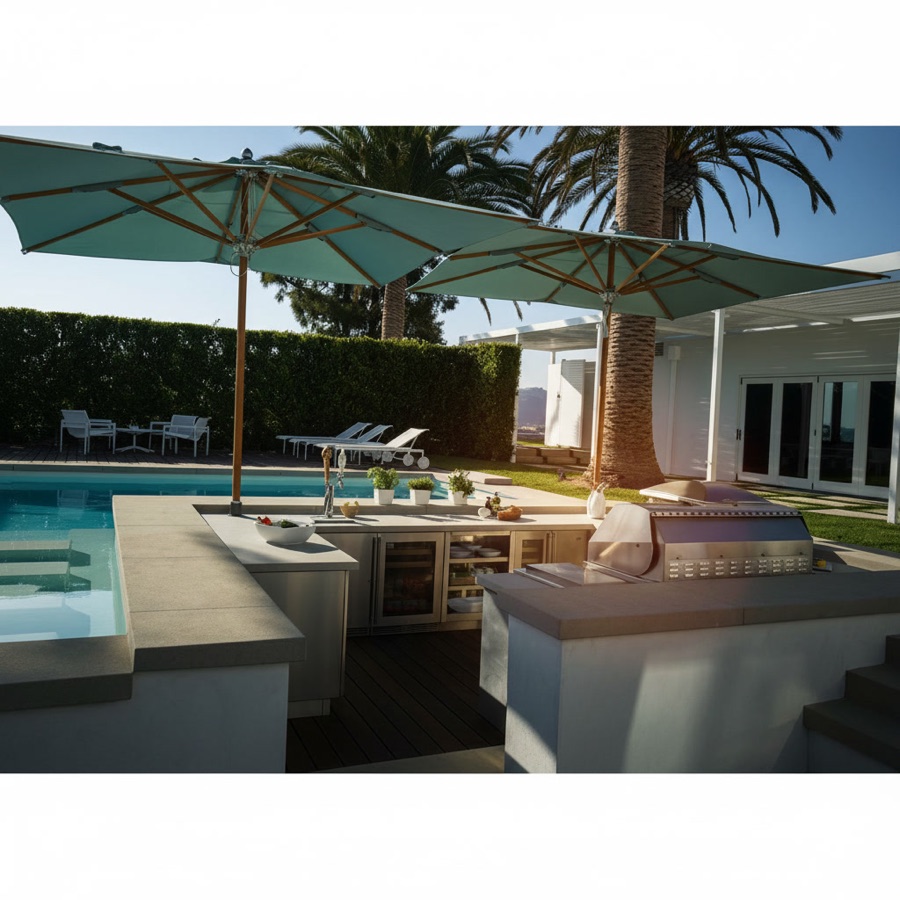
Poolside stone and steel kitchen counter with steel barbecue, wine cooler and aqua-green parasols

Stone and Steel Beneath the Parasols

Aqua-green parasols open their corollas above the pool's edge, and the kitchen works in their shade: pale stone counters spread across white volumes, the steel barbecue lifts its lid with the grill ready, the glass-fronted wine cooler keeps its chill in view. Beyond the water, a white villa and a palm complete a scene of perfect holiday; the sunloungers await the after-lunch hour.

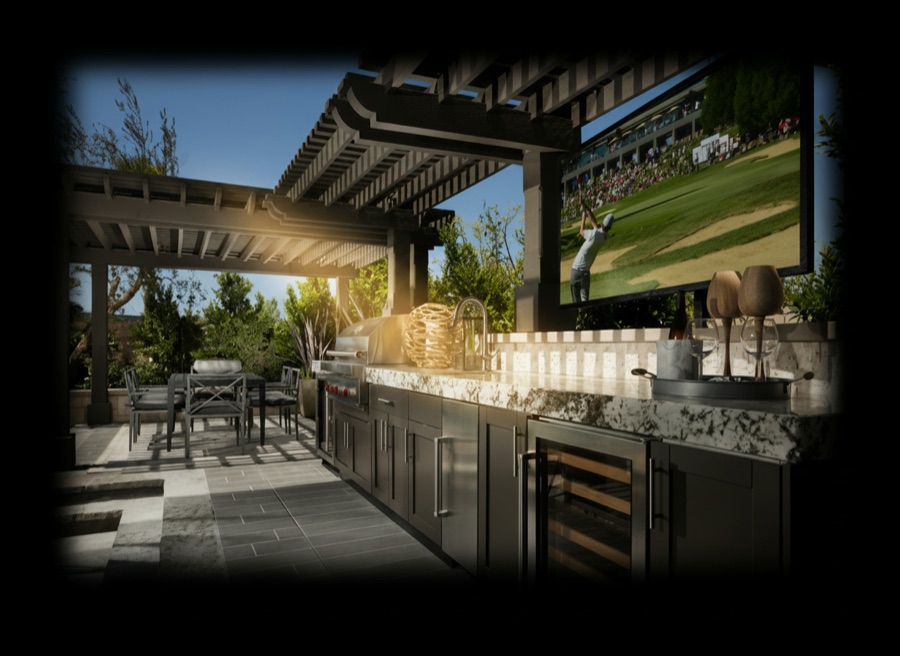
Outdoor kitchen with marble cladding and steel worktop, gas barbecue and glass-front fridge under a pergola

The Marble Kitchen, Elegance Beneath the Pergola

Beneath the woven shade of the pergola, the Marble Kitchen extends its line along the terrace: marble cladding with restless veining wraps the modules like a tailored suit, while the steel worktop runs above them, polished and professional. The glass-front refrigerator reveals bottles chilling; the semi-professional gas barbecue waits behind its clean lines. All around, the scene is that of an open-air salon: the screen framed in wood, the seating, the green landscape opening beyond the balustrade.

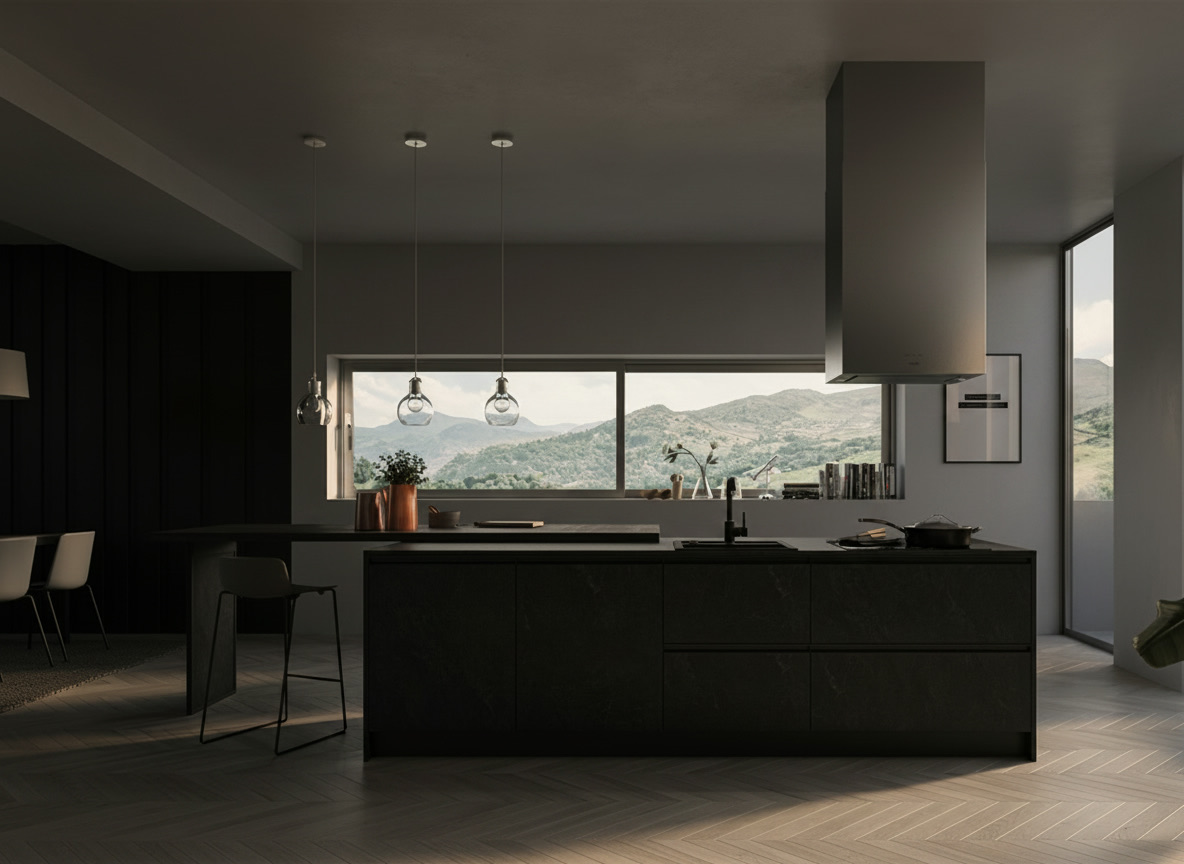
Dark stone-effect island with suspended steel hood and panoramic window over the valley

The Dark Monolith Before the Valley

The island presents itself as a monolith: sides and fronts in a dark stone-effect finish, its textural weave holding the light, and a top integrating hob and sink in a single working surface. Above, the steel volume of the hood descends from the ceiling with the precision of a silent lift; behind, the ribbon window opens the scene onto the valley, and the hills enter the kitchen like a painting that changes with the seasons. Dark walls, stools at the counter, spotlights: everything contributes to a gathered, almost meditative atmosphere. It is the contemporary luxury of indoor kitchens designed to measure: few elements, each one exact. Michelessi builds these projects by uniting technical surfaces and natural materials — up to marble worked according to tradition — and calibrating every volume on the true light of the space. The landscape then plays its part: but only if the design leaves it the stage.

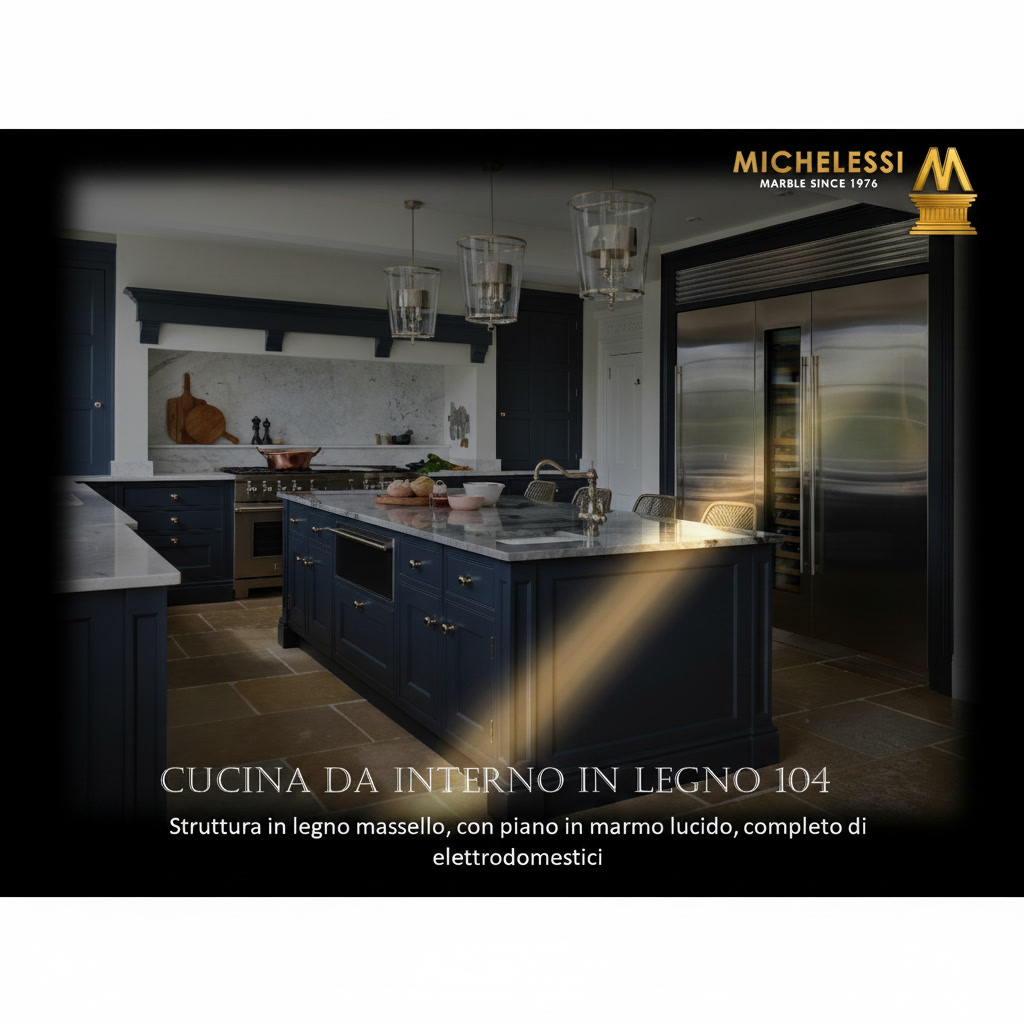
Solid wood kitchen in blue with island, polished marble top and large steel refrigerator

Solid wood kitchen in blue with island, polished marble top and large steel refrigerator

The deep blue of the solid wood dresses the whole kitchen — base units, columns, the central island — and suspended glass lanterns add a light worthy of an English residence; the polished marble top, pale and veined, crowns the island and the perimeter counters with a surface that reflects the day. The great professional steel refrigerator occupies the back wall like a luminous monolith; the hood set into the blue boiserie and the pale stone floor complete the scheme. This is a kitchen complete with appliances, conceived for lovers of the classic contemporary: decisive colours, true materials, tended details. Polished marble gives the blue its natural counterpoint: pale stone breathing above a deep colour. The bespoke working of the counters — thicknesses, edges, recesses — carries the hand of Michelessi and of Italian craftsmanship: because a blue this important deserves a marble equal to it. A blue that receives guests properly: with substance, not with effects.

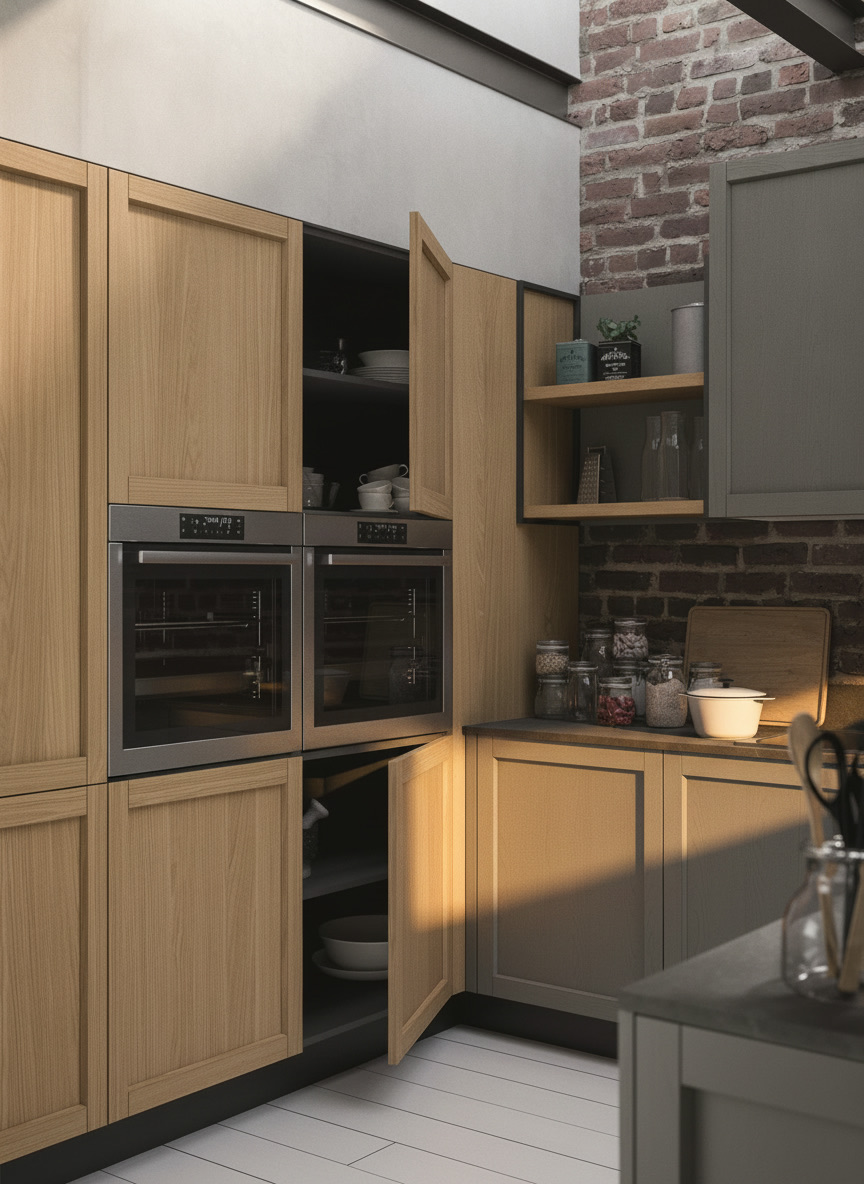
Tall kitchen unit in pale wood with double oven, open doors and exposed brick wall

Twin Ovens in the Oak Column

The doors of the tall unit open like the pages of a book and reveal the two steel ovens, set one above the other in the pale oak panelling: a perfect machine dressed in wood. Beside it, the exposed brick wall brings its urban character into the scene, while grey framed modules, a corner shelf and glass jars on the dark worktop complete the tale of a kitchen designed for those who truly cook. The oven column is one of the most intelligent gestures of contemporary design: working height, visual order, cables and technology hidden behind the joinery. In Michelessi indoor kitchens every built-in is studied to measure, so that appliances and wood live together to the millimetre, with the precision of Italian craftsmanship. The result is this naturalness: technology disappearing into the material, reappearing only when needed, at the moment of baking Sunday bread. And on Sunday, when both ovens are working, the wood around them smells of a full house.

Lacquered wooden kitchen with white travertine island, integrated sink, oven and burners

Lacquered wooden kitchen with white travertine island, integrated sink, oven and burners

Three blown-glass lamps descend over the island like transparent bells: beneath them, a white travertine top spreads its luminous stone and receives the ceramic basin that projects from the pale wooden volume — the sink integrated into the counter, a steel mixer at its service. Black stools line the bar; behind, dark grey bases and pale boiserie with a long hood compose the working wall with oven and burners. An oak floor warms the scene. This is the contemporary that does not forget its memory: the farmhouse basin within a modern design, Roman stone above present-day joinery. The white travertine, cut to measure with the basin set in to perfection, is the bridge between the eras — the Michelessi speciality, Italian craftsmanship in stone. And the effect, beneath those bells of glass, is that of things done right: timeless. The white basin, under that suspended glass, seems to have been waiting forever for your hands.

Steel or stainless steel: what is the difference?

Stainless steel contains chromium and nickel: the chromium forms an invisible, self-healing protective layer on the surface, which in normal use stops rust from forming. Ordinary steel has none and oxidises. In the kitchen there are two alloys to know, AISI 304 and AISI 316, and the difference between them is mostly about salt and chlorine.

Stainless steel kitchen: AISI 304 or AISI 316

For a home kitchen both alloys will do; AISI 316 is chosen near the sea or a pool, because it resists chlorides, that is, salt air and chlorine, better. The difference comes from the molybdenum that 316 adds. It is not immune, however: even 316 has limited use where there is a lot of seawater, and a kitchen on the coast still needs care. We choose the alloy by looking at where the kitchen stands: away from the coast 304 is enough; on the coast and by a pool we move to 316. Those who ask us "stainless steel or aluminium?" get a simple answer: we work stainless steel, 304 and 316; we do not work aluminium.

AspectAISI 304AISI 316
Reference compositionChromium 18%, nickel 10%, carbon 0.05%Chromium 16%, nickel 11.3-13%, molybdenum 2-3%
Chlorides (salt, chlorine)Resists less well than 316Resists better, thanks to the molybdenum
Where we recommend itIndoor and outdoor kitchens away from the seaCoastal kitchens, poolside, seaside terraces
To rememberNo bleach or chlorineNot immune to seawater: it needs upkeep

Stainless steel finishes: satin, brushed, polished, orbital, painted

The finish decides how the steel looks and how much it shows the signs of use. On the market you find the mirror polish, the satin or brushed finish, the orbital finish and steel painted in a colour of your choice. According to one manufacturer of steel kitchens, the orbital finish makes scratches and fingerprints less visible. In general, after a few weeks of use fingerprints become less noticeable, and for the most-touched areas there are anti-fingerprint surfaces. The satin finish has a grain running in one direction, and it is along that grain that the cloth is wiped. The finish is chosen in the design, together with the doors, the worktop and the pairings.

Stainless steel kitchen: hygiene and health

No: stainless steel is not harmful to health, and it is suitable for contact with food. Those who study the material describe it as inert for people and for the environment, easy to wipe clean and highly hygienic, and name it as the best solution when hygiene matters above all else. A steel worktop can be designed in a single piece, with the sink built in, so dirt finds no joints to settle in; it is a detail settled in the design.

Does a steel kitchen scratch, rust or make noise?

It scratches, and that is its weak point; it does not rust in normal use; on noise we have no verified figure to quote and we promise nothing.

  • Scratches. A dragged blade, a moved pan or an abrasive powder will leave a mark, more than on ceramics and hard stones. The protective layer of stainless steel renews itself, as long as you avoid ordinary steel wool, which reduces its ability to repair itself. Where you cut a lot, a chopping board or a hard-stone worktop is more suitable.
  • Rust. AISI 304 or 316 stainless steel does not rust in normal use. What damages it is bleach, chlorine-based disinfectants (the label shows "Cl") and ordinary steel wool.
  • Noise. We have no decibel figure to quote, nor a technical source that quantifies it, and we do not promise one: it is a point to clarify in the design, before building.

How to clean a stainless steel kitchen

Clean it with a soft damp cloth and a neutral detergent, wiping along the grain of the satin finish, then rinse and dry. Avoid ordinary steel wool, which scratches; abrasive powders; and bleach or products marked "Cl", which can damage the surface. On satin finishes always work in the direction of the grain.

Steel and marble kitchen: where to put each

The most sensible way to pair them is to give each its own job: steel where there is water, heat and grease, that is around the sink and the hob; marble where you rest things and prepare food, that is on the worktop and the island. It is a design choice, not an absolute rule. Marble is a calcareous stone: it is sensitive to acids, such as lemon and vinegar, and a trivet is wise under hot pans. Steel is not calcareous and handles heat well, but it fears chlorine.

AreaMaterialWhy
Sink and washing areaStainless steel, with the bowl built into the worktopWater, detergents and acidic foods; a surface that wipes clean easily
HobStainless steel or sintered stoneHeat and grease; steel handles heat well and wipes clean easily, sintered stone withstands high temperatures, the manufacturer states
Preparation and resting worktopMarble: Calacatta, Statuario or CarraraThe stone you see and touch; to be dried and cleaned with care
Island and counterMarble on top, steel on the sides and working areaThe contrast between the vein of the stone and the satin metal
Dark contrastNero Marquina, a black Spanish marble with a white veinA dark ground beside pale steel, with the same cautions about acids

Marble care is covered in the guide on marble worktop care and maintenance; the other stones are on the marbles page.

Steel, marble, granite or porcelain stoneware: which worktop wears least?

No material wins on every count: steel is the most hygienic and the easiest to clean but it scratches, granite is not scratched by a knife, porcelain stoneware and sintered stone, the manufacturers state, withstand direct heat, and marble is the most sensitive. That is why many kitchens use more than one.

Stainless steel: scratches
It scratches; the orbital finish, one manufacturer states, makes marks less visible.
Stainless steel: acids
Not calcareous and unmarked by lemon and vinegar; it fears chlorine and bleach.
Stainless steel: heat
Handles it well; a boiling pan can be set down without worry.

Marble, granite, porcelain stoneware (Laminam) and sintered stone (Dekton) are compared on the same criteria in the materials table of the bespoke kitchens page.

Wood and steel kitchens

Solid wood and steel work well together because they do different jobs: the wood warms the doors and tall units, while the steel works where hygiene and resistance to water are needed. It is a pairing people search for, in the versions with walnut and steel and with dark wood and steel. Solid wood doors are made to measure, with a steel worktop and sink around the water, or with a steel base and wooden tall units. The twin department explains the pairing in wood and marble, stone or steel kitchen and the choice of walnut in walnut kitchen. The pairing of wood and stone is on the page about the marble and wood kitchen; doors, hinges and finishes are on the page doors, hinges and finishes.

Professional, industrial or chef-style steel kitchen for the home

A professional kitchen for the home borrows the language of chefs' kitchens, meaning exposed steel, continuous worktops and a steel extractor, but it remains a domestic kitchen, with the rules of the home. The electrical, water and gas systems, with ventilation and air supply, are carried out by a qualified firm, as Italian decree DM 37/2008 requires; the design prepares connections and compartments before building. The industrial style comes from satin steel set against dark wood and dark stone surfaces. For the top end there is the page on bespoke luxury kitchens.

Steel kitchen with an island or open to the living room

A steel island, on its own or with a marble top, is a single block that is easy to clean: steel on the sides and in the working areas, marble on the side where people sit or rest things. Measurements, clearances and the hob on the island are explained on the page about the kitchen with an island. If the kitchen is open to the living room, the steel stays in view and the extractor and the air supply matter, as the page on the open-plan kitchen and living room explains.

Outdoor steel kitchens

Outdoors, steel is used for frames, doors, sinks, grills and drawers, and near the sea or a pool AISI 316 is chosen. As a worktop, steel scratches: a slab of granite, quartzite or sintered stone is usually laid over the steel modules. One manufacturer lists stainless steel among the materials naturally resistant to UV rays and water. Steel structures are lighter than a block of solid stone; on a terrace the load-bearing capacity of the floor is checked all the same. The details, with the gas barbecue and the weights, are on the page about the stainless steel and stone outdoor kitchen; for the complete kitchen with sink and fridge there is the page on the complete outdoor kitchen; the steel doors that close an outdoor kitchen are in enclosed and covered outdoor kitchen, and the whole picture is under outdoor kitchens.

How we work: from survey to installation

For steel the step that counts is the drawing of the worktop: integrated bowl, finish, cut-outs and pairings with marble are fixed in the 3D design before construction, and the marble slab beside the steel is chosen in person in Aprilia. The site survey is free in Rome, Latina and throughout Lazio; outside Lazio, measurements and photos are gathered through a guided video-call survey. The six steps common to every kitchen, from survey to installation by our own team, are told on the page how a bespoke kitchen comes about.

How much does a bespoke steel kitchen cost?

The price of a steel kitchen is built item by item: it depends on the linear metres and shape (island included), the finish and thickness of the worktop, the built-in sink, the doors, the pairings with marble or wood, the appliances, the services and the installation. A price list per metre would be untrue, and without a survey a figure would not be serious. Timing is not promised in the abstract either, because it depends on the design, its complexity, the state of the site and the logistics. More answers are on the page questions and answers on bespoke kitchens.

The quote is free: request it here.

Frequently asked questions

Frequently asked questions

What is the difference between steel and stainless steel?

Stainless steel contains chromium and nickel: the chromium forms an invisible, self-healing protective layer on the surface, which in normal use protects against rust. Ordinary steel has none and oxidises. When people talk about a steel kitchen they almost always mean stainless steel, normally in the AISI 304 or AISI 316 alloys.

AISI 304 or AISI 316 for the kitchen?

For an indoor kitchen both will do. AISI 316 contains molybdenum (2-3%) and resists chlorides, meaning salt air and chlorine, better: it is chosen near the sea or a pool. AISI 304 has 18% chromium and 10% nickel and suits kitchens away from the coast. Michelessi chooses the alloy according to where the kitchen stands.

Which is the better material for a kitchen, stainless steel or aluminium?

We work stainless steel, in the AISI 304 and AISI 316 grades: it is the material of professional kitchens, suitable for contact with food and easy to clean. We do not work aluminium, so we make no comparisons that we could not verify on our own work. If you want a metal kitchen, at Michelessi it is stainless steel, on its own or with marble, stone and solid wood.

Is stainless steel harmful to health?

No. Stainless steel is suitable for contact with food and is inert for people and for the environment; it wipes clean easily and offers a high level of hygiene. Those who study it name it as the best solution when hygiene matters above all else. It only needs the right products: no chlorine, bleach or ordinary steel wool.

Does a steel kitchen scratch?

Yes, steel scratches: it is its weak point, especially compared with ceramics and hard stones. Knives, dragged pans and abrasive powders leave marks. According to one manufacturer, the orbital finish makes them less visible. Where you cut a lot, a chopping board or a hard-stone worktop, such as granite or porcelain stoneware, is more suitable.

Does stainless steel rust?

Not in normal use: AISI 304 or 316 stainless steel has a protective layer that renews itself. It is damaged by bleach, chlorine-based products (the label shows "Cl") and ordinary steel wool, which scratches and reduces its ability to repair itself. Near the sea or a pool, 316 is chosen: it resists chlorides better without being immune.

How do you clean a stainless steel kitchen?

With a soft damp cloth and a neutral detergent, wiping along the grain of the satin finish; then rinse and dry. Avoid ordinary steel wool, abrasive powders, bleach and products marked "Cl". Fingerprints, obvious at first, become less visible after a few weeks of use; anti-fingerprint surfaces also exist.

What finishes are there for stainless steel?

On the market you find the mirror polish, the satin or brushed finish, the orbital finish and steel painted in a colour of your choice. According to one manufacturer, the orbital finish makes scratches and fingerprints less visible. The finish is chosen at the design stage, together with doors, worktop and pairings with marble or solid wood.

Can a steel kitchen be paired with marble?

Yes, and it is a pairing people search for. Marble is a calcareous stone: it is sensitive to acids, such as lemon and vinegar, and a trivet is wise under hot pans; steel is not calcareous and handles heat well. So steel goes around the sink and hob and marble on the worktop and island: Calacatta, Statuario, Carrara or Nero Marquina.

Is a steel worktop noisy?

We have no verified decibel figure to quote and Michelessi does not promise one: the point is dealt with in the design, before building. If noise worries you, it is best raised from the very first drawing.

Is stainless steel suitable outdoors too?

Yes. Outdoors, steel is used for frames, doors, sinks, grills and drawers; near the sea or a pool AISI 316 is chosen. As a worktop it scratches, so a slab of granite, quartzite or sintered stone is usually laid over the steel modules. The details are on the page about the stainless steel and stone outdoor kitchen.

Which kitchen worktop wears least?

No material wins on every count. Granite is not scratched by a knife and handles heat, although a concentrated heat source is not advised; porcelain stoneware and sintered stone, the manufacturers state, resist the direct heat of pots, and the stoneware has very low porosity; steel wins on hygiene and cleaning but scratches; marble is the most sensitive. That is why the material is chosen area by area.

How much does a bespoke stainless steel kitchen cost?

There is no price that holds for everyone: it depends on linear metres and shape (island included), the finish and thickness of the worktop, the built-in sink, doors, pairings with marble or wood, appliances, services and installation. The quote is free everywhere; the site survey is free in Rome, Latina and throughout Lazio. Michelessi does not publish price lists.

Call us WhatsApp